What Is Quantus (QTC)? Getting to Know a Quantum-resistant Blockchain
2026-09-30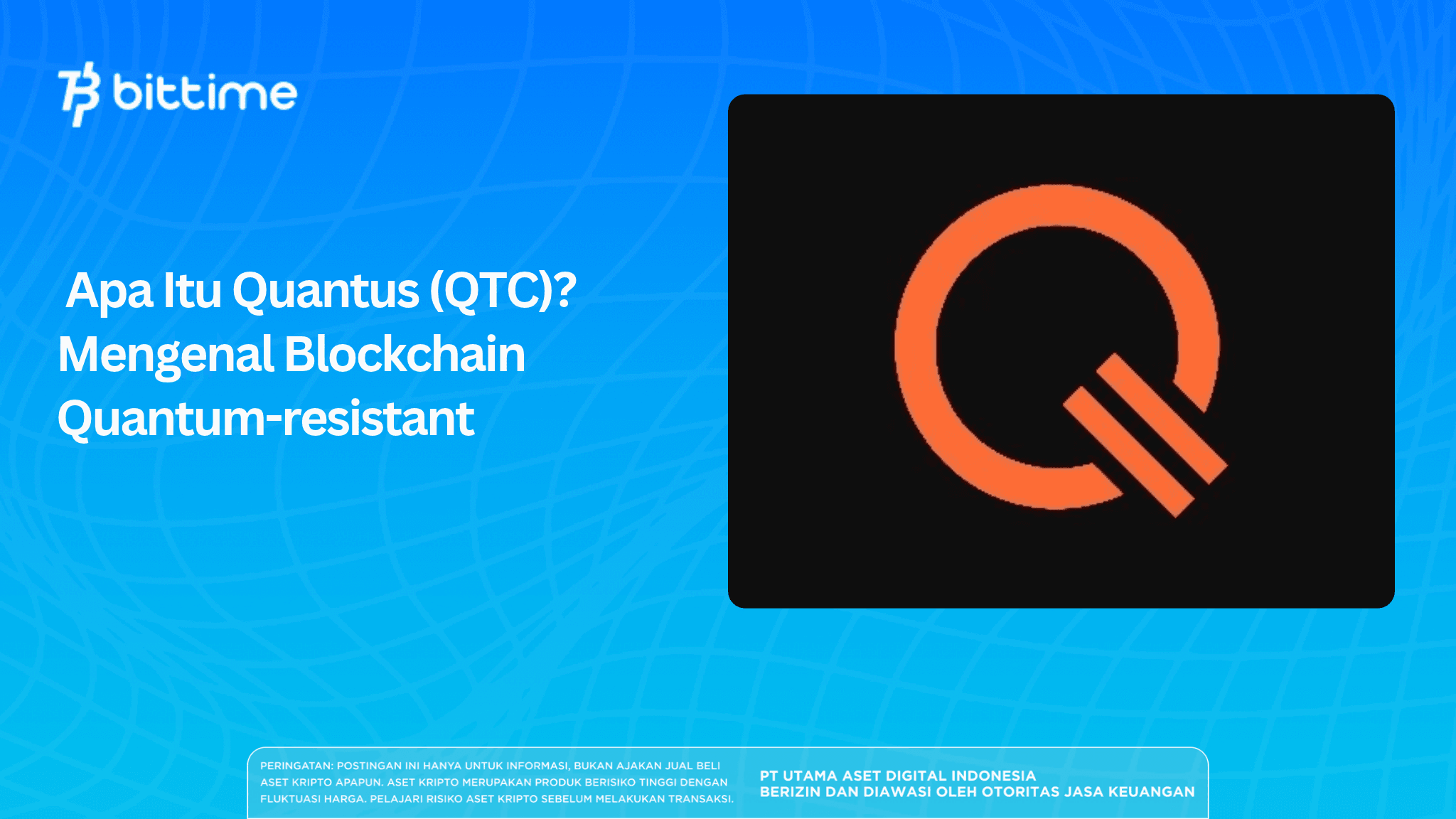
More than 7,000 GPUs immediately started mining as soon as the Quantus mainnet went live on Wednesday, September 9, 2026. That figure comes from the Quantus team itself, and for a newly launched network, it is quite large. So what is Quantus, and why are miners scrambling for QTC coins that at launch could only be obtained through mining?
Quantus Network presents a Layer 1 blockchain Layer 1 designed to withstand quantum computer attacks. This article covers how it works, QTC tokenomics, the latest market data, and the risks to watch.
Key Takeaways
- Quantus (QTC) is a Proof-of-Work Layer 1 blockchain with a maximum supply of 21 million coins and ML-DSA digital signatures designed to resist quantum computers.
- As much as 73% of QTC can only be created through mining, while 27% was minted at genesis for investors, the team, and the company with a vesting schedule.
- The mainnet has only been running since September 9, 2026, market liquidity is still thin, and most technical claims come from the project itself.
What Is Quantus (QTC)?
Quantus is a Layer 1 blockchain that targets one main function: peer-to-peer electronic cash that is secure against quantum attacks, private, and scalable. The name Quantus is taken from Latin, meaning "how much," according to the whitepaper Quantus v0.4.1.
The whitepaper written by Christopher Smith and Jonathan Angle emphasizes that Quantus is not a general-purpose smart contract platform. Its character is closer to Bitcoin, Monero, or Zcash than to Ethereum and Solana.
The network is built on Substrate, the blockchain framework created by Parity Technologies, the team behind Polkadot. Its consensus is Proof-of-Work with a target block time of 12 seconds, and the QTC coin has a supply cap of 21 million like Bitcoin.
The mainnet officially went live on September 9, 2026. Its official wallet is available on iOS and Android, with public beta status.
If you want to start getting to know crypto assets through a local platform, you can register on Bittime, an OJK-licensed crypto exchange. Check the availability of the asset you are interested in directly on the platform before trading.
Why Are Quantum Computers Considered a Threat to Blockchain?
Bitcoin and Ethereum secure transactions with elliptic curve cryptography (ECDSA). According to the Quantus whitepaper, Shor's algorithm on a sufficiently powerful quantum computer could derive a private key from a public key, allowing an attacker to forge transactions.
The same whitepaper notes a Google Quantum AI estimate in March 2026: fewer than 500,000 physical qubits to break a 256-bit elliptic curve key, down about 20-fold from the previous best estimate.
No one knows when such a powerful quantum computer will arrive. The whitepaper mentions the possibility within five years, but that estimate comes from the party selling the solution.
According to Quantus, older blockchains face a complicated migration because every coin holder must move their assets to post-quantum addresses. Quantus avoids that problem by only supporting post-quantum address types from the start.
Read Also: BIS Reveals New Potential for XRP Ledger in the Digital Financial System
How the Quantus Blockchain Works
ML-DSA Signatures
Every transaction is signed with ML-DSA (formerly named CRYSTALS-Dilithium), the NIST FIPS 204 standard. The Quantus wallet uses ML-DSA-65 by default, while ML-DSA-87 with the highest security level can be selected by users. Inter-node communication is secured with ML-DSA-87 and ML-KEM-768.
The Cost of Extra Security
Post-quantum signatures are much larger. An ML-DSA-87 signature is 4,627 bytes, while ECDSA is only 65 bytes. One transparent transfer with ML-DSA-87 takes about 7.3 KB, so a block with 3.75 MB capacity fits only about 510 transfers, or around 43 transactions per second.
Wormhole Addresses and ZK Proofs
To overcome this, Quantus uses wormhole addresses. Thousands of transactions are compressed into one zero-knowledge proof (Plonky2) that is verified directly on-chain, without Layer 2. Transactions through this route are called encrypted because the relationship between sender and receiver is broken on-chain.
The Quantus whitepaper states that the current two-layer aggregation scheme reaches about 430 QTPS for encrypted transactions, with a theoretical limit of about 2,800 QTPS. That is theoretical throughput from the project document, not a public test result.
Proof-of-Work with Poseidon2
Its consensus is similar to Bitcoin, but the SHA-256 hash function is replaced with Poseidon2 to make it more compatible with the ZK proof system. This change is for ZK efficiency, not for quantum security.
Read Also: Popular Tokenized Stocks 2026: Technology Stocks Become Investors' Favorite
QTC Tokenomics
QTC monetary policy is set out in the whitepaper Quantus v0.4.1:
- Maximum supply: 21,000,000 QTC.
- Emission: block rewards are calculated from (maximum supply minus circulating supply) divided by 50,000,000, so the curve declines smoothly without sudden halvings.
- Genesis: 27% (5,670,000 QTC) is minted once at the start, while 73% (15,330,000 QTC) can only be obtained through mining.
- Investors, founders, and team: 23% of total supply, locked for the first year since mainnet, then linear vesting over 36 months via an on-chain vesting pallet.
- Company: 4% of total supply. 1% is liquid at genesis for initial liquidity, the remaining 3% is locked and vests on the same schedule.
- No dev tax: miners receive the full block reward.
As for fees, a transparent transfer with ML-DSA-65 costs about 0.0062 QTC and goes entirely to miners. Encrypted transactions are charged 0.04% with a minimum of 0.01 QTC, half to miners and half burned.
Fee burning reduces circulating supply and goes into the block reward budget, so rewards do not run out while the 21 million cap is maintained. The allocation above differs from previous whitepaper versions, so check the latest version before citing it.
Read Also: 10+ Best AI Coins 2026: Here Is the List of Artificial Intelligence-Themed Cryptos!
Latest Developments and QTC Market Data
The official Quantus blog reports more than 53,000 blocks in the first week without interruption. Average hash power was 11.2 TH/s, and 2,371 daily active users were recorded in the mobile wallet on launch day. A total of 16,463 QTC has been issued, and 4,011 ZK proofs were verified for 19,248 private payments.
Before launch, Eiger, Neodyme, and Hashcloak conducted independent audits, while Immunefi held a public audit competition in August 2026, according to the Quantus whitepaper.
On trading, BSCN reported that Quantus chose NEAR Intents as QTC's first venue, with no confirmed listing date. On the other hand, CoinGecko as of September 30, 2026 recorded only one market, QTC/USDT on SafeTrade, with a price of around US$83.97 and 24-hour volume of around US$1.16 million.
The QTC price rose more than 115% in 24 hours, with a daily range of US$36.10 to US$92.57. Market cap is not yet displayed because circulating supply has not been reported. Market figures change quickly, so check again before making a decision.
Read Also: 10 Largest Real-World Asset (RWA) Crypto Tokenizations in the World
Risks to Watch
- The project is very young. The mainnet has only been running since September 9, 2026, and most performance claims come from the project itself.
- Implementation risk. The Quantus whitepaper acknowledges that no process completely eliminates the risk of bugs, including flaws in the ZK circuit that could potentially trigger coin inflation.
- Algorithm risk. ML-DSA is relatively new. If a flaw is found, the network must switch to another algorithm.
- The arrival time of quantum computers is uncertain. The threat could arrive later than expected, and that weakens the project's urgency.
- Thin liquidity. According to data CoinGecko, the sell-side order book depth on SafeTrade is only about US$88 within 2% of the price, so even small orders can move the price.
This article is educational and is not investment advice. Crypto assets are high-risk and highly volatile, so do your own research and use only funds whose risk you are prepared to bear.
Conclusion
Quantus offers an answer to one specific question: how to keep digital money safe when quantum computers are powerful enough to break old cryptography. The combination of ML-DSA, ZK proofs, Proof-of-Work, and a 21 million supply makes this project easy to recognize among other blockchains.
Even so, Quantus is still only a few weeks old with thin liquidity and many claims that have not been tested over time. Monitor official updates, read the latest whitepaper version, and recheck market data before making a decision.
Check the prices of Bitcoin (BTC), Ethereum (ETH), XRP, Solana (SOL), GRAM, and BNB, as well as the leading memecoin DOGE. You can trade directly on Bittime!
Bittime is a licensed Digital Financial Asset Trader (PAKD) platform supervised by the Financial Services Authority — where you can buy Bitcoin in Indonesia and hundreds of other crypto assets starting from IDR 10,000. The registration process is fast, secure, and can be started today.
Monitor USDT to IDR conversions and the price movements of your favorite crypto assets in real time. Everything is available in one crypto investment app that can be downloaded for free on the Play Store.
Ready to start? Register now on Bittime and execute your investment strategy with a platform trusted by millions of users in Indonesia.
FAQ
What is Quantus (QTC)?
Quantus is a Proof-of-Work Layer 1 blockchain that uses ML-DSA post-quantum signatures. QTC is its native coin with a maximum supply of 21 million.
Is Quantus truly immune to quantum computers?
Quantus claims to be secure because it uses the NIST FIPS 204 standard. Its own whitepaper acknowledges that this new algorithm may still contain flaws that only become known later.
How can you get QTC?
At launch, QTC could only be obtained through mining, and CoinGecko now records trading on SafeTrade. Quantus also mentions NEAR Intents as its first venue without a listing date.
What is the total supply of QTC?
The total QTC supply is capped at 21 million coins. 73% is created through mining and 27% was minted at genesis for investors, the team, and the company.
Is Quantus safe for investment?
There is no guarantee of safety or profit, because the project is still only a few weeks old with thin liquidity. Do your own research and only use funds that are prepared to bear the risk.
Disclaimer: The views expressed belong exclusively to the author and do not reflect the views of this platform. This platform and its affiliates disclaim any responsibility for the accuracy or suitability of the information provided. It is for informational purposes only and not intended as financial or investment advice.
.png)