Is the Amazon Robotics Fund (ARF) Legit or a Scam? Here's the Analysis
2026-07-28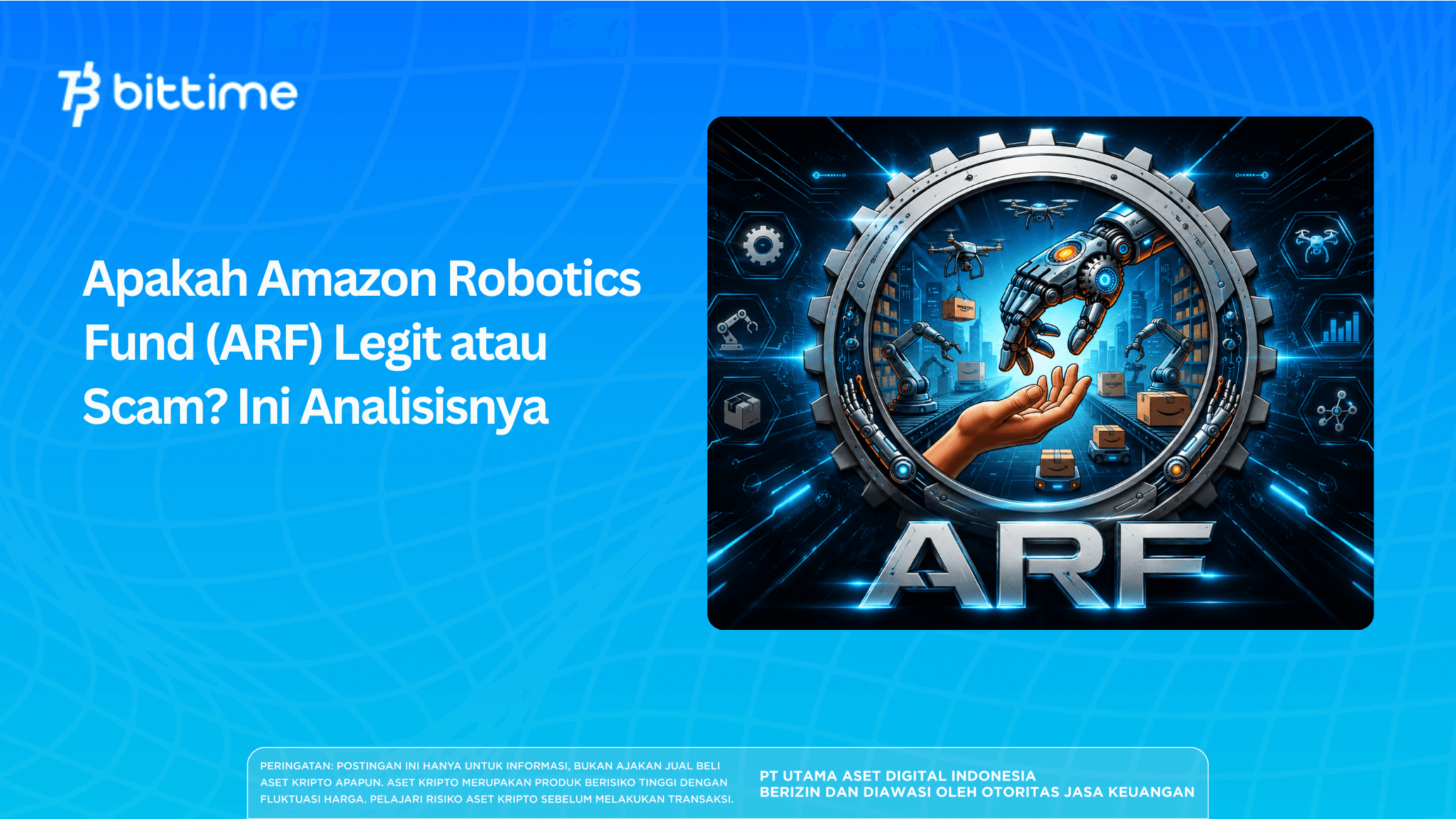
Is it Amazon Robotics Fund (ARF) legit or scam cannot be decided solely based on the name, appearance of the site, or the increase in the token price.
ARF does have a contract on Solana and an active trading market, but the project explicitly claims to be a community memecoin with no affiliation, endorsement, or official relationship with Amazon.com or Amazon Robotics.
Key Takeaways
- ARF is not an official Amazon investment fund, product, or token despite using the name “Amazon Robotics Fund.”
- The complete identity of the team or the independent contract audit report published by the project has not been found.
- The token is unverified, its liquidity is relatively low, ownership is quite concentrated, and its utility is still dominated by narrative.
What is the Amazon Robotics Fund (ARF)?
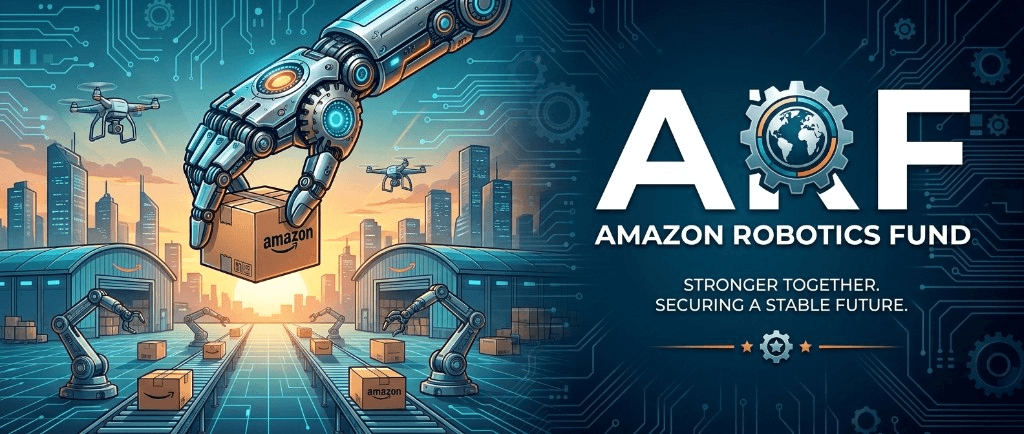
The Amazon Robotics Fund or ARF is Solana-based memecoin which carries the themes of artificial intelligence, robotics, automation, blockchain, and decentralized finance.
The project website describes ARF as a digital asset ecosystem built for communities looking to take an early position in the development of the automation economy.
Its narrative connects industrial robotics, strategic capital, blockchain technology, and global participation. However, the same website emphasizes that ARF is solely a community-driven, narrative-driven project, not a formal investment institution.
The ARF contract address listed is:
4UEfFzoo7ZfynUprybpB3HkvxXd5rfzCBB7mzT1Kpump
The token is traded via the ARF/SOL pair on a decentralized exchange at Solana network. Market data shows that tokens are launched through the memecoin issuance ecosystem and traded using liquidity pools, rather than through stock exchanges or conventional investment products.
Purchasing ARF does not give the token holder:
- Amazon stock.
- Dividends from Amazon.
- Ownership of Amazon Robotics.
- Rights to Amazon's robot technology.
- Part of Amazon's investment portfolio.
- Income from warehouse or logistics business.
- Claims against certain robotics companies.
Token value primarily depends on market demand, community strength, promotional activity, liquidity availability, and interest in AI and robotics narratives.
Read also:Is the Oil Strategic Reserve (OSR) Legit? Check the Facts Before You Get Fomo!
Who is the Team Behind the ARF Project?
The complete identity of the team is one of the most important aspects when evaluating a new crypto project. The ARF website reviewed does not display the names of the founders, developers, advisors, legal entity, or team members that can be independently verified.
The following information is also not yet clearly available:
- Name of the project management company.
- The country where the legal entity is registered.
- Operational address.
- Professional developer profile.
- Experience building blockchain projects.
- Team wallet and treasury.
- Governance structure.
- Legal or compliance contact.
- Confirmed technical partners.
An anonymous team doesn't automatically prove a token is a scam. Many memecoins are built without public identities.
However, this situation increases the risk because investors do not know who is responsible if the roadmap is not implemented, the site disappears, liquidity is withdrawn, or there is a dispute over the use of the project name.
For a project claiming to build a long-term ecosystem at the intersection of robotics, AI, and DeFi, team transparency should be a key foundation. Ambitious claims require measurable technical, legal, marketing, security, and business development resources.
Read also:Is Digital Oil ($OIL) Legit? The Memecoin of Peter Schiff's Oil Price Narrative
Is ARF Officially Linked to Amazon?
The answer is No.
The project states explicitly that ARF has no affiliation, endorsement, or relationship with:
- Amazon.com, Inc.
- Amazon Robotics.
- Government or state institutions.
- Sovereign wealth fund.
- Other official institutions.
Amazon itself has an official investment program that supports companies in robotics, warehouse automation, logistics, and supply chain technology.
However, the program is calledAmazon Industrial Innovation Fund, a US$1 billion venture investment program that invests directly in technology companies. Launched in 2022, the program has a verifiable structure and leadership.
The Amazon Industrial Innovation Fund differs from the ARF in several ways:
- The official program is managed by Amazon.
- The investments are directed to real technology companies.
- The funding uses a venture capital structure.
- The investment portfolio can be checked.
- The program does not use ARF tokens.
- There is no statement that Amazon is issuing a robotics memecoin.
Therefore, the growth of Amazon's robotics business does not automatically provide fundamental value to ARF. Investors who purchase ARF are essentially speculating on the community token, not investing in Amazon or its investment program.
To expand your research, you can register at Bittime and check available crypto assets through the marketplace page. Be sure to confirm ARF availability directly, as this article does not state that the token has been listed on Bittime.
What Does the ARF Project Claim and Does It Make Sense?
ARF promotes the narrative that automation, AI, robotics, and decentralized finance will become increasingly interconnected. Overall, the development of industrial robotics and AI is a real technology trend.
Amazon also continues to develop robotics for warehouses and supply chains and invests in automation companies.
However, the existence of a real trend does not automatically provide utility to tokens that use that theme.
Automation-Based Ecosystem Claims
ARF is described as a digital asset ecosystem that enables the community to participate in the future of automation. The project's website uses terms like "strategic positioning," "automation economy," and "long-term value creation."
The problem is, it's not clear how the token derives value from the automation industry. There's no evidence that ARF:
- Have robots or automation technology.
- Investing in robotics startups.
- Earn income from real business.
- Have a contract with a logistics company.
- Funding AI research.
- Provides active governance rights.
- Used to pay for a service.
- Have a product that can be used.
Thus, claims regarding participation in the automation economy are still closer to marketing narrative than a proven business model.
Capital Transfer Claim
The site suggests that capital from Amazon, Nvidia, Tesla, and Microsoft could flow into the “ARF Ecosystem.” There are no investment mechanisms, agreements, or capital flow data to support this connection.
The statement is more accurately read as a conceptual outline or branding strategy. Investors should not interpret it as evidence that these companies are investing in ARF.
Project Roadmap
The ARF roadmap includes four phases:
- Community launch, identity formation, and token ecosystem.
- Expansion of the number of holders and search for partnerships.
- Utility development, cross-network expansion, and increased institutional attention.
- The formation of a mature ecosystem that combines robotics, AI, and DeFi.
The roadmap doesn't include a complete schedule, success indicators, product specifications, budget, partner names, or technical documentation. Therefore, investors can't yet gauge whether each phase has been achieved.
Read also:Is Pons Launchpad Legit or a Scam? Learn How It Works and the Risks
Why is the name “Amazon” used without any proof of affiliation?
The exact reason for choosing the name “Amazon Robotics Fund” is not explained in detail on the project website.
Inferentially, the use of the name reinforces the narrative connection between ARF, warehouse robotics, AI, and automation.
The site also displays the names and tickers of major companies as part of an illustration of "capital migration." At the same time, a disclaimer is placed at the bottom to clarify that there is no official relationship with Amazon.
This kind of strategy can cause confusion because:
- Users may only read the name and promotional section.
- Some buyers may not see the disclaimer.
- The term “Fund” can be considered as an investment product.
- The purchase button can give the impression that the project has received institutional validation.
- The visuals of robotics can be associated with the actual Amazon business.
Using a major company name isn't automatic proof that a token is a scam. However, investors should assess whether the branding has the potential to create a perception of credibility that isn't supported by a legal or business relationship.
The safest course of action is to evaluate ARF as an independent memecoin without linking it to Amazon's reputation.
Read also:Is Show Token (SHOW) Safe or a Scam? Check the Facts
Is There an Audit or Verification of ARF Contracts?
At the time of the inspection, no independent smart contract audit report was found listed on the ARF website.
One automated audit tool displays a "no issues" status, but also warns that automated audit results aren't always accurate. This type of audit is different from manual audits from blockchain security firms, which publish their methodology, scope, findings, and proof of improvement.
Meanwhile, a risk assessment of Solana wallets revealed several findings:
- Token status unverified.
- Additional supplies cannot be printed based on mint status when checked.
- Token accounts cannot be frozen.
- Token metadata can still be changed.
- The twenty largest holders control around 48.94% of the supply.
- The number of holders in the inspection was around 132 addresses.
The unprintable and unfreezeable statuses are important factors to consider. However, they don't necessarily prove the project's overall security.
The "unverified" label doesn't necessarily mean the token is fake. It simply indicates that users can't yet rely on the token registry to validate the project's identity.
Read also:Is FireFaucet Win Legit? Here's How It Works, Its Security, and Its Earning Potential
ARF Liquidity and Market Conditions
As of the market snapshot on July 28, 2026, ARF's price was around US$0.00006, with a market capitalization, or fully diluted valuation, of approximately US$58,000.
Visible liquidity was around US$16,000, while 24-hour trading volume was reported at around US$144,000–US$151,000. These figures are subject to rapid change.
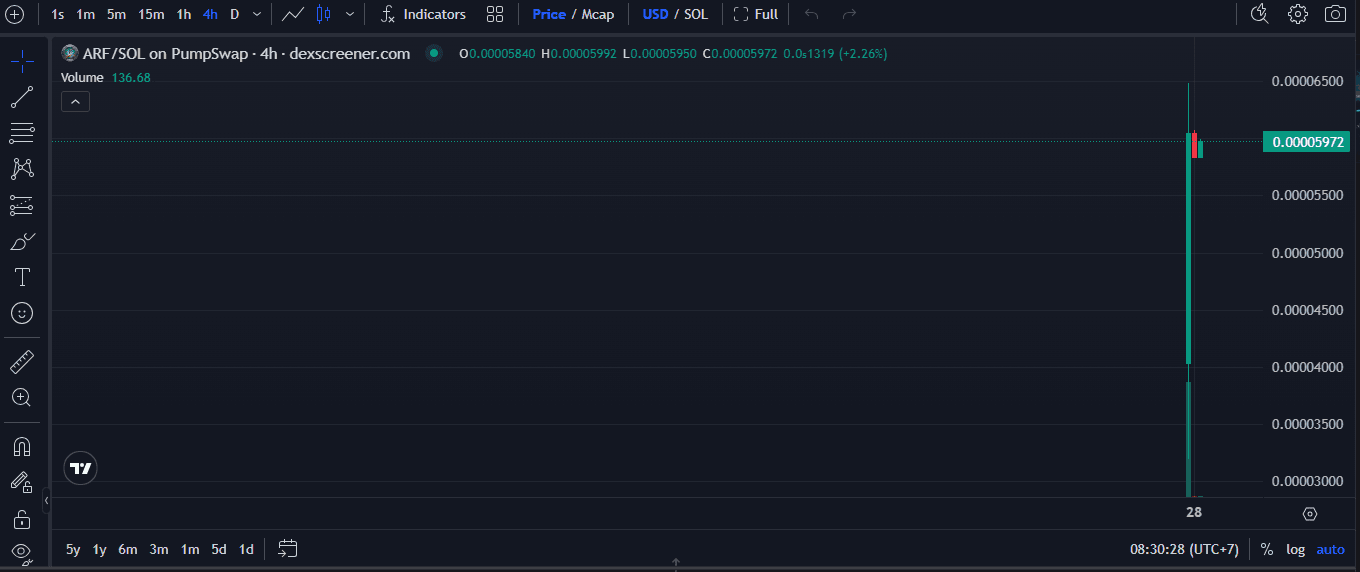
Liquidity of US$16,000 indicates relatively shallow market depth. Market capitalization doesn't reflect the actual amount of money available to all holders.
As an illustration, if many token holders sell at the same time:
- Prices may drop sharply.
- Slippage increases.
- The sales value is lower than the screen price.
- The pool may lose balance.
- Large positions are difficult to close.
- Prices may experience extreme volatility.
On-chain data also shows a fairly high concentration of ownership. Some examinations note that nearly 49% of the supply is held by the twenty largest addresses.
Some wallets may be liquidity pools or contracts, so the data needs to be analyzed individually before concluding that all are insider-owned.
Start trading SOL/IDR with Bittime here!
How to Check Team and Project Transparency?
1. Search for Team Member Names
Check whether the site lists the full names of the founders, developers, advisors and operational managers.
Don't just stop at a photo or name. Match that information with your professional profile, work experience, project history, and technical contributions.
2. Check the Legal Entity
Find information about:
- Company name.
- Registration number.
- Country of establishment.
- Business address.
- Director.
- Terms of use.
- Privacy policy.
- Legal contact.
Projects that claim to build long-term ecosystems should be able to explain who is responsible.
3. Developer Wallet Analysis
Look for the token creator wallet, seed funding wallet, treasury, and addresses that acquired tokens in the first phase.
Pay attention to whether multiple wallets are connected through transactions, receiving funds from the same source, or selling tokens simultaneously.
4. Check Holder Distribution
High holder concentration can increase the risk of price manipulation. Keep liquidity pools, exchange wallets, smart contracts, and personal wallets separate to avoid misleading analysis.
5. Audit Verification
A credible audit report should at least state:
- Name of auditor.
- Contract address.
- Date of inspection.
- Scope.
- Severity of findings.
- Repair status.
- Checked code repository.
An image labeled “audited” without a readable report is not evidence of an audit.
6. Look for Product Evidence
Check if the project has testable applications, source code, users, integrations, partners, revenue, or token functionality.
Roadmaps and slogans are not the same as products.
7. Evaluate Team Response
A credible team should be able to answer questions about tokenomics, wallets, audits, utility, and brand relations without dismissing legitimate criticism.
Read also:America Oil Reserve Agility (AMORA): Legit or Just a Narrative Token?
What Are the Warning Signs of a Risky Project?
Names Resembling Big Companies
The project name can mislead buyers into thinking there's an official relationship, even though the disclaimer states otherwise. This is a perception risk that should be considered.
No Team Identity
Anonymity reduces accountability and makes it difficult for investors to check a developer's track record.
Big Claims Without a Product
Narratives about AI, robotics, institutions, and the global ecosystem must be supported by verifiable products or partnerships.
Roadmap Too General
Terms like “growth,” “acceleration,” and “institutional awareness” don’t provide measurable targets without dates, products, or indicators of success.
No Independent Audit
Automated checks are not a substitute for a complete contract audit.
Small Liquidity
Pools with limited liquidity can increase volatility, slippage, and difficulty exiting positions.
Holder Concentration
Large ownership in a few wallets makes the price vulnerable to coordinated selling or insider distribution.
Unverified Token
This status increases the risk of purchasing counterfeit tokens or relying on metadata that has not been validated by the registry.
The Call to Buy is More Dominant than Documentation
The site provides several purchase buttons, but information regarding audits, team, tokenomics, and legal structure is still limited.
Using the Term “Fund”
The word "fund" can suggest a portfolio, investment manager, or productive assets. In the case of ARF, the project itself categorizes it as a memecoin, not an official investment fund.
Read also:Is the NTFS (National Trust Fund System) Legit? Here Are the Facts
Conclusion: Is ARF Worth Watching?
Amazon Robotics Fund may be considered a very high risk speculative asset, but the available evidence is not enough to state that ARF is definitely a scam.
The most responsible conclusion is that ARF is a new memecoin based on Amazon, robotics, and AI themes with no official connection to the Amazon company. Its value is not yet supported by a verifiable product, revenue, investment portfolio, or utility.
Monitor project developments and market news on the Bittime Blog before considering a transaction.
Bittime is a licensed and regulated Digital Financial Asset Trader (PAKD) supervised by Indonesia’s Financial Services Authority (OJK) — where you can buy Bitcoin in Indonesia and hundreds of other crypto assets starting from just Rp10,000. The registration process is fast, secure, and you can get started today.
Track USDT to IDR conversions and monitor your favorite crypto assets in real time. Everything is available in one crypto investment app that you can download for free on the Play Store
Ready to start? Register now on Bittime and execute your investment strategy with a platform trusted by millions of users in Indonesia.
FAQ
Is the Amazon Robotics Fund an official Amazon token?
No. The project states that ARF has no affiliation, endorsement, or relationship with Amazon.com or Amazon Robotics.
Is ARF a scam?
There's not enough evidence to declare ARF a scam. However, its anonymous team, unavailable audits, low liquidity, and limited utility make it extremely risky.
Has the ARF contract been audited?
There are automated audits that found no specific issues, but these results come with a warning that the automated audit may be inaccurate. A complete independent audit report has not been found on the project website.
Why does ARF use the name Amazon?
The project doesn't provide a detailed explanation for its name. While it uses a narrative about robotics and automation, a disclaimer states that ARF is not affiliated with Amazon.
Is ARF safe to buy?
No crypto asset is completely risk-free, especially a new token with thin liquidity. ARF should only be considered by users who understand the risks of memecoins and are prepared to lose their entire allocated funds.
Disclaimer: The views expressed belong exclusively to the author and do not reflect the views of this platform. This platform and its affiliates disclaim any responsibility for the accuracy or suitability of the information provided. It is for informational purposes only and not intended as financial or investment advice.

.png)