What Is the Chinese Yuan (CNH)? Understanding the Offshore Yuan and Its Role in Global Markets
2025-09-22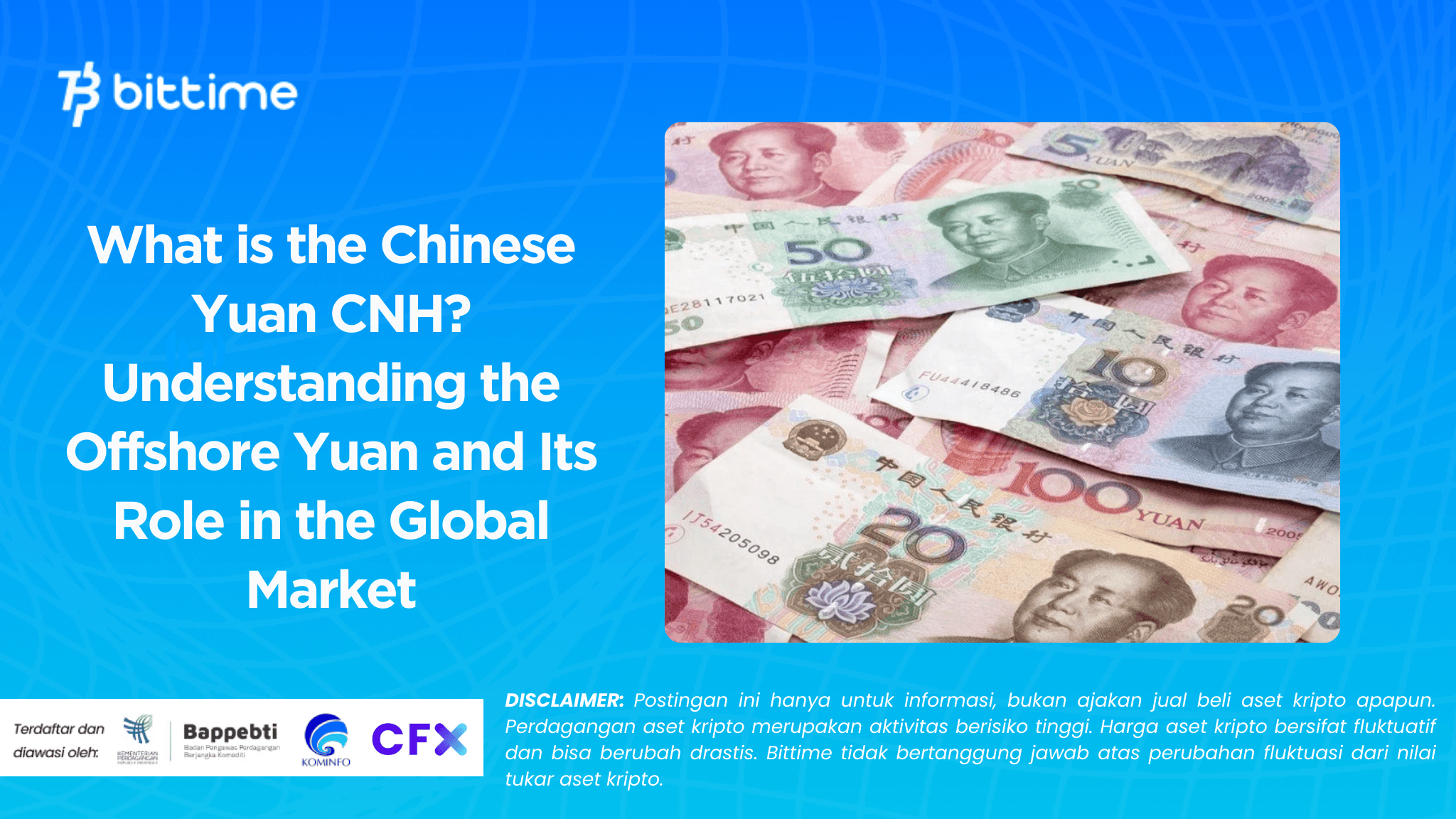
Bittime - In recent years, China's currency has increasingly come into the spotlight in international trade.
Besides CNY (Chinese Yuan Onshore) which is commonly used in the country, there are CNH (Chinese Yuan Offshore)traded overseas, especially in international financial centers such as Hong Kong, London, and Singapore.
This difference raises an important question: what is CNH, and why is this currency becoming increasingly relevant, especially with the advent of stablecoins.AxCNH?
This article will discuss comprehensively about what it isChinese Yuan CNH, its differences with CNY, its use in international trade, and how blockchain technology is bringing about a stablecoin version of CNH.

What is Chinese Yuan CNH?
CNHis an abbreviation of Chinese Yuan Offshore, which is the version of the Chinese yuan currency traded overseas.
Different from CNY (Chinese Yuan Onshore) which is tightly controlled by the People's Bank of China (PBoC) and used domestically, CNH is more freely traded in global markets.
The CNH was introduced around 2010 to support the internationalization of the yuan. With the CNH, international businesses and investors can transact in Chinese currency without being overly tied to domestic regulations.
Read Also: China's Yuan Stablecoin: A Strategy to Counter US Dollar Dominance
Difference between CNY and CNH
Although same-sama representsRenminbi (RMB), there are some important differences betweenCNY And CNH:
- Location of use
- CNY: Used in mainland China.
- CNH: Used in offshore markets.
- Exchange rate policy
- CNY: Its value is strictly controlled by the PBoC.
- CNH: More influenced by global market mechanisms.
- Liquidity
- CNY: Bound by strict capital regulations.
- CNH: More flexibility for international trade.
This difference makes CNH more attractive to global investors who need direct access to the Chinese currency.
CNH in International Trade
CNH becomes an important instrument to encourageinternationalization of the yuan. Many countries and companies have begun using CNH for cross-border transactions, especially in trade with China.
Some of the benefits of CNH in global trade include:
- Reducing dependence on the US dollar.
- Providing alternative payments in international trade.
- Promoting the yuan's status as a global reserve currency.
In addition, CNH is often used in financial instruments such as international bonds known asdim sum bonds.
Read Also: The Future of Crypto in Hong Kong: Are There Still Obstacles?
Stablecoin AxCNH: Yuan Offshore di Blockchain
The latest development that is increasingly interesting is the presence ofAxCNH, the first stablecoin backed by the Chinese Yuan Offshore (CNH). This stablecoin is issued by a Hong Kong-based company and traded on a blockchain network.
The arrival of AxCNH marks a significant milestone in China's efforts to expand digital yuan adoption.
With this stablecoin, global investors can access CNH more quickly, transparently, and efficiently through the Web3 ecosystem.
This innovation can also strengthen CNH's position as an international currency, while competing with US dollar-based stablecoins such as USDT or USDC.
CNH's Impact on Global Markets
CNH's presence has several strategic implications:
- Diversification of foreign exchange reserves– Several central banks have started to add CNH to their foreign exchange reserves.
- Geopolitical influence– CNH has the potential to become China's tool to reduce the dominance of the US dollar.
- Adoption of blockchain technology– The presence of AxCNH demonstrates the synergy between traditional finance and Web3 innovation.
Read Also: Hong Kong Gives Green Light to Ethereum ETF Staking Feature?
Conclusion
Chinese Yuan CNH is the form of yuan traded overseas, different from the CNY which is valid domestically in China.
CNH has a big role in international trade because it is more flexible, supports the internationalization of the yuan, and is now available as a stablecoin.AxCNH.
With the advent of CNH and digital innovations like stablecoins, the yuan's future in the global market is increasingly strong.
For business people, investors, and economic observers, understanding the difference between CNY and CNH is crucial for developing trade and investment strategies in the era of financial globalization.
How to Buy Crypto on Bittime

Want to trade sell buy Bitcoins and crypto investment easily? Bittime is here to help! As an Indonesian crypto exchange officially registered with Bappebti, Bittime ensures every transaction is safe and fast.
Start with registration and identity verification, then make a minimum deposit of IDR 10,000. After that, you can immediately buy your favorite digital assets!
Check the exchange rate BTC to IDR, ETH to IDR, SOL to IDR and other crypto assets to find out today's crypto market trends in real-time on Bittime.
Also, visit the Bittime Blog for interesting updates and educational information about the crypto world. Find reliable articles about Web3, blockchain technology, and digital asset investment tips designed to enrich your crypto knowledge.
FAQ
What is CNH in Chinese currency?
CNH is Chinese Yuan Offshore, which is yuan that is traded offshore and is more freely traded in the global market than CNY.
What are the main differences between CNY and CNH?
CNY is used domestically in China under strict regulations, while CNH is traded abroad under more flexible exchange rates.
What is AxCNH stablecoin?
AxCNH is the first stablecoin backed by Chinese Yuan Offshore (CNH), designed for digital trading in the blockchain ecosystem.
Why is CNH important in international trade?
CNH helps reduce dependence on the US dollar and strengthens the yuan's position as a global currency.
Disclaimer: The views expressed belong exclusively to the author and do not reflect the views of this platform. This platform and its affiliates disclaim any responsibility for the accuracy or suitability of the information provided. It is for informational purposes only and not intended as financial or investment advice.

.png)