7 Main Reasons Why Online Loan Applications Are Rejected - Learn and Fix Them
2026-03-20
The reasons why online loans are rejected often leave people confused, especially when funds are urgently needed. Many people ask why online loans are always rejected even though the data has been filled in and the application has already been submitted.
The issue is that rejection usually does not happen for just one reason. It could be because the documents are unclear, the income is considered insufficient, or the previous payment history is still not good enough.
The good news is that being rejected by an online lender is not the end of everything. Instead, it can be a sign that there are areas that need to be fixed first so the chances of the next application being approved are higher.
By understanding what causes a loan application to be rejected, you can improve each weak point one by one and reapply in a way that is more organized, realistic, and safe.
Key Takeaways
- Online loan applications are most often rejected because the data, documents, and financial profile are not convincing enough.
- Bad credit history is not the only cause. Loan amount, job status, and verification also have a major impact.
- The more carefully you prepare your data and match the loan to your repayment ability, the greater your chances of getting approved.

Register on Bittime now and start trading crypto with a fast, secure, and easy process in the app.
Why Are Online Loans Always Rejected?
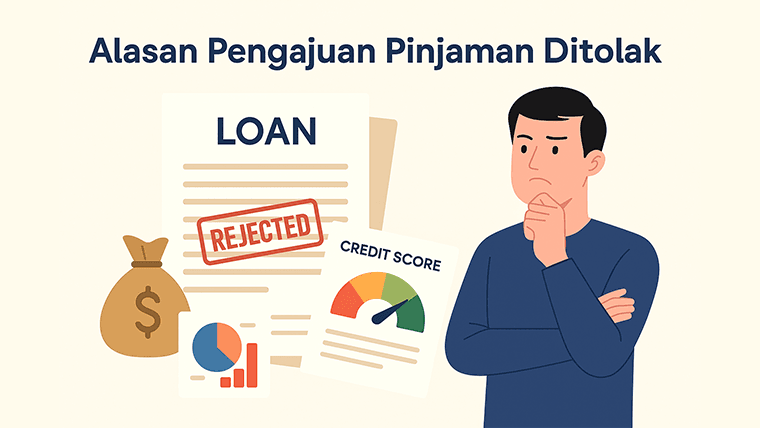
If you have ever asked why my loan application keeps getting rejected, the answer usually lies in risk assessment. Digital lending platforms do not only look at your need for funds, but also at how safe you are as a prospective borrower. They want to ensure the data is valid, the installments are reasonable, and the chance of default is not too high. So, the reasons online loans are rejected are often more technical than personal.
What needs to be remembered is that rejection does not always mean you are permanently unqualified. Often, the system is simply reading that some information does not match yet or that there is a risk it is not comfortable approving.
Because of that, the best step is not to rush into applying to many apps at once, but to understand the root of the problem first. That way, you not only know why an online loan was rejected, but also how to fix it more wisely.
Read Also: Join the Bittime Futures Public Beta Waitlist and Get Trial Funds Rewards up to 1500 USDT
Why can rejection happen even though the application feels easy?
Because the process behind the scenes is still strict. Even though the application looks fast, the system still evaluates identity, income, payment history, and even the consistency of the data you enter.
Does being rejected once mean you will always be rejected?
No. In many cases, online loan applications are rejected only because of issues that can be fixed, such as blurry documents, inactive phone numbers, or a loan amount that is too high.
7 Main Reasons Online Loans Are Rejected

1. Incomplete or Blurry Documents
This is the most common reason. Your ID photo may be cropped, the salary slip may be unreadable, the verification selfie may be unclear, or some documents may not have been uploaded yet. Small issues like these can directly cause the system to hold or reject the application.
2. Poor Credit History
If you have ever been late on installment payments, have active arrears, or still have problematic loans outstanding, your chances of being rejected will be higher. Financial institutions pay very close attention to past payment behavior.
3. Income or Job Is Considered Unstable
Income that is too low compared to the requested loan, unstable employment, or a lack of income proof often makes the system hesitant. They want to see that the installments can actually be repaid.
4. The Loan Amount Is Too Large
Many people apply for the highest possible limit. In fact, an amount that is too large is often considered unrealistic. As a result, the online loan application is rejected because it is seen as beyond the applicant’s repayment capacity.
Read Also: Crypto Trading Strategies for Beginners, Don’t Do This!
5. Inconsistent Data
The name on the bank account is different from the name on the ID card, the address is different, the ID number is mistyped, or the emergency contact number does not match. These things may look trivial, but they have a major impact on the verification process.
6. Failed Phone Number and Identity Verification
A phone number that is inactive, an email that cannot be accessed, or an unanswered verification call can cause the application to stop midway. The system needs to ensure that the applicant can actually be contacted.
7. Applying to Too Many Apps Too Often
If you apply to many platforms within a short period of time, this can be read as a sign of overly urgent cash needs or a high-risk profile. As a result, your chances of approval actually decrease.
How to Fix an Application That Is Frequently Rejected?
If the reasons your online loan is rejected are starting to become clear, the next step is to fix them one by one. Start with the easiest things first. Recheck all documents, make sure the photos are clear, and match all data with your official identity.
After that, look at the financial side. Is the requested amount too large? Are previous installments still problematic? Can the income you listed really be proven?
The best approach is to reduce risk in the eyes of the lender. Apply for a more realistic amount, use a bank account under your own name, activate a phone number that can truly be reached, and do not send many applications at once.
This way, you give a signal that your application is more organized and makes more sense. When you understand what causes a loan application to be rejected, you also realize that the main solution is not to keep reapplying recklessly, but to improve the quality of the application.
Practical steps you can take right away
- Re-upload your documents with bright, non-blurry photos.
- Match your name, address, and bank account data with your official identity.
- Apply for a smaller, more reasonable loan amount.
- Make sure your phone number and email are active.
- Pay off or tidy up old arrears before applying again.
- Prepare clear proof of income.
- Give it some time before trying another platform.
Read Also: 7 Effective Ways to Trade Crypto for Beginners, Complete with Tips and Tricks
Signs That You Should Delay Your Application First
Sometimes the best solution is not to apply again immediately, but to pause for a while and reorganize your financial condition. For example, if your monthly installments are already heavy, your income is not stable yet, or you still have other arrears, a new application may actually worsen the situation.
In situations like that, questions such as why my loan application keeps getting rejected are often answered simply: because your financial condition is not ready yet.
Delaying does not mean failing. In fact, this can be the healthiest decision. Use the time to improve cash flow, pay overdue obligations, and reduce the habit of applying for loans impulsively.
The better your basic financial condition, the greater the chance that your next application will look more feasible. So, if your online loan keeps getting rejected repeatedly, see it as a signal to stop for a moment and reset your strategy.
Conditions that should be fixed first
- You still have active arrears.
- Your income is not regular yet.
- You have many ongoing installments at the same time.
- Employment or income documents are not ready yet.
- You were just rejected by many apps in a short period of time.
Conclusion
The reasons online loans are rejected are generally not a mystery. Usually, there is a clear pattern, ranging from untidy documents and an imperfect credit history to a loan amount that is too high.
So, if you are still asking why online loans are always rejected, focus on two things: organize your data and match the application to your real ability.
If you want to keep learning how to manage your finances and explore other digital asset opportunities more wisely, you can explore Bittime Exchange or read the latest educational articles on Bittime Blog.
FAQ
What is the most common reason a loan application is rejected?
The most common reasons are incomplete documents, mismatched data, and a poor credit history.
Why does my loan application keep getting rejected?
Usually because there are issues that have not been fixed yet, such as unstable income, old arrears, or failed verification.
Is an online loan rejected because of credit score alone?
No. Credit score is important, but it is not the only factor. Data, job status, loan amount, and verification also matter a lot.
How long should you wait before applying again?
There is no one fixed answer, but it is best to give it some time while fixing the causes of the rejection first.
What should be done after an online loan application is rejected?
Recheck your data, fix your documents, tidy up your payment history, and reapply with a more realistic amount.
How to Buy Crypto on Bittime

Want to trade and buy Bitcoin easily and invest in crypto? Bittime is ready to help! As an Indonesian crypto exchange officially registered with Bappebti, Bittime ensures every transaction is safe and fast.
Start by registering and verifying your identity, then make a minimum deposit of Rp10,000. After that, you can immediately buy your favorite digital asset!
Check the exchange rates for BTC to IDR, ETH to IDR, SOL to IDR and other crypto assets to find out today’s crypto market trends in real time on Bittime.
In addition, visit Bittime Blog to get various interesting updates and educational information about the crypto world. Find trusted articles about Web3, blockchain technology, and digital asset investment tips designed to enrich your knowledge of the crypto world.
Disclaimer: The views expressed belong exclusively to the author and do not reflect the views of this platform. This platform and its affiliates disclaim any responsibility for the accuracy or suitability of the information provided. It is for informational purposes only and not intended as financial or investment advice.

.png)