World Oil Fund Institution (WOFI): Oil Token, Scam or Legit?
2026-08-31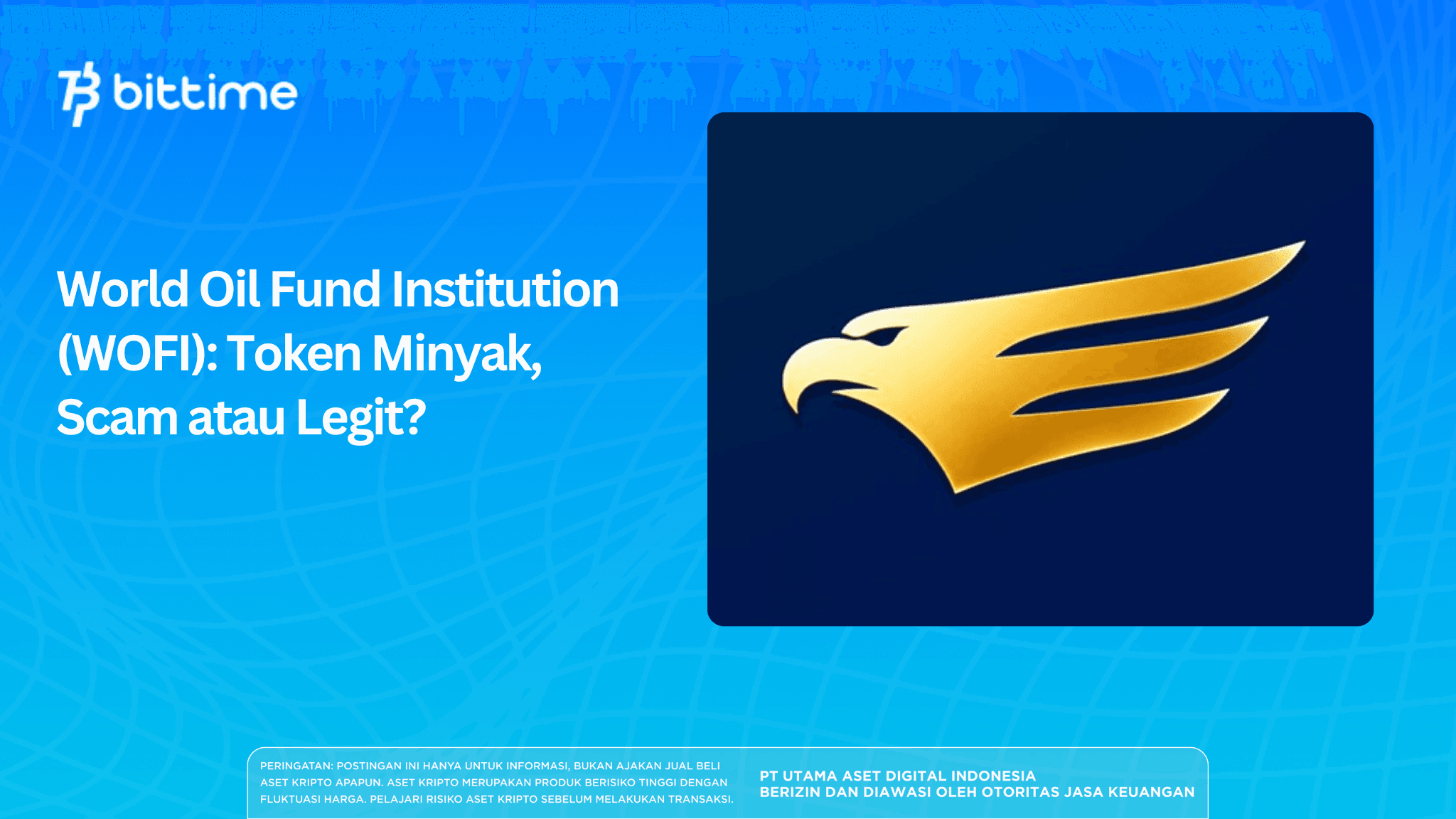
The WOFI price chart on CoinMarketCap DEX at the end of August 2026 shows candle movements that made many traders hold their breath: a green line climbing steeply for a few hours, then one giant red candle wiping out almost all the gains in just minutes.
This phenomenon is what made the question "what is WOFI" suddenly popular. World Oil Fund Institution claims to be an oil token backed by real barrels, but on-chain data tells a different story.
This article thoroughly dissects WOFI coin's claims, from the "1:1 barrel-backed" narrative on its official website, findings about dozens of contract addresses also claiming to be WOFI, to concrete evidence of price movements that could be an important lesson before you decide to buy WOFI crypto.
Key Takeaways
- WOFI claims to be backed by 1.284 million barrels of crude oil, but the custodian, team, and backing ratio have not been independently verified.
- The name "WOFI" is used by more than nine different contract addresses on Solana, making the risk of buying a cloned token very high.
- On-chain data shows that one WOFI contract once crashed 99.78% in a single candle, a classic pattern of pump-and-dump tokens from pump.fun.
What is WOFI (World Oil Fund Institution)?
WOFI is a Solana-based token that carries an ambitious narrative: turning crude oil into a digital asset that can be traded on-chain.
Its official website, wofi.live, features the slogans "1:1 Barrel-Backed", "Regulated Custody", and "Coinbase Listed" as main attractions, complete with a four-stage roadmap covering deed, allocation, pipeline, and reserve.
The total supply of this token is in the range of 999.9 million to 1 billion units, depending on which contract is accessed. Unfortunately, a publicly verifiable whitepaper has not been found as of this writing. Without clear legal documents, the claim of being "backed by real oil" remains just a marketing narrative.
Before delving further into risk analysis, it is a good idea to first prepare a secure and regulated trading account. You can register an account on Bittime to start monitoring crypto market movements while learning to distinguish projects with clear fundamentals from those that rely solely on hype.
WOFI's 1:1 Barrel-Backed Claim: Fact or Just a Narrative?
According to an analysis by Top1Markets, WOFI's main claim actually leaves more questions than answers. Its official site mentions a "Tier-1 Regulated" custodian, but the name of that institution is never explicitly mentioned on any page.
Yet, for an asset that claims to be backed by a physical commodity, the custodian's identity is the most basic information that should be transparent.
The backing ratio is also economically questionable. With a supply of 1 billion tokens and a claim of 1.284 million attested barrels, the public has not received an economic explanation of how that number translates into a 1:1 value per token.
Moreover, the "Coinbase Listed" status promoted on the official site turns out to be not entirely accurate — Top1Markets notes that Coinbase itself has not yet listed WOFI as a tradable asset on its centralized exchange, although Coinbase's price tracker page does display aggregated data from DEXs.
The team behind this project is also not doxxed — no names or faces that can be publicly verified. The combination of an unclear custodian, an unexplained backing ratio, and an anonymous team makes the "oil token" claim of WOFI just a marketing story, not an accountable fact.
Read Also: Nvidia's $500 Billion AI Funding, Are AI Crypto Tokens Also Benefiting?
Beware, There Are Dozens of Different WOFI Contracts
This is the most crucial part for you to understand before transacting. The name "WOFI" is not just used by one token, but is attached to many different contract addresses circulating on various platforms.
A search on Coinbase, Solscan, and Solana Tracker found at least nine different contracts that all claim to be WOFI, with market capitalizations ranging from a few thousand dollars to more than $5 million USD.
Some examples are quite striking. One contract listed on Bitget has liquidity of about $1.9 million USD, but is held by only 34 wallets, with the top ten wallets controlling 99.8% of the supply.
Two other contracts tracked by Solana Tracker have only 8 and 6 holders. Meanwhile, OKX data shows that one variant of WOFI once surged over 41,000% in 24 hours — a spike that reflects wild speculation far more than healthy project growth.
This pattern is common for tokens deployed via pump.fun: anyone is free to create a new contract with the same name and symbol to ride the popularity of a viral narrative. As a result, people searching for "WOFI coin" on the internet are at high risk of buying the wrong contract, or even one intentionally created to trap new buyers.
Read Also: Tokenized Stocks vs Traditional Stocks: Definition, Differences, and How to Buy
On-Chain Data: A Real Example of WOFI Pump-and-Dump
One WOFI contract tracked on CoinMarketCap DEX, namely B2fTPiFwhL7JAiaYbbEfYyzvpeJz5JcmFTiSdjB7pump, is a clear example of how a token with a big narrative can end up sadly within hours.
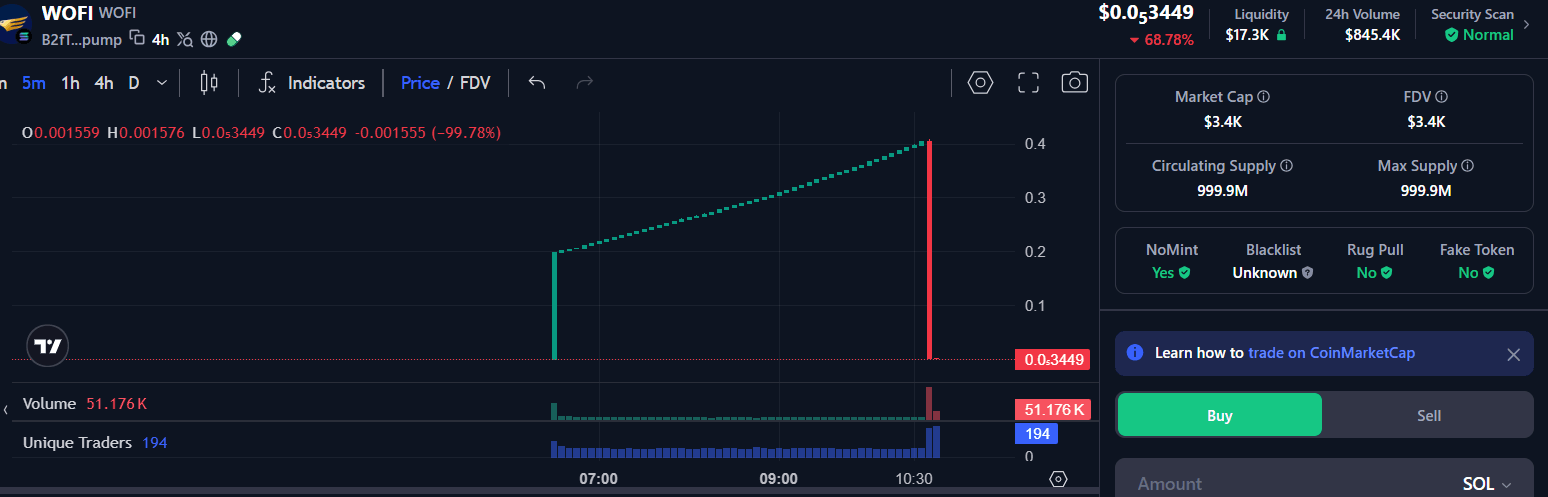
This token's market cap is only $3.4 thousand USD, with liquidity of $17.3 thousand USD, but 24-hour trading volume actually reached $845.4 thousand USD — a volume-to-liquidity ratio that is far from normal and typically indicates repeated small-scale trading activity, not genuine market interest.
Price-wise, this token briefly rose from an opening of $0.001559 to a high of $0.001576, before crashing 99.78% in a single candle. Over the last 24 hours, the price is still down 68.78%. Interestingly, the automated security scan label on the platform marks this token as "Normal", with NoMint "Yes", Rug Pull "No", and Fake Token "No".
Such labels only check the technical characteristics of the contract, such as whether the developer still has the authority to mint new tokens, not a guarantee that the token price will not collapse drastically due to mass selling by a handful of wallets.
This case reinforces one thing: a technically "safe" contract status is not the same as financial safety for investors.
Read Also: 10 Free Bitcoin Mining and Faucet Sites 2026, Which Ones Are Legit?
Is WOFI Legit or a Scam?
The most honest answer to this question is: it depends on the definition of "legit" you use. Technically, the token named WOFI does indeed exist on the Solana blockchain and can be verified.
Its website is active and displays consistent branding. However, from the perspective of transparency and accountability, the following red flags are worth considering before buying WOFI token:
- The custodian of the oil reserves is not named publicly.
- The 1:1 backing ratio between tokens and barrels has not been economically explained.
- The "Coinbase Listed" status on the official site does not fully match the actual facts.
- The development team is anonymous, with no traceable track record.
- More than nine different contracts use the name WOFI, opening the door to clone tokens.
- Some WOFI contracts are held by only a handful of wallets with extreme ownership concentration.
- Price history shows extreme volatility, including a near-100% crash within hours.
With these findings, WOFI is best categorized as a very high-risk and speculative asset, not a stable investment instrument, let alone a "digital oil asset" as promoted.
Read Also: 10+ Best AI Coins 2026: This is the List of Artificial Intelligence Themed Crypto!
Conclusion
World Oil Fund Institution offers an interesting concept by combining the oil narrative with blockchain technology, but the reality on the ground is far from its marketing claims. Unclear custody, an anonymous team, dozens of clone contracts with similar names, and on-chain evidence of a 99.78% price crash in a single candle show that WOFI is far from being a stable and verifiable oil token.
For those interested in the digital commodity narrative, the safest approach is to independently verify the contract address, limit exposure to funds you can afford to lose, and prioritize assets with much clearer fundamentals and legal standing.
Check the prices of other Memecoins like Dogecoin (DOGE), Shiba Inu (SHIB), Pepe (PEPE), and Bonk (BONK), and start trading on Bittime.
Bittime is a Digital Financial Asset Trader (PAKD) platform licensed and supervised by the Financial Services Authority — where you can buy Bitcoin in Indonesia and hundreds of other crypto assets starting from Rp10,000. The registration process is fast, secure, and can be started today.
Monitor the USDT to IDR conversion and the price movements of your favorite crypto assets in real-time. All available in one crypto investment app that can be downloaded for free on the Play Store.
Ready to start? Register now on Bittime and execute your investment strategy with a platform trusted by millions of users in Indonesia.
FAQ
1. What is WOFI (World Oil Fund Institution)?
WOFI is a Solana-based token that claims to represent ownership of crude oil on-chain with a 1:1 barrel-backed scheme. This claim has not been supported by legal documents or a custodian that can be independently verified.
2. Is WOFI coin really backed by crude oil?
There is no independent evidence confirming this. Its official site mentions reserves of 1.284 million barrels, but the custodian's identity and the backing ratio are not explained transparently.
3. Why does the WOFI price fluctuate extremely?
The token's liquidity is still very thin and ownership is concentrated in a handful of wallets. This condition makes the price vulnerable to manipulation through large buy or sell orders.
4. Is WOFI token legit or a scam?
Technically, the token does exist on the blockchain, but transparency regarding the custodian, team, and backing ratio is still very low. WOFI is better considered a very high-risk asset rather than a verified legitimate project.
5. How to safely buy WOFI crypto?
Always verify the official contract address before transacting, as there are many clone tokens with the same name. Use a trusted platform, limit the amount of funds you use, and never consider it a safe long-term investment instrument.
Disclaimer: The views expressed belong exclusively to the author and do not reflect the views of this platform. This platform and its affiliates disclaim any responsibility for the accuracy or suitability of the information provided. It is for informational purposes only and not intended as financial or investment advice.

.png)