Token Unlock November 2026: Understanding the Risks of EIGEN, ENA, and KITE
2026-11-02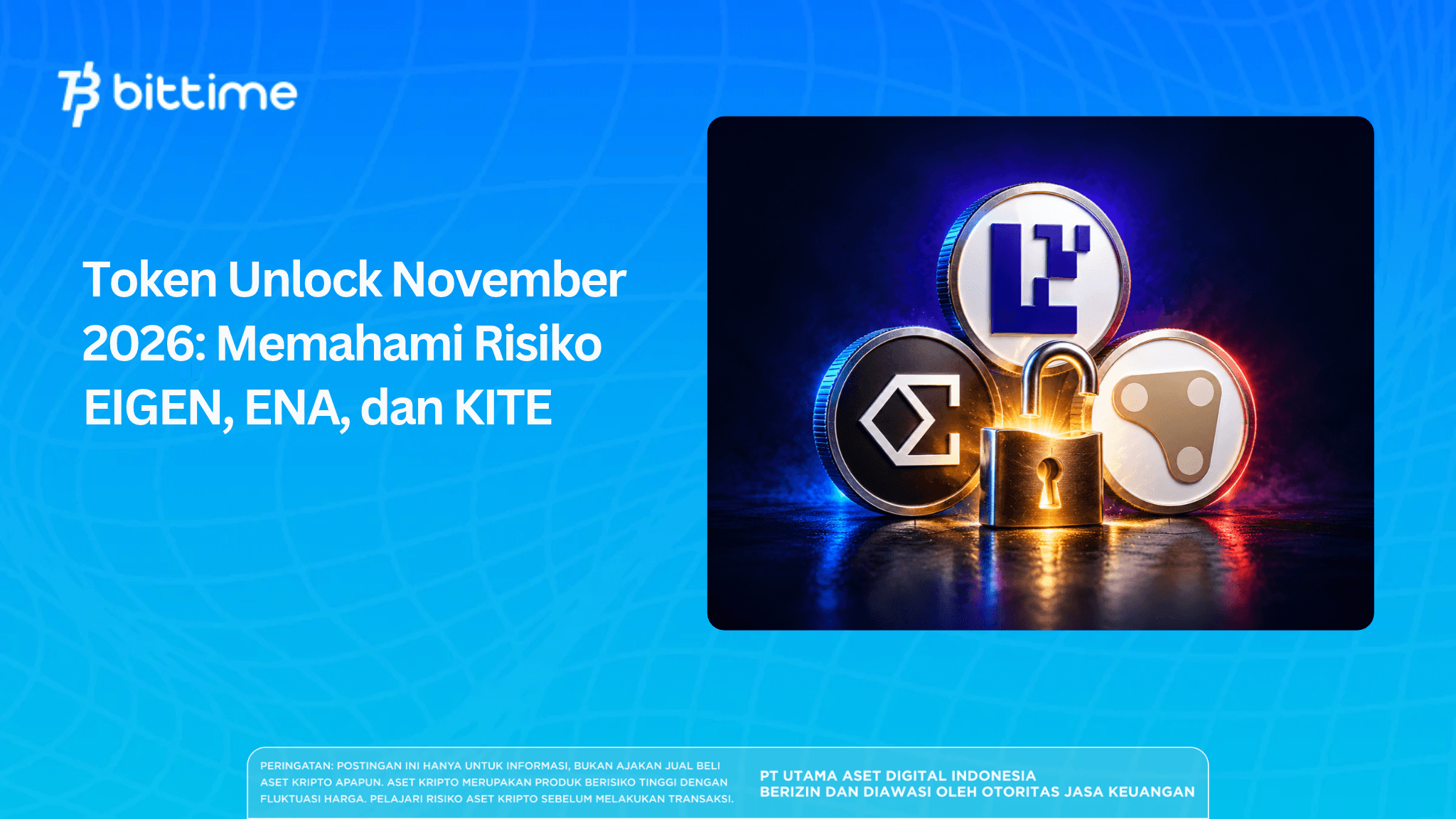
As you follow November 2026 token unlocks, you will encounter widely varying release figures for EIGEN, ENA, and KITE. The amounts can range from millions to billions of tokens, but the largest figure does not necessarily indicate the highest risk. Token recipients, the supply already in circulation, and the availability of buyers also help determine the impact.
Before drawing conclusions from an unlock calendar, check what is actually being measured and whether the schedule is confirmed. The following discussion of EIGEN, ENA, and KITE helps you compare the data, understand potential selling pressure, and identify what still needs confirmation.
Key Takeaways
- Unlock percentages can only be compared fairly when they use the same supply basis and data timestamp.
- Unlocked tokens do not necessarily move to exchanges or get sold by their recipients immediately.
- Market depth, transfer destinations, and the context of price movements help assess risks beyond the calendar figures.
November 2026 Token Unlocks: Understanding the Data for Three Assets
A token unlock occurs when restrictions on tokens are lifted according to their distribution schedule or terms. Recipients can then access those tokens, while the impact on circulating supply depends on the rules and how the tokens are subsequently used.
The early-November data below provides a starting point for discussing three selected assets. The listed schedules still need to be checked against project updates and evidence that the releases have taken place.
Read also: Cryptocurrencies Worth Watching in November 2026
EIGEN: Check the Schedule and Calculation Basis
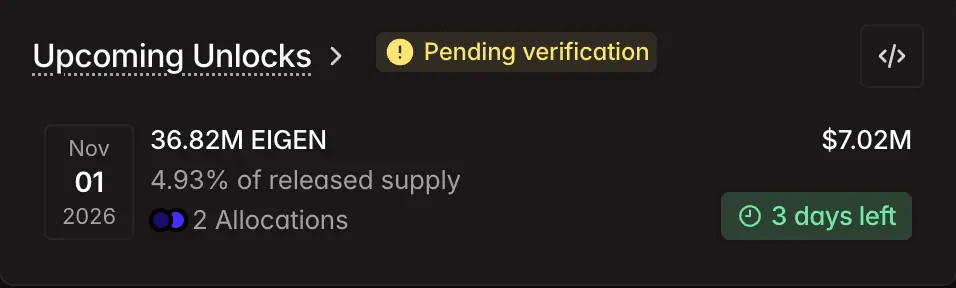
Preliminary data lists a planned release of approximately 36.82 million EIGEN on November 1, 2026, equivalent to 4.93% of the released supply. This schedule still needs verification, so the release cannot be considered complete simply because the date has passed.
For EIGEN, tokens available for allocation may differ from tokens already in circulation. Some community allocations are distributed gradually, so not all available tokens necessarily enter the market immediately.
When checking EIGEN's unlock schedule, pay attention to the recipients and when their lockup period began. For investors and contributors, the reference point is when the token first became transferable; using only the launch date can lead to incorrect calculations.
ENA: What Does a 0.63% Unlock Mean?
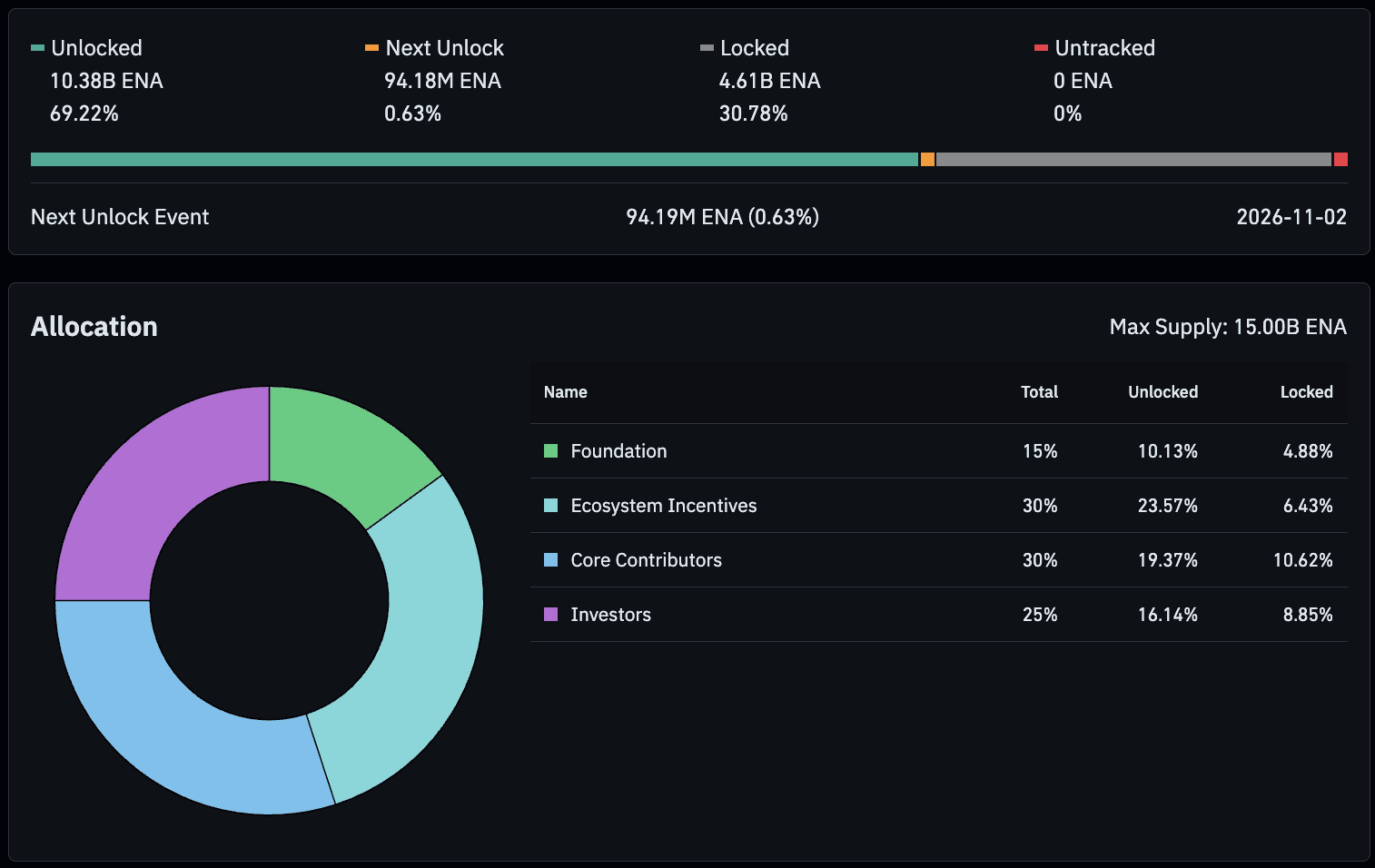
In the preliminary data, ENA's unlock schedule lists approximately 94.19 million tokens for November 2, 2026. That amount represents roughly 0.63% of the maximum supply of 15 billion ENA.
The 0.63% figure uses the entire maximum supply as its denominator, including tokens not yet available on the market. To determine the size of that addition relative to tokens already in circulation, you need circulating supply data from the same point in time.
ENA is the governance token of Ethena, with a different function from USDe. Make sure the data you are reading actually concerns ENA so that the supply analyses of the two assets are not mixed up.
KITE: Look Beyond the Token Count
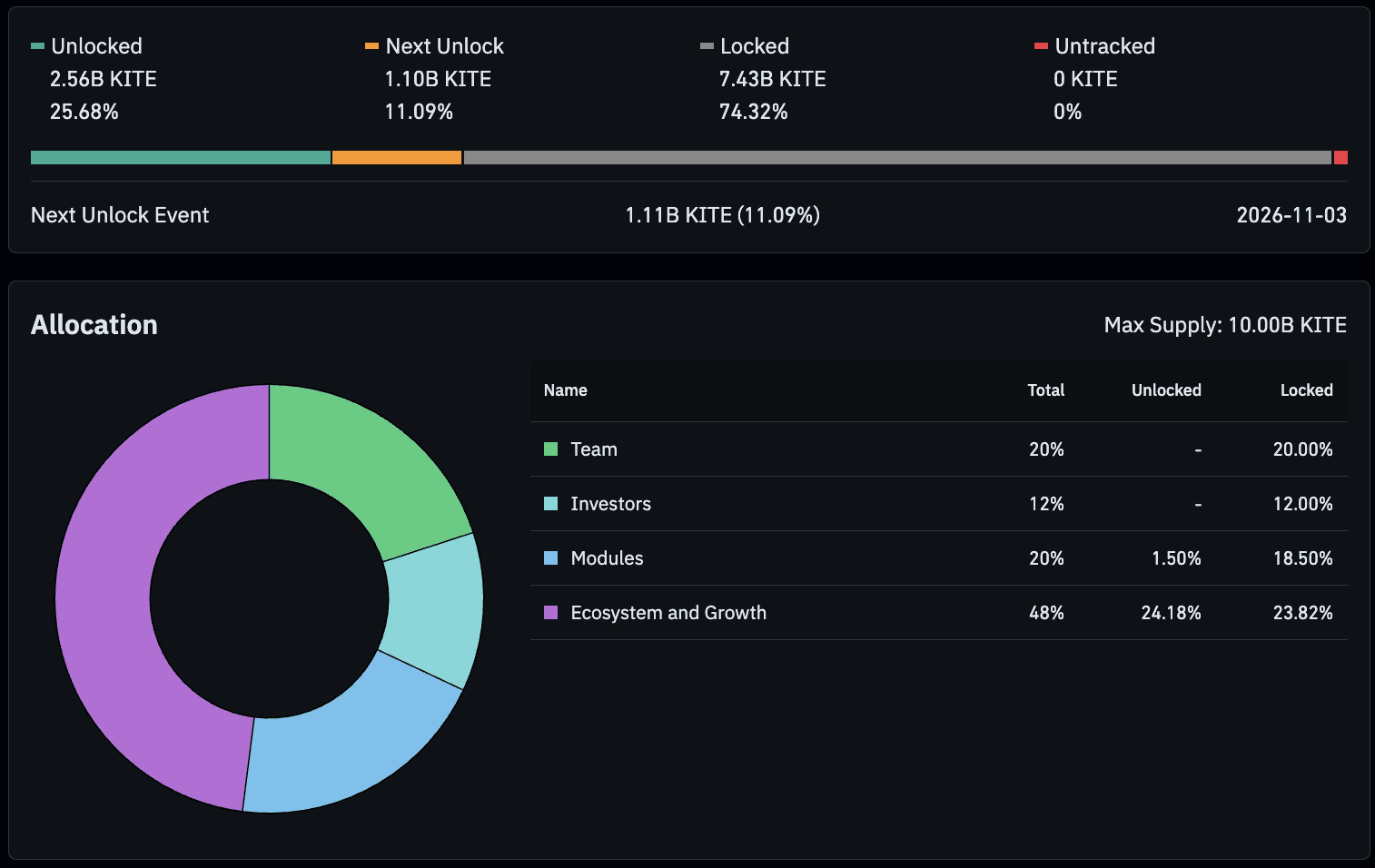
For KITE, preliminary data indicates a planned release of approximately 1.11 billion tokens on November 3, 2026, or around 11.09% of the maximum supply. The token count is rounded, so dividing the displayed figures may produce a result that differs slightly from that percentage.
The tokenomics documentation caps KITE's supply at 10 billion. Its allocations cover the ecosystem and community, investors, modules, and the team and contributors.
This allocation breakdown describes the overall plan; it does not yet explain who will receive tokens on November 3. The release details still need to be checked before linking the event to team or investor activity.
Read also: Elyon Airdrop: How to Earn Points and ELN Token Rewards
Why Can Unlock Percentages Be Misleading?
At first glance, the figures 4.93%, 0.63%, and 11.09% appear ready to be ranked from smallest to largest. However, EIGEN uses released supply as its calculation basis, while ENA and KITE use maximum supply.
Released supply indicates tokens that have been released according to the data provider's definition. Circulating supply estimates the amount in circulation, while maximum supply is the issuance limit. Check which terms are being used before comparing percentages.
To compare the size of an unlock with circulating supply, use the following calculation:
Unlock ratio = number of tokens unlocked ÷ circulating supply before the unlock × 100%.
Hypothetical example: an asset has a maximum supply of 1 billion tokens, but only 100 million are in circulation. An unlock of 10 million tokens equals just 1% of the maximum supply, yet represents 10% of the circulating supply before the event.
The figures in this example are illustrative only, not data for the three tokens. The same addition of 10 million tokens can appear small or large depending on the denominator.
Also record when the supply data was captured. If you use the supply after the unlock, the ratio will differ from a calculation using the supply before the release.
Read also: IAO Airdrop: Presale Refund Announced—What About the Token Allocation?
Trading Volume Is Not the Same as Buy Orders Waiting to Be Filled
Daily volume records transactions that have already occurred over a given period. The order book shows the buy and sell orders currently available at various price levels.
When assessing the impact of a token unlock, examine these two figures separately. A market that trades actively throughout the day may not have enough buy orders near the latest price to absorb a large sale all at once.
Imagine an asset has a daily trading volume of US$50 million, but buy orders within 2% below the latest price total only US$300,000. A rapid sale worth US$1 million could exhaust the nearest orders and reach lower prices.
This example also uses hypothetical figures. In actual trading, orders can change while a sale is taking place, and each trading venue has its own liquidity.
Pay attention to the spread—the difference between the best bid and ask prices—then examine the amount of orders at several price levels. This helps you better understand slippage risk: the actual transaction price may differ from what you expected.
Do not rely on a single order book snapshot. Because orders can change or be canceled, check several times to see whether market depth holds up.
Read also: PEPE and UNI Bought by a Wallet Suspected of Links to the Binance Hack
Tokens Have Unlocked—Does That Mean They Have Been Sold?
There are three distinct events to consider when assessing token unlock risk: tokens becoming accessible, tokens moving between wallets, and tokens being sold. These can happen at different times.
Recipients may hold their tokens, use them within the ecosystem, or transfer them to a custody service. To call it a sale, there must be evidence that the tokens were actually exchanged for another asset.
Even a transfer to an exchange address does not confirm that the tokens have been sold. In addition to checking the accuracy of the address label, remember that individual users' trades within centralized exchanges are usually not visible on a public blockchain.
For a more systematic investigation, record:
- The originating address and the basis for identifying its owner.
- The transfer destination and the level of confidence in its label.
- The number of tokens and the time of the transfer.
- Further evidence supporting or contradicting a suspected sale.
These records help you establish what is actually visible from the transactions. If the available evidence only shows a transfer between wallets, your conclusion should go no further.
The Price Fell After an Unlock—What Caused It?
Prices can fall after an unlock, but the cause is not necessarily the token release itself. At the same time, Bitcoin may be weakening, project news may emerge, or market liquidity may change.
For example, a token falls 5% while its comparison group of assets falls 8%. Token holders still experience a decline in value, but the token actually outperforms the comparison group over that period.
Also examine price movements before the unlock date. Market participants who know the schedule may adjust their positions earlier, although this still needs to be substantiated with data for EIGEN, ENA, and KITE.
Compare several periods before and after the event with other relevant assets. This provides a fuller picture, although it is not enough to establish a single cause or determine the next price direction.
Read also: KOR Airdrop: Check the Requirements and Register Before November 2, 2026
Why Do Unlock Schedules Differ Across Platforms?
Data differences can arise from update times, time zones, recipient categories, or the scope of the event. One calendar may show a single category, while another service combines several releases.
The date tokens become available may also differ from the claim or distribution date. If two calendars do not match, check which event each platform records.
The conflicting EIGEN schedules across platforms could not be confirmed in this review. A more detailed calendar display alone is not a sufficient reason to choose one date over another.
Prioritize the project's vesting terms, then cross-check them against event details and evidence of completion, where available. Record the data timestamp so that subsequent updates can be compared clearly.
5 Things to Monitor Before and After an Unlock
- Event confirmation. Confirm the date, time zone, recipient category, and schedule status before adding the event to your calendar.
- Comparable measurements. Compare ratios against circulating supply using consistent data timestamps.
- Evidence of distribution. Check whether the tokens have become accessible or have actually been transferred, rather than merely noting that the estimated date has passed.
- Trading conditions. Monitor spreads, order book depth, and liquidity changes in the relevant markets.
- Price context. Compare the token's movements with the broader market and other news before drawing conclusions.
When taking notes, distinguish between verified data, assumptions, and what remains unclear. That way, you know which parts need updating when new information emerges.
If you want to explore other crypto services, review their features and fees before deciding to sign up for Bittime. An unlock schedule alone is not a sufficient basis for immediately buying or selling an asset.
Conclusion
When reviewing November 2026 token unlocks, use token counts as the starting point for your assessment. For EIGEN, ENA, and KITE, follow up by checking the basis of the percentages, whether the schedules are confirmed, and the availability of buyers in the market.
From there, monitor the distribution and trading activity that actually take place. If the data is incomplete, hold off on judging which token carries the highest risk until there is sufficient evidence.
Bittime is a Digital Financial Asset Trader (PAKD) platform licensed and supervised by the Financial Services Authority (OJK)— a place where you can buy Bitcoin in Indonesia and hundreds of other crypto assets starting from IDR 10,000. Registration is fast and secure, and you can get started today.
Track conversions from USDT to IDR and the price movements of your favorite crypto assets in real time. Everything is available in one crypto investment app that you can download for free from the Play Store.
Ready to get started? Sign up for Bittime now and put your investment strategy into action with a platform already trusted by millions of users in Indonesia.
FAQ
Which tokens are covered in this discussion of November 2026 token unlocks?
This article discusses EIGEN, ENA, and KITE based on an early-November snapshot. These three were selected for discussion; they are not a complete list of all unlocks that month.
Do token unlocks always cause prices to fall?
An unlock alone cannot establish which direction prices will move. The market response depends on demand, liquidity, token recipients' actions, and other conditions at the time of the event.
Why is the number of unlocked tokens insufficient for comparing risk?
Each token has a different price, supply size, and trading conditions. The unit count needs to be supplemented with a ratio relative to circulating supply and evidence of how tokens are used after they unlock.
What is the difference between circulating supply and released supply?
Circulating supply estimates the tokens in circulation, while released supply indicates tokens that have been released according to the data provider's definition. Released tokens may not yet have entered the market, so the two terms should not automatically be used interchangeably.
Why can token unlock schedules differ across platforms?
Platforms may use different update times, distribution categories, or recording methods. Cross-check the same event against the project's documentation before deciding which figures to use.
Disclaimer: The views expressed belong exclusively to the author and do not reflect the views of this platform. This platform and its affiliates disclaim any responsibility for the accuracy or suitability of the information provided. It is for informational purposes only and not intended as financial or investment advice.
.png)