Tether (USDT) at Risk of Being Delisted from European Exchanges – What’s Behind It
2026-07-01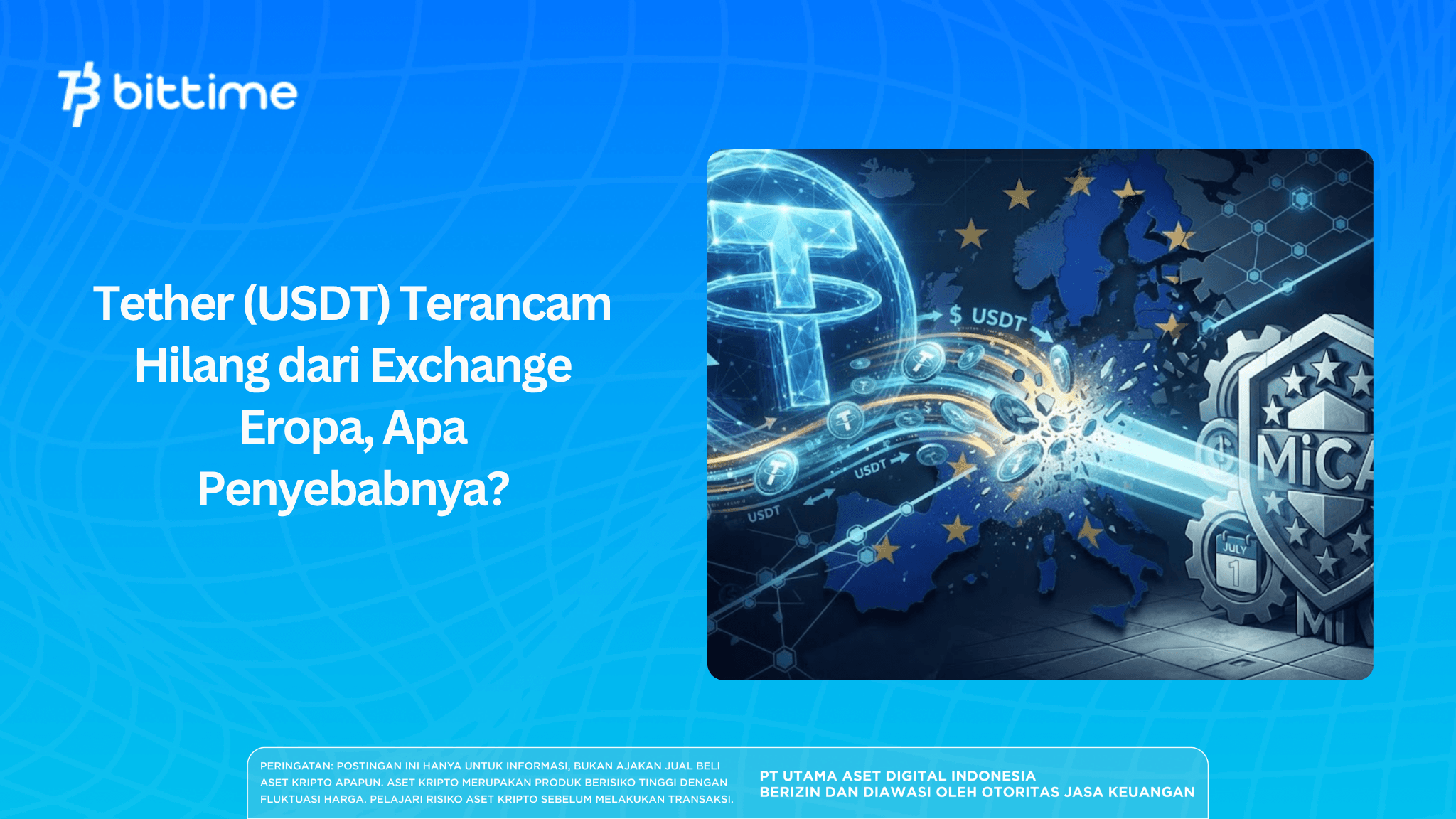
Tether (USDT) is back in the spotlight as several crypto exchanges across Europe begin restricting the stablecoin following the full implementation of the MiCA regulation on July 1, 2026.
The move is not driven by liquidity concerns but by Tether's lack of MiCA authorization, requiring exchanges in the EEA to limit or remove USDT services. What is MiCA, and how could it impact the crypto market?
Key Takeaways
- From July 1, 2026, USDT is no longer supported by MiCA-licensed exchanges in the European Union.
- MiCA regulates exchanges and custodians, not private ownership of USDT.
- The change could strengthen USDC's position in the European crypto market.
Register at Bittime now and start trading crypto with a fast, secure, and easy process in the app.
What is MiCA and Why is it Important?
Before understanding the reason behind USDT's removal from Europe, it is important to first know what MiCA is.
Markets in Crypto-Assets (MiCA) is the European Union's first comprehensive crypto regulatory framework. This regulation was designed to create uniform standards across all member states for overseeing crypto assets, including stablecoins.
One of the main focuses of MiCA is to ensure that stablecoin issuers have adequate asset reserves, transparent governance, and obtain official licenses before their products can be traded on platforms operating in the EEA.
With these rules, regulators hope to minimize risks to consumers and the stability of the financial system.
Read Also: MiCA Regulation vs Indonesia: Which One is Better Prepared to Regulate Crypto?
Why is USDT Threatened with Removal from European Exchanges?
Source: X.com/coinbureau
The main reason for USDT's delisting from Europe is Tether's decision not to apply for a license as an Electronic Money Token (EMT) issuer in accordance with MiCA requirements.
Without this license, exchanges with operating licenses in the European Union are no longer allowed to provide trading or services for this stablecoin to customers in the EEA region.
In recent months, several major platforms have taken anticipatory steps, including:
- Coinbase Europe has stopped supporting USDT.
- Crypto.com Europe has restricted USDT services.
- Binance entities for the EEA region have begun reducing USDT trading pairs.
- Several other platforms have started transferring user balances to regulated stablecoins.
This means the removal of Tether from EU exchanges is not a unilateral decision by the exchanges, but a consequence of MiCA regulation implementation.
Check out the step-by-step guide to buying Tether (USDT) on the Bittime market!
Why Didn't Tether Comply with MiCA Regulation?
A common question is why Tether chose not to obtain a MiCA license, even though USDT is the world's largest stablecoin.
One of the widely discussed factors is MiCA's requirement that a portion of stablecoin reserves be placed with banking institutions in the European region.
This business model is considered different from Tether's long-standing strategy in managing its asset reserves.
In addition, the company appears to prefer maintaining its focus on the global market outside the European Union rather than adjusting its operations to the new regulation.
This decision is also in line with Tether's previous move to discontinue its euro-based stablecoin (EURT), signaling the company's reduced focus on the European market.
Read Also: USDT Traded 8.5% More Expensive in India, What is the Cause?
Is USDT Completely Banned in the European Union?
The answer is not entirely.
MiCA regulations do not prohibit people from owning or using USDT. The regulation targets crypto service providers operating legally in the European Union.
This means there is an important distinction:
- MiCA-licensed exchanges can no longer offer USDT to EEA customers.
- Users who store USDT in non-custodial wallets (self-custody wallets) can still hold and transfer the token through the blockchain network.
- DeFi protocols that are not under centralized custodial services also still allow the use of USDT, although access may differ depending on each jurisdiction.
Thus, the issue of USDT being removed from Europe is better understood as restrictions on regulated platforms, not the removal of the token from the blockchain.
Convert 1 USDT to USD - Tether to United States Dollar
Who Benefits the Most?
The biggest beneficiary of this policy is expected to be Circle, the issuer of the USDC stablecoin.
USDC has obtained MiCA compliance, so it can continue to be traded legally on all exchanges with European Union licenses.
As a result, trading volume that previously used USDT is likely to shift to:
- USDC
- EURC
- Other stablecoins that have received regulatory approval
For institutional investors who must comply with regulations, this shift is almost inevitable because they cannot use services outside the MiCA legal framework.
Read also: 3 Benefits of Saving USDT - Potential and Long-Term
Impact on the Global Crypto Market
Although Europe is an important market, USDT's global dominance is unlikely to change drastically in the short term.
USDT remains the largest stablecoin by market capitalization and continues to be widely used in Asia, Latin America, the Middle East, and various developing countries.
However, the implementation of Tether regulation in the European Union shows that the stablecoin landscape is entering a new, stricter era.
Some potential impacts include:
- Trading volume on European exchanges shifting to USDC.
- Competition among stablecoins becoming increasingly dependent on regulatory compliance.
- Other stablecoin issuers are likely to be more proactive in obtaining licenses in various jurisdictions.
In the long term, regulation can become a factor just as important as liquidity in determining a stablecoin's dominance.
Start trading USDT/IDR with Bittime here!
What Should Investors Pay Attention To?
For investors outside Europe, this change may not have a direct impact on daily USDT usage.
However, the development remains important as it shows that regulation now has a major influence on the digital asset ecosystem.
Investors should pay attention to several things:
- The policies of the exchanges where they trade.
- Stablecoins that have met regulations in their respective countries.
- Changes in trading pair liquidity due to volume shifting from USDT to USDC.
Understanding regulatory developments is becoming increasingly important because it can affect access to digital assets, even though the technology remains available on the blockchain.
Read Also: Is Exchanging Rupiah to USDT Safe Now? See the Pros and Risks
Conclusion
The full enforcement of MiCA marks a major change in the stablecoin industry in Europe. Tether's decision not to apply for a license means USDT must exit several exchanges operating under European Union regulations, although the token can still be used through non-custodial wallets and the blockchain network.
For the global market, this step does not immediately reduce USDT's dominance, but demonstrates that regulatory compliance is now a major factor in stablecoin competition.
Meanwhile, USDC has the opportunity to strengthen its position as the leading stablecoin in the European region because it has met all MiCA requirements.
Want to own an asset whose value follows the US dollar? Check the movements of USDT, USDC, USD1, and USDS, then start trading your favorite stablecoin on Bittime.
Bittime is a licensed and supervised Digital Financial Asset Trader (PAKD) platform by the Financial Services Authority — the place where you can buy Bitcoin in Indonesia and hundreds of other crypto assets starting from Rp10,000. The registration process is fast, secure, and can be started today.
Monitor the conversion USDT to IDR and the price movements of your favorite crypto assets in real-time. All available in one crypto investment app that can be downloaded for free on the Play Store.
Ready to start?Register now at Bittime and execute your investment strategy with a platform trusted by millions of users in Indonesia.
FAQ
What is MiCA?
MiCA (Markets in Crypto-Assets) is a European Union regulation that governs stablecoin issuers, crypto assets, and crypto service providers to operate under uniform standards.
Why is USDT being removed from European exchanges?
Because Tether has not applied for a MiCA license as a stablecoin issuer, exchanges licensed in the European Union can no longer offer USDT to EEA customers.
Is USDT banned in the European Union?
No. MiCA regulation restricts regulated exchange services, but does not prohibit people from owning or using USDT through non-custodial wallets.
Who benefits from the MiCA policy?
Circle as the issuer of USDC is one of the parties that benefits the most because USDC has met MiCA requirements and remains available on European exchanges.
Are users outside Europe affected?
Not directly. However, regulatory changes can affect global liquidity, stablecoin choices on international exchanges, and the direction of crypto asset regulation development in other countries.
Disclaimer: The views expressed belong exclusively to the author and do not reflect the views of this platform. This platform and its affiliates disclaim any responsibility for the accuracy or suitability of the information provided. It is for informational purposes only and not intended as financial or investment advice.

.png)