SK Hynix Announces a $29 Billion Buyback—Why Did Its Stock Price Drop Instead?
2026-08-20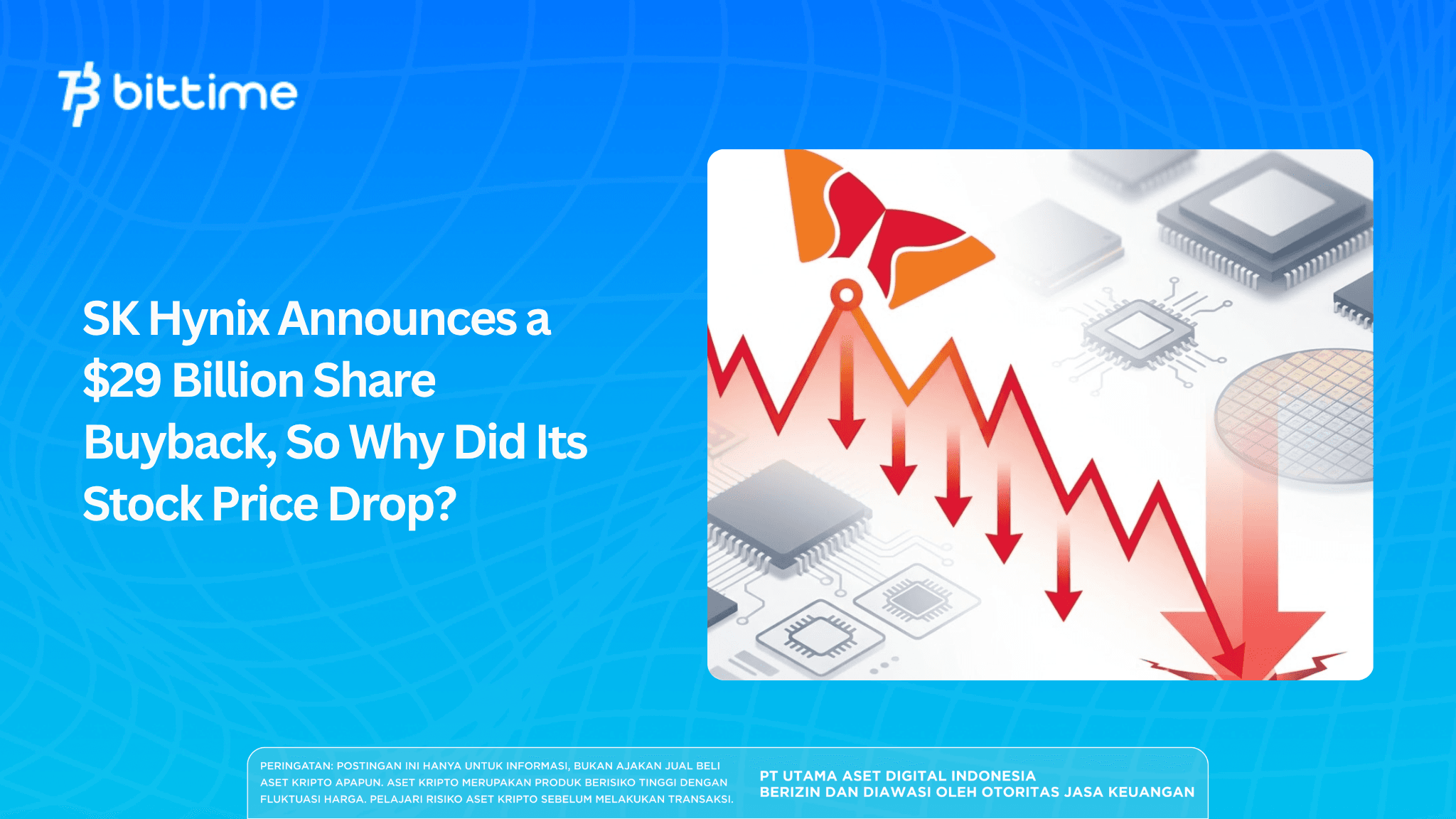
The news of SK Hynix buyback worth 40 trillion won, or around US$28.6–29 billion, should have been a positive signal for shareholders.
The program is one of the largest buyback actions in South Korean stock market history and includes both share repurchases and cancellations.
However, the market response was the opposite. SK Hynix shares fell around 9.75% in Seoul trading on August 19, 2026, after investors had already begun reducing their exposure to technology and AI chip stocks.
This phenomenon shows that corporate decisions that benefit shareholders are not always enough to overcome broader market concerns.
Investors are now questioning not only how much money the company is returning, but also whether the growth of AI chip stocks can be sustained amid high valuations and massive AI infrastructure spending.
Key Takeaways
- SK Hynix's US$29 billion program involves the repurchase and cancellation of around 24.07 million shares, or 3.3% of outstanding shares.
- The stock decline was largely driven by concerns over semiconductor valuations, the sustainability of AI spending, and profit-taking after a significant previous rally.
- SK Hynix's fundamentals remain strong, with record second-quarter 2026 performance and net cash of around 69.4 trillion won.
What Does SK Hynix's US$29 Billion Stock Buyback Include?
On August 19, 2026, SK Hynix's board of directors approved a 40 trillion won share repurchase program and will cancel all shares purchased. The program is scheduled to run from August 20 to November 19, 2026.
Using the closing price of 1,662,000 won before the announcement, the company estimates that it could purchase around 24.07 million shares, equivalent to approximately 3.3% of total outstanding shares.
What makes this program significant is that the acquired shares will not be held as treasury stock but will actually be canceled. As a result, the number of outstanding shares will permanently decrease.
In theory, the cancellation increases the relative ownership represented by each remaining share. If the company's earnings continue to grow, earnings per share, or EPS, could also increase because there are fewer shares over which earnings are divided.
SK Hynix also raised its capital return target to more than 50% of cumulative free cash flow for the 2025–2027 period, from the previous target of up to 50%. The returns will be made through a combination of buybacks, share cancellations, and cash dividends.
Read Also: Memory Stocks Rally: AI Boom Drives Micron, SanDisk, and SK Hynix
Why Did SK Hynix Stock Fall Instead?
The main question is no longer whether the buyback is positive, but why did SK Hynix's stock price continue to fall?
The first answer is sector sentiment.
SK Hynix is one of the companies most sensitive to the AI and memory semiconductor cycles.
When investors begin to question whether major technology companies will continue increasing AI data center spending at the same pace, memory suppliers' stocks also come under pressure.
Reuters reported that the nearly 10% decline occurred amid concerns over the sustainability of AI spending by U.S. technology companies. This means the market is pricing in risks to future memory demand growth, not just SK Hynix's current financial condition.
There is a second factor: valuation.
SK Hynix has enjoyed a major rally due to expectations for High Bandwidth Memory, or HBM, demand. After the strong price increase, investors began questioning whether exceptionally high earnings growth could be sustained.
MarketWatch noted that SK Hynix shares had more than doubled during the year before the correction and had fallen nearly 50% from their June peak.
Therefore, the decline does not mean the market considers the buyback to be bad. Instead, investors may view the buyback as a response to the correction that has already occurred.
Want exposure to U.S. stocks? Sign up on Bittime and start investing through tokenized stocks.
Buybacks Do Not Eliminate the Risks of AI Chip Stocks
SK Hynix's stock buyback does increase potential value for shareholders, but it does not solve all of the company's business challenges.
The memory industry is highly cyclical. When demand is high and supply is limited, DRAM and HBM prices can rise sharply. However, if global production grows too quickly or demand slows, pressure on prices can emerge.
This risk is increasingly relevant in the AI era because major technology companies are spending enormous amounts of capital to build data centers. At the same time, investors are beginning to ask when that spending will generate enough returns to justify the investment.
In July, SK Hynix and Samsung Electronics shares also came under significant pressure due to concerns over AI spending and semiconductor sector valuations.
In other words, the market is shifting from the question, “Will AI need more chips?” to “How profitable and sustainable will AI growth be?”
Read Also: Samsung, SK Hynix, and Micron Face Lawsuit Over Alleged RAM Supply Manipulation
SK Hynix Fundamentals Still Show Strong Growth
Although SK Hynix's stock has fallen, the company's fundamentals have not shown damage comparable to the decline in its share price.
In the second quarter of 2026, SK Hynix reported revenue of around 79.32 trillion won and operating profit of approximately 60.54 trillion won, with an operating margin of 76%. Revenue increased 257% year over year, while operating profit surged 557%.
The performance was primarily supported by high-value memory products such as HBM, DRAM for AI servers, and enterprise SSDs. The company also said HBM4 has achieved operating speeds and power efficiency that meet customer requirements.
The financial position is also strong. Cash and cash equivalents reached around 88 trillion won at the end of the second quarter, while debt declined to 18.6 trillion won. Net cash stood at approximately 69.4 trillion won.
These figures help explain why the company is able to conduct a large-scale buyback while continuing to invest in capacity.
Check the prices of tokenized stocks such as Amazon Tokenized Stock Ondo (AMZNON), Netflix Tokenized Stock Ondo (NFLXON), Microsoft Tokenized Ondo (MSFTON), and many more exclusively on Bittime.
SK Hynix Still Needs to Invest in AI Memory
This is where the dilemma for investors lies.
On one hand, the company is returning capital through buybacks and dividends. On the other hand, the growth of Korean chip companies such as SK Hynix depends on their ability to expand capacity to meet AI demand.
SK Hynix recently announced a 54 trillion won investment in the Yongin Y2 and Cheongju M17 facilities to strengthen its medium- to long-term production base. The company is also continuing to expand its packaging and memory production facilities.
Therefore, investors need to view the buyback as part of the company's capital allocation strategy, not as a sign that SK Hynix is stopping investments.
The company is essentially trying to do two things at the same time: maintain growth capacity for AI memory and provide greater capital returns to shareholders.
What Does the Buyback Mean for SK Hynix Shareholders?
If shares are repurchased and then canceled, the number of outstanding shares decreases. Assuming earnings remain the same, the portion of earnings attributable to each share can increase.
However, this mechanism does not automatically increase SK Hynix's share price.
The price remains determined by market expectations for future earnings, valuation, chip demand, economic conditions, and sector sentiment.
In SK Hynix's case, the benefits of the buyback could be temporarily overshadowed by market concerns over AI chip stock valuations and the data center spending cycle.
This explains why the stock can fall on the same day that the buyback program is announced.
Read Also: SK Hynix Prepares US$29 Billion U.S. Listing, Focuses on Attracting AI Investors
What Should You Watch for From SK Hynix in 2026?
To assess the outlook for SK Hynix in 2026, investors need to pay attention to several key indicators.
The first is the development of HBM demand, particularly HBM4 and subsequent generations. The second is memory pricing and the balance between supply and demand. The third is hyperscaler AI spending, as companies such as SK Hynix are highly dependent on such infrastructure investments.
The fourth is capital allocation. After the 40 trillion won buyback is completed, investors will look at whether the company continues purchasing shares, increases dividends, or prioritizes investment again.
In addition, SK Hynix's Nasdaq ADR listing since July 2026 could expand its global investor base. SK Hynix said the listing is intended to broaden its investor base and strengthen its position as a key AI memory partner.
Is SK Hynix Stock Still Attractive?
The nearly 10% decline does not immediately change the investment thesis for SK Hynix. The company's fundamentals remain very strong, particularly because of its position in the HBM and AI memory supply chain.
However, valuations and expectations are also much higher than they were several years ago. Investors now need evidence that AI memory growth can be sustained, rather than just one or two quarters of exceptional results.
Therefore, the SK Hynix buyback could become a positive medium-term catalyst because it reduces the number of outstanding shares and signals management's confidence in the company's value.
But to reverse the market pressure, the company still needs sustainable earnings growth.
Interested in investing in the crypto AI sector? Track prices and start trading popular AI coins such as Bittensor (TAO), NEAR Protocol (NEAR), and Artificial Superintelligence Alliance (FET) directly on Bittime.
Conclusion
SK Hynix's US$29 billion program is an aggressive move to increase returns to shareholders.
By canceling around 3.3% of outstanding shares and raising its distribution target to more than 50% of cumulative free cash flow, the company is sending a strong signal that management considers its stock to be trading below its intrinsic value.
However, SK Hynix shares fell because the market is currently paying more attention to concerns over semiconductor valuations and the sustainability of AI spending. The company's fundamentals are strong, but expectations for the stock are also very high.
Gain exposure to shares of leading technology companies through tokenized stocks such as AMZON, TSLAX, MSFTON or GOOGLX on the Bittime market.
Bittime is a licensed Digital Financial Asset Trader (PAKD) platform regulated and supervised by the Financial Services Authority (OJK) — where you can buy Bitcoin in Indonesia and hundreds of other crypto assets starting from Rp10,000. Registration is fast, secure, and you can get started today.
Track the USDT to IDR conversion and your favorite crypto asset prices in real time. Everything is available in a single crypto investment app that can be downloaded for free from the Play Store.
Ready to get started? Sign up on Bittime now and execute your investment strategy with a platform trusted by millions of users in Indonesia.
FAQ
What is the SK Hynix US$29 billion buyback?
SK Hynix approved a share repurchase and cancellation program worth 40 trillion won, or around US$28.6–29 billion. The program targets approximately 24.07 million shares, or 3.3% of outstanding shares.
Why did SK Hynix shares fall after announcing the buyback?
The decline was mainly related to market concerns over semiconductor stock valuations, the sustainability of AI spending, and profit-taking after a significant previous rally.
Does the SK Hynix buyback benefit shareholders?
In theory, share cancellations reduce the number of outstanding shares, which can increase the portion of earnings attributable to each remaining share. However, a buyback does not guarantee that the stock price will rise because prices remain influenced by market expectations.
Why is SK Hynix important in the AI chip stock industry?
SK Hynix is a major memory manufacturer and holds a strong position in HBM, which is used for AI infrastructure. Its 2026 performance also shows strong growth in HBM, AI server DRAM, and enterprise SSD products.
What are SK Hynix's fundamentals like in 2026?
In the second quarter of 2026, SK Hynix reported revenue of 79.32 trillion won and operating profit of 60.54 trillion won. Net cash reached approximately 69.4 trillion won.
What are the main risks for SK Hynix stock?
The main risks include the memory industry's cycle, changes in HBM demand, high valuations, a slowdown in AI spending, increasing memory supply, and pressure from other semiconductor manufacturers.
Disclaimer: The views expressed belong exclusively to the author and do not reflect the views of this platform. This platform and its affiliates disclaim any responsibility for the accuracy or suitability of the information provided. It is for informational purposes only and not intended as financial or investment advice.

.png)