SHIB Falls Sharply, Should Holders Sell or Hold?
2026-11-06
SHIB fell sharply on November 5, 2026, hitting $0.00000437 on Kraken, a level last seen in August. Over the past 24 hours, the price of Shiba Inu fell by approximately 5.6%, alongside a Bitcoin correction of more than 6%. The decline pushed SHIB back toward a support area that had previously marked the beginning of a price recovery.
For holders, this situation raises an important question: is it better to sell SHIB now or continue holding? The answer cannot be based solely on the daily percentage decline. Bitcoin's performance, price movements near support, and portfolio risk are all important considerations before deciding what to do next.
Key Takeaways
- SHIB hit $0.00000437 on November 5, 2026, its lowest level since August, as Bitcoin and the broader crypto market also weakened.
- SHIB has support near $0.00000435, while the first key resistance level to break is $0.00000485.
- Whether to sell or hold should depend on market conditions, investment objectives, and each holder's ability to tolerate risk.
Shiba Inu Price Falls to Its Lowest Level Since August
Selling pressure on Shiba Inu increased again in early November 2026.
During trading on November 5, SHIB opened at around $0.00000472 and briefly reached $0.00000478 before falling to $0.00000437.
The price later traded around $0.00000452 in the evening observation, representing a daily decline of approximately 5.6%.
The decline was not an isolated event. Over the preceding 30 days, SHIB had already lost approximately 21.4% of its value, while its market capitalization stood at around $2.66 billion.
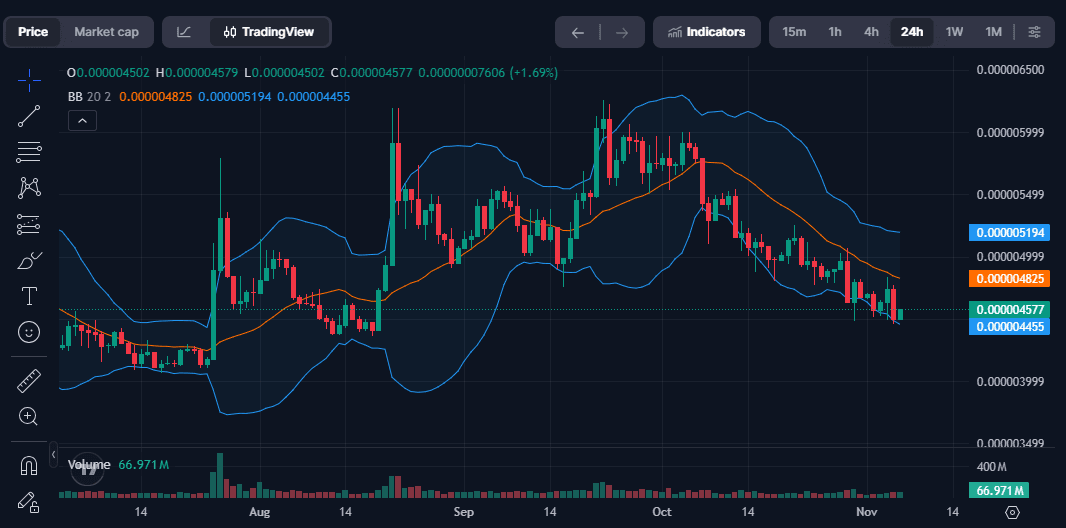
This movement shows that pressure on Shiba Inu had persisted for longer than a single trading session.
These figures reflect market observations on November 5, 2026, and may differ from the price when this article is read.
Why Is the August Price Level Back in Focus?
On August 12, 2026, SHIB touched $0.00000435 before eventually recovering.
One week later, the token was trading around $0.00000474 again. That area drew renewed attention when SHIB experienced a similar decline in November.
Although the price has returned close to the same level, market conditions are different.
The August recovery occurred as Bitcoin began to strengthen. This time, however, Bitcoin is undergoing a relatively deep correction.
Therefore, the previous rebound alone is not enough to conclude that SHIB will rise again from the same area.
Read also: Baby Doge Coin vs. Shiba Inu: Which Meme Coin Is More Attractive in 2026?
Why Is the Price of SHIB Falling?
This latest weakness in Shiba Inu has coincided more closely with broader crypto market pressure than with any single issue specific to the project.
Three factors help explain the situation.
1. Bitcoin's Decline Weighs on Market Sentiment
Bitcoin was among the assets facing significant selling pressure on November 5. Its price briefly fell below $75,600, declining approximately 6.3% over 24 hours.
When BTC falls sharply, altcoins generally feel the effects, particularly highly volatile assets such as meme coins.
Investors tend to become more cautious when markets weaken. Some reduce their risk exposure, while short-term traders may close positions to avoid larger losses.
Interestingly, SHIB's 5.6% decline was slightly smaller than Bitcoin's correction over the same observation period.
This suggests that Shiba Inu's weakness should not necessarily be interpreted as selling pressure directed specifically at the token.
2. U.S. Technology Stocks Also Come Under Pressure
The crypto market correction occurred as U.S. technology stocks, particularly semiconductor companies, were also under pressure.
The situation reflects a more cautious attitude toward risk assets among investors.
Meme coins such as SHIB are particularly sensitive to these shifts in sentiment because trading activity is heavily influenced by short-term expectations.
Nevertheless, it would be inaccurate to conclude that falling technology stocks directly caused SHIB's price to drop.
Cryptocurrency movements are also shaped by other factors, including liquidity, trader activity, and overall market conditions.
3. SHIB Loses the $0.0000045 Support Area
Before the latest decline, the $0.0000045 area had repeatedly attracted buyers and provided support for SHIB.
However, on November 5, the price briefly moved below that level.
A move below support typically prompts traders to watch for the risk of further losses.
Even so, a break that occurs only during intraday trading does not necessarily indicate a decisive breakdown.
The price needs to be monitored through the candle close to determine whether buyers can reclaim that area.
Trading volume has also not shown unusually high activity.
On Kraken's SHIB/USD pair, reported volume was approximately 77 billion SHIB, below the previous 30-day average of nearly 90 billion tokens.
This suggests that the decline on that exchange was not accompanied by an extreme surge in trading volume.
In other words, selling pressure was evident, but there is insufficient evidence to describe it as widespread capitulation across the entire SHIB market.
Read also: Top Ethereum Meme Coins in 2026: How to Buy Them on Bittime
SHIB Technical Analysis: Latest Support and Resistance Levels
Having returned to August's price area, SHIB is at an important technical juncture.
The price is testing a zone that previously contained declines. If buyers return, a recovery remains possible.
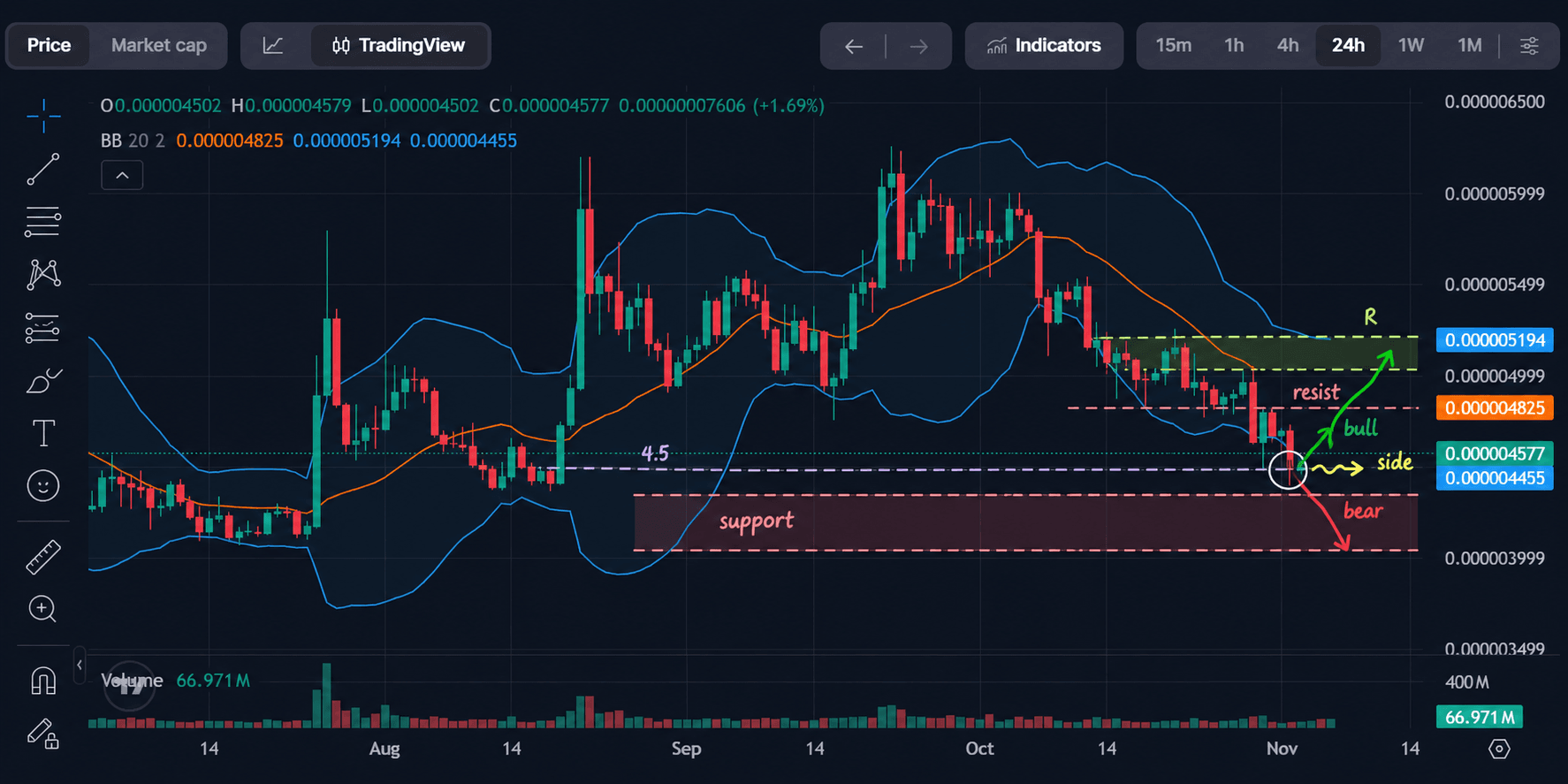
Conversely, failure to hold support could allow bearish pressure to continue.
Key SHIB Support Levels to Watch
The first level is $0.0000045, which previously acted as support. When the price trades below it, the level can become short-term resistance.
To ease bearish pressure, SHIB needs to trade consistently above this area again.
The next support lies at $0.00000435, close to the low recorded in August.
If that area fails to hold, market attention could shift to $0.00000405, the 2026 low according to the dataset used.
However, this figure is only a technical reference point. There is no certainty that the price will fall that far.
SHIB Resistance Levels if the Price Begins to Recover
On the upside, SHIB needs to overcome resistance around $0.00000485. This level is close to the 20-day moving average as observed on November 5.
If the price moves higher, the next challenge is the $0.0000050–$0.0000052 range. This area is important because it has repeatedly limited gains in the past.
A more convincing recovery would require a close above resistance, ideally supported by higher trading volume.
Without that confirmation, a rebound could stall before the overall trend changes.
Read also: Shibarium Reaches 270 Million Wallets: What Does It Mean for Shiba Inu's Price?
Should SHIB Holders Sell or Hold?
When prices fall sharply, the urge to sell immediately often grows, especially when a portfolio has already lost substantial value.
However, the decision to sell or hold SHIB cannot be determined by a single red candle.
Every holder's circumstances are different. Some bought SHIB for short-term trading, while others planned from the outset to hold the asset for several years.
These different objectives influence how each investor responds to volatility.
When Does Holding SHIB Still Make Sense?
Holding SHIB may be worth considering if the investment objective is genuinely long term and the risk of losses was factored in from the beginning.
For example, a holder might have a relatively small SHIB allocation in their portfolio and no immediate need for the invested funds.
Under those circumstances, daily price fluctuations may not require an immediate decision.
However, one question still needs to be answered: does the original reason for buying SHIB remain valid?
If confidence in the asset's prospects rests solely on the hope that its price will return to the purchase level, the holding strategy should be reassessed.
Holding a token longer does not automatically reduce losses.
When Should Selling SHIB Be Considered?
Selling during a decline does not always amount to panic selling.
It may instead be part of a previously established risk-management strategy.
For example, SHIB may account for too much of a portfolio, or losses may begin to exceed the investor's tolerance.
A need for funds in the near future is another important consideration.
For short-term traders, changes in price structure that no longer align with the original plan may justify reassessing a position.
What should be avoided is making a hasty decision simply because the price fell sharply in a single day.
What About Selling Only Part of a Position?
A holder's options are not necessarily limited to selling every token or keeping the entire position.
Reducing part of a position can be one way to adjust a portfolio's risk exposure.
This approach allows investors to retain some exposure to SHIB while reducing the amount of capital affected by volatility.
However, no single percentage reduction suits everyone. The amount retained should reflect each investor's financial circumstances and investment objectives.
Read also: BUILDon (B) Price Prediction 2026: Why Is B Coin Rising?
SHIB Price Prediction: Can It Still Rebound?
After falling toward $0.0000043, SHIB faces several possible paths.
Its next move will depend heavily on Bitcoin's performance and whether the price can hold near historical support.
Bullish Scenario: SHIB Reclaims Support
The possibility of a rebound improves if Bitcoin stabilizes and selling pressure across the crypto market eases.
Under those conditions, SHIB must first reclaim the $0.0000045 area.
If it succeeds, resistance at $0.00000485 will be the next challenge.
A break above that level could open the way for a test of the $0.0000050–$0.0000052 zone.
However, a recovery toward resistance does not mean that the bearish trend has ended.
Neutral Scenario: Price Moves Sideways
SHIB could also enter a consolidation phase as sellers begin to lose momentum but buyers remain too weak to push the price higher.
The price may trade within a limited range while the market waits for a clearer direction.
Conditions like these often make daily price movements appear unpredictable.
Trading volume can help indicate whether the market is building fresh momentum or losing interest.
Bearish Scenario: Support Breaks Again
The risk of a further correction increases if SHIB fails to move back above $0.0000045.
If the price subsequently breaks below $0.00000435, the market could retest lower areas.
The $0.00000405 level is one historical reference worth monitoring.
Bearish pressure could intensify if Bitcoin experiences another major decline.
This scenario is not a certainty but an illustration of the risks based on price structure during the observation period.
Read also: WWAR Price Prediction: Can World War Asset Reserve Reach $0.10?
Can SHIB Burns and Shibarium Support a Recovery?
Beyond market conditions, developments in the Shiba Inu ecosystem are also important to holders.
One of these is token burning, also known as SHIB burn.
This process reduces supply by sending tokens to an address from which they cannot be recovered.
In theory, lower supply can support prices if demand remains strong.
However, the effect is not always immediately visible.
Even a large percentage increase in the burn rate may have little impact if the actual number of tokens burned is small relative to the total supply.
Another factor to watch is Shibarium.
The network was developed to support transactions and applications within the Shiba Inu ecosystem.
Growth in Shibarium activity can strengthen ecosystem adoption but does not necessarily drive SHIB's price higher in the short term.
Assessing its impact requires network activity data and the actual number of tokens burned, rather than announcements or community sentiment alone.
Read also: Can XTX Reach $0.10?
Five Things SHIB Holders Should Monitor
Before deciding whether to sell or keep holding SHIB, several indicators can help assess market conditions.
- Bitcoin's direction. BTC's movements remain an important indicator of sentiment across the cryptocurrency market.
- SHIB's daily closing price. Watch whether the token can move back above the support area that it briefly lost.
- Trading volume. Higher volume during a price recovery can strengthen a rebound signal, while heavy volume during a decline can indicate greater selling pressure.
- SHIB's performance against BTC. The SHIB/BTC ratio helps show whether Shiba Inu is displaying relative strength or lagging behind Bitcoin.
- Ecosystem developments. Token burn data, activity on Shibarium, and changes in on-chain conditions can provide further insight into the project.
These indicators will not necessarily point in the same direction at all times.
Considering several sources of information together is generally more useful than making decisions based on a single price movement.
If you want to follow developments in Shiba Inu, Bitcoin, and other crypto assets, you can sign up for Bittime to monitor market information and read the latest analysis before making decisions.
Conclusion
SHIB fell to price levels last seen in August 2026 as Bitcoin and the wider crypto market came under pressure.
The $0.00000435 area is in focus because it previously helped contain declines. On the other hand, SHIB still needs to break through resistance to demonstrate a stronger recovery.
For holders, the decision to sell or hold should be guided by their investment objectives and individual risk limits, rather than fear of further declines or hopes of an immediate rebound.
Bitcoin's performance, trading volume, and SHIB's ability to hold support will be important indicators of its next direction.

Bittime is a licensed Digital Financial Asset Trader (PAKD) regulated and supervised by Indonesia's Financial Services Authority (OJK) — where you can buy Bitcoin in Indonesia and hundreds of other cryptocurrencies starting from IDR 10,000. Registration is fast, secure, and you can get started today.
Track the conversion rate of USDT to IDR and real-time price movements of your favorite crypto assets. Everything is available in a single crypto investment app that you can download for free from the Play Store.
Ready to get started? Sign up for Bittime now and put your investment strategy into action on a platform trusted by millions of users in Indonesia.
FAQ
Why has SHIB's price fallen so sharply?
SHIB declined alongside Bitcoin and several other crypto assets on November 5, 2026. During the observed period, Bitcoin fell by approximately 6.3%, while Shiba Inu dropped by around 5.6%. There is insufficient evidence that the decline was primarily caused by an issue specific to the SHIB project.
Should SHIB holders sell or hold?
The decision depends on investment objectives, position size, and the ability to absorb losses. Long-term holders may have different considerations from traders focused on daily price movements. No single strategy is suitable for every SHIB holder.
Could SHIB's price fall further?
Further declines remain possible if the price fails to hold historical support. Based on data from November 5, 2026, the $0.00000435 and $0.00000405 levels are important reference points. Neither is a guaranteed price target.
Could SHIB rise again in 2026?
A recovery remains possible if market conditions improve and selling pressure begins to ease. SHIB needs to break above resistance at $0.00000485 before testing the $0.0000050–$0.0000052 zone. Price action and trading volume will be important in confirming the strength of any rebound.
What should investors consider before selling SHIB?
Review the original purchase price, position size, liquidity needs, and reasons for investing. Also consider Bitcoin's performance and changes in SHIB's price trend. Decisions based on a risk-management plan are more measured than selling out of panic.
Disclaimer: The views expressed belong exclusively to the author and do not reflect the views of this platform. This platform and its affiliates disclaim any responsibility for the accuracy or suitability of the information provided. It is for informational purposes only and not intended as financial or investment advice.

.png)