History of Ripple (XRP) that you must know
2024-12-04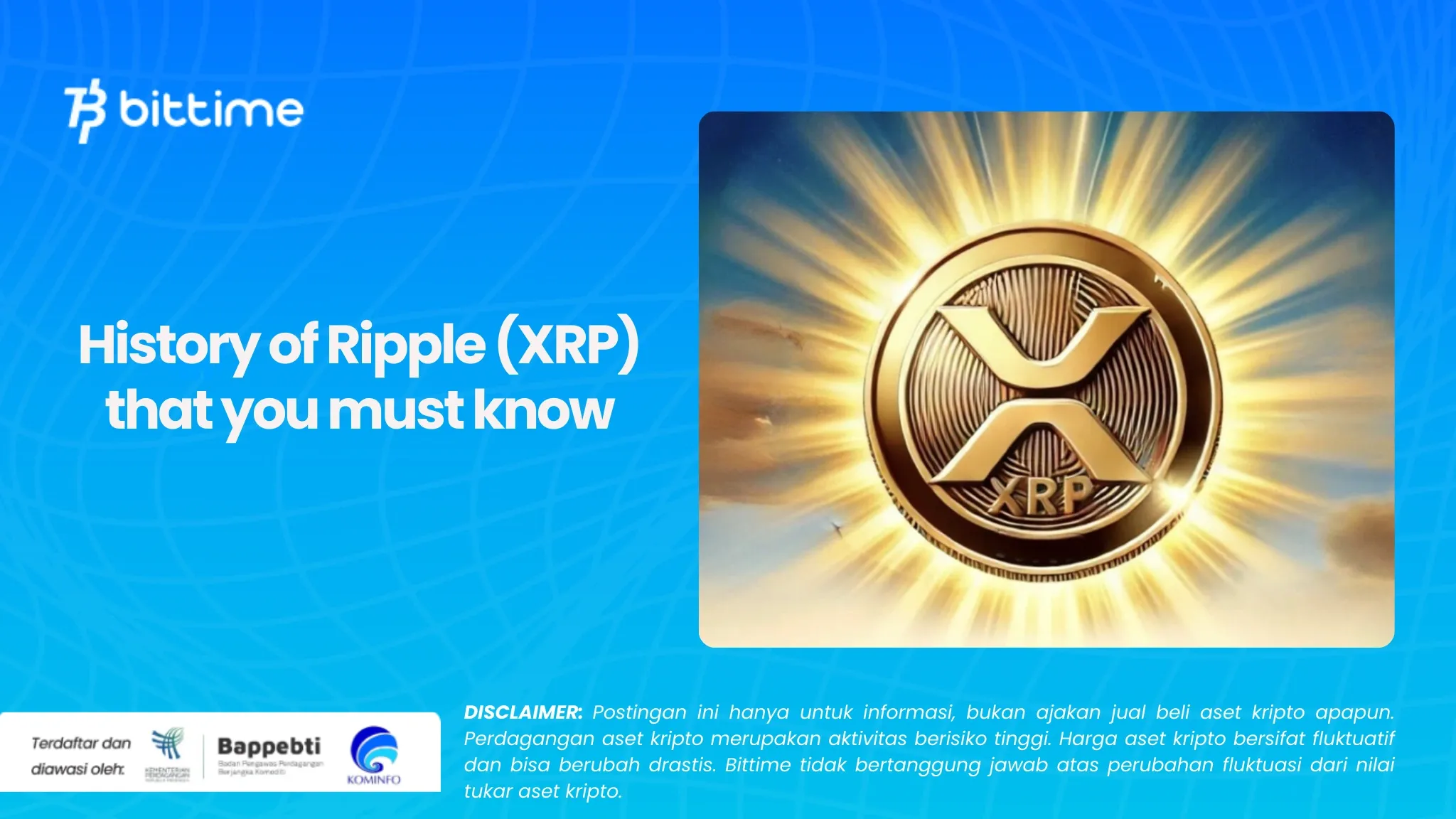
Bittime - You must be familiar with Ripple or XRP, one of the cryptocurrencies that is quite well known in the digital market. Even though it is often involved in controversy and legal issues, XRP remains a hot topic that is worth discussing. So, what makes Ripple and XRP so attractive? What makes it different from other cryptocurrencies like Bitcoin or Ethereum? Come on, let's discuss the history and journey of XRP which is full of twists and turns!

What is XRP?
Before we dive in, it's important to first know what XRP is. XRP is a cryptocurrency created to facilitate transactions between countries. Compared to Bitcoin which uses a mining process, XRP uses a different system. XRP uses XRP Ledger, a decentralized public ledger.
However, what differentiates XRP is that transactions on this ledger are validated by validator nodes which is trusted, not by mining like in Bitcoin.
XRP also does not require a mining process that consumes a lot of energy. All XRP tokens have been mined since inception, with a total of 100 billion XRP already available.
To date, more than 46 billion XRP has been circulating on the market. So, XRP can be said to be more efficient and environmentally friendly than Bitcoin which uses a lot of energy for mining.
Read Also: Nodepay Airdrop Enters Phase 2, Listing End of December?
The Early History of Ripple
To understand the history of Ripple, we have to go back to 2004. In that year, John Fugger create RipplePay, a peer-to-peer (P2P) payment network that allows people to send money without going through a bank. The basic idea is that if someone trusts another person, then transactions can be carried out directly without the need to involve a third party, such as a bank.
Then in 2011, Jed McCaleb-founder Mt. Gox—sees great potential in this RipplePay concept. He plans to develop RipplePay into a system that uses blockchain technology. McCaleb then collaborated with Fugger, and in 2012, Fugger handed over the RipplePay project to McCaleb and Chris Larsen, a successful entrepreneur who now serves as chairman of Ripple.
Together, they started building OpenCoin, which would later be known by the name Ripple. In 2015, they changed the company name to Ripple Labs, and start developing RippleNet, an XRP-based global payment network that can be used by financial institutions around the world.
Read Also: How to Connect Wallet for Nodepay Airdrop and Pictures
Ripple Partnerships with Major Financial Institutions
One of the reasons why XRP is highly regarded in the cryptocurrency world is its ability to collaborate with large financial institutions. RippleNet enables faster, cheaper, and more efficient cross-border money transfers compared to traditional banking systems.
Some of the big names that have worked with Ripple are MoneyGram, which uses Ripple services for cross-border payments until 2021. Santander Bank, one of the world's largest banks, also partnered with Ripple in 2020 to develop a cross-border payments system called One Pay FX. Besides that, Bank of America And Standard Chartered also uses RippleNet in their payment network.
So, this partnership shows that Ripple has huge potential to change the way the world conducts international transactions, right?
Legal Controversy and Crisis
However, Ripple's journey has not always been smooth. One of the main problems that often arises is nature centralized of XRP. Although XRP is referred to as a cryptocurrency, the management and distribution of XRP tokens is completely controlled by Ripple Labs.
This means that Ripple has full power over the supply of XRP that is not yet in circulation. This sparked concerns that XRP lacks decentralization compared to other cryptocurrencies, such as Bitcoin.
Apart from that, legal problems also began to emerge in 2015. Ripple fined $700,000 for non-compliance Bank Secrecy Act in the XRP token sale. Ripple is also involved in a dispute with R3, a blockchain company accused Ripple of breaching an agreement to purchase 5 billion XRP.
However, the biggest legal problem occurred in 2020, when United States Securities and Exchange Commission (SEC) sued Ripple over allegations that it sold XRP as a security without registering with the SEC. According to the SEC, XRP should be registered as a security because it is used to fund the Ripple platform.
Ripple denies these accusations and states that XRP is not a security, and assesses that the SEC does not apply the same rules to other cryptocurrencies, such as Bitcoin and Ethereum.
This legal problem has not yet been resolved, and until now Ripple is still fighting with the SEC in court.
Conclusion
Looking at Ripple (XRP)'s journey to date, it can be said that despite facing many challenges and controversies, XRP still has a strong position in the cryptocurrency market. Its partnerships with major financial institutions show that XRP has the potential to change the way the world conducts cross-border transactions.
However, the future of XRP is still full of uncertainty, especially with ongoing legal issues. Will Ripple be able to overcome all these challenges and continue to grow? Or will XRP face greater difficulties in the future? We still have to wait and see how this story continues.
FAQ Ripple (XRP)
What is XRP?
XRP is a cryptocurrency designed to make cross-border transactions easier in a fast and low-cost manner, using a decentralized ledger system called the XRP Ledger.
What is the difference between Ripple and XRP?
Ripple is a company that develops payment technology, while XRP is a digital currency used in the RippleNet network for international transactions.
Why is XRP in legal trouble with the SEC?
The SEC sued Ripple for selling XRP as a security without official registration, which is considered a violation of capital market regulations.
How to Buy Crypto on Bittime
Want to trade sell buy Bitcoins and crypto investment easily? Bittime is here to help! As an Indonesian crypto exchange officially registered with CoFTRA, Bittime ensures every transaction is safe and fast.
Start with registration and identity verification, then make a minimum deposit of IDR 10,000. After that, you can immediately buy your favorite digital assets!
Cek rate BTC to IDR, ETH to IDR, SOL to IDR and other crypto assets to find out today's crypto market trends in real-time on Bittime.
Additionally, visit Bittime Blog to get various interesting updates and educational information about the world of crypto. Find trusted articles about Web3, blockchain technology, and digital asset investment tips designed to enrich your knowledge in the world of crypto.
Reference
Sergeenkov, Andrey, XRP: A History, accessed December 4, 2024.
Corporate Finance Institute, Ripple, accessed December 4, 2024.
Author: MF
Disclaimer: The views expressed belong exclusively to the author and do not reflect the views of this platform. This platform and its affiliates disclaim any responsibility for the accuracy or suitability of the information provided. It is for informational purposes only and not intended as financial or investment advice.

.png)