Nvidia Stocks Fall, Coca-Cola and PayPal Rise: What's Causing Them?
2026-07-29
Nvidia stock fell, while Coca-Cola and PayPal rose during trading on July 28, 2026, as investors responded to a combination of sector rotation, earnings reports, AI stock valuations, and falling oil prices.
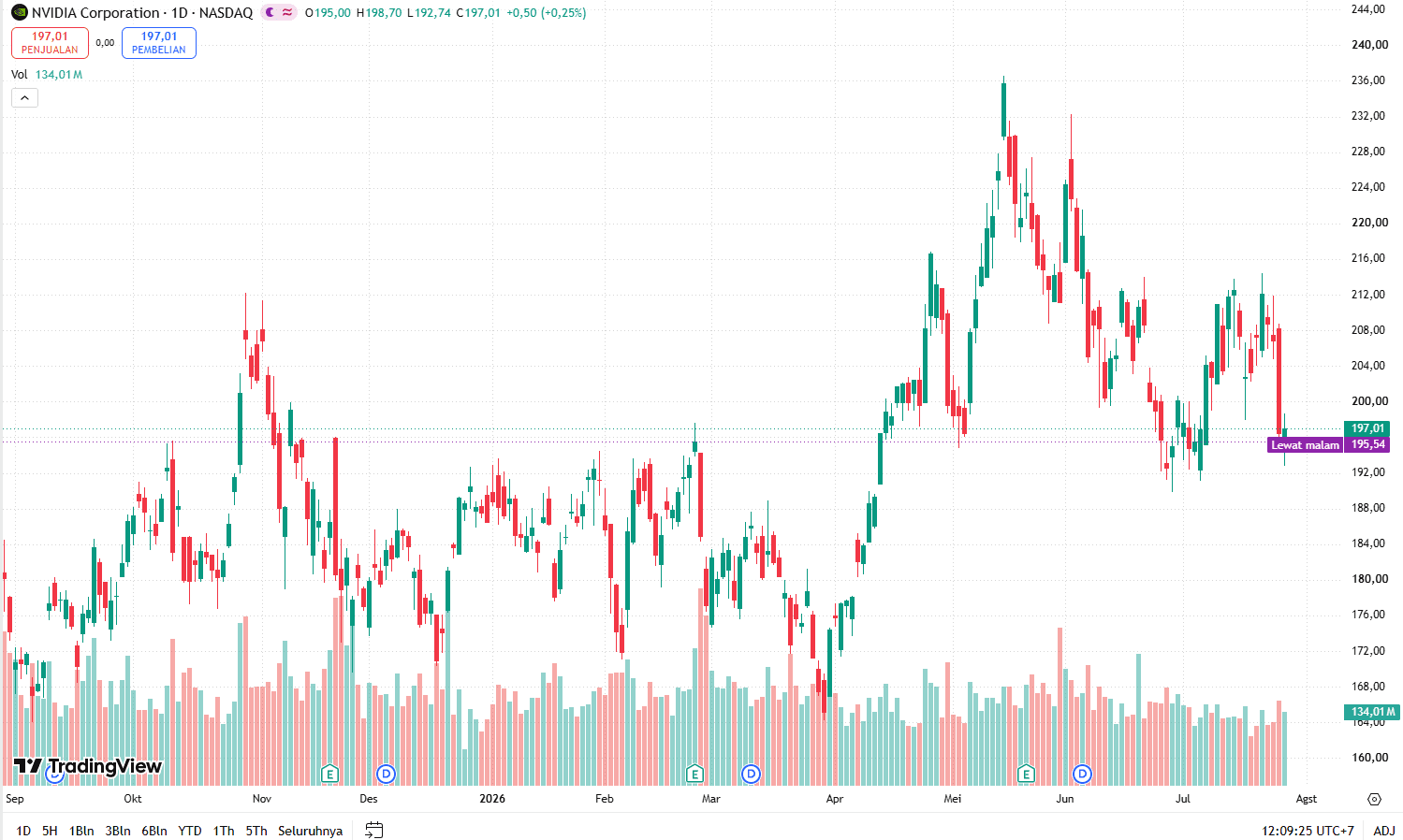
Although Nvidia came under pressure alongside other semiconductor stocks, closing data show that NVDA recovered and ended slightly higher by 0.27% at $197.01.
This means the pressure on Nvidia reflected intraday weakness and negative sentiment in the chip sector rather than a decline in its closing price.
Key Takeaways
- Semiconductor stocks came under pressure due to profit-taking, valuation concerns, and questions about the return on AI investment.
- Coca-Cola rose about 5% after reporting growth in revenue, volume, margins, and profit, while also raising its 2026 outlook.
- PayPal gained about 4% after earnings exceeded consensus estimates and management raised its full-year performance guidance.
How Is the U.S. Stock Market Performing?
The U.S. stock market moved unevenly on Tuesday, July 28, 2026. The S&P 500 rose 0.2% to 7,428.78, while the Dow Jones gained 537.24 points, or 1%, to 52,747.32. In contrast, the Nasdaq Composite fell 0.2% to 24,876.91 due to pressure on chip stocks and companies that had previously been the main winners of the AI rally.
This divergence indicates a market rotation. Investors are not abandoning equities altogether, but are shifting funds from highly valued technology companies toward consumer, industrial, and defensive stocks reporting stronger financial results.
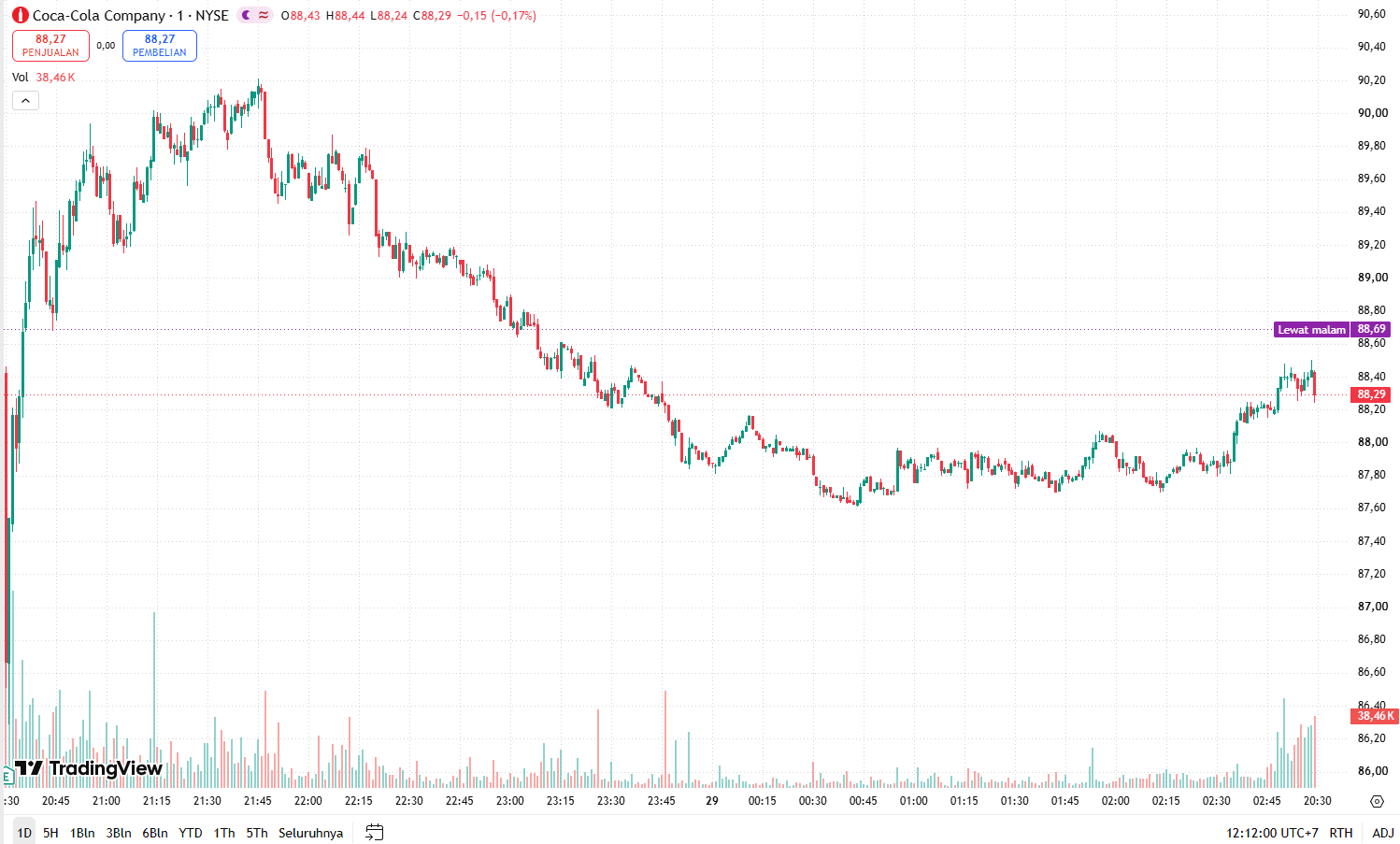
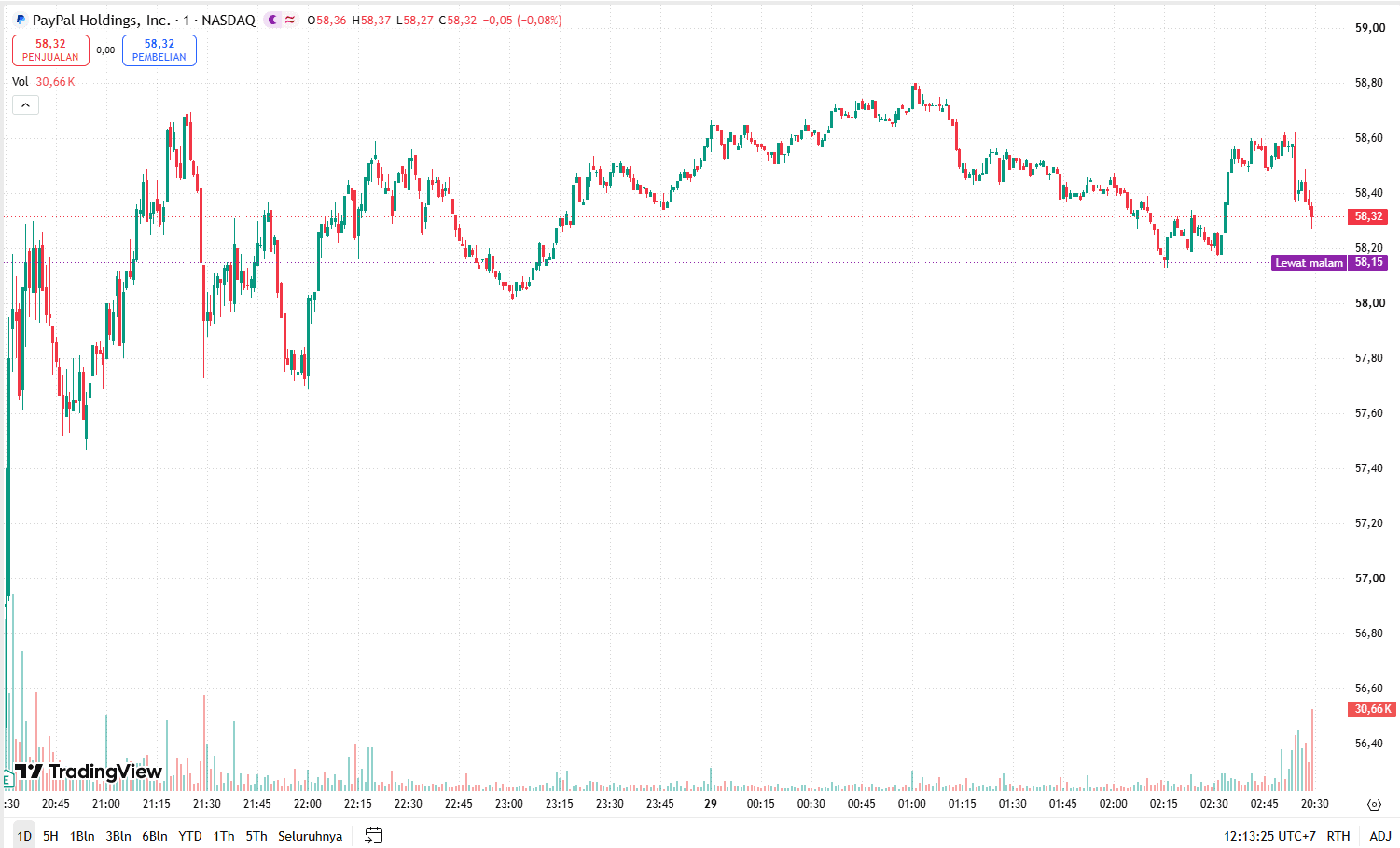
Coca-Cola was one of the Dow's main drivers after its shares rose 5.02% to $88.27. PayPal gained about 4% to $58.32. Meanwhile, Nvidia traded between $192.82 and $198.67 before closing at $197.01.
Read also: AI Stocks That Surged in 2026 and Their Future Prospects
Why Did Nvidia Stock Come Under Pressure?
The pressure on Nvidia did not emerge because demand for AI chips suddenly disappeared. The weakness was driven more by a shift in investors' assessment of valuations and the sustainability of AI infrastructure spending.
After AI stocks recorded a prolonged rally, investors began questioning when hundreds of billions of dollars in data center investment would generate comparable returns.
These concerns triggered profit-taking in Nvidia, AMD, Micron, Applied Materials, and other semiconductor stocks.
Sentiment also deteriorated amid concerns that advances in China's chip technology could intensify competition.
Micron fell 8.9%, AMD declined 8.1%, and Applied Materials dropped 7.8%. Outside the United States, South Korea's Kospi index plunged 10.8% amid heavy pressure on chipmakers.
However, Nvidia's fundamentals remain strong. In the quarter ended April 26, 2026, the company reported revenue of $81.6 billion, up 85% from the previous year. This helps explain why Nvidia shares recovered before the close even though the chip sector experienced a broad sell-off.
For investors, the key is to distinguish between a correction caused by business deterioration and one caused by overly high expectations.
Nvidia is facing the second case: demand remains substantial, but its share price must continue to be supported by exceptional earnings growth.
Want to gain exposure to US shares? Sign up to Bittime and start investing via tokenised stocks.
What Drove Coca-Cola Stock Higher?
Coca-Cola rose because its second-quarter results showed that consumer demand remained resilient.
Net revenue grew 7% to $13.4 billion, while global unit case volume increased 5%. Organic revenue rose 6%, and the company again gained value share in the nonalcoholic ready-to-drink beverage market.
Earnings per share reached $1.03, up 16%. Meanwhile, comparable EPS increased 11% to $0.97. Operating margin also improved from 34.1% to 34.9%, while comparable operating margin rose from 34.7% to 35.6%.
The results show that Coca-Cola is not relying solely on price increases. Volume grew across several regions, including Asia Pacific, North America, Latin America, and Europe, the Middle East, and Africa.
Coca-Cola Zero Sugar recorded 16% volume growth, strengthening the company's position as consumer preferences continue to change.
Management also raised its 2026 outlook. The company now expects organic revenue growth of about 5% and comparable EPS growth of 9%–10%. The higher guidance gives investors a stronger reason to move into defensive stocks with stable cash flow.
Read also: Stocks with the Most Investors in Indonesia in 2026
Why Did PayPal Stock Rise?
PayPal stock rose after the company reported results that exceeded market expectations. Q2 2026 revenue reached approximately $8.68 billion, up 5% year over year and above the estimate of about $8.47 billion. Adjusted EPS of $1.38 also exceeded the $1.28 consensus.
Total payment volume reached $486.4 billion, growing by approximately 9%–10%. Transaction margin dollars increased 1% to about $3.9 billion, or 3% when interest income on customer balances is excluded.
Investors also welcomed the improved guidance. PayPal now expects 2026 adjusted EPS of approximately $5.38 and transaction margin dollars of around $15.6 billion.
The company had previously issued a more conservative outlook, so the revision indicates that its transformation program is beginning to deliver results.
Growth in Venmo, Braintree, debit cards, buy now, pay later services, and efficiency initiatives also supported sentiment.
However, not all issues have been resolved. Non-GAAP operating margin fell 248 basis points to 17.4%, meaning the market still needs evidence that higher volume can generate consistent earnings growth.
Start trading NVDAX/IDR with Bittime here!
How Did Falling Oil Prices Affect the Market?
Brent crude for October delivery fell 4.4% and closed at $82.08 per barrel. The price declined sharply after the September contract had briefly exceeded $102 the previous week.
The decline occurred because the market saw a possibility that tensions in the Middle East could ease and that an agreement might be reached to keep oil shipments flowing smoothly through the Strait of Hormuz. As the risk of supply disruption decreases, the geopolitical premium embedded in oil prices also falls.
Lower oil prices can have several effects:
- Reduce fuel costs for airlines and transportation companies;
- Lower distribution costs for consumer companies;
- Ease inflationary pressure;
- Push bond yields lower;
- Reduce the need for central banks to raise interest rates.
The yield on the 10-year U.S. Treasury fell from 4.65% to 4.60%. The market also reduced its estimated probability of a rate increase after lower energy prices helped ease inflation concerns.
However, cheaper oil does not benefit every sector. Energy companies may face pressure on revenue and margins if the decline persists.
Read Also: How to Invest in Global Stocks with a Small Amount of Capital Through Tokenized Stocks
What Do These Stock Movements Mean for Investors?
The movements in Nvidia, Coca-Cola, and PayPal show that the market does not always move in one direction. Investors are differentiating companies based on valuation, earnings resilience, the quality of guidance, and their ability to generate cash flow.
Nvidia still offers exposure to AI growth, but its volatility is high because expectations are already elevated. Coca-Cola offers defensive characteristics, dividends, and more stable revenue.
PayPal sits between the two: its valuation is lower than that of AI stocks, but the company still needs to prove that its transformation is succeeding.
The three stocks can serve different functions in a portfolio:
- Nvidia: high growth with expectation and valuation risk;
- Coca-Cola: stability, cash flow, and defensive characteristics;
- PayPal: recovery potential with strategy execution risk.
Start trading KOON/IDR with Bittime here!
What Risks Should Investors Watch?
Nvidia investors should monitor a slowdown in data center spending, chip export restrictions, competition, and the possibility of valuation compression. Even strong financial results can trigger a decline if guidance fails to meet market expectations.
Coca-Cola faces risks from rising raw material costs, currency fluctuations, changing consumption patterns, and a valuation that is becoming expensive for a defensive stock. With a P/E ratio of about 27.8, investors are paying a premium for the company's stability and business quality.
PayPal faces competition from cards, digital wallets, Apple Pay, Google Pay, and other payment platforms. Margin compression and limited account growth could also hinder the stock's recovery even if quarterly results exceed consensus estimates.
Keep tracking other stock tokens such as AMZON, AMDON, and NFLXON as well as MSFTON, then you can start trading on the trusted exchange, only on Bittime.
Conclusion: Where Are Nvidia, Coca-Cola, and PayPal Headed Next?
Nvidia's direction will be heavily influenced by the capital expenditure reports of major technology companies and its ability to sustain data center growth.
Short-term pressure may continue if the market keeps reducing exposure to highly valued AI stocks. However, strong fundamentals still provide recovery potential when sector sentiment improves.
Coca-Cola is supported by volume growth, margin expansion, and higher guidance. After the stock rose about 5%, further upside will depend on the company's ability to maintain growth without relying too heavily on price increases.
PayPal is showing early signs of recovery through volume growth, better-than-expected earnings, and higher guidance. However, investors need to monitor margins and management's ability to convert transaction growth into sustainable profit.
Overall, the July 28, 2026 session showed a rotation from momentum toward earnings quality. Investors should not simply follow rising stocks, but assess the reasons behind their movements, valuations, and company-specific risks.

Gain exposure to shares in leading technology companies through tokenised stocks like TSLAX, MSFTON or GOOGLX only on Bittime!
Bittime is a licensed Digital Financial Asset Trader (PAKD) platform regulated and supervised by Indonesia's Financial Services Authority — where you can buy Bitcoin in Indonesia and hundreds of other crypto assets starting from Rp10,000. Registration is fast, secure, and can be completed today.
Track the conversion USDT to IDR and the real-time price movements of your favorite crypto assets. Everything is available in one crypto investment app that can be downloaded free from the Play Store.
Ready to get started? Sign up for Bittime now and execute your investment strategy on a platform trusted by millions of users in Indonesia.
FAQ
Why Was Nvidia Stock Described as Falling Even Though It Closed Higher?
Nvidia came under pressure alongside the semiconductor sector during trading. The stock later recovered and closed slightly higher by 0.27%, meaning the weakness was more visible on an intraday basis.
How Much Did Coca-Cola Stock Rise?
Coca-Cola rose about 5.02% and closed at $88.27 on July 28, 2026. The gain followed Q2 results and a full-year outlook that exceeded market expectations.
Why Did PayPal Rise After Its Earnings Report?
PayPal reported adjusted EPS and revenue above consensus estimates. The company also raised its 2026 guidance for earnings and transaction margin dollars.
Are Falling Oil Prices Good for the Stock Market?
Cheaper oil can reduce inflation and operating costs for various companies. However, the decline can hurt oil producers and energy companies.
Which Is Most Attractive: Nvidia, Coca-Cola, or PayPal?
The answer depends on the investor's risk profile. Nvidia is growth-oriented, Coca-Cola offers stability, while PayPal is a recovery stock that still requires strong execution.
Disclaimer: The views expressed belong exclusively to the author and do not reflect the views of this platform. This platform and its affiliates disclaim any responsibility for the accuracy or suitability of the information provided. It is for informational purposes only and not intended as financial or investment advice.
.png)