Rupiah Falls 9% YTD, Hitting Its Lowest Level in History
2026-11-26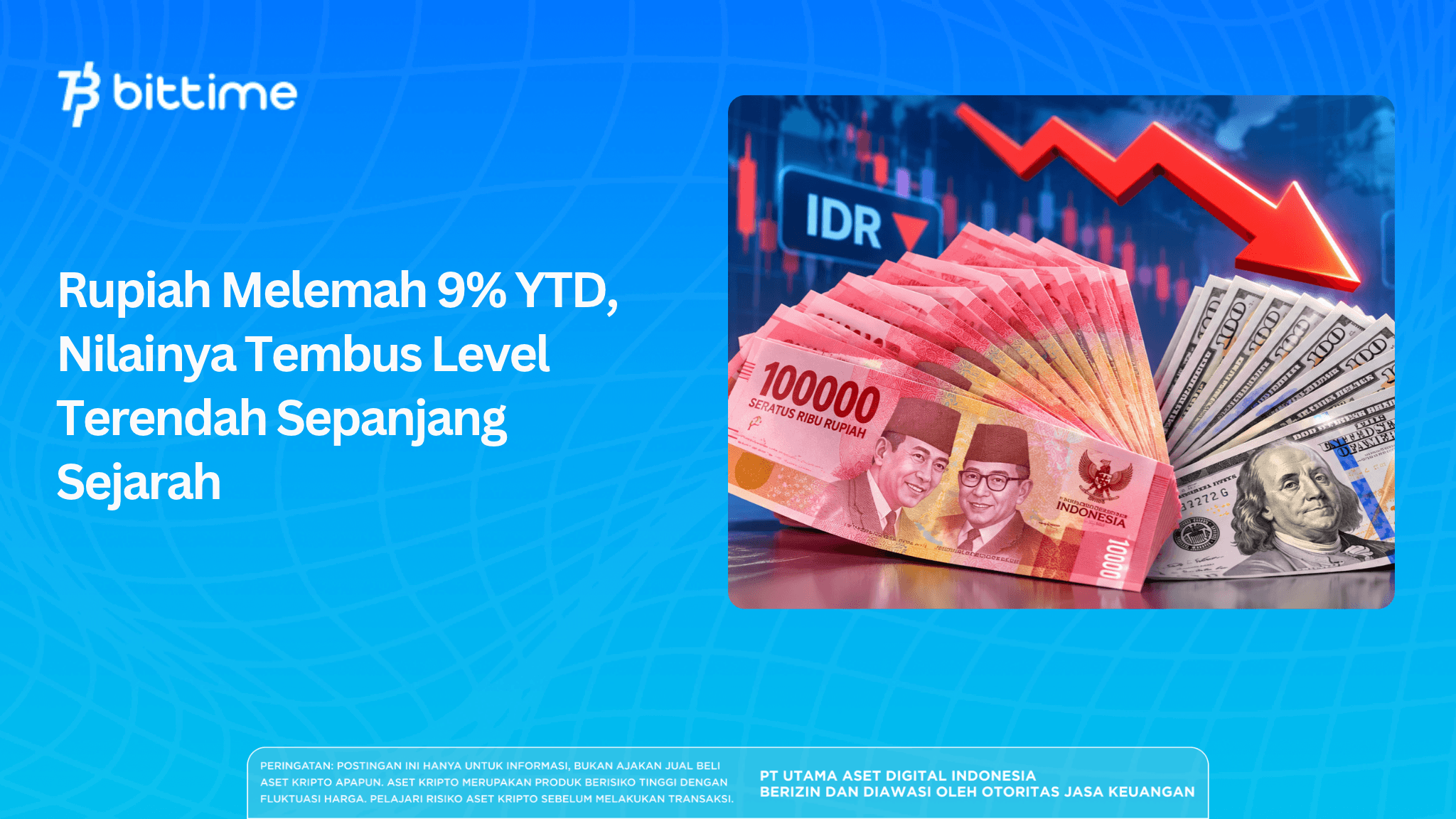
The rupiah weakened to Rp18,319 per US dollar. That was the price of one US dollar when trading closed on Wednesday, November 25, 2026. This made the rupiah's depreciation reach its weakest level in history, with its decline throughout 2026 approaching 9%.
Movements in the rupiah against the US dollar have implications for import costs, dollar-denominated debt, and the rupiah prices of Bitcoin and USDT.
Key Takeaways
- The rupiah closed at Rp18,319 per US dollar on November 25, 2026, weakening 0.5% in a single day and setting a new record low.
- Bank Indonesia recorded an 8.47% decline since the beginning of 2026 as of November 19, driven by a stronger US dollar, geopolitical tensions, and fiscal pressures.
- In nominal terms, the exchange rate has surpassed its 1998 and 2020 levels, but the percentage decline is significantly smaller.
Rupiah Closes at a Record Low of Rp18,319: What Is Driving the Decline?
According to Bloomberg Technoz, the rupiah briefly plunged 0.53% to Rp18,324 at 2:30 p.m. Western Indonesia Time (WIB), before closing 0.5% lower at Rp18,319 per US dollar.
The US Dollar Index rose 0.19% to 104 as markets became increasingly convinced that the Federal Reserve would maintain a hawkish stance at its December meeting. Tensions in the Middle East added to risk-off sentiment toward emerging-market assets, including those in Indonesia.
Permata Bank Chief Economist Josua Pardede cited geopolitical uncertainty and the risk of capital outflows from the domestic financial market. Across Asia, the rupiah was the third-weakest currency that day, behind the Taiwan dollar (0.62%) and the Thai baht (0.57%). The Indian rupee, meanwhile, strengthened by 0.57%.
If you want to monitor the digital asset market amid exchange rate volatility, register now on Bittime, a platform registered with and supervised by Indonesia's Financial Services Authority (OJK). Crypto assets carry high risks, and their prices are volatile.
Read Also: Rupiah Weakens and Government Bond Yields Rise: What Does This Mean for Crypto?
Nearly 9% Weaker in 2026: Domestic Pressures Add to the Strain
Bank Indonesia recorded an 8.47% depreciation in the rupiah throughout 2026 as of November 19, according to JawaPos. BI Senior Deputy Governor Destry Damayanti said the currency weakened by approximately 1.6% in the second half of the year, a relatively more moderate pace.
Based on the closing rate at the end of 2025 of Rp16,712 per US dollar, using Bloomberg data cited by Metro TV, the rupiah had weakened by approximately 8.8% through November 25. Year-to-date figures may vary across institutions depending on the reference date and calculation method.
On the domestic front, Chunyu Zhang of Bloomberg Intelligence highlighted the budget deficit, which approached the 3% of GDP limit in 2025, and debt interest payments, which consumed approximately one-fifth of government revenue.
The recurring current account deficit since the second quarter of 2023 has also become a structural constraint. According to Bisnis.com, government debt interest payments reached Rp494 trillion by the end of October 2026. Bank Indonesia raised its BI Rate by 25 basis points to 6% at its November 17–18 meeting, according to JawaPos.
The government bond market has moved in a different direction. The 10-year government bond yield fell to 7.71%, but non-resident ownership remained at around 13%, well below the pre-pandemic level of more than 30%. A decline in yields does not necessarily indicate a reversal in foreign capital flows.
Read Also: Prabowo Targets Rupiah at Rp16,800–17,500 per US Dollar in 2027: What Does This Mean for Crypto?
How Severe Is the Decline Compared with the 1998 and 2020 Crises?
In nominal terms, Rp18,319 has surpassed the 1998 intraday peak of Rp16,800 and the March 2020 low of Rp16,550, according to CNBC Indonesia. However, the percentage declines are significantly different. Refinitiv data shows that the rupiah plunged 128.7% in 1997 and 77.98% throughout 1998, when the Asian monetary crisis hit a fragile banking system and an economy burdened by substantial dollar-denominated debt.
In March 2020, the rupiah plunged 13.67% in a single month as foreign investors withdrew funds during the pandemic. The depreciation in 2026 has been more gradual. This nominal comparison also does not account for inflation over several decades.
What Does This Mean for Investors and Crypto Assets?
Bitcoin's price in rupiah is calculated by multiplying its price in US dollars by the exchange rate. Therefore, when the exchange rate rises, the rupiah value of a Bitcoin holding also increases if its dollar price remains unchanged. The same principle applies to USDT, a stablecoin pegged to approximately one US dollar.
However, Bitcoin is not a dollar deposit. If BTC prices fall, any gains from exchange rate movements may disappear and could even turn into losses. The rupiah exchange rate can also reverse at any time.
Read Also: How Does Rupiah Depreciation Affect USDT? Is It Profitable?
Conclusion
The rupiah closed at Rp18,319 per US dollar on November 25, its weakest level on record, with its year-to-date depreciation estimated at around 8.5–9%. The pressure comes from a stronger US dollar and domestic fiscal challenges. However, the scale of the decline remains far below that experienced during the 1998 and 2020 crises.
FAQ
What was the rupiah exchange rate when it hit its weakest level?
The rupiah closed at Rp18,319 per US dollar on Wednesday, November 25, 2026, according to Bloomberg data.
By what percentage has the rupiah weakened year to date?
Bank Indonesia recorded an 8.47% depreciation as of November 19, 2026. Other calculations may differ slightly depending on the reference date.
What are the main reasons behind the rupiah's depreciation?
The US dollar has strengthened amid expectations about the Federal Reserve's monetary policy, alongside geopolitical risks. Domestic pressures include debt interest payments and the current account deficit.
Is the current situation comparable to the 1998 crisis?
Not necessarily. Although the nominal exchange rate is weaker, the pace of depreciation is considerably slower than it was during 1997–1998.
Do Bitcoin or USDT holders automatically profit when the rupiah weakens?
Not automatically. Their value in rupiah may increase due to exchange rate movements, but a decline in asset prices or a strengthening rupiah could eliminate those gains.
How to Buy Crypto on Bittime

Looking to trade and invest in crypto easily? Bittime is an Indonesian crypto exchange registered with and supervised by the OJK. Get started by registering and completing identity verification, then deposit a minimum of Rp10,000 and purchase your preferred digital assets.
Check the BTC to IDR, ETH to IDR, and SOL to IDR exchange rates to monitor market trends. Also visit the Bittime Blog for the latest information on Web3, blockchain, and digital asset investment tips.
Disclaimer: The views expressed belong exclusively to the author and do not reflect the views of this platform. This platform and its affiliates disclaim any responsibility for the accuracy or suitability of the information provided. It is for informational purposes only and not intended as financial or investment advice.

.png)