MiCA Regulations vs Indonesia: Which Is Better Prepared to Regulate Cryptocurrencies?
2026-06-26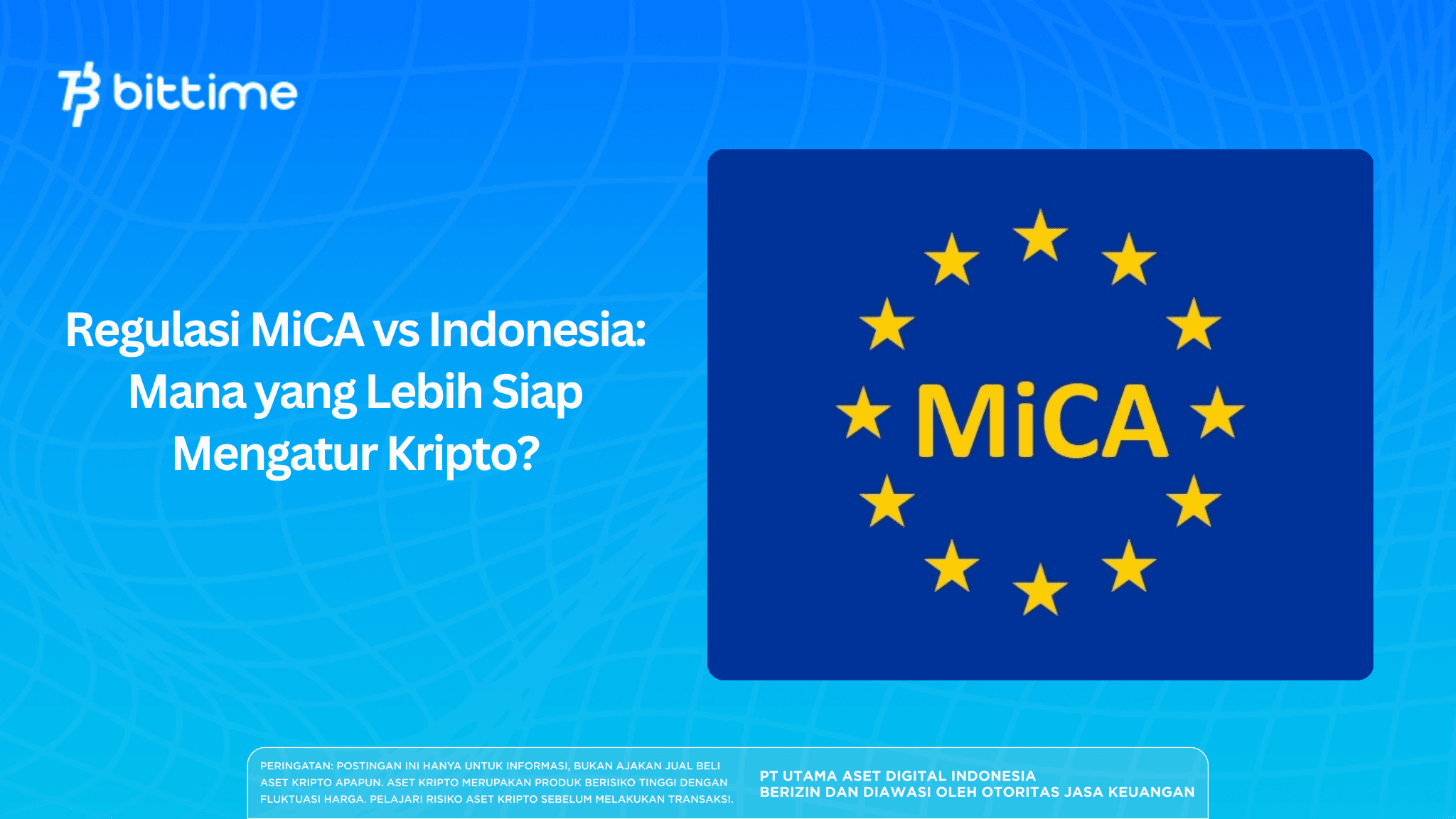
The global digital asset industry is entering a more mature phase. After years of operating in regulatory gray areas, countries are now beginning to implement stricter legal frameworks to oversee the trading, custody, and issuance of crypto assets.
Two important developments occurred almost simultaneously in mid-2026. In Europe, the Markets in Crypto-Assets (MiCA) regulation officially entered full implementation on July 1, 2026.
Meanwhile, Indonesia has just passed revisions to the Law on the Development and Strengthening of the Financial Sector (P2SK), which strengthens the authority of the OJK in supervising crypto assets.
Both regions share the same goal: improving investor protection and creating a healthier crypto industry. However, the approaches used have several fundamental differences.
Key Takeaways
- MiCA is the world’s most comprehensive crypto regulation, covering the entire European Union through a single license.
- Indonesia is transitioning from Bappebti oversight to the OJK to classify crypto as a more tightly supervised financial asset.
- Europe is ahead in implementation readiness, while Indonesia is still waiting for further technical rules from the OJK.
Register on Bittime now and start trading crypto with a fast, secure, and easy process in the app.
What Is MiCA and Why Is It Important?
MiCA (Markets in Crypto-Assets) is the first crypto asset regulation to apply comprehensively across all 27 European Union member states.
The main goal of the MiCA crypto regulation is to create a uniform standard for all crypto companies operating in the region. Before MiCA, each country had its own rules, so companies had to obtain separate licenses in multiple jurisdictions.
With MiCA, companies that obtain a license in one member state can provide services across the European Union through a system known as passporting.
This regulation covers:
- Crypto exchanges
- Digital wallet providers
- Crypto brokers
- Stablecoins
- Custody service providers
- Certain digital asset issuers
MiCA also sets standards for minimum capital, corporate governance, customer fund protection, risk management, and anti-money laundering compliance.
The EU’s MiCA Enters Full Enforcement Phase
Starting July 1, 2026, the MiCA transition period officially ends.
This means companies that have not obtained a Crypto Asset Service Provider (CASP) license can no longer serve users in the European Union legally.
Data from the European Securities and Markets Authority (ESMA) shows that only a small portion of companies managed to secure full licenses before the deadline ended.
Thousands of companies that previously operated under national licenses must now stop services or migrate to entities that comply with MiCA.
This shows that Europe’s crypto regulation is not just a legal framework on paper, but has real enforcement mechanisms.
Even some major stablecoins and platforms had to make significant adjustments in order to continue operating in the region.
New to crypto investing? Bitcoin (BTC) and Ethereum (ETH) can be popular starting options to watch and trade on Bittime.
Indonesia Changes Crypto Status to Financial Assets
On the other hand, Indonesia is undergoing a major transformation in digital asset supervision.
Previously, crypto assets were under Bappebti’s supervision because they were categorized as commodities traded on the futures exchange.
However, through the revision of the P2SK Law, the government expanded the OJK’s authority over crypto, so digital assets are now treated as part of the financial services sector.
This change has major implications.
With this new status, the OJK has the authority to apply standards long used in the traditional financial sector, including:
- Minimum capital requirements
- Corporate governance
- Segregation of customer funds
- Custody supervision
- Risk management
- Operational compliance
This step marks an important paradigm shift in Indonesia’s crypto regulations.
Read Also: Officially Supervised by the OJK, Bittime CEO Ryan Lymn Opens Access to RWA with a One-Stop Platform
Key Differences Between MiCA and Indonesia’s Crypto Regulation
Although they share similar goals, there are several differences between the two regulatory frameworks.
First, MiCA is already very detailed and applies directly across the entire European Union. Companies know exactly what standards must be met to obtain a license.
Meanwhile, Indonesia is still in transition. The P2SK Law revision provides a legal foundation, but many industry players are still waiting for the technical rules to be issued by the OJK.
Second, MiCA offers a single market access framework for companies that obtain a license. A company can reach more than 450 million EU residents with just one permit.
Indonesia does not yet have a similar mechanism because its regulations apply only nationally.
Third, MiCA specifically regulates stablecoins, token issuers, and various other categories of digital assets. Indonesia currently remains focused on strengthening oversight of exchanges and digital asset service providers.
Challenges Faced by Indonesia
Although Indonesia’s policy direction is considered positive, there are several challenges that still need to be addressed.
One of the industry’s main concerns is the clarity of derivative regulations from the OJK. Market participants need certainty regarding compliance standards, licensing structures, and permitted business models.
In addition, there are concerns about potential market concentration if digital asset trading activity is required to go through a certain structure that is too centralized.
Another challenge is maintaining a balance between investor protection and innovation.
Overly strict regulations risk slowing industry growth, while overly loose regulations can increase consumer risk.
Read Also: Complying with MiCA, RLUSD Stablecoin Will Operate in the European Market
Which Is More Ready to Regulate Crypto?
If measured by current implementation, the European Union is still one step ahead.
MiCA already has a complete legal framework, clear licensing mechanisms, and firm enforcement deadlines. Companies that fail to meet the requirements immediately face legal consequences and operational restrictions.
Indonesia is at an important stage toward the same direction. The shift from Bappebti to the OJK shows the government’s commitment to placing digital assets within the formal financial system.
However, Indonesia’s readiness still depends heavily on the speed of technical rule issuance, inter-agency coordination, and the industry’s ability to meet the new standards that will be applied.
In the long run, Indonesia’s success will be determined not only by how strict its regulations are, but also by its ability to create a safe, competitive ecosystem that still supports blockchain innovation.
Interested in starting crypto investing? See how to buy Bitcoin (BTC) or Ethereum (ETH), popular coins for beginners!
Conclusion
The comparison between MiCA regulation and Indonesia’s crypto rules shows that both are moving toward the same goal: making digital assets part of an officially supervised financial system.
The European Union currently leads in implementation readiness through MiCA, which is already fully in force across the region.
Indonesia is building a new regulatory foundation by strengthening the OJK’s authority and transforming crypto’s status from a commodity into a financial asset.
The next few years will be crucial in seeing whether Indonesia can match the level of legal certainty and investor protection that MiCA has established in Europe.
Let’s start trading crypto with major assets like BTC/IDR and ETH/IDR directly in the Bittime app.
Bittime is a licensed and regulated Digital Financial Asset Trader (PAKD) platform supervised by the Financial Services Authority (OJK) — a place where you can buy Bitcoin in Indonesia and hundreds of other crypto assets starting from Rp10,000. The registration process is fast, secure, and can be started today.
Track USDT to IDR conversions and the price movements of your favorite crypto assets in real time. Everything is available in one crypto investment app that can be downloaded for free on the Play Store.
Ready to get started? Sign up now on Bittime and execute your investment strategy with a platform trusted by millions of users in Indonesia.
FAQ
What is MiCA?
MiCA, or Markets in Crypto-Assets, is the European Union’s crypto asset regulation that governs exchanges, stablecoins, digital wallets, and other crypto asset service providers.
What is the main goal of MiCA regulation?
MiCA’s goal is to create a uniform regulatory standard across the European Union while improving investor protection and market stability.
Does Indonesia already have crypto regulations?
Yes. Indonesia has a crypto asset regulatory framework that is now strengthened through the revision of the P2SK Law and the transfer of supervision to the OJK.
What is the difference between OJK and Bappebti in overseeing crypto?
Bappebti oversees crypto as a commodity, while the OJK oversees crypto as part of the financial services sector.
Is MiCA stricter than Indonesia’s regulations?
At present, MiCA is considered more comprehensive because it has detailed rules and is fully applied across the entire European Union, while Indonesia is still in the implementation stage of its new regulations.
Why is crypto regulation important?
Regulation helps improve investor protection, prevent fraud, strengthen industry governance, and create legal certainty for market participants.
Disclaimer: The views expressed belong exclusively to the author and do not reflect the views of this platform. This platform and its affiliates disclaim any responsibility for the accuracy or suitability of the information provided. It is for informational purposes only and not intended as financial or investment advice.

.png)