Uber Stock Outlook After Q2 Earnings and Robotaxi Expansion
2026-08-06
Uber's stock outlook is back in focus after the company released its Q2 2026 earnings. Revenue continued to grow, particularly in the delivery business, but the share price came under pressure because gross bookings guidance was viewed as weaker than market expectations.
At the same time, Uber is increasing its focus on robotaxis as one of the foundations of its long-term growth.
Key Takeaways
- Uber's revenue continues to grow, but disappointing bookings guidance has weighed on investor sentiment.
- Robotaxi expansion could become a major opportunity, although monetization will require time and investment.
- A buy-the-dip strategy should take valuation, margins, cash flow, and competitive risks into account.
Uber Q2 2026 Earnings Summary
Uber's Q2 2026 earnings show that the company's core business continues to expand. Mobility remains an important segment, while delivery helps strengthen revenue growth and increase how frequently users engage with the app.
Investors assess more than whether revenue is growing. The market also watches gross bookings, margins, monthly active users, trips, free cash flow, and management's guidance for the next quarter.

Source: AI-Generated Image
Pressure on the stock emerged when gross bookings guidance was seen as insufficiently strong. This shows that investor expectations for Uber were already high. A report that looks operationally solid can still trigger a decline if projected growth falls below analysts' estimates.
Read also: GOOG Stock Rises 4.16%: Is AI Monetization Starting to Pay Off?
Why Did Uber Stock Fall?
The main reason Uber stock fell was not simply poor quarterly results. The market reaction was driven more by the gap between actual performance and expectations for the future.
Gross Bookings Guidance Was Unconvincing
Gross bookings represent the total value of transactions conducted through Uber's platform. This metric is important because it provides an indication of demand for mobility and delivery services.
If guidance is below expectations, investors may conclude that the pace of growth is beginning to slow. Concerns become greater when the stock's prior valuation already reflected strong expansion.
Market Expectations Were Already High
Uber has evolved from a company focused on pursuing growth into a business that is increasingly emphasizing profitability and cash flow. This shift has attracted more investor interest, but it has also raised the market's expectations for increasingly strong results.
When a report does not deliver a positive surprise, some investors choose to lock in profits. This can trigger a correction even if the company's fundamentals have not deteriorated significantly.
Technology Expansion Costs
The robotaxi strategy requires technology integration, partnerships, safety testing, operational support, and regulatory adjustments. All of these processes can increase costs before generating a meaningful contribution to revenue.
Read also: Tokenized Stock Volume Jumps 288%: Why Is the QQQ Token Dominating?
Uber's Robotaxi Expansion: Opportunity or Burden?
Uber's robotaxi expansion is one of the most important elements of the company's long-term outlook. Uber does not need to manufacture every autonomous vehicle itself. The company can serve as a platform that connects robotaxi operators with millions of users.
This model offers several opportunities:
- Add more vehicle options within the app
- Reduce dependence on a single type of provider
- Leverage Uber's large user base
- Expand the reach of autonomous vehicle partners
- Increase trip volume over the long term
If robotaxis are widely adopted, Uber could benefit from its distribution network, payment system, demand-mapping capabilities, and operational experience.
However, the outcome remains uncertain. Robotaxis still face regulatory, safety, vehicle-cost, public-acceptance, and geographic-operating constraints. Uber must also maintain its relationship with drivers during the transition period.
To follow developments in technology stocks, the global economy, and digital assets, you can register with Bittime and read the latest market updates. Always compare information before making investment decisions.
Uber Stock Analysis After Earnings
An analysis of Uber stock should look beyond a single quarter. A post-earnings correction may be a short-term reaction, while the company's actual outlook depends on its ability to sustain growth and profitability.
Key indicators worth monitoring include:
- Gross bookings growth
- Monthly active users
- Number of trips
- EBITDA margin
- Free cash flow
- Delivery growth
- Robotaxi expansion
- Share repurchases
- Management guidance
If revenue and cash flow continue to grow while pressure on bookings proves temporary, the correction could become more attractive. Conversely, if the slowdown continues for several quarters, the stock's valuation may come under renewed pressure.
Read also: bStocks vs xStocks: Which Tokenized Stock Platform Is Better?
Is Uber Stock Worth Buying?
Whether Uber stock is worth buying depends on its valuation, the investor's time horizon, and risk tolerance. Long-term investors may view Uber as a global mobility platform with major opportunities in delivery, advertising, business services, and autonomous vehicles.
However, buying solely because the price has fallen is not a sufficient strategy. Investors should compare the share price with earnings growth, cash flow, and the outlook for margins.
Keep tracking other stock tokens such as AMZON, AMDON, and NFLXON as well as MSFTON, then you can start trading on the trusted exchange, only on Bittime.
Uber Buy-the-Dip Opportunity
A buy-the-dip opportunity in Uber may be considered if the correction is not accompanied by a deterioration in fundamentals. Investors can wait for the price to stabilize, watch support areas, and check whether analysts have made major revisions to their forecasts.
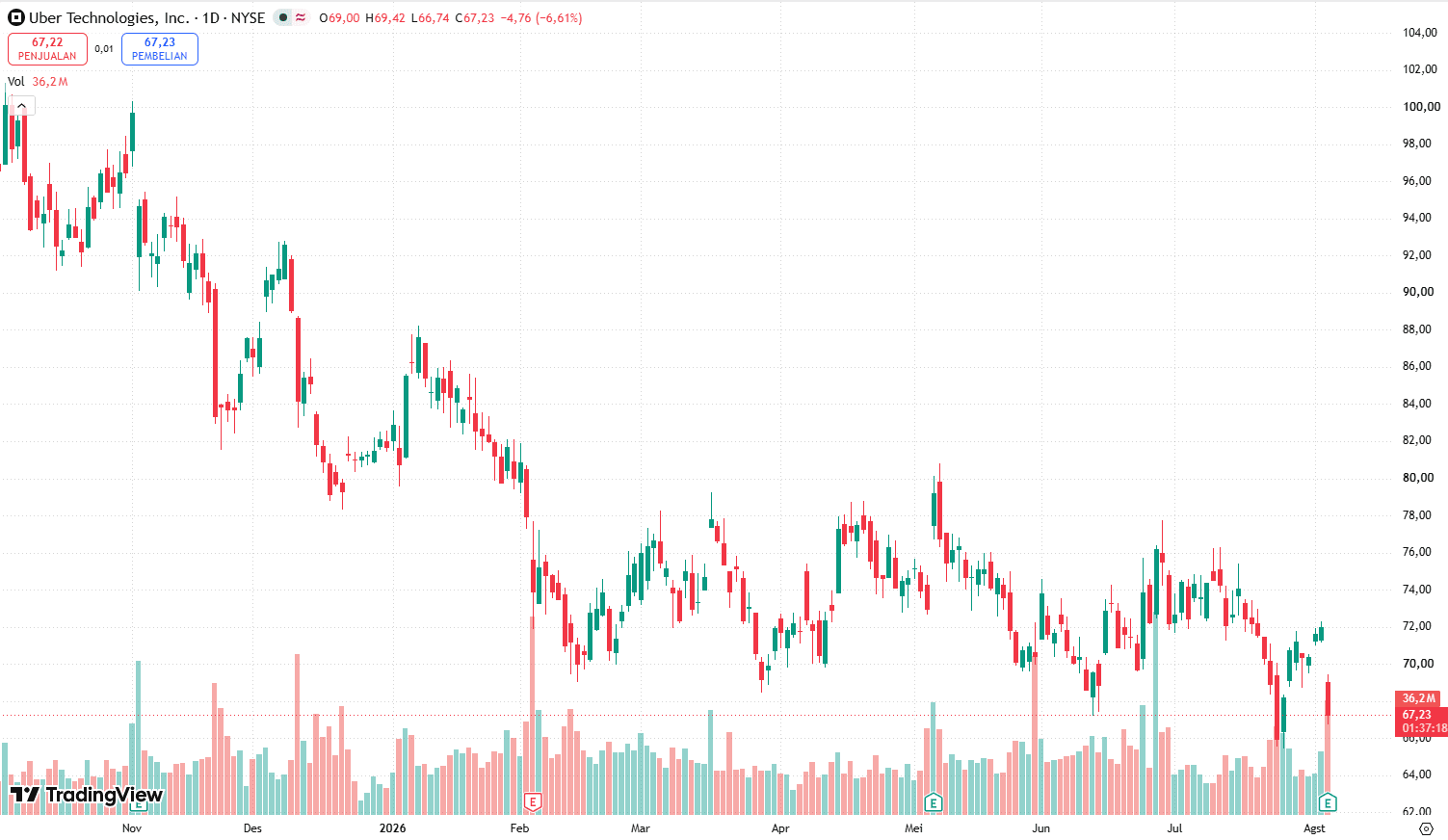
A phased buying strategy can help reduce the risk of mistiming an entry. However, it does not guarantee gains if the stock continues to decline.
Before taking a position, evaluate:
- Has the valuation become more reasonable?
- Has guidance only slowed slightly, or has it genuinely weakened?
- Are margins still improving?
- Does cash flow remain strong?
- Does the robotaxi expansion have a clear path to monetization?
Read also: List of AI Stocks That Surged in 2026 and Their Future Outlook
Uber Investment Risks
Uber's investment risks do not come solely from share-price volatility. The company also faces competition, labor regulation, incentive costs, an economic slowdown, and technology investments with uncertain outcomes.
Other risks include:
- Slower gross bookings growth
- Price competition in mobility and delivery
- Driver-status regulation
- Rising insurance costs
- Delays in robotaxi commercialization
- Margins pressured by promotions
- Valuation becoming too high again
Investors need to assess whether the growth potential is proportionate to these risks.
Read also: Invesco Tokenized Stock Trends: The Role of QQQ in the DTCC Trial
Uber Stock Forecast for 2026
Uber's 2026 stock forecast is best presented as a set of scenarios rather than a single precise figure.
In a positive scenario, gross bookings regain momentum, delivery sustains its growth, margins improve, and robotaxi expansion begins to make a tangible contribution. These conditions could improve investor sentiment.
In a neutral scenario, the business continues to grow but does not significantly exceed expectations. The share price would likely move in response to quarterly reports and broader market conditions.
In a negative scenario, bookings continue to slow, robotaxi costs increase, and margins weaken. This could lead investors to reduce the valuation they are willing to pay.
Read also: Jim Cramer Reveals 5 Buy-the-Dip Stocks as Margins Come Under Pressure
Conclusion
Uber's stock outlook after Q2 2026 earnings remains supported by growth in mobility, delivery, cash flow, and robotaxi opportunities. However, weaker gross bookings guidance has given the market a reason to be more cautious.
Robotaxi expansion could strengthen Uber's position as a mobility platform, but it requires time, capital, regulatory approval, and consistent execution. Therefore, the price correction is not automatically a buy signal.
Investors considering buying the dip should review valuation, margins, cash flow, management guidance, and robotaxi developments. Monitor the next report to determine whether the pressure is temporary or indicates a longer slowdown.

Interested in investing in global stocks? Check out tokenized stocks like AAPLX and TSLAX on the Bittime market.
Bittime is a Digital Financial Asset Trader (PAKD) platform licensed and supervised by Indonesia's Financial Services Authority (OJK) — where you can buy Bitcoin in Indonesia and hundreds of other crypto assets starting from Rp10,000. Registration is fast and secure, and you can get started today.
Track the conversion from USDT to IDR and follow the real-time price movements of your favorite crypto assets. Everything is available in one crypto investment app that can be downloaded for free from the Play Store.
Ready to get started? Register with Bittime now and put your investment strategy into action on a platform trusted by millions of users in Indonesia.
FAQ
Why Did Uber Stock Fall After Q2 2026 Earnings?
Uber stock fell because gross bookings guidance was viewed as weaker than expected. Investors also considered the cost of robotaxi expansion and the already elevated expectations.
How Did Uber Perform in Q2 2026?
Uber's business continued to grow, including contributions from delivery. However, the actual figures should be compared with analysts' targets and guidance for the next quarter.
Is Robotaxi Expansion Positive for Uber?
Robotaxis can expand vehicle choices and increase trip volume. However, regulation, safety, costs, and the time required for monetization remain risks.
Is Uber Stock Worth Buying After the Decline?
The correction could present an opportunity if fundamentals and cash flow remain strong. Investors should still review valuation and risks before buying.
What Is Uber's Stock Price Target?
Price targets vary according to each analyst's assumptions. Use them as a reference rather than a guarantee, and check the date and underlying methodology.
Disclaimer: The views expressed belong exclusively to the author and do not reflect the views of this platform. This platform and its affiliates disclaim any responsibility for the accuracy or suitability of the information provided. It is for informational purposes only and not intended as financial or investment advice.

.png)