AI Prompts for Academic Research: Examples of ChatGPT and Gemini for Students
2026-08-19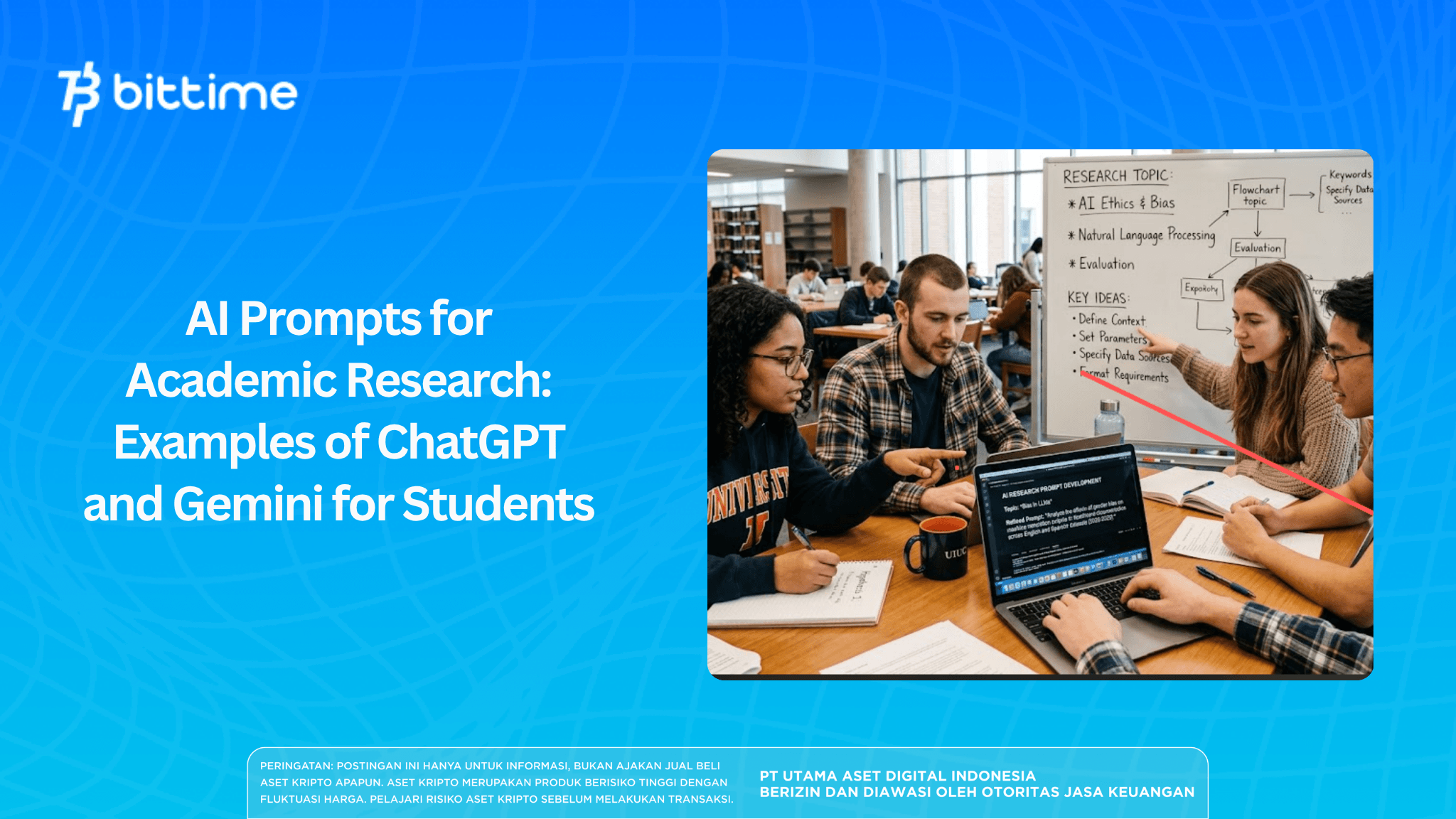
Generative AI is increasingly being used by students to assist with academic processes, from finding research ideas to creating thesis outlines.
ChatGPT and Gemini can help speed up a number of repetitive tasks, but the quality of the results still depends heavily on the instructions provided.
Therefore, AI prompts for academic research should not simply be commands such as “find journals about my topic.” More structured instructions can help AI understand the research context, analysis objectives, methodological limitations, and required answer format.
However, AI should be positioned as a thinking aid, not a replacement for the academic process. Language models can generate incorrect information, including inaccurate references.
Students should still review the original sources, examine the methodology, and follow the AI usage policies of their university or the journal they are targeting.
Key Takeaways
- Specific AI prompts for students can make the research process more focused, from finding ideas to editing academic writing.
- ChatGPT and Gemini can be used for different tasks such as mapping literature, formulating research questions, comparing theories, and critiquing drafts.
- AI for thesis research should be used as a research assistant. Every fact, quotation, piece of data, and reference must still be verified against the original academic source.
Why Are AI Prompts Important in Academic Research?
A prompt is an instruction given by a user to an AI model to generate a specific response. In research, prompts determine the context provided to the model and help guide the desired form of the output.
Prompts that are too general tend to produce generic answers. Conversely, prompts that explain the topic, academic discipline, research method, population, objectives, and output format can produce more relevant responses.
For example, instead of writing: “Explain fintech.”
Students can provide a more specific AI prompt example:
“Act as a research assistant in the field of economics. Explain the development of fintech adoption among Indonesian university students over the past five years. Separate the factors into technological, social, and economic factors. Do not create references. Mark sections that require verification from academic sources.”
These instructions give AI clearer boundaries and reduce the risk of responses going beyond the research requirements.
Read Also: 30 ChatGPT Prompts: Great for Content Creation and Free
A More Effective ChatGPT and Gemini Prompt Structure
Both ChatGPT prompts and Gemini prompts can use the same basic structure. Students can begin by defining the AI's role, providing research context, explaining the task, setting limitations, and then specifying the output format.
For example:
Role: Act as a research methodology lecturer.
Context: I am a Bachelor's student in Management researching e-wallet usage.
Task: Help identify relevant variables.
Limitations: Use a consumer behavior perspective and do not create fictional references.
Output: Present the results in a table and provide a reason for each variable.
This approach can be used with both ChatGPT and Gemini. The main differences usually lie in the features and integrations of each platform.
Therefore, students should choose tools based on their needs rather than relying on a single model for every stage of the research process.
Be productive with AI, be smart with your investments. Register on Bittime and build your portfolio today.
ChatGPT Prompt Examples for Research
ChatGPT prompts for research can be used from the early stages, when students are still determining their research focus.
Determining the Research Question
“Act as a research methodology expert. I want to study the impact of artificial intelligence use on student productivity. Create five specific research question options that can be studied at the undergraduate level. For each question, explain the possible variables and the appropriate type of method.”
This prompt helps narrow a topic that is still too broad into more operational research questions.
Finding a Research Gap
“I am researching the relationship between e-wallet use and consumer behavior among students. Based on the following summaries of five studies, identify similarities, differences, inconsistencies in findings, methodological limitations, and possible research gaps. Do not invent research findings beyond the information I provide.”
The key is to include sources or summaries already available to the student. This way, AI works as a synthesis tool rather than pretending to have references that have not been verified.
Critiquing Literature
“Analyze the following article as a journal reviewer. Identify the research objective, methodology, sample size, main findings, limitations, potential biases, and its contribution to my research question. Do not draw conclusions that are not contained in the article.”
This approach is safer than asking AI to create a complete literature review without providing source materials.
Read Also: AI Prompts for Crypto Trading for Beginners
Gemini Prompt Examples for Research
Gemini prompts for research can follow a similar pattern, especially when students want to organize information within the Google ecosystem or documents they are working on.
Creating a Literature Map
“I am conducting research on the adoption of generative AI in higher education. Help me create a topic map covering three perspectives: technology acceptance, academic integrity, and learning outcomes. For each perspective, explain the main concepts, possible variables, and research questions that could be developed.”
The results can be used as an initial framework before students conduct an actual literature search through academic databases.
Comparing Theories
“Compare the Technology Acceptance Model (TAM) and UTAUT for research on the use of generative AI by students. Explain the main assumptions, variables, strengths, limitations, and the conditions under which each theory is more appropriate.”
Prompts like this are useful when students are faced with multiple theory options and need a comparison framework before discussing them with their academic advisor.
Checking an Academic Draft
“Review the following paragraph for clarity of argument, relationships between ideas, use of academic terminology, and potential claims that require sources. Do not change the substance without providing a reason.”
AI is then used as an editor and logic checker, while the final decision remains with the student.
Read Also: Great! 20 Gemini AI Prompts for Studio Photos or Photos Wearing a Suit
AI Prompts for Thesis Research from Start to Finish
Using AI for a thesis is most effective when it is divided according to each stage of the research process. In the early stages, AI can help narrow the topic and formulate research questions.
During the literature review, AI can help create source matrices, group themes, and compare theories.
During the methodology stage, students can ask AI to explain the differences between quantitative, qualitative, or mixed-methods approaches based on the research objectives.
Once the data has been obtained, AI can help explain statistical concepts or interpret results that have already been calculated, but students still need to use appropriate software and statistical methods.
During the writing stage, AI prompts for students can be used to review argument structure, clarify sentences, or identify sections that require citations.
Don't miss AI coin price updates such as Bittensor (TAO), Venice Token (VVV), NEAR Protocol (NEAR), and Internet Computer (ICP) on Bittime.
How to Avoid AI Reference Hallucinations
One of the biggest risks of using AI for research is fabricated references. Language models can generate author names, journal titles, DOIs, or publication years that appear convincing but do not actually exist.
Therefore, do not use ChatGPT prompts or Gemini prompts that ask AI to “provide 20 complete journals” and then immediately copy the results into your bibliography.
Use instructions such as:
“Use only the sources I provide. Do not create references. If the information is unavailable, write ‘not found.’”
After that, verify every source through databases such as Google Scholar, Scopus, Web of Science, university libraries, or official journal websites.
The same principle applies to quotations and data. AI can help identify patterns or explain concepts, but academic evidence must come from verifiable sources.
Read Also: How to Day Trade Crypto Smarter with Gemini AI: A Complete Guide
Is ChatGPT or Gemini Better for Research?
There is no single answer that applies to every research project. ChatGPT can be useful for brainstorming, text analysis, outlining, and editing. Gemini also offers strong capabilities when students work with documents and integrated Google services.
Both have limitations. AI models can misunderstand context, produce overextended conclusions, or provide information that has not been verified.
Therefore, the best choice is not to find the “smartest AI,” but to choose the tool that best suits each stage of the research process while maintaining human academic judgment.
Ethics of Using AI in Research
The use of AI in research must follow institutional policies. Some universities may restrict AI use for certain parts of academic assignments, while journals or conferences may require disclosure of AI use.
Students also need to distinguish between AI assistance and outsourcing academic work. Asking AI to improve grammar is different from asking AI to create an entire thesis and then claiming it as one's own work.
Strong research still requires an understanding of the problem, the ability to read sources, evidence evaluation, and the student's responsibility for the final results.
Read Also: Viral ChatGPT Cartoon Prompt: Example Prompt & How to Join
Conclusion
AI prompts for academic research can help students save time and organize the research process more systematically.
ChatGPT and Gemini can be used for brainstorming, research questions, literature reviews, theory comparisons, editing, and analysis preparation.
However, the true value lies not in the number of prompts used, but in the quality of the questions and the student's ability to evaluate AI responses. Use AI to accelerate thinking, not replace the scientific process.
For AI use by students and AI use for thesis research, the basic principles remain the same: provide clear context, limit the task, ask AI to state uncertainty, verify sources, and document AI use according to applicable academic rules.

Inspired by the development of AI technology? It's time to monitor AI coins such as Bittensor (TAO), NEAR Protocol (NEAR), Artificial Superintelligence Alliance (FET), and Render (RENDER) on Bittime.
Bittime is a licensed Digital Financial Asset Trader (PAKD) platform regulated and supervised by the Financial Services Authority (OJK) — where you can buy Bitcoin in Indonesia and hundreds of other crypto assets starting from IDR 10,000. Registration is fast, secure, and can be started today.
Monitor USDT to IDR conversions and the price movements of your favorite crypto assets in real time. Everything is available in a single crypto investment app that can be downloaded for free from the Play Store.
Ready to get started? Register on Bittime now and execute your investment strategy with a platform trusted by millions of users in Indonesia.
FAQ
What is an AI prompt for academic research?
An AI prompt for academic research is a structured instruction given to AI to assist with research tasks such as finding ideas, analyzing literature, formulating research questions, or academic editing.
What is an example of a ChatGPT prompt for research?
One example is asking ChatGPT to act as a methodology expert to help develop research questions, identify variables, or critique a research design based on information provided by the user.
What is an example of a Gemini prompt for research?
Gemini prompts can be used to compare theories, create literature maps, organize research documents, or review the structure and clarity of academic drafts.
Can ChatGPT and Gemini be used for a thesis?
Yes, as assistance tools, as long as their use complies with university policies and does not replace the student's responsibility for the research content. All data, references, and arguments still need to be verified.
Can AI create journal references?
AI can help find or organize references, but students should not assume that every reference generated by AI is valid. Every source should be checked through a trusted academic database or publisher.
How do you create a good AI prompt for students?
Create instructions that specify the AI's role, research topic, context, objective, limitations, permitted sources, and desired output format. The clearer the context, the easier it is for AI to provide a relevant response.
Disclaimer: The views expressed belong exclusively to the author and do not reflect the views of this platform. This platform and its affiliates disclaim any responsibility for the accuracy or suitability of the information provided. It is for informational purposes only and not intended as financial or investment advice.

.png)