What Is Papertrade (PAPER)? Token Functions, How It Works, and Its Risks
2026-10-29
Papertrade is a perpetual derivatives trading platform, i.e. contracts without an expiry date, running on HyperEVM in the ecosystem of Hyperliquid.
Its official token, PAPER, is issued from qualifying trading losses and can be used to earn a share of the protocol's revenue through staking.
Although the name sounds like practice trading, Papertrade uses real funds.
Understanding what Papertrade (PAPER) is means understanding the relationship between trader activity, profit payout funds, and token issuance.
This article discusses these mechanisms so that readers can assess the usefulness of PAPER and the risks that accompany it.
Key Takeaways
PAPER is a token for accessing protocol revenue sharing through staking, not a guarantee of loss repayment.
Papertrade transactions use Hyperliquid price references and are settled against the protocol's pool of funds.
The main risks include high leverage, profit payout queues, token transfer restrictions, and contract security.
What is Papertrade and How Does It Relate to Hyperliquid?
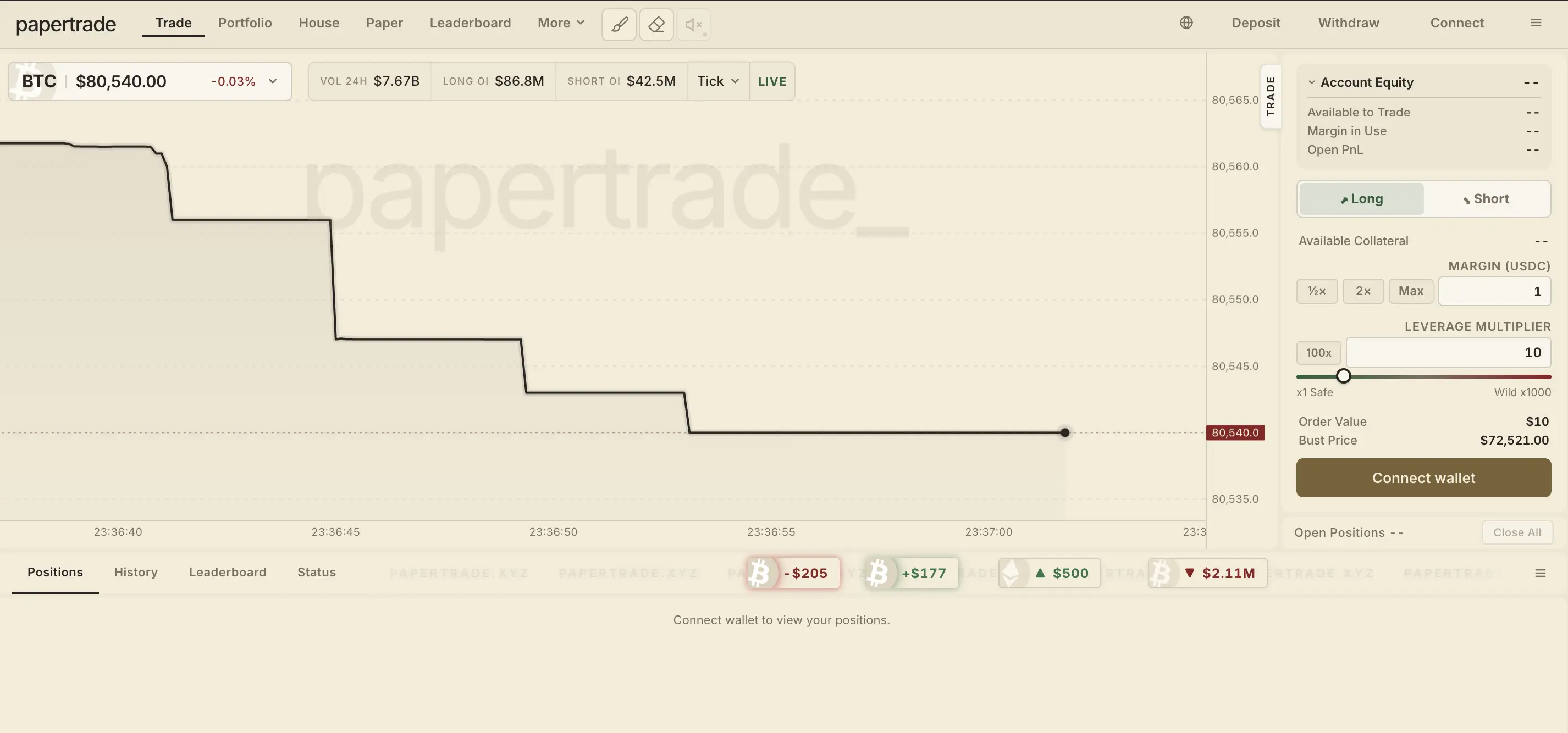
Source: papertrade.xyz
Papertrade offers synthetic trading: users take positions based on price movements without directly purchasing the underlying asset.
The platform uses smart contracts, which are blockchain programs that execute transaction terms.
Papertrade's relationship with Hyperliquid lies in the ecosystem and pricing references.
Papertrade contracts run on HyperEVM and read the midpoint of the best bid and ask prices from Hyperliquid.
User orders are not passed to Hyperliquid's order book, but are instead settled through Papertrade's own mechanisms.
Therefore, using Papertrade is not the same as opening a direct position in the Hyperliquid perpetual market.
This difference determines the source of profit payments and the risks borne by the user.
Read Also: What Is Hoodlers (HDLR)? An NFT That Earns ETH Rewards
How Papertrade Works: Trading Against the Pool
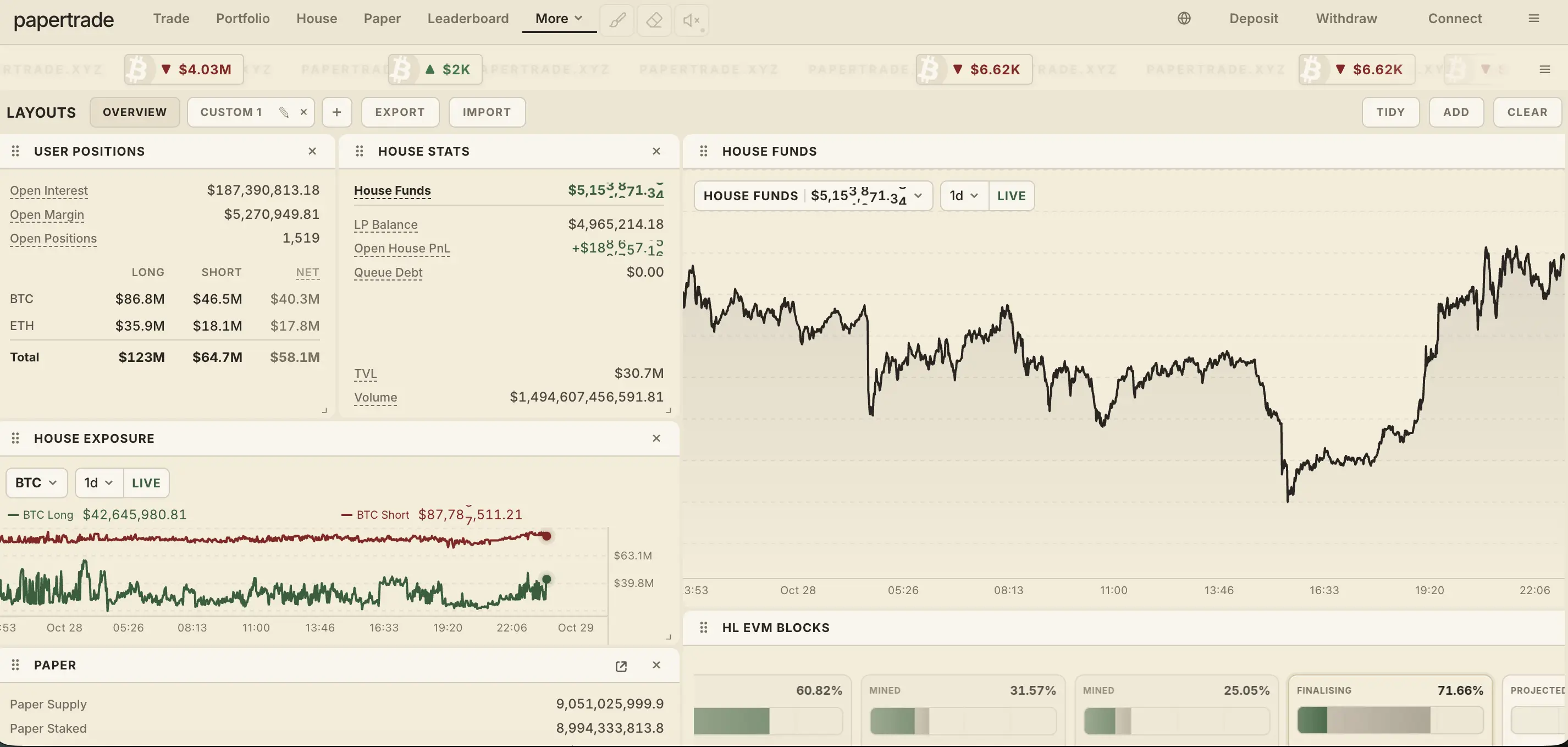
Source: papertrade.xyz
Pool as Counterparty to Transaction
The way Papertrade works is centered on liquidity pool, a pool of funds that acts as the counterparty to user transactions. Trader losses add to the pool funds, while trader profits become the pool's payment obligation.
When a user opens a position, the contract records the entry price based on the reference price.
When a position is closed, the system calculates the profit or loss according to the exit price and the protocol conditions.
If the pool funds are insufficient, the payout goes into a queue and depends on the next incoming funds.
Read Also: What is Super Micro Computer Tokenized bStocks (SMCIB)?
Leverage up to 1,000 Times
The platform offers leverage of up to 1,000 times, which is a multiplier of the position value against the collateral capital.
This feature allows large exposure with small collateral, but at the same time makes small price changes have a large impact on capital.
Costs and Profit Cuts
Papertrade states that it does not charge recurring funding fees. However, users still need to account for profit cuts and fees that apply when positions are settled.
The absence of funding fees does not mean that all transactions are free of charge.
Read Also: How to Buy TMG Coin with Rupiah (IDR) | T-Mac DAO
PAPER Token Functions and Revenue Sharing
The function of the PAPER token is to provide access to a share of the protocol's revenue through staking, which is placing tokens in the contract to participate in the distribution of rewards.
Payment using USDC and distributed according to the user's staking proportion.
The documentation describes two sources of distribution: a portion of certain trading fees and pool surplus above the US$5 million listing threshold.
Fee sharing only occurs when the payment queue is empty and the pool can afford it. Therefore, PAPER ownership does not generate a fixed income.
The differences in their activities can be summarized as follows.
Staking and unstaking are said to have no lock-up period.
However, the ability to unstake is different from the ability to transfer or sell tokens to other parties.
Read Also:What Is MUB? Understanding Micron Stock Tokens and How They Work
PAPER Tokenomics: Supply Comes from Losses
Initial Supply and Publishing Sources
PAPER tokenomics starts from zero supply, with no initial minting, team allocation, venture capital investor allocation, airdrop, or vesting schedule.
Token issuance comes from realized losses or liquidations that meet the requirements.
Issuance Mechanism and Ownership Dilution
The second version of the contract documentation, effective October 21, 2026, uses an issuance mechanism based on a proportion of the then-current supply for each dollar of eligible loss base.
When the pool is negative, the recovering portion of the loss can receive a multiplier of up to five times, increasing over the first three days.
This mechanism causes supply to increase following trading activities.
New issuances can also reduce the ownership percentage of existing holders if their token holdings don't increase. This decrease in ownership proportion is called dilution.
Take advantage of today’s opportunity to get started with investing. Sign up to Bittime and start building your portfolio.
PAPER Transfer Restrictions
The documentation states that PAPER cannot be transferred between wallets at launch, although staking, unstaking, and claiming are functional.
Therefore, receiving tokens should not be equated with receiving an asset that can be immediately sold.
Want to have exposure to American stocks? Register at Bittime and start investing through tokenized stocks.
Papertrade Risks Before Starting to Trade
The first risk is liquidation due to high leverage.
Receiving PAPER after a losing position does not erase the loss of funds nor guarantee its replacement value.
The second risk is the pool's ability to pay out profits. The payout queue means that recorded trading results may not be immediately available for disbursement.
Further risks include manipulation of reference prices and the authority of managers to change parameters or increase contracts.
Official documentation acknowledges that the controls implemented have not completely eliminated the risk of price manipulation.
Before making a transaction, please check the latest terms and conditions on the official website (https://papertrade.xyz/). If you want to start using crypto trading services, you can register at Bittime and check available assets, this article does not confirm PAPER listing.
Bittime is a licensed and regulated Digital Financial Asset Trader (PAKD) supervised by Indonesia’s Financial Services Authority (OJK) — where you can buy Bitcoin in Indonesia and hundreds of other crypto assets starting from just Rp10,000. The registration process is fast, secure, and you can get started today.
Track USDT to IDR conversions and monitor your favorite crypto assets in real time. Everything is available in one crypto investment app that you can download for free on the Play Store
Ready to start? Register now on Bittime and execute your investment strategy with a platform trusted by millions of users in Indonesia.
FAQ
Is Papertrade a demo account?
No. Papertrade uses real funds, so trading losses actually reduce the user's capital.
How to get PAPER token?
PAPER is issued when a user realizes a loss or experiences a liquidation that meets the protocol requirements.
What are the benefits of staking PAPER?
Staking provides access to revenue sharing in USDC according to token proportions and protocol distribution conditions.
Can PAPER be sold directly?
Don't assume it. The documentation states that interwallet transfers are limited at launch, although staking and unstaking are available.
Does receiving PAPER mean trading losses come back?
No. PAPER provides access to potential subsequent distributions, not an automatic refund of lost funds.
Disclaimer: The views expressed belong exclusively to the author and do not reflect the views of this platform. This platform and its affiliates disclaim any responsibility for the accuracy or suitability of the information provided. It is for informational purposes only and not intended as financial or investment advice.
.png)