Nikkei 225 Prediction: Tech Stocks Weaken, Will the Index Fall Again?
2026-07-20
The Nikkei 225 forecast for July 20, 2026, still points to high volatility after the index fell sharply in the previous trading session.
Weakening global technology stocks and rising United States–Iran conflict makes investors tend to reduce exposure to risky assets.
Key Takeaways
- The Nikkei 225 closed down 4.03% to 64,141.12 on July 17, 2026, due to pressure on technology stocks and worsening geopolitical sentiment.
- The Tokyo Stock Exchange was closed on July 20 due to Marine Day, but derivatives trading continued, so futures movements became a benchmark for sentiment.
- The short-term bias remains bearish as long as futures fail to break through the resistance of 65,247–65,422, while key support is at 64,764–64,456.
Nikkei Index Analysis July 20, 2026
Index Nikkei 225 closed trading on Friday, July 17, 2026, down 2,694.42 points, or 4.03%, to 64,141.12. This decline indicates a sell-off that wasn't confined to a single sector but had impacted broader Japanese market sentiment.
The Topix index also fell 2.72% to around 3,919. Meanwhile, Nikkei futures for September 2026 were at around 65,073, after falling 0.82%.
Sources : AI Generated Image
The difference in these levels is important to note. The figure of 64,141.12 represents the closing price of the Nikkei 225 index on the cash market, while the level of 65,073 refers to futures contracts. Therefore, the daily support and resistance levels around 64,456 to 65,422 are more appropriate for interpreting futures movements.
On Monday, July 20, 2026, regular stock trading in Tokyo will be suspended due to Japan's Marine Day observance. However, derivatives markets will remain open for holiday trading. This makes futures an early indicator of potential market direction when regular stock trading resumes.
Read also: Tokenized Stock Capitalization Hits a Record US$2.3 Billion, Ondo Finance Controls 41% of the Market
Why Did the Nikkei Index Fall Sharply?
The Nikkei's decline wasn't caused by a single factor. The pressure stemmed from a combination of a decline in technology stocks, heightened geopolitical risks, rising oil prices, and declining investor appetite for riskier assets.
Global Tech Stocks Weaken
Technology stocks have a significant influence on the Nikkei 225's movements because the index uses a price-weighted method. High-priced technology and semiconductor companies can contribute significantly more than other issuers.
When chip and technology stocks weaken on Wall Street, that sentiment often spills over into Asian markets. Investors may reduce positions in Japanese companies involved in semiconductors, chip production equipment, artificial intelligence, and electronic devices.
Pressure will intensify if the global technology correction proves more than temporary. High valuations make shares in this sector sensitive to changes in growth expectations, interest rates, energy costs, and corporate capital expenditures.
Want to gain exposure to US shares? Sign up to Bittime and start investing via tokenised stocks.
Profit Taking Action After Long Rise
Before the correction, the Nikkei had recorded strong gains and reached a record close in late June 2026. Once the market has risen sufficiently, negative news can trigger more aggressive profit-taking.
Investors who previously made large profits tend to secure their positions when uncertainty increases. This selling can escalate into a broader correction when prices break through key technical levels or trigger automatic sell orders.
The Nikkei has fallen more than 10% from its record close on June 25, 2026. Overall, this situation has put the index into correction territory and increases the possibility of wider price movements.
US-Iran Conflict Suppresses Risk Appetite
The escalation of the conflict between the United States and Iran has placed additional pressure on global stock markets. Investors are concerned about disruptions to energy trade routes in the Strait of Hormuz, one of the most important routes for global oil shipments.
When the risk of war increases, market participants typically shift away from stocks and toward assets considered more defensive. This shift is known as risk-off sentiment.
The impact on the Nikkei could come through several channels:
- Foreign investors reduced positions in Japanese stocks.
- Energy prices increase companies' production costs.
- Global inflation expectations are rising again.
- The prospects for interest rate cuts are becoming more uncertain.
- Demand for technology stocks and cyclical stocks weakened.
Read also: Why Netflix (NFLX) Stock Dropped to $73.68 After Q2 2026 Earnings
The Impact of the US–Iran Conflict on the Japanese Stock Market
Japan is a country that relies heavily on energy imports. Therefore, rising oil prices could put pressure on the trade balance, transportation costs, and corporate margins.
High oil prices can hurt sectors like aviation, logistics, manufacturing, chemicals, and companies with large energy consumption. Companies may have to bear the additional costs or pass them on to consumers through price increases.
From a macroeconomic perspective, the energy boom could also amplify inflationary pressures. This situation makes it difficult for investors to predict Japan's monetary policy and economic growth.
However, the impact isn't necessarily negative for all markets. Energy companies, commodity traders, and businesses that benefit from rising raw material prices may demonstrate greater resilience.
Investors need to look at sectoral composition, not just the movement of the main index.
Read also:ONDO Price Jumps 20% After Collaboration with DTCC, Could It Reach US$0.70?
Nikkei 225 Support and Resistance
Technical analysis for trading on July 20, 2026, uses the September Nikkei futures contract as a reference because the regular Japanese stock market is closed.
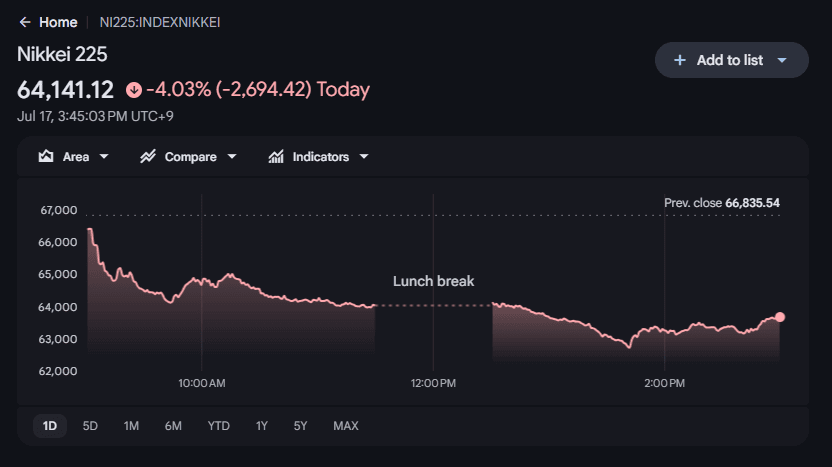
Source INDEX NICKEL: NI225
Level Support Nikkei
The first support area is located around 64.764. The next level is around64.456.
Support is an area that has the potential to withstand selling pressure. However, this level does not guarantee an immediate price rebound.
If futures fall and remain below 64,456, bearish pressure could persist. Market participants could then look to the spot index's previous close of 64,141 as a psychological reference point.
The intraday low on July 17th, around 62,705, is also a monitoring area if selling intensifies again. A decline towards that level indicates the market is retesting the point where buyers previously stepped in.
Level Resistance Nikkei
The nearest resistance is around 65.247, then 65.422.
If futures manage to break through and hold above 65,422, the potential for a technical rebound becomes more likely. However, a brief rise isn't enough to prove a trend change.
Investors need to see whether the strengthening is supported by:
- The easing of geopolitical conflicts.
- Decline in oil prices.
- US tech stocks recover.
- Stronger purchasing volume.
- Improved sentiment on Japanese semiconductor stocks.
As long as these factors do not improve, the increase can still be considered a technical rebound in a corrective trend.
Read also:SBI Group Partners with Ondo Finance to Tokenize Japanese Stocks
Nikkei 225 Prediction: Will It Fall Again?
The Nikkei remains vulnerable to further declines. Pressure on technology stocks has not yet fully abated, while conflicts in the Middle East are adding to uncertainty about energy prices and global inflation.
However, a sharp drop of 4.03% in a single session could also trigger short-term buying. Some investors may find certain stock prices more attractive after the correction.
Therefore, the direction of the Nikkei should be read through three scenarios.
Bearish Scenario
A bearish scenario would occur if futures break through the support levels of 64,764 and 64,456. The decline would intensify if oil prices continue to rise and global technology stocks weaken again.
Under these conditions, the market could test the spot close of 64,141. If selling pressure extends when regular markets reopen, the previous low around 62,705 could become the next focus.
Consolidation Scenario
A consolidation scenario occurs if the futures move between support at 64,456 and resistance at 65,422.
This movement suggests the market is awaiting new catalysts. Investors are likely monitoring developments in the US-Iran conflict, oil prices, Wall Street's direction, and the reaction of semiconductor stocks.
Consolidation after a sharp decline can be a base-forming phase. However, the same phase can also turn into a pause before the next decline.
Rebound Scenario
The rebound scenario strengthens if futures break through 65,422 and maintain that level. The chances of a recovery will be greater if US technology stocks begin to recover and oil prices decline.
However, investors should not immediately assume the correction is over. A rebound needs to be confirmed by movement across multiple sessions, not just intraday gains.
Read also:SPCX Crashes Below $135, Erasing IPO Gains: Is SpaceX's Bitcoin Holdings Now a Liability?
Factors Investors Need to Monitor
Predicting the Nikkei 225 isn't enough to rely solely on price charts. A number of external catalysts can quickly change market direction.
Oil Price Movements
Rising oil prices pose one of the biggest risks to Japan. Continued price increases could put pressure on energy-using companies and worsen inflation expectations.
Conversely, a decline in oil could ease market concerns and support a stock recovery.
United States Technology Stocks
Wall Street often serves as a guide for Japan's technology sector. Stock movements in semiconductors, artificial intelligence, and other major tech companies have the potential to determine sentiment in the upcoming Asian session.
Yen Exchange Rate
A weaker yen can help exporters' earnings when converted into Japanese currency. However, excessive weakening also increases the cost of importing energy and raw materials.
Therefore, the impact of the yen on the Nikkei needs to be analyzed together with oil prices and global trade conditions.
Developments in the US–Iran Conflict
Any news of new attacks, blockades, negotiations, or security in the Strait of Hormuz can trigger market movements. Escalation of the conflict tends to depress stocks, while signs of de-escalation can trigger a rapid recovery.
Foreign Investor Fund Flow
Foreign investors play a significant role in the Japanese stock market. Heavy selling could prolong the correction, while a return of capital inflows could strengthen the rebound.
Read also: 7 Reasons You Should Start Investing in Tokenized Stocks
Japanese Stock Market Outlook
The short-term outlook for the Japanese stock market remains clouded by volatility. The sharp decline suggests investors are adjusting for risk, particularly in highly valued technology stocks.
In the medium term, the Japanese market could still benefit from export performance, technology investment, corporate governance reforms, and semiconductor sector growth. However, these factors could be temporarily offset if geopolitical conflicts continue to drive up energy prices.
Short-term investors should focus on technical levels and daily sentiment changes. Long-term investors should assess whether the decline is due to deteriorating company fundamentals or simply a change in market sentiment.
A selective approach is more relevant than buying the entire market without evaluation. Stocks with strong cash flow, manageable debt, and the ability to pass on cost increases to consumers are potentially more resilient to uncertainty.
Conclusion
The Nikkei 225 forecast for July 20, 2026, remains bearish, primarily due to weakening technology stocks and the escalating US-Iran conflict. Rising oil prices are adding pressure on Japan, which relies heavily on energy imports.
For futures contracts, key support levels are at 64,764 and 64,456, while immediate resistance levels are at 65,247 and 65,422. A break above support could extend the correction, while a move above resistance could open the door to a technical rebound.
Japan's regular stock markets are closed on July 20th for Marine Day, so investors should read futures movements as early indicators. Keep an eye on oil prices, Wall Street tech stocks, the yen exchange rate, and conflict developments before making any decisions.

To keep up with changes in global sentiment and their impact on stock markets and digital assets, stay up dated with Bittime!
Bittime is a licensed and regulated Digital Financial Asset Trader (PAKD) supervised by Indonesia’s Financial Services Authority (OJK) — where you can buy Bitcoin in Indonesia and hundreds of other crypto assets starting from just Rp10,000. The registration process is fast, secure, and you can get started today.
Track USDT to IDR conversions and monitor your favorite crypto assets in real time. Everything is available in one crypto investment app that you can download for free on the Play Store
Ready to start? Register now on Bittime and execute your investment strategy with a platform trusted by millions of users in Indonesia.
FAQ
Why did the Nikkei 225 fall sharply?
The Nikkei fell due to a sell-off in technology stocks, worsening global sentiment, and the escalating US-Iran conflict. Rising oil prices also raised concerns about Japan's energy costs and inflation.
What is the Nikkei 225 support on July 20, 2026?
Nikkei futures support is around 64,764 and 64,456. These levels refer to futures, not the Nikkei 225 index in the cash market.
What is the Nikkei resistance today?
Immediate resistance is around 65,247 and 65,422. A breakout above these levels could open the door to a rebound, but confirmation is still needed.
Will the Japanese Stock Exchange open on July 20, 2026?
Tokyo's regular stock market is closed in observance of Marine Day. However, derivatives markets are open for holiday trading on that date.
Will the Nikkei 225 fall again?
A downside risk remains if futures break support and geopolitical conflict worsens. Conversely, a decline in oil and a recovery in tech stocks could trigger a rebound.
Disclaimer: The views expressed belong exclusively to the author and do not reflect the views of this platform. This platform and its affiliates disclaim any responsibility for the accuracy or suitability of the information provided. It is for informational purposes only and not intended as financial or investment advice.

.png)