DAWS Price Prediction: Can It Break US$0.1?
2026-10-13
A DAWS price prediction targeting US$0.1 needs to be assessed through valuation and the market’s ability to absorb trades. The target can be calculated, but the available evidence is insufficient to conclude that Digital American Water Supply will reach it within a specific period.
The two most important factors in this analysis are supply clarity and trading quality. This article examines the required price increase, explains the assumptions behind the calculations, and discusses conditions that could support or prevent the target.
Key Takeaways
- The US$0.1 target is an analytical scenario, not a guaranteed price.
- Differences in supply data mean valuation estimates must be interpreted conditionally.
- Liquidity, sustained demand, and project transparency are more useful than relying on a token price that appears cheap.
What Is Digital American Water Supply (DAWS)?
DAWS is a Solana token built around the narrative of water demand for artificial intelligence infrastructure. However, the project states that the token does not confer ownership of physical water and does not represent any government agency, utility company, or named entity.
Discussion of DAWS coin’s potential therefore needs to focus on the token and its market. An industry’s need for water does not automatically create demand for a crypto asset using that theme.
An economic connection can only be assessed if there is a clear mechanism, such as a paid service or verifiable rights. Without such a mechanism, the industry narrative should be treated as a communication theme rather than a basis for token holders’ income.
Read also: STRK Price Rises: What Is Starknet’s Quantum-Resistant Target for 2027?
DAWS Price and Market Conditions
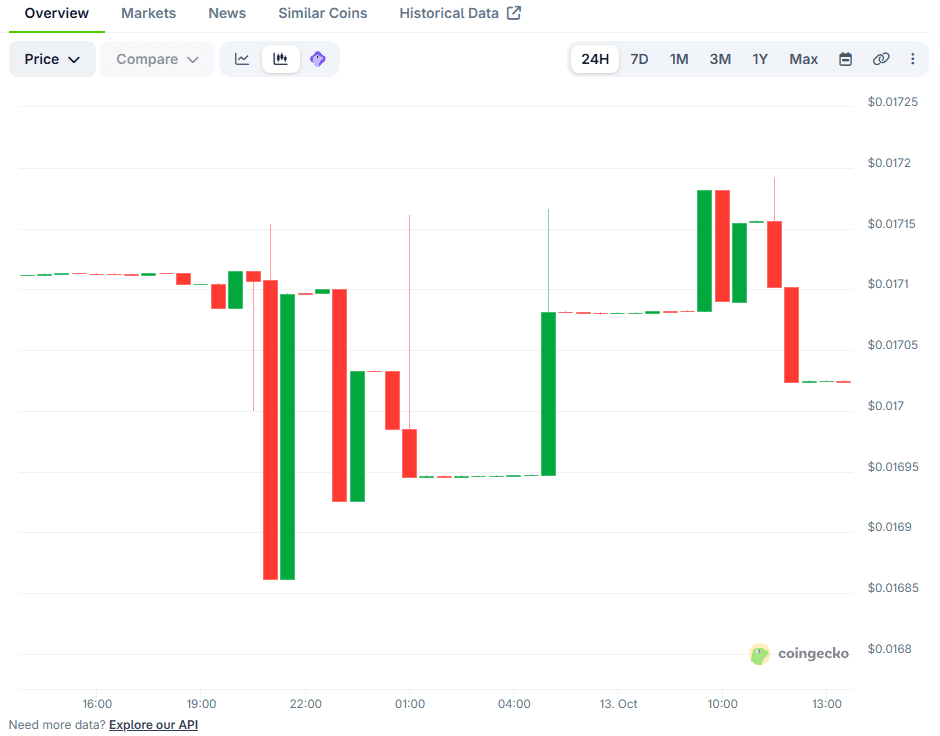
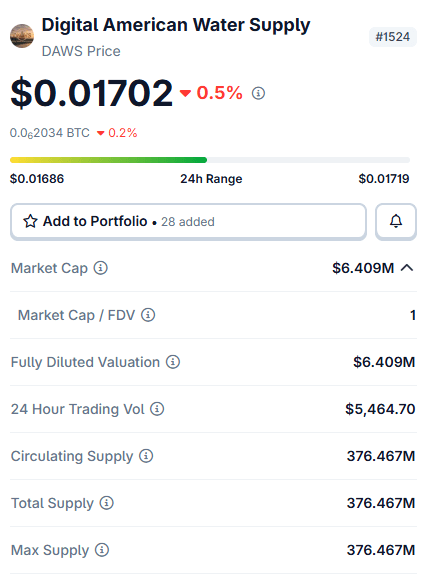
During the check on October 13, 2026, at around 1:47 p.m. Western Indonesian Time (WIB), the data page displayed a price of US$0.01702, a market capitalization of approximately US$6.409 million, and 24-hour volume of US$5,487.63. The circulating supply was listed at approximately 376.467 million DAWS.
These figures are a snapshot of the page, not a guarantee of a live execution price. The market listings section on the same page displayed a different price, so US$0.01702 is used only as a reference for the simulation.
Readers need to match update times, trading pairs, and quoted prices before making a decision. Combining figures from different times can produce calculations that appear precise but do not reflect actual trading conditions.
DAWS Price Prediction: Can It Reach US$0.1?
How Much Would the Price Need to Rise?
Calculations using the reference price produce the following:
- Price multiple: US$0.1 ÷ US$0.01702 = approximately 5.88 times.
- Percentage increase: (5.8754 − 1) × 100% = approximately 487.54%.
This is the author’s calculation based on a price snapshot, not a probability forecast. It does not establish when the target will be reached or the net profit after fees.
The difference between a price multiple and a percentage increase also matters. The final price includes the initial value, while the percentage increase measures only the amount added to that value.
What Would DAWS’s Market Cap Be at US$0.1?
Assuming the circulating supply remains at 376.467 million tokens, the market capitalization at the target price would be:
US$0.1 × 376,467,000 = approximately US$37.65 million.
The project website states a total supply of 1 billion tokens. If that figure is used as the full supply basis, the valuation at the same price would be US$100 million, not automatically the circulating market capitalization.
The contract addresses referenced by the two sources match, but the reason for the supply discrepancy has not been verified. Both calculations are therefore conditional scenarios and do not establish that a token release schedule exists.
What Does That Valuation Mean?
Market capitalization calculates the value of circulating tokens, while fully diluted valuation , or FDV, uses the full supply basis. Treating them as equivalent without checking supply can change the conclusions of the analysis.
An increase in market capitalization is also not the same as the amount of new money that must flow in. Prices are formed through trades involving a portion of the tokens, then used to value the entire supply on which the calculation is based.
A valuation that still looks small compared with other assets therefore does not prove that the target is easy to reach. Comparisons are useful only when they account for market quality, token usage, and ownership distribution.
Read also: CyberLeek Rises Today: Reasons Behind the Move and Price Analysis
Three Factors That Could Support a DAWS Price Increase
1. Sustained Demand
The bullish scenario is stronger if buying continues across several periods, rather than only during promotions. To test this, observe whether activity persists after the initial attention fades.
Follower counts or social media mentions are not sufficient evidence. The analysis needs to connect that attention with verifiable trades and market participation.
2. Adequate Liquidity
Liquidity determines how easily trades can be executed without large price changes. In a thin market, execution prices can diverge from estimates, especially as order sizes increase.
To assess DAWS’s development, compare estimated transaction outcomes for the same trade value over time. These changes are more informative than simply watching the last traded price.
3. Transparency in Project Implementation
Clear documentation can help readers assess what has been completed and what remains a plan. Relevant evidence includes explanations of supply, transactions related to token changes, and documentation of functions that are actually available.
In this analysis, transparency is a condition that would strengthen the scenario, not a catalyst that has already occurred. New claims should be assessed once supporting evidence is available.
Read also: USDP Coin Price Prediction: How Realistic Is the US$1 Target?
Risks That Could Prevent DAWS from Reaching Its Price Target
Misinterpreting Data
Supply labels, prices, and update times must be consistent before being used in calculations. Data discrepancies do not automatically prove fraud, but they reduce confidence in the analysis.
Do not immediately interpret a supply discrepancy as tokens awaiting an unlock or tokens that have been burned. Such conclusions require tracing transactions and obtaining explanations that can be tested.
Difficulty Realizing Portfolio Value
The balance value displayed in an app usually uses a reference price. When you sell, the actual proceeds can differ because of market depth, fees, and price changes during processing.
The ability to sell therefore needs to be assessed alongside the ability to buy. A price gain on screen may not be realizable for the entire position at the same price.
Ownership Concentration
If most tradable tokens are held by a small number of parties, their decisions could influence the market. This is a risk to examine, not a conclusion that DAWS ownership has been proven to be concentrated.
Holder analysis also needs to distinguish between personal wallets, liquidity pools, and service addresses. A list of the largest holders without classification can lead to an inaccurate assessment.
Read also: ZEUS Coin After a 129% Rise: Further Correction or Another Recovery?
Bullish, Neutral, and Bearish Scenarios
Bullish scenario: buying activity persists, trades become easier to execute, and documentation becomes clearer. Under these conditions, evaluating a higher target becomes more reasonable.
Neutral scenario: the price moves without meaningful changes in market participation or project evidence. Updating observations is more appropriate than raising targets simply because of a few positive trades.
Bearish scenario: selling increases while the market’s ability to absorb it weakens. The price can fall sharply if prospective buyers are unwilling to accept offers at previous levels.
All three scenarios are conditional. No probabilities, deadlines, or support and resistance levels are assigned because a verified chart is not yet available.
Read also: RLC Coin Surges Nearly 100%: Heading Toward US$0.84 or a Correction?
Five Things to Check Before Assessing DAWS
- Token identity: match the full contract address before opening a trading pair.
- Data timing: use price and supply figures from compatible observation periods.
- Transaction outcomes: check the estimated tokens received or sale proceeds, including fees.
- Project evidence: distinguish between available features, development plans, and marketing claims.
- Decision criteria: define the conditions that would invalidate your initial assumptions.
Record your findings so that subsequent changes can be compared objectively. This helps keep decisions from depending solely on memories of the highest price or the most attention-grabbing post.
If you want to use Bittime, you can sign up and review the available assets. Learn about each asset and its risks before trading.
Conclusion
A DAWS price prediction of US$0.1 lacks sufficient evidence to be treated as a certain expectation. Calculating the target helps measure the scale of the required change, but its feasibility still depends on supply data, trading conditions, and sustained demand.
Check how those factors develop before updating your assessment. Price targets should follow the available evidence.

Bittime is a Digital Financial Asset Trader (PAKD) platform licensed and supervised by Indonesia’s Financial Services Authority (OJK), where you can buy Bitcoin in Indonesia and hundreds of other crypto assets starting from IDR 10,000. Registration is quick and secure, and you can get started today.
Track the USDT to IDR conversion rate and your favorite crypto assets’ price movements in real time. Everything is available in one crypto investment app that you can download for free from the Play Store.
Ready to get started? Sign up for Bittime now and execute your investment strategy on a platform trusted by millions of users in Indonesia.
FAQ
Can DAWS’s price reach US$0.1?
The target is a possibility to examine, not a certainty. The available data is insufficient to establish its likelihood or the time needed to achieve it.
How much does DAWS need to rise to reach US$0.1?
From the simulation’s reference price, the required increase is approximately 487.54%. The calculation needs to be updated if the starting price changes.
What would DAWS’s market cap be at US$0.1?
The simulation using the stated circulating supply produces approximately US$37.65 million. This figure is conditional because the discrepancy in supply data remains unresolved.
What could drive DAWS’s price higher?
Sustained demand and improving trading conditions could strengthen the bullish scenario. Both need to be demonstrated through market observations, not just community claims.
What are the main risks to check before buying DAWS?
Check data reliability, the ability to sell, and token distribution. Also, do not treat the project’s narrative as proof of rights to physical assets.
Disclaimer: The views expressed belong exclusively to the author and do not reflect the views of this platform. This platform and its affiliates disclaim any responsibility for the accuracy or suitability of the information provided. It is for informational purposes only and not intended as financial or investment advice.

.png)