Pearl Coin (PRL): Mining Crypto While Running AI: Is It Really Possible?
2026-07-21
Pearl Coin or PRL is a native asset from blockchain Layer-1 which uses AI computing as part of the mining process. Through Proof of Useful Work, matrix multiplication that runs AI inference can also help secure the network and generate PRL rewards.
Key Takeaways
- Pearl replaces conventional hashing with matrix multiplication, a core operation used by AI models.
- Mining while running AI is technically possible, but its benefits depend on having the inference or training work actually needed.
- PRL carries high risks because mining profits decline as difficulty increases, market liquidity is limited, and the adoption of paid computing still needs to grow.
What is a Pearl Coin?
Pearl Coin is the native cryptocurrency of Pearl, a Proof of Useful Work (PoUW)-based Layer-1 blockchain. This network uses matrix multiplication computation as a mechanism to determine which miners are authorized to add new blocks.
Matrix multiplication is a crucial mathematical operation in artificial intelligence. Large language models, image generators, recommendation systems, and various machine learning applications perform this operation repeatedly during training and inference.

Source pearlresearch.ai
Pearl tries to combine two activities that have been running separately:
- Computation to produce AI output.
- Computing to secure the blockchain.
In the traditional model, AI companies pay GPUs to run inference. Meanwhile, Proof of Work networks use hardware and electricity to run calculations aimed at earning the right to mine blocks.
Pearl proposes a “two results from one job” model. The GPU performs matrix multiplication to run the AI model, while the same computational footprint is used to generate mining proofs.
The mainnet launched on April 27, 2026. Pearl's infrastructure is built using the UTXO model and a number of components that adapt the Proof of Work blockchain architecture, but the miner's work function is replaced with AI-relevant computation.
Read also:What Is Gno.land (GNOT)? A Go-Based Layer-1 Blockchain for Smart Contracts
Apa Itu Proof of Useful Work?
Proof of Useful Work is a consensus mechanism that requires miners to complete computations that have potential benefits beyond blockchain security.
In traditional Proof of Work, miners attempt to generate hashes that meet the network's target. Unwinning hashes serve no other economic purpose. The computation is still crucial for maintaining the security and decentralization of the network, but the mathematical results are not used as other products.
Pearl takes a different approach. Miners perform general matrix multiplication, or MatMul, using GPUs. This operation dominates many modern AI processes.
In simple terms, the process can be understood as follows:
- The AI system has two sets of matrices that need to be multiplied.
- The GPU performs the matrix multiplication.
- The protocol adds controlled mathematical noise to the input.
- Miners produce computational results and cryptographic proofs.
- The network verifies that the work is actually done.
- Miners who meet the target can produce blocks and earn PRL.
- The original matrix results are recovered for use by the AI system.
The protocol uses noise with a specific structure to prevent miners from selecting easily calculated inputs. The system also ties proofs to the blockchain state so that old computation results cannot be reused to mine new blocks.
Why Matrix Multiplication Was Chosen?
Matrix multiplication was chosen because it meets several important characteristics:
- Widely used in AI.
- Requires a lot of computing.
- Can be run in parallel by GPU.
- The processing time is relatively predictable.
- Can be integrated with cryptographic proof mechanisms.
- The results can be used in inference or training.
The Pearl protocol currently focuses on integer computation and specific quantizations. Native support for low-precision floating-point formats common in modern training and inference is still in the development pipeline.
Read also:What Is WOLF Reserve (WOLF)? An Introduction to the RWA-Based ReserveFi Protocol
Is it true that PRL mining can be done while running AI?
Technically, the answer isCan.
When a GPU runs AI model inference through the Pearl implementation, the matrix multiplication operation can produce two outputs simultaneously. The first output is the inference result, while the second output is the probability of obtaining valid evidence for mining.
Tests published by the developers show a few percent additional overhead compared to the standard inference engine. The measurements recorded an overhead of about 5.08% on a Llama 70B configuration with four H200 GPUs and about 3.9% on a DeepSeek V3.2 configuration with eight H200s.
These figures come from project testing and still need to be replicated independently on a variety of devices and workloads.
Pearl has also been deployed on an inference endpoint for a 31 billion-parameter instruction-tuned model. The service is offered at a price more than 25% below standard, with a subsidy tied to the PRL mined during the inference process.
This implementation demonstrates that the concept is more than just theory. However, one use case isn't enough to prove that all Pearl mining activities have generated economic computation.
Read also:Is Pons Launchpad Legit or a Scam? Learn How It Works and the Risks
Is All Pearl Mining Included in Useful Work?
Not always.
Computing can be considered truly useful when someone needs its results. For example, customers who pay to run chatbots, analyze documents, generate code, or process AI models.
Problems arise when miners perform matrix multiplication solely to pursue PRL rewards. If the results of these computations aren't used by applications or customers, their work remains in securing the blockchain, but they aren't creating the AI products the market needs.
This distinction results in two categories of mining:
Mining with Real AI Demand
GPUs perform inference or training requested by customers. Operator revenue can be derived from both computational costs and PRL rewards.
This is the ideal form of Proof of Useful Work because one use of electricity produces two sources of economic value.
Speculative Mining
GPUs perform artificial matrix tasks without any buyers for the results. Miners earn PRL, but the AI output remains unused.
In this situation, the system more closely resembles Proof of Work, with the computational type being AI computing. Its energy efficiency claims are also weakened because there's no actual secondary work being utilized.
Industry analysis of the Pearl network notes that most of the early activity still comes from speculative miners, while paid compute requests are only available on a limited scale.
Read also:What Is RobinVista? Getting to Know the Fixed-Fee DEX on Robinhood Chain
How Does Pearl Coin Mining Work?
Miners provide GPUs to run Pearl's computing kernel. These devices perform noisy matrix multiplication and find a result that satisfies the network's difficulty level.
The process generally includes:
- Set up a server or computer with a supported GPU.
- Installing node, wallet, and miner software.
- Choose solo mining or join a mining pool.
- Specify the wallet address to receive rewards.
- Perform matrix multiplication computations.
- Send valid proof to the network or pool.
- Receive reward shares based on computational contributions.
Early implementations focused heavily on Nvidia GPUs because their mining software and kernels utilize the Nvidia computing ecosystem. Data center cards like the H100 and H200 offer high performance, while several community pools are also developing support for consumer GPUs.
Mining Pearl isn't as simple as installing an application on a laptop. Operators need to consider:
- GPU price and capacity.
- Electricity consumption.
- Cooling system.
- Server stability.
- Cloud or GPU rental fees.
- Pool fees.
- Network difficulty.
- Reward per block.
- PRL price and liquidity.
- Device downtime.
Users should not purchase hardware solely based on daily profit calculations. Revenue can change rapidly as more GPUs join the network.
Read also:What Are Hood Stocks ($HSTOCKS)? How They Work and the Risks
Why Can PRL Mining Profits Drop?
Mining rewards are distributed based on computational competition. As total network capacity increases, each GPU's chance of earning a reward decreases unless the PRL price increases proportionally.
In the early stages of the network, estimated revenue for high-end GPUs dropped by nearly 50% within a few weeks as difficulty increased. This suggests that high profit opportunities tend to attract new miners and compress profits.
Profitability is influenced by:
- PRL Price.
- Block reward.
- Difficulty jaringan.
- GPU performance.
- Electricity prices.
- GPU rental fee.
- Pool fee.
- Software efficiency.
- Inference work value.
- Operational hours.
If operators only earn token rewards, their revenue is heavily dependent on the PRL price. If operators also have AI customers, inference fees can provide additional revenue, reducing the dependence on the token price.
Read also:Robinhood (FOX): A New Meme Coin on Robinhood Chain, What's Its Potential?
What is the Function of PRL Coin?
PRL is the primary monetary asset in the Pearl network. Its functions include:
- Rewards for miners.
- Payment of transaction fees.
- Incentives to secure the network.
- Potential subsidies for AI computing costs.
- Assets transferred through the Pearl network.
The long-term vision is to make PRL relevant to the growing demand for AI computing. As companies run more inference through Pearl, the computation is expected to improve network security while generating PRL.
However, tokens are not automatically exchangeable for GPU capacity. The whitepaper states that the relationship is currently one-way: useful computing can generate tokens, but tokens do not automatically guarantee their holders access to computing services. A marketplace that matches computing supply and demand remains a development concept.
Read also:What Is Cardtopia (CARDTOPIA)? How to Open TCG Packs and Collect Cards
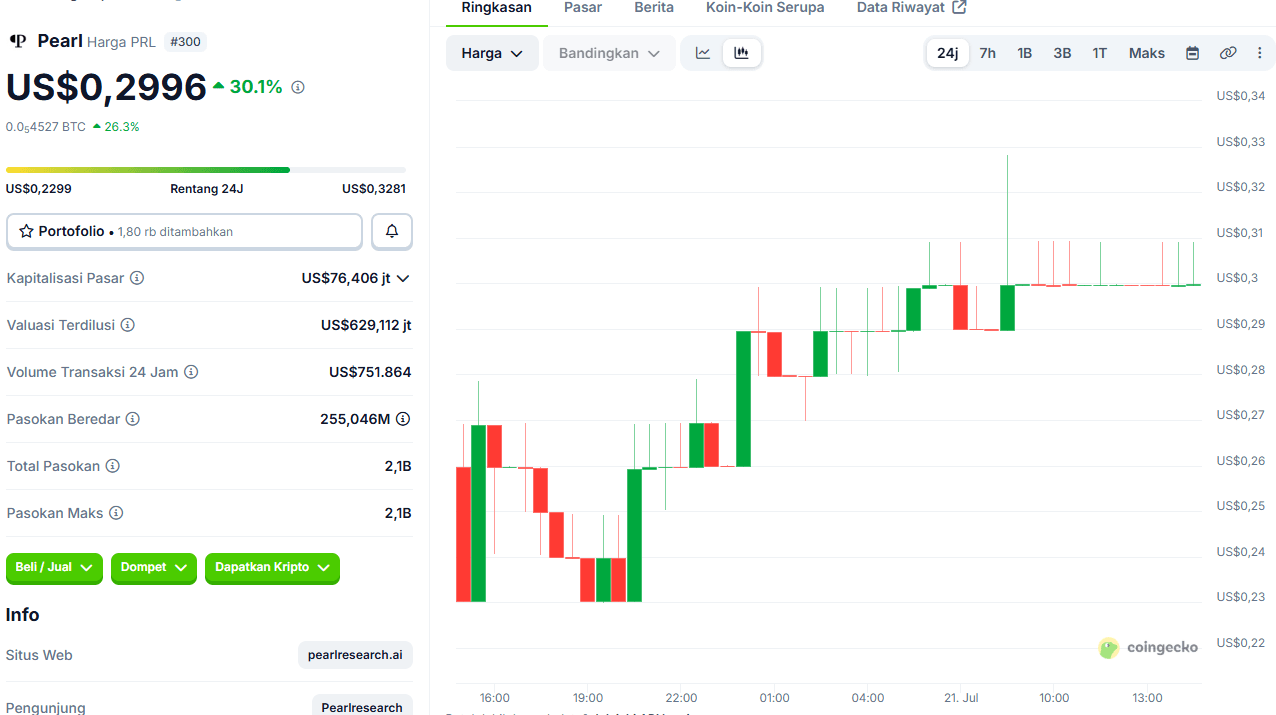
Tokenomics Pearl Coin
PRL has maximum supply2.1 billion coins, or 100 times Bitcoin's maximum supply. Tokens are issued through block rewards to miners, with an emission schedule that decreases over time.
Market data as of July 21, 2026, indicates that approximately 255–260 million PRL are in circulation. This figure is equivalent to approximately 12% of the maximum supply.
The still low circulating supply ratio means investors need to distinguish between two measures:
- Market capitalization, namely the price multiplied by the PRL that is already in circulation.
- Fully diluted valuation, which is the price multiplied by the total maximum supply.
At the time of review, the market capitalization was around US$76 million, while the diluted valuation was closer to US$629 million. This gap suggests that future token issuances could increase the available supply in the market.
Read also:What Is HyperBull (HBULL)? How It Works and Its Potential Yield
Pearl Coin Price and Market Conditions
PRL prices are aroundUS$0,30when checked on July 21, 2026. The 24-hour trading volume was below US$1 million, while the price had fallen by about 25% over the previous seven days.
These figures can change rapidly and need to be updated before the article is published.
Liquidity is a key concern. Most PRL volume is concentrated on a small number of exchanges, and order book depth in some markets remains limited. Large buy or sell orders can result in high spreads and slippage.
Keep track of PONS and other crypto assets by signing up for Bittime and following the latest market updates.
Prospective buyers should check:
- Volume coming from each exchange.
- Order book depth.
- The difference between the buying and selling prices.
- Availability of deposits and withdrawals.
- Supported PRL network types.
- Platform reputation.
- Transaction fees.
- Risk of delisting.
Don't buy another token just because it uses the PRL ticker. The same symbol can be used by several different projects.
Read also:What is the Global Digital Water Reserve (GDWR) on Solana?
Pearl Research AI Advantages
Computing Has the Potential for Double Value
A single GPU activity can generate both AI output and block reward opportunities. This approach has the potential to improve the economics of computing providers.
Relevant to AI Growth
Matrix multiplication is a core operation in modern AI. As inference demand continues to grow, the number of computations that can theoretically be connected to Pearl will also increase.
Using Versatile Hardware
Mining runs on GPUs, not single-purpose ASICs. GPUs can still be used for inference, training, rendering, or other computing tasks.
Implementation is Underway
The mainnet, wallet, miner, explorer, and inference implementations are available. The Proof of Useful Work concept has been tested in real-world applications, although the scale is still limited.
Focus on Input Privacy
Commitments and zero-knowledge proofs are designed to allow the network to verify work without revealing the entire matrix, which could contain model weights or sensitive data.
Read also:What Is USPR? Supply, Liquidity, and Risk on Solana
Risks of Pearl Coin and AI Mining
The Demand for Useful Compute at Scale Has Not Yet Been Proven
Long-term success depends on companies actually purchasing inference or training through the Pearl system. Without such demand, most mining becomes merely speculative computing.
Difficulty Can Depress Income
The introduction of more GPUs reduces the reward per unit of computation. Miners who purchase devices when profits are high may face a longer payback period.
Rewards Continue to Dilute
New PRL is issued through mining. Selling pressure can arise when miners sell rewards to cover electricity, cloud rental, and operational costs.
Limited PRL Liquidity
Market volume and depth aren't yet comparable to major crypto assets. Miners may struggle to sell large amounts of their rewards without depressing the price.
Risk Technology
PoUW is a novel approach. Bugs in the kernel, proof, nodes, wallets, or consensus could disrupt the network.
AI Support Still Limited
Current implementations don't yet cover all modern AI computing formats. Native floating-point support and low-precision training are still being developed.
Hardware Centralization Risks
Expensive data center GPUs offer a performance advantage. If capacity is concentrated in a few large operators, network decentralization can be weakened.
PRL Price Risk
Token prices aren't solely influenced by technology adoption. Market sentiment, listings, mining speculation, emissions, and global crypto conditions can all cause significant volatility.
Read also:What is HOOD4663? A Community Token Inspired by Robinhood Chain
Is Pearl Coin Legit or Scam?
Pearl has an active network, source code, technical documentation, a whitepaper, a block explorer, a research team, and a testable Proof of Useful Work implementation. These factors differentiate it from AI tokens that simply use marketing narratives.
However, the ongoing status of a technology project does not mean that the investment is safe or guaranteed to be successful.
Some aspects still need to be proven:
- Growth of paid computing customers.
- The percentage of mining that comes from real AI work.
- Long-term network security.
- Ability to support the latest computing models and formats.
- PRL Liquidity.
- Mining economics after rewards decline.
- Decentralized mining pool.
- Sustainability of enterprise cooperation.
A more accurate conclusion is that Pearl is an experimental project with real technology, but its economic model still faces high adoption risks. The term "legit" should not be equated with "profitable."
Is Pearl Coin Mining Still Profitable?
There's no one-size-fits-all answer for miners. Profit depends on equipment, electricity costs, rental fees, pool fees, difficulty, and PRL prices.
Before starting mining, calculate:
- Daily PRL income.
- Realistic market price to sell.
- Electricity costs per day.
- Pool fee.
- Cooling costs.
- Device depreciation.
- Connection and server fees.
- Downtime risk.
- Applicable taxes.
- Difficulty changes.
Miners with existing idle GPUs may face lower capital risk than those purchasing new servers specifically for PRL. AI operators are also better positioned if their computing is already generating revenue from customers.
Purchasing a GPU solely based on the expectation of immediate profit is highly risky. Mining revenues typically decline as the opportunity becomes more popular.
Pearl Research AI Prospects
Pearl's prospects are determined by the project's ability to transform PoUW from a mining experiment into a computing infrastructure.
The three most important indicators are:
- Increased demand for inference and paid training.
- Increasing number of cloud or AI provider partners.
- Liquidity growth and PRL usage.
If paid work grows, GPU providers could receive both inference revenue and PRL rewards from the same computation. This model has the potential to make AI services more competitively priced.
Conversely, if most capacity is solely focused on chasing block rewards, Pearl will rely on the token price and the influx of new miners. This makes its economics more similar to traditional crypto mining.
Conclusion
Pearl Coin is a Layer-1 blockchain cryptocurrency that uses Proof of Useful Work. Miners perform matrix multiplication, a core operation in AI models, to secure the network and earn PRL rewards.
Mining while running AI is indeed possible. Inference implementations have demonstrated that a single GPU process can generate both model output and mining evidence with relatively little additional overhead.
However, not all matrix multiplication is automatically useful. The greatest added value only arises when the computation is executing real customer requests. When tasks are executed without users, mining still consumes energy without producing the necessary AI products.
Pearl offers an interesting technological approach, but investing in and mining PRL still carries high risks. Prospective users should evaluate computational demand, difficulty, token issuance, liquidity, device costs, and product development before making a decision.

Bittime is a licensed and regulated Digital Financial Asset Trader (PAKD) supervised by Indonesia’s Financial Services Authority (OJK) — where you can buy Bitcoin in Indonesia and hundreds of other crypto assets starting from just Rp10,000. The registration process is fast, secure, and you can get started today.
Track USDT to IDR conversions and monitor your favorite crypto assets in real time. Everything is available in one crypto investment app that you can download for free on the Play Store
Ready to start? Register now on Bittime and execute your investment strategy with a platform trusted by millions of users in Indonesia.
FAQ
What is Pearl Coin?
Pearl Coin is the native cryptocurrency of the Pearl blockchain, ticker code PRL. Its network uses matrix multiplication-based Proof of Useful Work.
Can PRL be mined while running AI?
Yes. Matrix multiplication operations for inference can also generate mining evidence. However, the economic benefits depend on having customers who need the inference results.
What GPU is used for Pearl mining?
Initial implementations focus on Nvidia GPUs, including data center cards and a limited number of consumer GPUs supported by specific pools. Compatibility may change with software updates.
What is the maximum supply of PRL?
The maximum supply of Pearl Coin is 2.1 billion PRL. New coins are issued to miners through block rewards.
Is Pearl Coin safe for investment?
Pearl boasts a robust technology and network, but PRL remains a high-risk asset. Key risks include volatility, limited liquidity, token issuance, mining difficulty, and the immaturity of demand for paid AI.
Disclaimer: The views expressed belong exclusively to the author and do not reflect the views of this platform. This platform and its affiliates disclaim any responsibility for the accuracy or suitability of the information provided. It is for informational purposes only and not intended as financial or investment advice.

.png)