Is the Oil Strategic Reserve (OSR) Legit? Check the Facts Before You Get Fomo!
2026-07-23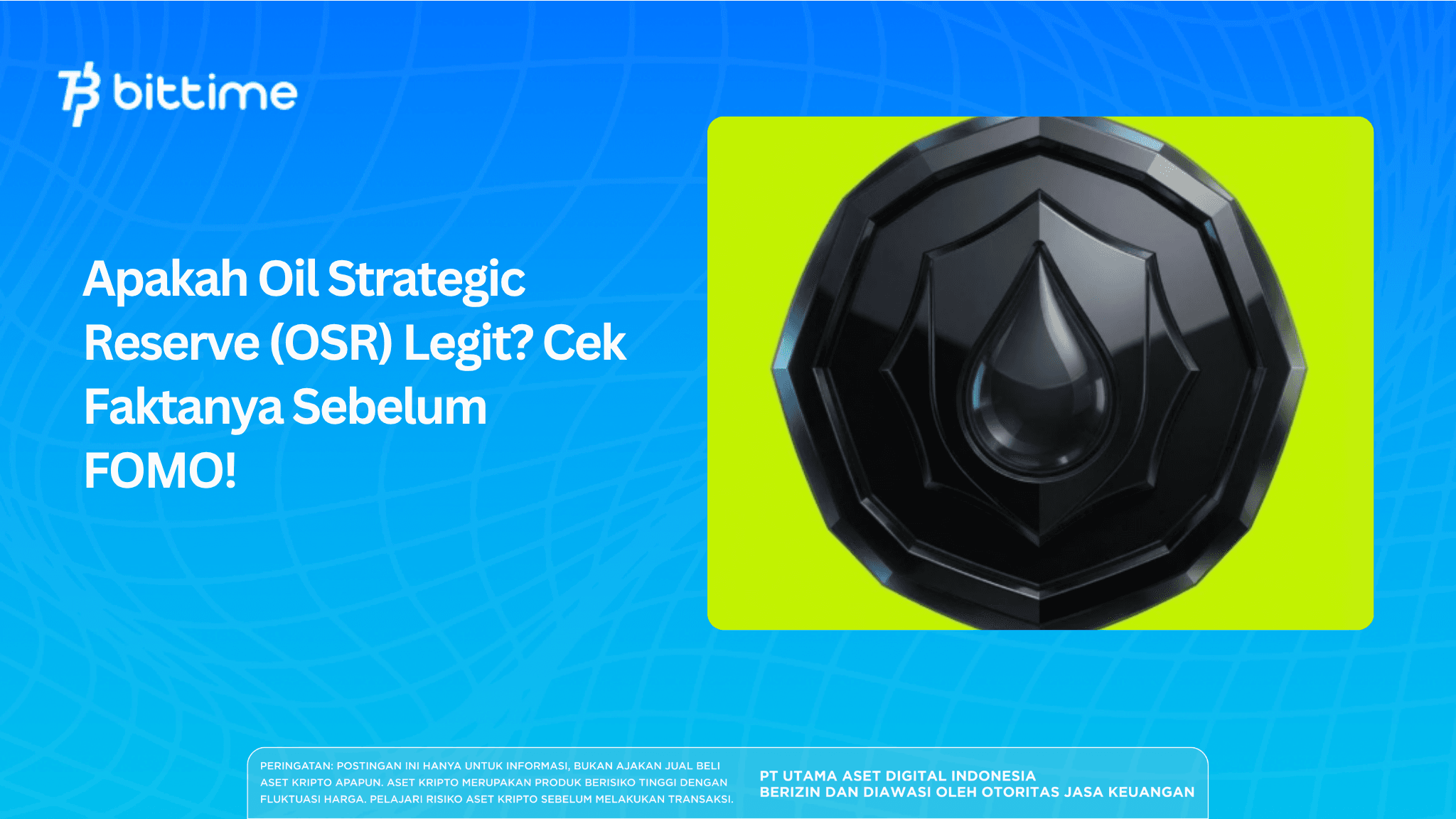
Oil Strategic Reserve or OSR is a new token in Robinhood Chain which uses the strategic oil reserve narrative. While the token and its trading market are verifiable, there has been no sufficient evidence that OSR represents physical oil or is connected to the United States government's oil reserves.
Key Takeaways
- OSR is a new token with liquidity of around US$3,000 and a market cap of around US$3,000 when checked on July 23, 2026.
- The presence of OSR on Robinhood Chain does not prove official endorsement or affiliation because the network is permissionless.
- There is no visible evidence of oil reserves, custodial audits, redemption mechanisms, or legal documentation linking OSR tokens to physical oil.
What is the Oil Strategic Reserve (OSR)?
Oil Strategic Reserve is a crypto token with the symbol OSR published on Robinhood Chain. On the market page, its name is also displayed as Oil Strategy Reserve, so there is a slight difference between the terms "Strategic" and "Strategy" used in promotions and token data.
OSR is traded through the OSR/WETH pair using a liquidity pool on a decentralized exchange. This token uses the narrative of strategic oil reserves, a term readily associated with energy, commodities, and real-world assets or RWA.
However, the currently available data suggests OSR is more of a community token or speculative asset than a verified oil tokenization.
Detailed information regarding:
- Identity of the legal entity issuing the publication.
- Oil storage location.
- The amount of oil that supports the token.
- Name of commodity custodian.
- Asset insurance policy.
- Proposed audit report.
- Legal rights of token holders.
- The mechanism for exchanging tokens for oil or money.
- Pricing method based on oil.
- Involvement of government agencies.
Without these components, the use of the name “Oil Strategic Reserve” is not enough to prove that OSR is a truly commodity-backed crypto asset.
Read also:Is Pons Launchpad Legit or a Scam? Learn How It Works and the Risks
Why is OSR so widely discussed?
OSR emerged at a time of increased memecoin and speculative token activity on Robinhood Chain. The network launched as infrastructure for on-chain finance and the tokenization of real-world assets, but its initial trading also included various community tokens and memecoins.
Some factors that can make OSR attractive include:
Oil Narratives and Real-World Assets
Oil is a widely recognized global commodity. Using the term "strategic reserve" can suggest that the token is linked to a country's assets, energy security, or commodity reserves.
The RWA narrative is also gaining popularity because it promises a connection between blockchain and real-world assets.
However, a commodity-themed name is not evidence of any assets backing the token.
Launched on New Network
Traders often search for early tokens on newly launched blockchains, hoping to discover projects before they gain wider market attention.
The strategy is risky because the new network also makes it easier for projects to emerge without a clear track record, audits, or products.
Very Small Market Capitalization
Tokens with a market cap of a few thousand dollars can move very quickly when new purchases come in.
Prices can increase many times over with relatively little capital. The reverse effect also applies: a single large sale can deplete liquidity and plunge prices.
The FOMO effect
A name that sounds like an institutional project may encourage users to buy before verifying.
FOMO is usually reinforced by:
- Fast-rising graphics.
- Community posts.
- Klaim “early”.
- Market capitalization target.
- Comparison with other tokens.
- Narratives of oil and geopolitics.
- Use of popular blockchain names.
Read also:Is Show Token (SHOW) Safe or a Scam? Check the Facts
What Does the OSR Project Claim?
OSR is marketed through an identity linked to strategic oil reserves. The project website also features a marketplace page and wallet interaction, but the presence of a transaction interface does not prove that the token holds oil reserves.
For a token to be considered a credible commodity tokenization, projects typically need to explain:
- What assets back each token.
- Who owns the oil?
- Where is the oil stored?
- Who is the custodian?
- How the proposal is audited.
- How often are audits performed?
- Do token holders have legal claims?
- How the redemption process is carried out.
- How storage and insurance costs are paid.
- What happens if a publisher goes bankrupt?
On OSR, such information is not yet sufficiently visible in verifiable public materials.
Therefore, project claims should be understood as marketing narrative that still needs proof, not as confirmation that the token is actually oil-backed.
Read also:Is the USFR (United States Food Reserve) Legit? Here Are the Facts
Is OSR Linked to US Oil Reserves?
There has been no evidence that the OSR is connected to the United States' Strategic Petroleum Reserve.
The US Strategic Petroleum Reserve is a government-managed emergency stockpile of crude oil to mitigate the impact of energy supply disruptions. The reserve is managed by a government agency and stored in dedicated facilities.
Crypto tokens that use the term “strategic reserve” do not automatically have access, ownership, or claim to that reserve.
To prove an official relationship, at least the following must be available:
- Announcements from government agencies.
- Official cooperation document.
- Custody contract.
- Legal framework of ownership.
- Statement regarding tokenized assets.
- Independent audit report.
- Redemption mechanisms that can be implemented.
No such document has been found for OSR.
The safest interim conclusion is:
The OSR should not be considered a representation of United States petroleum reserves until official, verifiable evidence is available.
Read also:Is USCR (United States Crypto Reserve) Legit? Here Are the Facts
What is the OSR Contract Verification Status?
The OSR token contract address listed on the trading pair is:
0xfb6b133aE4D0Dde1f00801D74235D8170E48a13B
The OSR/WETH pair address is:
0x2d15d18F192Cc9f40179c5A2676d3c467984F687
The automated check on the trading page displays a “no issues” status. However, the page also warns that automated checks aren’t always accurate.
This status is not the same as:
- Independent security audit.
- Verify team identity.
- Verification of oil reserves.
- Regulatory approval.
- Support from Robinhood.
- Legal verification of token holders' rights.
- Guarantee that liquidity will not be withdrawn.
No contract audit reports from a widely recognized independent auditor have been found. The contract code, ownership functions, mint capabilities, and administrative settings still need to be checked directly through the explorer.
Thus, the contract status can be summarized as follows:
The token and its contract exist on-chain, but the project's security and legality verification are not yet strong enough to call OSR safe.
Read also:America Oil Reserve Agility (AMORA): Legit or Just a Narrative Token?
How is OSR Market Data?
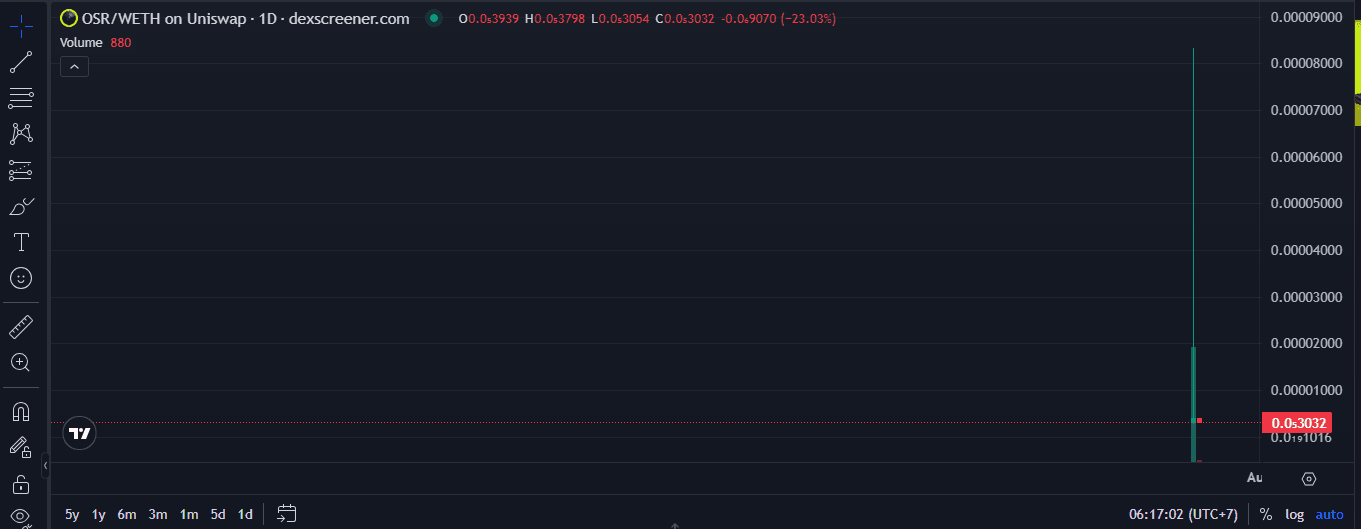
When checked on July 23, 2026, the OSR trading pair was only about a day old.
Market data shows:
- Price around US$0.000003032.
- Liquidity is around US$3,000.
- Market capitalization is around US$3,000.
- Fully diluted valuation sekitar US$3.000.
- 24-hour volume is around US$1,000.
- A total of 26 transactions in 24 hours.
- Six buy transactions and 20 sell transactions.
- Price drop of around 22% in 24 hours.
- The pool contains about 929 million OSR and only about 0.105 WETH.
These figures indicate a very small market.
Liquidity of around US$3,000 means the ability to buy and sell large amounts is severely limited. Even transactions of hundreds of dollars can have a significant price impact.
What Are the Security Risks of OSR Tokens?
Very Low Liquidity Risk
Low liquidity makes it difficult for users to exit positions without lowering the price.
For example, if someone buys US$1,000 worth of tokens in a pool with only around US$3,000 in liquidity, the transaction can drastically change the asset ratio.
Risk Slippage
Slippage is the difference between the estimated price and the actual execution price.
In tokens with low liquidity, slippage can result in buyers receiving fewer tokens or sellers receiving funds far below the apparent price.
Risiko Liquidity Provider
Users need to check who is providing the liquidity, whether the liquidity position is locked, and whether the provider can withdraw it.
If most of the liquidity is withdrawn, the ability to sell tokens may disappear.
Holder Concentration Risk
A complete picture of the distribution of holders in the market information examined is not yet available.
If a small number of wallets control most of the supply, a sale from a single holder can drive the price down.
Contract Risk
An automatic “no issues” status is not a full audit. Risks may still arise from:
- Administrative functions.
- Ability to print tokens.
- Transfer settings.
- Rights of the contract owner.
- Structure fee.
- Integration with other contracts.
- Code error.
Risk of Unverified Asset Claims
The biggest risk is not just price, but misunderstanding.
Users may think OSR is tokenized oil because of its name, but there is no evidence of reserves, custody, audits, or redemption rights.
Risk of Fake Tokens
The OSR symbol can also be used by other tokens. Several oil-reserve-themed projects have used similar names on different networks.
Users should check the contract address, not just the name and logo.
Read also:What Is America Oil Reserve Agility (AMORA)? Its Function, Tokenomics, and Prospects
Is OSR Similar to Previous Oil Scam Projects?
OSR has a similar narrative pattern to a number of oil reserve-themed tokens that have appeared before.
Some earlier tokens used national oil claims, government reserves, or commodity backing to establish a sense of legitimacy. Public scrutiny later revealed issues such as lack of government confirmation, low liquidity, concentrated ownership, and unverifiable proof of reserves.
However, the similarity of the narrative does not prove that OSR was created by the same party or is definitely a scam.
This comparison just shows some of the risk signs to watch out for:
- Using the term national oil reserves.
- Does not display custodian.
- Does not have a backup audit.
- Does not provide redemption.
- Does not indicate government affiliation.
- Has little liquidity.
- Promoted before full documentation was available.
- Relying on the RWA name to attract buyers.
OSR should be assessed based on its own contract, holder distribution, proof of assets, and legal documents.
Read also:What is GigaBull ($GIGABULL)? Price Prediction, Opportunities, Risks, and How to Monitor It
How Does Robinhood Chain Highlight This Project?
There have been no official announcements specifically highlighting, supporting, or verifying OSR.
Robinhood Chain is designed as a permissionless network. Anyone can interact, build applications, or publish smart contracts without requiring special support from network administrators.
It means:
- Just because a token is on the Robinhood Chain doesn't mean it was created by Robinhood.
- Tokens traded on the network do not mean the tokens have been audited by Robinhood.
- Financial or commodity themed names are not evidence of partnership.
- The presence of a token in the explorer is not a form of consent.
The company building the network is focused on asset tokenization and on-chain finance. However, its permissionless nature also allows for the independent launch of memecoins and speculative tokens.
Therefore, users should distinguish between:
official assets issued or announced directly And third party tokens that happen to be built on the same network.
Read also:What Is IF Coin? Is Robinhood Chain's Memecoin Legit or Not?
What Do Analysts Say About OSR?
No in-depth reviews from institutional analysts or independent auditors have been found that specifically verify OSR.
From a risk analysis perspective, real-world asset-themed tokens should be assessed through two layers:
On-Chain Layer
The examination includes:
- Token contract.
- Total supply.
- Holder distribution.
- Wallet deployer.
- Liquidity.
- Trading activities.
- Administrative rights.
- Transfer history.
Off-Chain Layer
The examination includes:
- The presence of physical oil.
- Legality of the publisher.
- Proof of custody.
- Audit proposals.
- Insurance.
- Token holder rights.
- Redemption mechanism.
- Legal jurisdiction.
OSR has a basic on-chain layer consisting of tokens and liquidity pools. However, the off-chain layer required to prove oil backing has yet to be implemented.
In the tokenization of physical commodities, the costs of storage, insurance, auditing, and asset management must also be explained transparently.
Therefore, the analytical conclusion is not directly “scam”, but rather:
OSR value claims do not yet have evidence support commensurate with the risks and marketed narrative.
Read also:DeXe Coin Dumps 83%: Why Did DEXE Price Drop So Sharply?
How to Check OSR Before Buying
Perform the following checks before performing a swap:
- Match the token contract address.
- Check the distribution of the 10 largest holders.
- Identify wallet deployer.
- Check the contract's ability to mint tokens.
- Check the contract owner's rights.
- Evaluate the liquidity pool status.
- Look for evidence of liquidity locking.
- Calculate price impact before buying.
- Conduct a sales simulation.
- Look for contract audit reports.
- Ask for proof of oil reserves.
- Check the identity of the custodian.
- Look for legal documents regarding token holder rights.
- Verify the relationship with the claimed institution.
- Use funds you are prepared to lose entirely.
Don't enter your seed phrase or private key on the project website. Transactions should only be approved through your wallet.
Is OSR Worth Watching or Being Wary of?
OSR is worth noting as an example of a new token capitalizing on the oil and RWA narrative. However, it is more appropriately placed in the category highly speculative until there is stronger evidence.
Factors that support caution include:
- The token lifespan is very short.
- Liquidity is only around US$3,000.
- Market capitalization is very small.
- Selling activity is more dominant when examined.
- There is no evidence of oil reserves.
- There is no custodial audit.
- There is no redemption mechanism.
- There is no official relationship with the US government.
- There is no official support from Robinhood.
- Independent contract audits have not yet been found.
OSR is not suitable to be considered as an alternative oil investment based solely on the project name.
To stay up to date with new tokens, RWAs, and the latest crypto news, you can sign up at Bittime and regularly read market updates. Ensure assets are officially available and conduct independent verification before making a transaction.
Conclusion
Oil Strategic Reserve, or OSR, is a new token on Robinhood Chain that uses the strategic oil reserve narrative. The token, its contracts, and trading pairs can be verified on-chain.
However, this existence does not prove that OSR is backed by physical oil. There has been no evidence of reserves, custodial audits, redemption mechanisms, legal rights of token holders, or any connection to the United States Strategic Petroleum Reserve.
OSR's presence on Robinhood Chain also doesn't prove official support. The network is permissionless, allowing anyone to issue tokens.
With liquidity of around US$3,000 and a trading life of around one day, the risks of volatility, slippage, price manipulation, and difficulty selling are very high.
The most objective conclusion is that OSR is a speculative token that does not yet have sufficient evidence to be called a verified oil token. Avoid FOMO and wait for audits, proof of backup, and legal clarity before considering exposure.
Keep an eye on price movements for leading RWA assets such as ONDO, LINK, and HBAR before trading on Bittime.

Bittime is a licensed and regulated Digital Financial Asset Trader (PAKD) supervised by Indonesia’s Financial Services Authority (OJK) — where you can buy Bitcoin in Indonesia and hundreds of other crypto assets starting from just Rp10,000. The registration process is fast, secure, and you can get started today.
Track USDT to IDR conversions and monitor your favorite crypto assets in real time. Everything is available in one crypto investment app that you can download for free on the Play Store
Ready to start? Register now on Bittime and execute your investment strategy with a platform trusted by millions of users in Indonesia.
FAQ
What is the Oil Strategic Reserve?
Oil Strategic Reserve is a token with the symbol OSR on Robinhood Chain. The token uses the narrative of oil reserves, but its commodity backing has not been verified.
Is OSR backed by US oil reserves?
No evidence of any connection to the United States government's oil reserves has been found. The project name does not confer any legal claim to the government's oil.
Are OSR contracts safe?
Automated checks don't reveal any immediate issues, but they aren't independent audits. Users still need to review the code, ownership rights, holder distribution, and liquidity.
Is OSR the official token of Robinhood?
There's no evidence that OSR is issued or supported by Robinhood. The token runs solely on the permissionless Robinhood Chain.
Is OSR worth buying?
OSR carries very high risks due to its low liquidity, short market life, and unverified asset claims. This token is not suitable for users who cannot afford to lose their entire capital.
Disclaimer: The views expressed belong exclusively to the author and do not reflect the views of this platform. This platform and its affiliates disclaim any responsibility for the accuracy or suitability of the information provided. It is for informational purposes only and not intended as financial or investment advice.

.png)