MiniMax M3: A 1-Million-Context Multimodal AI That Challenges GPT-5.5
2026-06-09
MiniMax M3 became one of the most exciting AI model launches in 2026. Developed by MiniMax, this model combines three capabilities previously found only in closed frontier models: native multimodality, a context window of up to 1 million tokens, and advanced coding and agentic tasks.
Those strengths have led many developers to compare MiniMax M3 vs GPT-5.5 and Gemini 3.1 Pro vs MiniMax M3.
Beyond high performance, MiniMax M3 is also designed to support modern AI workflows that require long-document understanding, complex task execution, and multimodal interaction in a single model.
Key Takeaways
- MiniMax M3 supports 1M context window thanks to MiniMax Sparse Attention (MSA).
- The model has native multimodality, enabling unified processing of text, images, and video.
- In several coding and agentic benchmarks, MiniMax M3 is claimed to compete with and even surpass GPT-5.5 and Gemini 3.1 Pro.
Sign up at Bittime now and start trading crypto quickly, safely, and easily in the app.
What Is MiniMax M3?
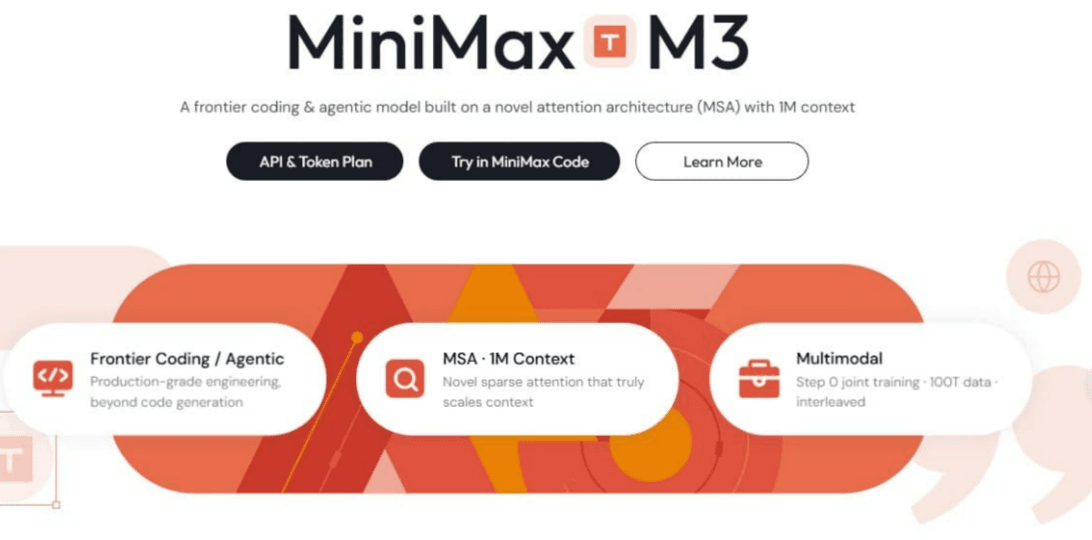
MiniMax M3 is the latest-generation AI model focused on three main areas: coding, agentic reasoning, and multimodal understanding.
Unlike many other models that add visual capabilities after training is complete, MiniMax M3 was built with a native multimodality approach from the start of training.
This enables deeper understanding between visual and textual information.
It is also one of the first open-weight models to combine:
- Context window of up to 1 million tokens
- Advanced coding capabilities
- Native multimodal support
This combination makes MiniMax M3 attractive to developers who need a coding-agent LLM, automation systems, or autonomous-agent-based AI applications.
Read also: What Is Odysseus AI? A Complete Guide to Use, Setup, and Review
MiniMax Sparse Attention Technology and the 1 Million Token Context Window
One of the biggest innovations in MiniMax M3 is the use of MiniMax Sparse Attention (MSA).
In traditional transformer models, computation cost rises quadratically as context length increases. That is why many models struggle to handle very long documents.
MSA is designed to address this problem with a more efficient sparse-attention approach. According to MiniMax, this architecture enables:
- Context window up to 1 million tokens
- Significantly lower computation cost
- Faster inference for long-horizon tasks
With these capabilities, MiniMax M3 can understand:
- Large code repositories
- Thousands-page legal documents
- AI experiment logs
- Long-form video
- Multi-step agentic workflows
MiniMax M3's 1M context capability is one of the factors that sets it apart from many AI models today.
Do not miss AI coin price updates such as Bittensor (TAO), Venice Token (VVV), NEAR Protocol (NEAR)and Internet Computer (ICP) on Bittime.
Native Multimodality Built From the Start
Many modern AI models offer multimodal capabilities. However, MiniMax emphasizes that M3 was trained multimodally from the earliest stage of pretraining.
This approach produces better alignment across different types of data, including:
- Text
- Images
- Video
According to the company, its training pipeline has been expanded to more than 100 trillion multimodal data tokens, allowing the model to understand visual and textual relationships more naturally.
In multimodal benchmarks such as OmniDocBench, MiniMax M3 is reported to score competitively and even outperform several other frontier models in visual document processing.
For developers building image-, document-, or video-based applications, the multimodal AI capability of a model like M3 is a significant advantage.
Read also: Slendro AI - the all-in-one AI service claims to be trusted by more than 1,000 customers since 2025
Coding and Agentic AI Tasks Performance
The area that has attracted the most attention is coding and autonomous agents.
MiniMax M3 is designed to perform:
- Multi-step planning
- Automatic tool use
- Complex workflow execution
- Code debugging and optimization
- Long-term collaboration with users
In benchmarks focused on software engineering, results published by MiniMax show strong performance:
- SWE-Bench Pro: 59.0%
- Terminal-Bench 2.1: 66.0%
- MCP Atlas: 74.2%
- KernelBench Hard: 28.8%
In internal experiments, MiniMax M3 was even able to run an autonomous scientific research reproduction for nearly 12 hours, generating dozens of commits and experiment charts without human intervention.
The model was also used for CUDA kernel optimization, producing up to a 9.4x performance improvement after hundreds of automatic iterations.
Capabilities like these show how AI agentic tasks are evolving from simple chatbots into systems that can complete complex projects independently.
Interested in starting crypto investing? See how to buy Bitcoin (BTC) or Ethereum (ETH) , two popular coins for beginners!
MiniMax M3 vs GPT-5.5 and Gemini 3.1 Pro
The comparison between MiniMax M3 vs GPT-5.5 and Gemini 3.1 Pro vs MiniMax M3 has become a hot topic in the AI community.
In general:
According to the SWE-Bench Pro benchmark published by MiniMax, M3 is claimed to outperform GPT-5.5 and Gemini 3.1 Pro in certain coding scenarios.
However, it should be noted that real-world performance still depends on the testing method, tooling, and type of task used.
Read Also: How to Day Trade Crypto Smarter with Gemini AI: A Complete Guide
DeepSWE Benchmark and Real-World Testing
Beyond official benchmarks, the AI community has also begun testing MiniMax M3 through various independent evaluations such as the DeepSWE benchmark.
The aim of these tests is to assess the model's ability to:
- Understand large codebases
- Fix complex bugs
- Manage extremely long context
- Run real software-engineering workflows
Early results show that the combination of a large context window and strong coding ability makes MiniMax M3 an interesting candidate as an alternative for large-scale software development projects.
Read also: What Is Genspark AI? A Super AI Agent to Boost Productivity
Can MiniMax M3 Become an Alternative to GPT-5.5?
For many developers, the answer is yes.
MiniMax M3 offers a unique combination of:
- Long context window
- Native multimodality
- Coding-agent capability
- Open-weight support
If the open-source roadmap and local deployment are truly realized, MiniMax M3 could become one of the most interesting alternatives to GPT-5.5 in the AI market.
Although more proof is still needed in large-scale production use, M3 shows that open-weight models are now beginning to compete with closed frontier models.
After learning about AI developments, it is time to explore AI-based crypto on Bittime such as digital assets AI, AGI, RENDER, TAO and many more AI coins.
Conclusion
MiniMax M3 points to a new direction in modern AI development. With support for a 1 million token context window, MiniMax native multimodality, and competitive coding and agentic capabilities, the model stands out as one of the serious contenders to GPT-5.5 and Gemini 3.1 Pro.
MiniMax M3's main advantage lies in its Sparse Attention technology, which enables the processing of very long contexts without sacrificing efficiency.
For developers who need AI for software engineering, automation, and multimodal workflows, MiniMax M3 is a model worth watching throughout 2026.
With the help of AI, crypto adoption could grow even faster—follow the trend with Bittime!
Bittime is a licensed and supervised Digital Financial Asset Trader (PAKD) platform under the Financial Services Authority — where you can buy Bitcoin in Indonesia and hundreds of other crypto assets starting from Rp10,000. Registration is fast, safe, and can be started today.
Track the conversion of USDT to IDR and the real-time price movements of your favorite crypto assets. Everything is available in one crypto investment app that can be downloaded for free on the Play Store.
Ready to start? Sign up on Bittime now and execute your investment strategy with a platform trusted by millions of users in Indonesia.
FAQ
What is MiniMax M3?
MiniMax M3 is MiniMax's latest multimodal AI model that supports coding, agentic reasoning, and a context window of up to 1 million tokens.
What are MiniMax M3's advantages over GPT-5.5?
MiniMax M3 offers a larger context window, open-weight support, and very strong agentic workflow capabilities for coding and automation tasks.
What is MiniMax Sparse Attention (MSA)?
MSA is an attention architecture developed by MiniMax to enable more efficient processing of very long context compared with traditional transformers.
How long is MiniMax M3's context window?
MiniMax M3 supports up to 1 million tokens, with a minimum guarantee of 512,000 tokens in API usage.
Does MiniMax M3 support image and video input?
Yes. MiniMax M3 has native multimodality that allows processing text, images, and video in one unified model.
Disclaimer: The views expressed belong exclusively to the author and do not reflect the views of this platform. This platform and its affiliates disclaim any responsibility for the accuracy or suitability of the information provided. It is for informational purposes only and not intended as financial or investment advice.

.png)