LayerZero Launches ATLAS, ZRO Prices Immediately Soar
2026-08-26
On August 25, 2026, LayerZero, a leading interoperability protocol, announced the launch of ATLAS, a trading and settlement infrastructure product built on its proprietary Zero blockchain.
The name ATLAS itself is an abbreviation ofAggregated Trading Liquidity and Settlement.
This announcement immediately rocked the market.
LayerZero Pricing rose significantly in a matter of hours.
LayerZero's native token, ZRO, which was trading around $1 previously, surged more than 30%.
At its peak, the price of ZRO touched $1.34 before finally stabilizing.
So, what exactly is ATLAS, and why is the price of ZRO coin rising so drastically? Let's dissect it in depth.
Key Takeaways
LayerZero officially launched ATLAS on August 25, 2026, a trading and settlement engine built on the Zero blockchain.
This launch immediately pushed the price of ZRO up more than 30% in a short time, from around $1 to $1.29.
ATLAS is designed as a “headless exchange” without its own interface, allowing third-party trading platforms.
What Is ATLAS? LayerZero's Next-Generation Trading Infrastructure
ATLAS LayerZero is no ordinary crypto exchange. LayerZero describes it as a "headless exchange," a backend engine that doesn't have its own app or trading interface.
Think of ATLAS as the “behind-the-scenes engine” that provides all the core functions of an exchange: order matching (matching), clearing (clearing), solution (settlement), and risk management (risk management), all integrated in one single system.
Read Also:What is Lobster Coin?
Built on Zero Blockchain
ATLAS is built on Zero, the blockchain announced by LayerZero in February 2026. Zero is designed specifically for financial market infrastructure, involving collaborations with financial giants such as Citadel Securities, DTCC (Depository Trust and Clearing Corporation), Intercontinental Exchange (ICE), and Google Cloud.
Zero uses zero-knowledge proofs to verify transactions on the chain (on-chain), combining high speed with transparent auditability.
Two Configurations: Open and Institutional
ATLAS comes in two versions to serve different market segments:
Open ATLAS is intended for crypto applications, prediction markets, and other public trading products. This version is permissionless and accessible to anyone.
Institutional ATLAS is designed for regulated exchanges and financial firms.
This version allows them to set their own market rules, who can trade and under what conditions, while still using the same engine underneath.
With this architecture, ATLAS can support a wide range of instruments: from spot crypto and perpetual futures to stocks, bonds, commodities, and prediction markets.
Read Also: 10 Crypto Airdrops August - September Ongoing Throughout 2026
Why Is ZRO Price Rising? Buyback and Burn Mechanisms Are Key
The reason for the increase in the price of ZRO coin cannot be separated from how ATLAS is integrated with the ZRO token.
LayerZero designed an economic mechanism that directly links trading activity on ATLAS with the demand and supply of ZRO.
Interested in exploring more opportunities in the crypto world? Register now at Bittime, a trusted crypto asset investment platform in Indonesia, and discover a wide selection of attractive tokens.
Fee and Rebate Mechanism
ATLAS charges one unified trading fee (all-in trading fee).
When a trading venue (third-party platform) uses ATLAS, they are entitled to a rebate (fee reduction) of between 20% and 65%, depending on two factors: the trading volume they handle and the amount of ZRO they stake.
The more ZRO staked and the greater the volume generated, the higher the rebate received.
The highest rebate rate even requires staking up to 1% of the total ZRO supply.
75% Fee for Buyback and Burn ZRO
This is the most interesting part. After the venue receives its rebate, the remaining trading fees are divided as follows:
25% of the remaining entry fee goes to market creator(the party that creates the market)
75% of the remaining costs are used to purchase and burn ZRO
This buyback and burn mechanism directly reduces the supply of ZRO circulating in the market.
With demand continuing to flow from trading activity on ATLAS and supply continuing to dwindle, upward pressure on the price of ZRO is becoming very strong.
Read Also: What Are Martians? The Rising Solana Meme Coin
ATLAS Performance and Impact in the Market
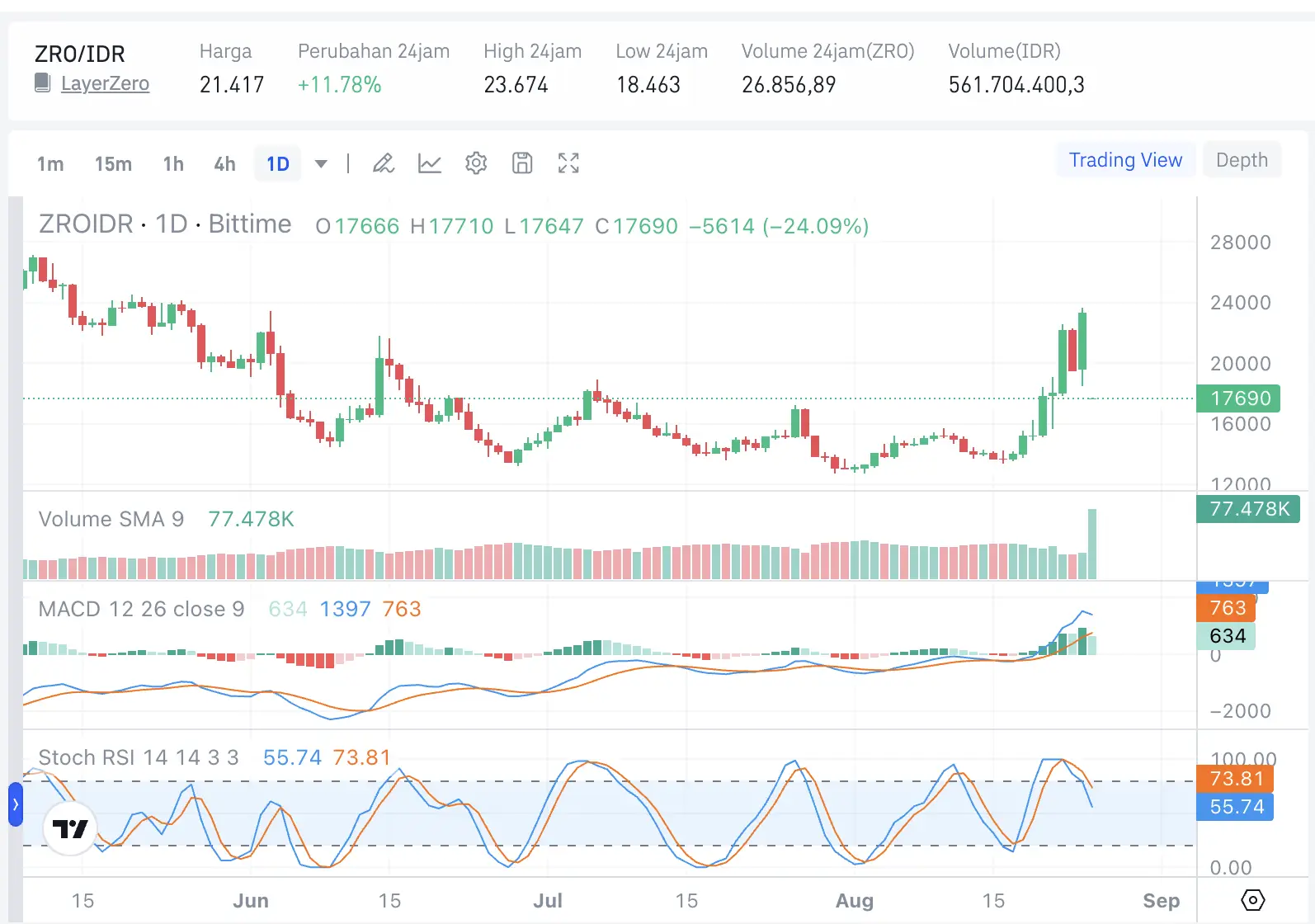
ZRO to IDR via Bittime Market
The launch of ATLAS immediately had a significant positive impact on the LayerZero ecosystem.
ZRO Price Surge
As mentioned earlier, the price of ZRO immediately skyrocketed by more than 30% after the announcement.
At its peak, ZRO touched $1.34 before eventually trading around $1.18 the following day.
ZRO's market capitalization also increased to around $454 million, with a 24-hour trading volume reaching $170 million.
Even more astonishingly, ZRO has recovered about 85% since the beginning of August 2026, rising from the $0.70 level to over $1.30.
This is a spectacular recovery after the token hit an all-time low of $0.71 on July 31, 2026.
Read Also: With the US Debt Crisis Looming, Ray Dalio Chooses Bitcoin and Gold
Impressive Technical Performance
From a technical standpoint, ATLAS is designed for high performance.
The infrastructure was initially projected to handle 200,000 transactions per second with a median latency of under one millisecond, specifically 965 microseconds for the median, with p95 at 1,418 ms and p99 at 2,641 ms.
LayerZero's Big Vision Behind ATLAS
Bryan Pellegrino, Co-founder and CEO of LayerZero, stated that ATLAS was built to address the increasingly complex needs of the global financial market.
"The world's global asset base is growing faster than ever before.
It is globally accessible, continuously available, and covers an increasing number of assets with sufficient depth and liquidity to build a meaningful market,” Pellegrino said.
With ATLAS, LayerZero moves beyond its role as an interoperability protocol (moving assets between chains) and into the market infrastructure where those assets are traded.
This is a major step that fundamentally changes LayerZero's position in the crypto ecosystem.
Conclusion: A New Era for LayerZero and ZRO
The launch of ATLAS LayerZero marks a new chapter for the LayerZero coin and its ecosystem.
By combining high-performance trading infrastructure, support from global financial institutions, and the economic mechanisms that benefit the ZRO token, LayerZero has created a very strong value proposition.
ZRO's price jumping more than 30% is just the beginning.
If ATLAS succeeds in attracting widespread adoption, both from native crypto platforms and traditional financial institutions, then demand for ZRO will continue to grow along with the trading volume flowing through this infrastructure.
However, as always in the crypto world, volatility remains high. Investors should continue to monitor ATLAS adoption developments and other macro factors that could impact the market.
Bittime is a licensed and regulated Digital Financial Asset Trader (PAKD) supervised by Indonesia’s Financial Services Authority (OJK) — where you can buy Bitcoin in Indonesia and hundreds of other crypto assets starting from just Rp10,000. The registration process is fast, secure, and you can get started today.
Track USDT to IDR conversions and monitor your favorite crypto assets in real time. Everything is available in one crypto investment app that you can download for free on the Play Store
Ready to start? Register now on Bittime and execute your investment strategy with a platform trusted by millions of users in Indonesia.
FAQ
What is LayerZero?
LayerZero is an interoperability protocol that enables the transfer of data and assets between different blockchains. LayerZero is known for its omnichain technology, which connects over 160 chains.
What is ATLAS from LayerZero?
ATLAS is a trading and settlement engine built by LayerZero on the Zero blockchain. ATLAS functions as a "headless exchange," a backend infrastructure without its own interface, providing matching, clearing, settlement, and risk management services to third-party trading platforms.
Why did the price of ZRO increase after the launch of ATLAS?
LayerZero's price is rising because ATLAS has a mechanism where 75% of trading fees after rebates are used to buy and burn ZRO. This mechanism reduces the circulating supply of ZRO, while demand increases with ATLAS adoption.
What is the ZRO buyback and burn mechanism?
Buyback and burn is a mechanism where LayerZero uses a portion of ATLAS trading fee revenue to purchase ZRO from the market and then permanently destroy it (burn it). This reduces the total supply of ZRO and can theoretically increase the value of the remaining tokens.
When will ATLAS officially launch?
ATLAS is scheduled to launch in late 2026. Currently, LayerZero has not confirmed an exact launch date other than an estimate of "later in 2026".
Disclaimer: The views expressed belong exclusively to the author and do not reflect the views of this platform. This platform and its affiliates disclaim any responsibility for the accuracy or suitability of the information provided. It is for informational purposes only and not intended as financial or investment advice.
.png)