KOR Airdrop: Check Requirements and Register Before November 2, 2026
2026-10-30
The KOR airdrop has entered its registration phase, according to the available announcement materials. The stated deadline is November 2, 2026, at 14:00 UTC or 21:00 WIB. Registration should be distinguished from token claiming: selecting a receiving method does not mean the tokens have already arrived in your wallet.
For participants who have previously been active in KOR Protocol, the current priorities are preparing the wallet they used, understanding the verification process, and checking the latest requirements. The steps below follow the available registration materials; individual eligibility status and the claim process still need to be confirmed through verified project channels.
Key Takeaways
- The registration materials state a deadline of November 2, 2026, at 21:00 WIB, with verification through Very Authenticator.
- The stated receiving options are through an exchange or directly to a wallet, subject to additional terms that need to be checked.
- The tokenomics specify a supply of 10 billion KOR and a 4% community access allocation, without explaining each participant's individual share.
What Are KOR Protocol and the KOR Token?
KOR Protocol is building infrastructure for managing creative assets, such as music and digital content. Its functions include verifying the origin and ownership of works, connecting creators' works with parties that need them, and processing payments.
The protocol is built on Base. Its technical documentation states that the current release focuses on verification and payment settlement functions, while the engine for distributing works to parties that need them is still under development. Therefore, planned features should be distinguished from capabilities that are already available.
In the ecosystem design, KOR serves as a utility and governance token. Its use cases include access to premium analytics features, payment of certain fees, staking-based participation, and protocol decision-making.
The KOR Foundation handles token coordination and ecosystem programs, while KOR is responsible for technology development. This division of responsibilities helps participants understand which channels are relevant for airdrop announcements and product updates.
Read also: Float Airdrop: How Rewards from FLOAT Trading Fees Work
KOR Airdrop Status: Registration Is Different from Claiming
There are four stages you need to distinguish to avoid misunderstanding the information:
- Registration: Participants submit or confirm the information requested by the program.
- Eligibility: The project determines whether participants meet the criteria.
- Allocation: The number of tokens allocated to participants is determined or displayed.
- Claim or distribution: Tokens are received according to the applicable method and schedule.
The registration screenshots mention selecting a claim method as part of the registration process. This does not prove that the claim transaction is already available on the same day.
Likewise, the registration deadline is not automatically the final deadline for claiming tokens. Record each date according to the relevant activity so you do not miss subsequent announcements.
Who Can Check KOR Airdrop Eligibility?
The registration materials are intended for users who have previously participated in KOR Protocol activities. Participants are asked to use the same wallet they used for their previous activities.
However, the available materials do not detail all the criteria, activity weightings, or minimum participation requirements. Therefore, a history of usage or ownership of a KOR ID is not sufficient to conclude that a wallet is guaranteed to receive tokens.
The term eligibility refers to qualification based on the program rules. Meanwhile, a snapshot is a record of an account's condition or activity at a specific point in time, which may be used in the assessment.
The snapshot date applicable to this registration cannot yet be confirmed from the materials provided. Do not assume that new activity after the announcement will automatically increase eligibility or allocation.
If you use multiple wallets, identify the address actually used for KOR activities. Record the complete address to reduce the risk of selecting the wrong account during the process.
Read also: Free Xaman XRP Airdrop: Check the Facts and Claimed Official Requirements
How to Prepare for KOR Airdrop Registration
The following steps summarize the registration materials and are not based on direct testing of the portal. Button displays and requirements may vary, so they need to be checked when you access the service.
1. Check the Portal Address Through Project Channels
The address listed in the materials is airdrop.korprotocol.foundation. Before connecting your wallet, make sure the same link is genuinely available through project channels that you recognize.
A domain name alone does not prove authenticity. Avoid relying solely on links sent in replies or private messages.
2. Use the Wallet from Your Previous Activities
Prepare the wallet you used to participate in KOR Protocol activities. Creating a new wallet does not mean your previous activity history will be transferred to it.
Check the displayed address before proceeding. If your wallet has multiple accounts, make sure the active account matches your participation records.
3. Complete Verification Through Very Authenticator
The screenshots mention identity verification through Very Authenticator. However, the types of data required, device requirements, and details of the process cannot yet be directly verified.
Read the verification requests before approving them. Do not assume that this process is necessarily the same as exchange KYC or that it definitely requires specific documents.
4. Choose the Appropriate Receiving Method
The materials mention an off-chain option through an exchange and an on-chain option directly to a wallet. Check the terms of each option before making a choice.
Make sure you understand whether the selection can be changed, what information is required, and how the tokens will be received. Do not enter an address or account identity based on assumptions.
5. Save Proof of Completion
If the portal displays a registration confirmation, save the record along with your wallet address and selected method. Registration proof is useful for subsequent checks, but it does not automatically prove that tokens have been allocated.
If no token amount is displayed yet, do not assume that the amount is zero or that the process has failed. Wait for the program to explain when the results will become available.
Read also: XTEN Airdrop: Participation Requirements and TGE Preparation for November 2026
On-Chain or Through an Exchange: What Should You Check?
For direct receipt to a wallet, check the network and destination address. The tokenomics identify Base as KOR's network, but distribution instructions still need to be matched with the claim announcement.
Transaction fees have not been detailed in the registration materials. Therefore, do not assume that the on-chain option is completely fee-free or determine the required gas balance before the procedure is clear.
For the exchange option, make sure the platform actually supports the distribution program in question. A listing announcement and support for receiving an airdrop are two different things.
Third-party materials mention several exchanges, but their individual support has not been verified. Check announcements from the relevant platforms before submitting account information or selecting one as your receiving destination.
Read also: How to Farm Metric: A Guide to Swaps, Points, and Fees
KOR Tokenomics: Supply and Allocation You Should Understand
The tokenomics materials specify a total supply of 10,000,000,000 KOR. The circulating supply at TGE is planned to be 2,286,666,667 KOR, approximately 22.87% of the total supply.
TGE, or Token Generation Event, is the initial token issuance stage. The supply figures at TGE describe the initial distribution plan, not the token price or the value of the airdrop in rupiah.
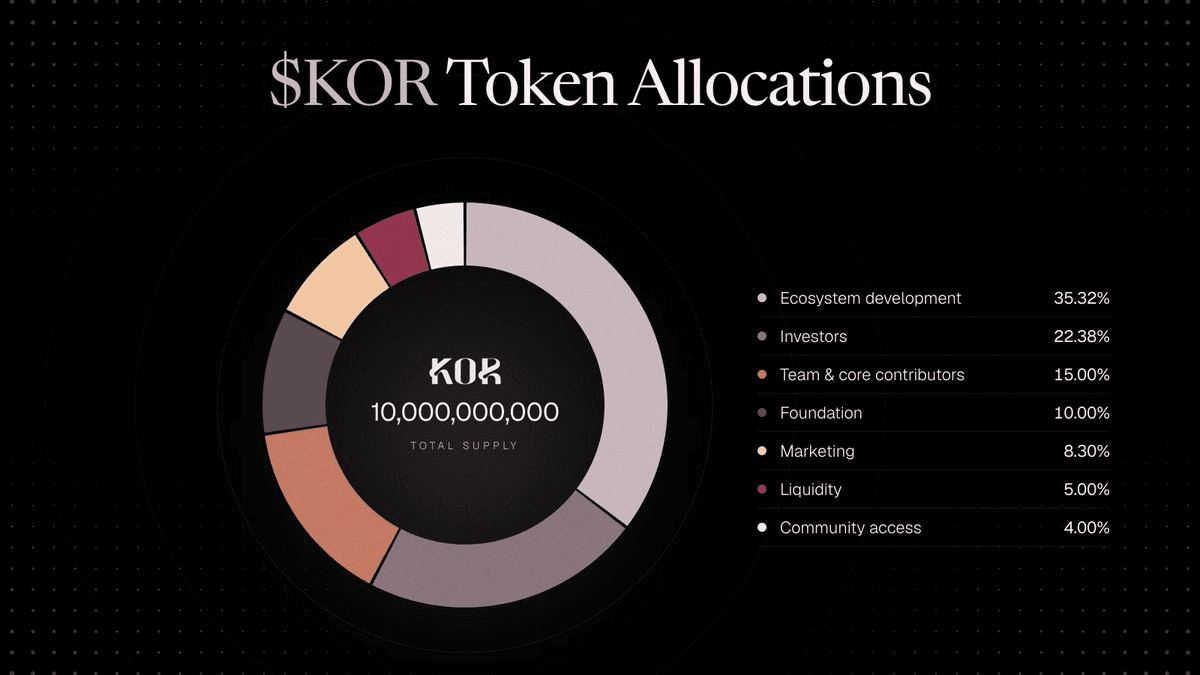
The listed allocation breakdown is as follows:
- Ecosystem development: 35.32%.
- Investors: 22.38%.
- Team and core contributors: 15%.
- Foundation: 10%.
- Marketing: 8.30%.
- Liquidity: 5%.
- Community access: 4%.
Based on the calculation, community access amounts to 400 million KOR. However, this figure represents an allocation category and does not explain whether the entire amount will be distributed through this registration process.
Without the number of recipients and the distribution formula, individual allocations cannot be calculated. The total community allocation should also not be multiplied by a speculative price to promise potential profits.
Read also: Predict.fun Airdrop — How to Check Eligibility and Claim PREDICT
Unlock Schedule and Risks After Distribution
The materials state that no team or investor allocations will be unlocked at the TGE. Both allocations have a 12-month cliff, which is the initial period during which tokens from those categories are not released.
After the cliff, 10% of each allocation is unlocked, with the remainder released monthly. The investor schedule ends in month 36 after the TGE, while the team schedule ends in month 48.
Vesting limits when tokens are released, but it does not guarantee price stability. Trading conditions are still influenced by demand, liquidity, and token holders' decisions.
KOR's utility should also be assessed separately from the airdrop. Plans for staking, premium access, and governance provide context for its use, but participant benefits depend on the rules and implementation of the product.
What Should You Monitor After Registering?
Monitor announcements regarding eligibility results, individual allocations, distribution schedules, and receiving instructions. Make sure each piece of information refers to the same stage of the program.
If you do not meet the requirements, look for an explanation of the criteria or a review mechanism, if one is provided. Do not send funds to anyone claiming they can change the checker results or increase your allocation.
Conclusion
To participate in the KOR airdrop, you need to understand the registration, verification, and distribution stages. The deadline stated in the materials is November 2, 2026, at 21:00 WIB, while eligibility and token allocations remain subject to the program's terms.
If you are also exploring crypto trading services, review their features and fees before deciding to register with Bittime. Registering with Bittime is not a requirement for the KOR airdrop.
Bittime is a licensed Digital Financial Asset Trader (PAKD) platform regulated and supervised by the Financial Services Authority (OJK) — where you can buy Bitcoin in Indonesia and hundreds of other crypto assets starting from IDR 10,000. Registration is fast and secure, and you can get started today.
Track the USDT to IDR conversion rate and the real-time price movements of your favorite crypto assets. Everything is available in one crypto investment app that you can download for free from the Play Store.
Ready to get started? Sign up on Bittime now and put your investment strategy into action with a platform trusted by millions of users in Indonesia.
FAQ
When Is the KOR Airdrop Registration Deadline?
The registration materials state November 2, 2026, at 14:00 UTC, equivalent to 21:00 WIB. Check the project's announcements again for any schedule changes.
Does Having a KOR ID Guarantee an Airdrop?
The materials provided do not establish any basis for such a guarantee. Eligibility must follow the program criteria and the results of the wallet assessment.
Can KOR Tokens Already Be Claimed?
The available materials explain the registration process and the selection of a receiving method. The availability of token claims cannot yet be confirmed through direct portal testing.
How Many KOR Tokens Will Each Participant Receive?
Individual allocations have not been explained in the available materials. The 4% community access allocation should not be interpreted as an equal distribution among all registrants.
Is the KOR Airdrop Claim Free?
The fee details for claiming have not yet been confirmed. For on-chain receipt, check the network fee requirements when the official instructions become available.
Disclaimer: The views expressed belong exclusively to the author and do not reflect the views of this platform. This platform and its affiliates disclaim any responsibility for the accuracy or suitability of the information provided. It is for informational purposes only and not intended as financial or investment advice.

.png)