Bank Clearing and Investment: Definition and How It Works
2026-07-29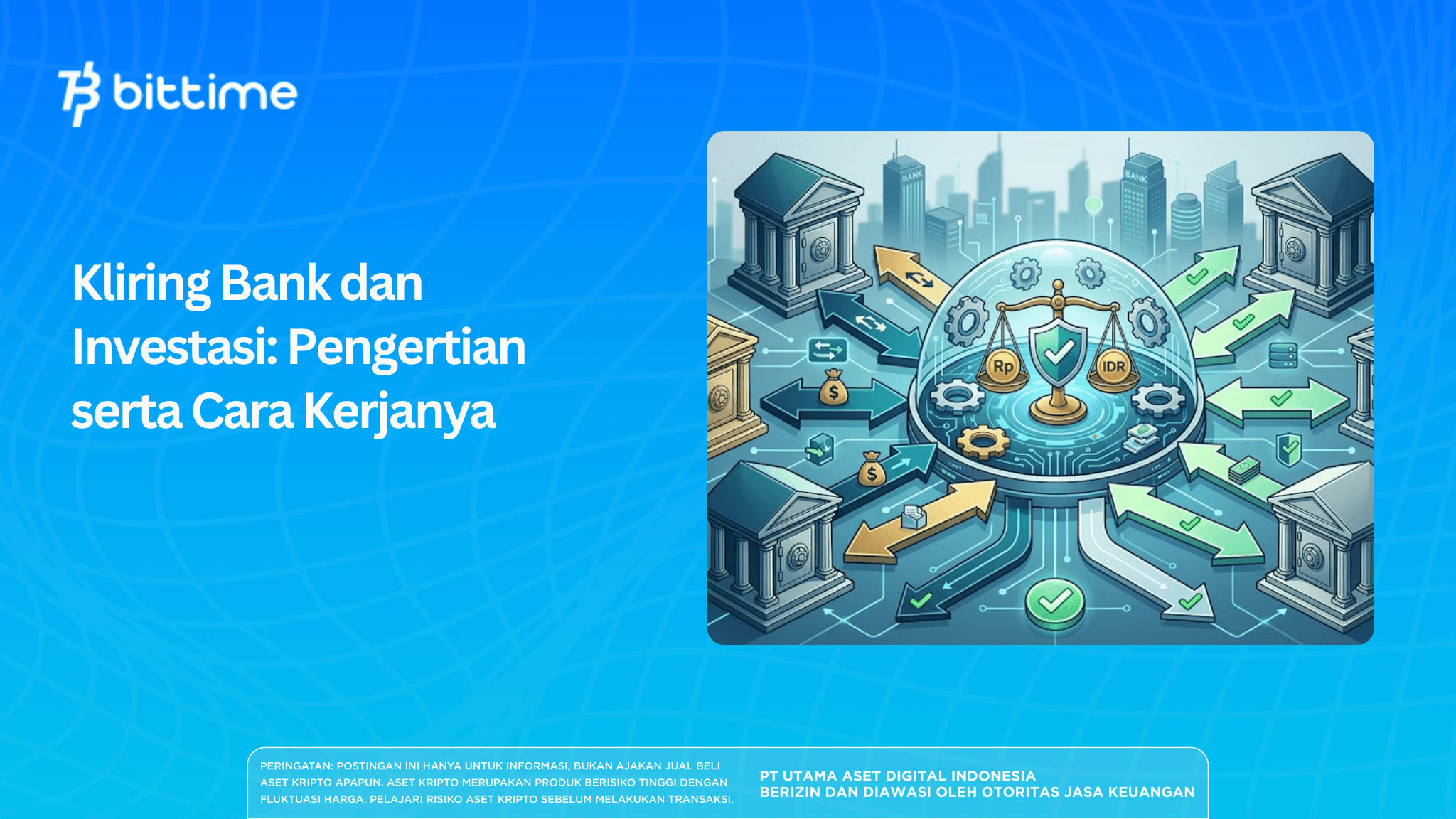
Every time an interbank transfer is credited or a stock transaction on the exchange is declared complete, there is one mechanism working silently behind it: clearing.
Indonesia’s financial ecosystem, from conventional banking to the capital market and crypto assets, all rely on this process to ensure that funds and assets truly move to the rightful parties.
This article comprehensively discusses the definition of clearing, from how it works and its types to the differences between banking clearing and investment clearing.
Key Takeaways
- Clearing is the process of settling transactions that ensures funds or assets truly move to the rightful parties, not merely an ordinary transfer.
- Banking clearing is regulated by Bank Indonesia with a settlement time of 2–3 days, while investment clearing is carried out by institutions such as KPEI with a reconciliation mechanism between sellers and buyers.
- Its main benefits include transaction efficiency, settlement certainty, and reduction of default risk across the entire financial system.
What Is Clearing in Banking and Investment?
Clearing is the process of settling transactions by fully transferring a certain amount of funds from one party to another, then recording it in each party’s books. This term is also often called Giro Traffic (LLG) in the banking context.
Bank Indonesia through Regulation No. 12 of 2010 defines clearing as "the exchange of electronic financial data and/or instruments among clearing participants... whose calculations are settled at a certain time."
This definition emphasizes that clearing is not an instant transfer, but a process that goes through a verification stage before funds truly change hands.
Outside of banking, the term clearing also applies in the investment world — ranging from stock transactions, options contracts, to futures contracts. Its function and mechanism are similar, although it is carried out by different institutions from the banking system.
Register now on Bittime with a fast, secure, and easy process!

Illustration: Generated by AI
How Does the Clearing Process Work?
The clearing process runs through a series of structured stages so that transaction settlement takes place safely and efficiently:
- Transaction initiation — a payment or asset trading transaction begins between two parties.
- Data collection and grouping — transaction data is collected by the clearing institution for further processing.
- Electronic data exchange — financial data is exchanged among clearing participants digitally.
- Net position calculation — the clearing institution calculates the difference in obligations among the parties involved.
- Settlement — funds or assets are truly transferred to the rightful parties.
- Reporting and reconciliation — transaction results are recorded and matched to ensure there are no data discrepancies.
- Risk management and supervision — the clearing institution monitors potential default risks throughout the process.
In ordinary banking clearing, this process takes about two to three days because the funds must first pass through Bank Indonesia before being distributed to the receiving bank.
If faster settlement is needed, there is the Real Time Gross Settlement (RTGS) option that can complete transfers in about four hours.
Read Also: 7 Reasons You Should Start Investing in Tokenized Stock
What Types of Clearing Are Used?
Clearing is grouped based on regional coverage, method, and the type of instruments used. Here are the most common types applicable in Indonesia:
- General Clearing — used for routine interbank transactions with small to medium values, processed in batches and supervised by Bank Indonesia.
- Local Clearing — covers interbank transactions within a specific clearing region, with a relatively faster settlement process.
- Interbranch Clearing — the calculation of instruments carried out specifically among branches within the same bank.
- Electronic Clearing — fully utilizes digital technology without exchanging physical instruments, making the process faster and more accurate.
- Real Time Gross Settlement (RTGS) — for large-value and urgent transactions, settled individually and is final.
- Debit Instrument Clearing — processes payments using instruments such as checks and giro bills.
Instruments commonly processed through the clearing mechanism include drafts, checks, giro bills, and debit notes. Bank clearing itself has a maximum daily transaction limit of Rp99,999,999 per day, so transactions above that amount are usually directed to RTGS.
Read Also: What Is HSC Stock? Definition, Risks, and the Latest List of HSC Stocks
Who Are the Parties Involved in Clearing?
The clearing process always involves three main parties: the fund sender, the fund recipient, and the intermediary as the clearing organizer. In the banking realm, Bank Indonesia acts as the organizer of the Bank Indonesia National Clearing System (SKNBI) that bridges interbank transactions.
In the investment realm, this intermediary role is held by specialized clearing institutions. For stock transactions on the Indonesia Stock Exchange, the role is carried out by PT Kliring Penjaminan Efek Indonesia (KPEI).
As an illustration, if Investor A buys shares through broker STU while Investor B sells the same shares through broker WYK, it is KPEI that holds the funds from STU and the shares from WYK, then distributes them to each party after all obligations are verified.
A similar scheme also applies in Indonesia’s crypto asset market. Crypto transactions recorded on the Central Finansial X (CFX) exchange are cleared by PT Kliring Komoditi Indonesia (KKI), so there is an independent verification layer that guarantees transaction settlement outside the crypto asset trading platform itself.
Read Also: 10+ Best AI Coins 2026: Here’s the List of Artificial Intelligence-Themed Cryptos!
What Are the Functions and Benefits of Clearing for Transactions?
Clearing provides benefits far greater than simply speeding up fund transfers. Here are its main functions for the financial system:
- Transaction efficiency — the sender and recipient do not need to settle face-to-face, so transaction costs and time are more economical.
- Settlement certainty — clearing ensures a transaction is not considered complete until both parties truly fulfill their respective obligations, thereby reducing default risk.
- Better liquidity — accelerates the turnover of funds in the overall financial system.
- Transparency and accountability — every transaction is recorded and can be traced, facilitating the audit process as well as reporting to regulators.
- Reduction of systemic risk — with the existence of independent clearing institutions, the failure of one party does not immediately spread to the entire system.
What Is the Difference Between Bank Clearing and Investment Clearing?
Although the basic concept is the same, banking clearing and investment clearing operate with quite different mechanisms. Here is the comparison:
The most fundamental difference lies in the object: bank clearing purely transfers money, while investment clearing must reconcile two sides at once — assets from the seller and funds from the buyer — so that both arrive simultaneously to the correct parties.
Read Also: Interbank Transfer Fee of 6500 & How to Deposit via Bank Transfer at Bittime
What Are the Risks and Obstacles in the Clearing Process?
Although designed to reduce risk, the clearing process still has limitations that users need to understand:
- Non-instant settlement time — ordinary bank clearing takes 2–3 days, so it is less ideal for urgent transfer needs.
- Daily nominal limit — general clearing transactions are limited to Rp99,999,999 per day, forcing large transactions to switch to RTGS with different costs.
- Technical system risk — because the process heavily depends on electronic data exchange, system disruptions can delay transaction settlement.
- Reconciliation risk — in investment clearing involving many parties, data matching errors can slow down settlement even though this rarely occurs thanks to the supervision of clearing institutions.
Even so, the existence of independent clearing institutions such as KPEI or KKI remains the main layer of protection, because transactions are guaranteed not to be considered complete until all obligations of each party are truly fulfilled.
Read Also: 10 Largest Crypto Asset Tokenization RWAs in the World
Conclusion: Why Is Clearing Important in the Financial System?
Clearing is the backbone that maintains trust in every financial transaction, whether it is an interbank transfer or the buying and selling of stocks and crypto assets. This process ensures that funds and assets truly move to the rightful parties, while also providing an independent verification layer that reduces default risk.
Without a well-functioning clearing mechanism, trust in the modern financial system — from banking to digital asset exchanges — would be far more fragile.

Check the price of Bitcoin (BTC), Ethereum (ETH), XRP, Solana (SOL), GRAM, and BNB as well as top memecoins DOGE. You can trade directly on Bittime!
Bittime is a Digital Financial Asset Trader (PAKD) platform licensed and supervised by the Financial Services Authority — a place where you can buy Bitcoin in Indonesia and hundreds of other crypto assets starting from Rp10,000. The registration process is fast, secure, and can be started today.
Monitor the conversion of USDT to IDR and the price movements of your favorite crypto assets in real time. Everything is available in one crypto investment app that can be downloaded for free on the Play Store.
Ready to start? Register now on Bittime and execute your investment strategy with a platform already trusted by millions of users in Indonesia.
FAQ
What is clearing?
Clearing is the process of settling transactions by fully transferring a certain amount of funds from one party to another. This process involves verification before funds or assets truly change hands.
How long does the bank clearing process usually take to complete?
Ordinary bank clearing takes about two to three business days. For faster settlement, the RTGS option is available, which takes about four hours.
What is the difference between clearing and RTGS?
Clearing is processed in batches with a longer settlement time but lower cost, while RTGS is processed individually in real time with generally higher costs. Both are supervised by Bank Indonesia.
Who handles the clearing of stock transactions in Indonesia?
The clearing of stock transactions on the Indonesia Stock Exchange is carried out by PT Kliring Penjaminan Efek Indonesia (KPEI). This institution guarantees the settlement of transactions between stock sellers and buyers.
Do crypto transactions also go through a clearing process?
Yes, crypto transactions recorded on the Central Finansial X (CFX) exchange are cleared by PT Kliring Komoditi Indonesia (KKI). This mechanism guarantees transaction settlement outside the crypto asset trading platform itself.
What are the main risks in the clearing process?
The main risks include non-instant settlement times as well as the daily transaction nominal limit on general clearing. Electronic system disruptions also have the potential to delay the data reconciliation process.
Disclaimer: The views expressed belong exclusively to the author and do not reflect the views of this platform. This platform and its affiliates disclaim any responsibility for the accuracy or suitability of the information provided. It is for informational purposes only and not intended as financial or investment advice.

.png)