Know the USDT Networks: TRC20 vs ERC20 vs BEP20
2026-08-03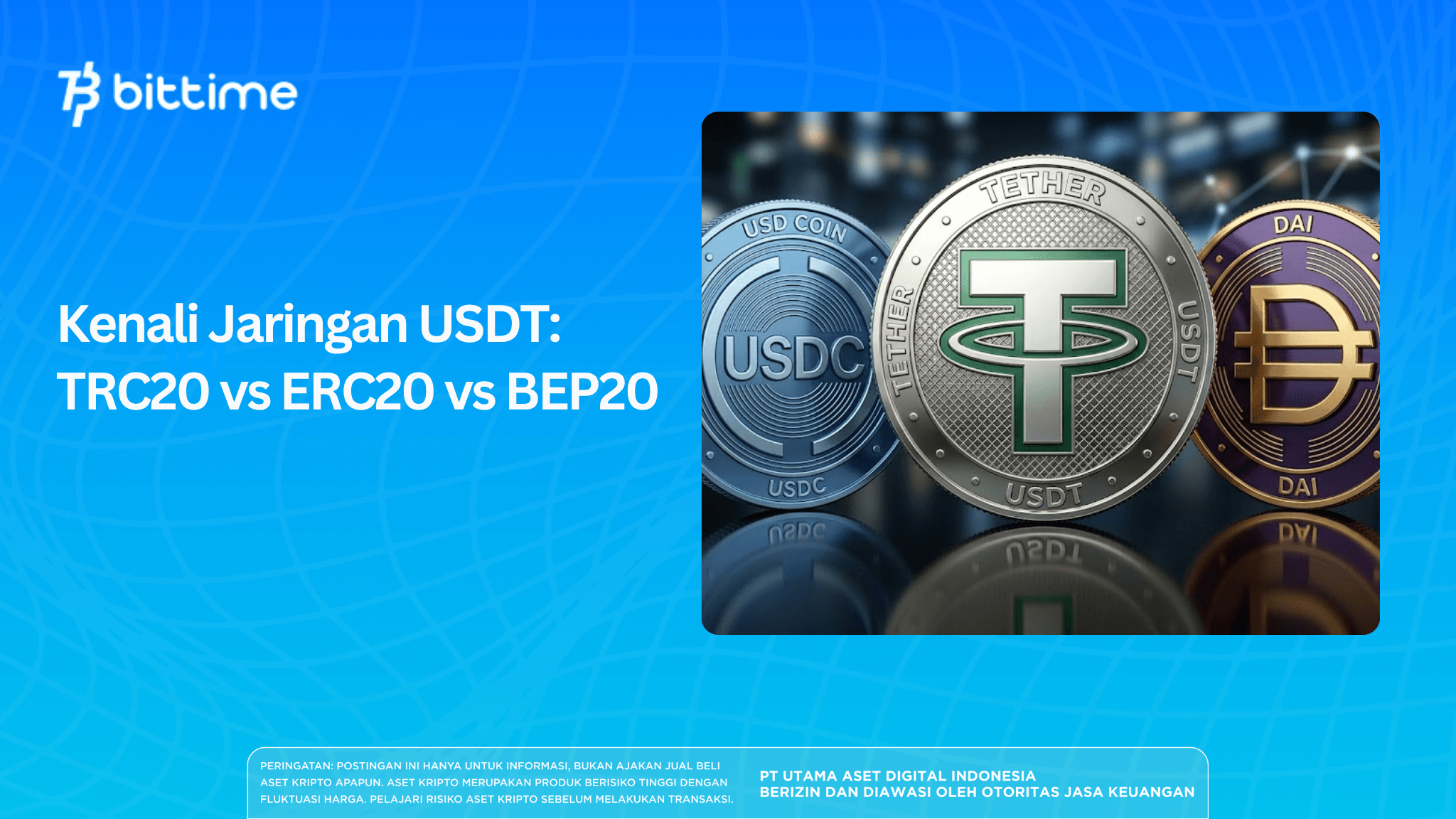
Try to recall the last time you wanted to send stablecoin USDT, when the exchange screen displayed three to four network options at once. If you hesitated when choosing between TRC20, ERC20, or BEP20, you are not alone.
Thousands of USDT transactions every day pause for a moment at the same point, because this single asset can actually "live" on several different blockchains with very different characteristics.
Key Takeaways
- TRC20 (TRON) is the most cost-effective and fastest for daily transfers, but its DeFi support is still limited.
- ERC20 (Ethereum) excels in the DeFi ecosystem, although its gas fees are the most expensive and fluctuate depending on network congestion.
- BEP20 (BNB Smart Chain) is the middle ground: low fees, reasonably fast, with continuously growing application support.
Why Can One USDT Run on Three Different Networks?
USDT is not a token that exists on only one blockchain. Tether issues USDT on many networks at once, including Ethereum (ERC20), BNB Smart Chain (BEP20), and TRON (TRC20). Their value remains the same as they all track the US dollar, but the technical pathways behind them are completely different.
The analogy is simple: USDT is the package content, while ERC20, BEP20, and TRC20 are the delivery routes. The package content is identical, but the vehicles and routes used are not the same. If the destination address only accepts packages via one specific route, you cannot just choose another route simply because its shipping cost is cheaper.
Read Also: 10 Stablecoins with the Largest Volume in the World
These three token standards are also all built with the Solidity programming language, and are used by popular projects such as Shiba Inu, PancakeSwap, and BitTorrent, according to community notes on Binance Square.
One thing that often confuses people: BEP20 runs on BNB Smart Chain, not the old Binance Chain (BEP2) — two different things even though the names are similar.
Before diving into the detailed comparison, if you want to start trading or transferring USDT safely on a platform that is already licensed by the OJK, you can register a Bittime account here and try it out directly.
Source: X/@tether
TRC20 vs ERC20 vs BEP20: Differences in Cost, Speed, and Risk
Here is a brief overview of these three networks:
TRC20 excels in cost and speed. The TRON network is designed to process transactions cheaply, making TRC20 a favorite for those who frequently move USDT between exchanges or send it to family, according to notes from Indodax Academy. Its drawback is that DeFi application support on TRON is still far narrower compared to Ethereum.
ERC20 is the oldest and most widely supported standard in the ecosystem. If you want to use USDT for swaps on decentralized exchanges, lending protocols, or Ethereum-based Web3 applications, ERC20 is almost always the mandatory choice. The consequence is that gas fees are paid in ETH and can spike when the network is congested.
BEP20 sits in the middle: fees are much more affordable compared to ERC20, transaction speeds are relatively fast due to the short block times of BNB Smart Chain, and its DeFi ecosystem continues to grow even though it is not yet as large as Ethereum. Its gas fees are paid in BNB.
Read Also: BI Stablecoin: Safe Investment in the Future of Crypto
One risk that applies equally to all three: choosing the wrong network is not just about losing fees, but can cause funds to get stuck. Because ERC20 and BEP20 addresses both start with "0x", many users assume they can be used interchangeably — even though the transaction is still recorded according to the network selected at the time of sending.
If the destination exchange only provides USDT ERC20 deposits, and you send via BEP20, the assets may not automatically credit and the recovery process depends on the platform's policy — some can help, some require additional fees, and some cannot be recovered at all.
The good news is that most cases of asset loss turn out not to be due to network hacks, but rather due to user error: selecting the wrong network, pasting the wrong address, or sending to a platform that does not support that network.
Conclusion
There is no single USDT network that is "the most correct" for every situation. TRC20 excels for fast and cheap transfers, ERC20 excels for access to the Ethereum DeFi ecosystem, and BEP20 is the cost-effective middle ground with continuously growing application support.
What is more important than simply looking for the cheapest fees is ensuring that the network you choose matches exactly the network supported by the destination platform. Before transferring a large amount, try sending a small amount first as a test, then save the TXID just in case you need to track it via a blockchain explorer.
Want assets whose value tracks the US dollar? Check the movements of USDT, USDC, USD1, and USDS. You can trade directly on Bittime!

Bittime is a Digital Financial Asset Trader (PAKD) platform licensed and supervised by the Financial Services Authority (OJK) — a place where you can buy Bitcoin in Indonesia and hundreds of other crypto assets starting from Rp10,000. The registration process is fast, secure, and can be started today.
Monitor the conversion of USDT to IDR and the price movements of your favorite crypto assets in real time. Everything is available in one crypto investment app that can be downloaded for free on the Play Store.
Ready to start? Register now on Bittime and execute your investment strategy with a platform trusted by millions of users in Indonesia.
FAQ
What are the main differences between TRC20, ERC20, and BEP20?
The three run on different blockchains: TRC20 on TRON, ERC20 on Ethereum, and BEP20 on BNB Smart Chain. These blockchain differences are what make their costs, speeds, and ecosystem support different as well.
Which network is the cheapest for sending USDT?
TRC20 is generally the cheapest, followed by BEP20, while ERC20 is usually the most expensive due to fluctuating Ethereum gas fees.
Is the value of USDT the same across these three networks?
Yes, the value remains the same because they all represent USDT that tracks the US dollar. What differs is only the blockchain network on which the token runs.
Why do both ERC20 and BEP20 addresses start with "0x"?
Because BNB Smart Chain is designed to be compatible with the Ethereum address format. Even though the format is similar, the transaction is still recorded on the blockchain according to the network selected at the time of sending.
What happens if you send USDT to an unsupported network?
The assets usually do not automatically credit to the destination account and the recovery process depends on the platform's policy. That is why checking the supported network before sending is far more important than chasing the lowest fees.
Which network is suitable for beginners?
TRC20 or BEP20 are often more beginner-friendly for everyday transactions because of their low fees. However, beginners must still ensure that the destination wallet or exchange truly supports the chosen network before sending.
Disclaimer: The views expressed belong exclusively to the author and do not reflect the views of this platform. This platform and its affiliates disclaim any responsibility for the accuracy or suitability of the information provided. It is for informational purposes only and not intended as financial or investment advice.

.png)