Shiba Inu Inflow Reaches 2.4 Trillion Tokens. What Triggered This Massive Surge?
2026-07-27
Shiba Inu inflows came into the spotlight after approximately 2.4 trillion SHIB tokens were recorded as entering exchange wallets within a 24-hour period on July 26, 2026. This activity occurred as the price moved rapidly from around $0.0000042 to the $0.0000054–$0.0000057 range.
However, a large inflow does not necessarily prove that a single whale is accumulating the token.
Key Takeaways
- The 2.4 trillion SHIB inflow was a gross inflow to the exchange, not a net purchase by a single whale.
- Demand from South Korean traders is one of the strongest factors behind Shiba Inu's rally.
- The SHIB rally remains at risk of a correction as exchange outflows are high and the price has moved very quickly.
What Happened to Shiba Inu Inflow?
In a 24-hour period, exchange wallets received approximately 2.4 trillion SHIB. At prices between $0.0000042 and $0.0000054, that amount is mathematically equivalent to a value of approximately $10.08 million to $12.96 million.
The numbers look large, but they need to be read carefully. The data in question is gross exchange inflow or all tokens entering the exchange wallet during the observation period. Gross inflow differs from netflow, which is the difference between incoming and outgoing tokens.
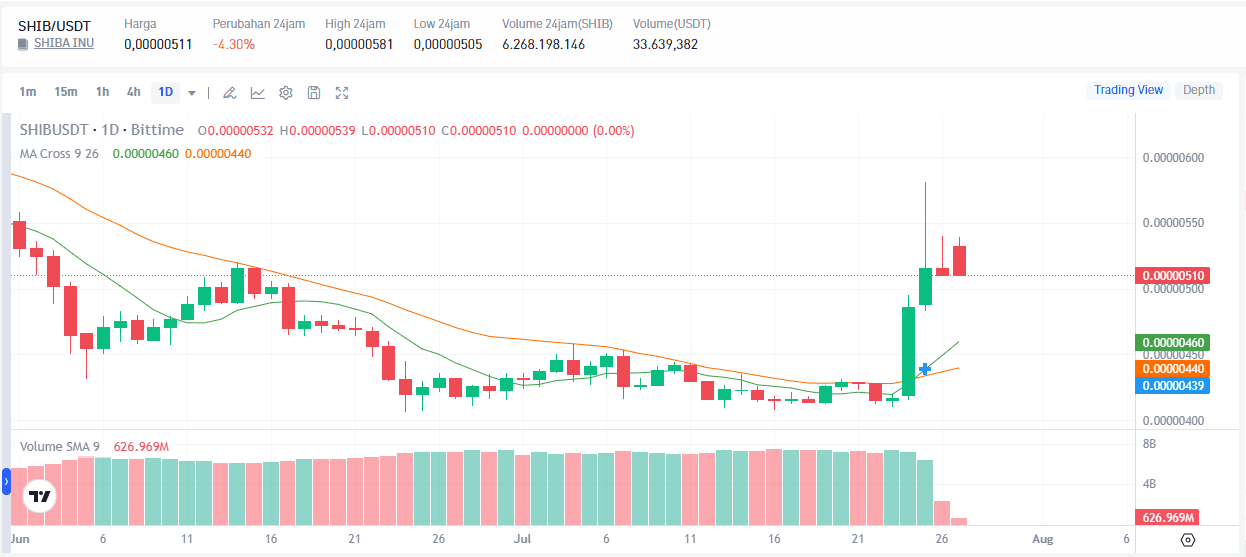
Source bittime.com/trade/SHIB-USDT
Around the same time, approximately 2.376 trillion SHIB were also recorded leaving trading platforms. Thus, the net flow was only around 22.6 billion tokens. This indicates very high two-way trading activity, not simply a wave of deposits for sale.
This distinction is important because exchange inflow is often interpreted as potential selling pressure. Tokens entering exchanges are indeed easier to sell, but when exchange outflow is nearly as large, the market may be experiencing:
- Rotation of positions between market players.
- Transferring tokens between platforms.
- Market maker activities.
- Liquidity adjustment.
- Buying and selling in large volumes.
- Withdraw tokens to personal wallet.
Therefore, the 2.4 trillion figure cannot be used alone to conclude that Shiba Inu whales are buying or selling.
Read also:Top Ethereum Meme Coins 2026: How to Buy on Bittime
Are SHIB Whales the Main Driver?
Activity by large holders likely contributed to the increase in volume, but the available data does not indicate that a single SHIB whale was responsible for the entire inflow. The movement is more consistent with the combined activity of traders, large holders, market makers, and liquidity providers.
Large-value transfers also do not always represent buy or sell transactions on the open market. For example, more than 1.16 trillion SHIB was transferred from wallets associated with Coinbase through several large transactions.
This transfer is believed to have resulted from an internal reorganization, rather than a sale by investors. The price also did not immediately experience a significant increase after the transfer took place.
Investors need to distinguish between several types of whale activity:
Whales Send SHIB to Exchanges
Transfers to exchanges could indicate that large holders are preparing tokens for sale, use as collateral, or transfer to a custodial service. The impact only becomes more bearish if the transfers are accompanied by increased net inflow and significant selling pressure.
Whales Withdraw SHIB from Exchanges
Withdrawals to personal wallets can reduce the supply immediately available for sale. However, these transactions can also be internal transfers or storage reorganizations.
Exchanges Move Tokens Between Wallets
Trading platforms routinely move assets between hot wallets, cold wallets, and operational addresses. The number of tokens can be substantial without changing the economic ownership in the market.
Therefore, the “whale transfer” label should not be immediately considered a buy or sell signal.
Read also:Shibarium Reaches 270 Million Wallets: What Does This Mean for Shiba Inu's Price?
South Korean Demand Sparks SHIB Rally
A more obvious catalyst for the SHIB rally was rising demand from South Korea. The SHIB/KRW pair on Upbit recorded a volume of approximately $62 million, accounting for more than 10% of SHIB’s global trading volume. Prices on that market were also trading at a slight premium compared to several international exchanges.
A premium occurs when the price of an asset on one platform is higher than on another. This condition may indicate stronger local demand.
The rally unfolded in two phases. The first surge occurred on Saturday night, after which the price moved relatively flat for several hours. The second wave took place during the Asian session, coinciding with increased activity from South Korean traders.
This pattern reinforces the assumption that the rally was not solely driven by whale transfers. Spot market demand played a larger role in driving the price.

Source: AI Generated Image
No New Fundamental Announcements
SHIB's approximately 36% surge occurred without any new product announcements or major developments within its ecosystem. There were no new catalysts from the Shibarium layer-2 network that could directly explain the price surge.
The movement of other dog-themed tokens was also more limited. Dogecoin only rose around 6% over the same period, while several smaller-cap tokens saw gains of around 10%. This performance difference suggests that capital inflows were more concentrated in SHIB, rather than a general rally in the meme coin sector.
Some factors that may be mutually reinforcing the rally include:
- A surge in purchases in the South Korean market.
- Relatively thin liquidity after a period of decline.
- Trader and market maker activities.
- Speculation after price breaks short-term resistance.
- Liquidation of short positions.
- The FOMO effect of rapid price increases.
- Increased attention on social media.
Short Liquidation Accelerates Shiba Inu Price Rise
When the price of SHIB begins to rise, traders who open short positions face losses. If the losses exceed the margin limit, the positions can be automatically liquidated.
Approximately $6 million in SHIB and 1000SHIB positions were liquidated across approximately 2,300 traders. Approximately $5 million of this amount came from short positions.
Short liquidation requires the platform to close the position by making a purchase. This process can create additional demand and accelerate the rally.
However, time-series data shows that the largest liquidations occurred after the price began to rise. This means that the short squeeze is more accurately viewed as a factor that amplified the rally, rather than its initial trigger. The liquidation volume is also considered insufficient to explain the overall price movement of approximately 36%.
The sequence of movements is likely to be as follows:
- Spot demand is starting to increase.
- Price breaks through the resistance area.
- Momentum traders joined in buying.
- Short positions are starting to get squeezed.
- Liquidation adds automatic purchases.
- FOMO drives volume higher.
- Prices enter volatile conditions.
Read also:SHIB Prediction 2030: 100 Million Shiba Inu Today Worth $781, Could It Be $19,710?
Why Are Stock Inflows Not Always Bearish?
In general, increased exchange inflow is often viewed negatively, as tokens entering exchanges are likely to be sold. However, this interpretation is only valid if supported by other indicators.
In this case, the inflow of approximately 2.4 trillion SHIB was nearly offset by the outflow of approximately 2.376 trillion SHIB. The small difference compared to the total movement indicates increased trading activity on both sides.
Exchange inflow is more likely to be bearish when:
- Net inflow increased sharply.
- Prices failed to rise despite high volume.
- Whales continue to send tokens to exchanges.
- Sell orders are getting thicker.
- Spot buying weakened.
- Price broke support with large volume.
Conversely, a large inflow is not necessarily bearish when:
- Outflow also increased.
- Spot demand absorbs supply.
- Volume and price rise together.
- The transfer comes from an internal reorganization.
- Tokens move between trading platforms.
Investors should examine gross inflow, gross outflow, and netflow simultaneously. Reading a single metric without context can lead to erroneous conclusions.
What is the Price of Shiba Inu Today?
On July 26, 2026,the price Shiba Inu It rose by around 36% to $0.0000057. This increase added approximately $1 billion to its market capitalization, bringing SHIB's market value to nearly $3.4 billion. Its daily trading volume is around $380 million.
As of July 27, 2026, the SHIB price was around $0.0000043. The difference from the previous day's peak indicates that some of the gains have been reversed, and volatility remains very high.
Corrections after sharp rallies are not uncommon. Short-term traders can realize profits, while late-entry buyers may sell when momentum begins to weaken.
This movement also demonstrates that a surge in inflow and volume doesn't guarantee continued price increases. The market needs to establish a new equilibrium after experiencing a short-term price change.
Read also:Shiba Inu (SHIB) Token Burning Increases 62,000%, What's the Impact?
Can Shiba Inu Still Rise?
Shiba Inu still has upside potential if spot demand continues and the price manages to hold above the breakout level. However, the potential for a continued rally needs to be assessed through confirmation, not just based on the magnitude of the token’s price movement.
Some signals that could support the continuation of the rally include:
- Volume remains high as prices rise.
- SHIB/KRW continues to record strong demand.
- South Korean premiums did not disappear suddenly.
- Exchange netflow did not turn very positive.
- Price formed a higher low after the correction.
- Previous resistance turned into support.
- The crypto market as a whole remains stable.
On the other hand, the risk of correction increases when:
- Volume drops when price tries to rise.
- South Korean traders are starting to take profits.
- Whales send more SHIB to exchanges.
- Net inflow increased without being matched by demand.
- Price fell back below the breakout area.
- Liquidation of long positions is starting to increase.
- Bitcoin and altcoin markets are weakening.
A one-day rally isn't enough to confirm a long-term trend change. A more consistent price structure and sustained demand are needed after the euphoria subsides.
Indicators to Monitor After the $2.4 Trillion SHIB Inflow
1. Exchange Netflow
Netflow provides a more useful picture than gross inflow. A large positive net inflow can increase the selling supply, while net outflow indicates more tokens leaving the exchange.
2. Volume SHIB/KRW
Korean won pair volume is a crucial indicator because it's the primary driver of the rally. A rapid drop in volume could signal that momentum is losing steam.
3. Price Differences Between Exchanges
A large premium indicates local demand but can also attract arbitrage. Arbitrage has the potential to narrow price differences while increasing selling pressure in more expensive markets.
4. Whale Shiba Inu Activities
Pay attention to the transfer direction, destination address, and whether the transaction is an internal transfer. Don't just look at the token amount.
5. Open Interest and Liquidation
A rapid increase in open interest can leave the market vulnerable to chain liquidations. After a short squeeze, the risk can reverse into a long squeeze if prices fall sharply.
6. Volume Spot
Rallies supported by spot buying generally have better fundamentals than those driven solely by leverage.
7. Support and Resistance
The price needs to hold the breakout area for the rally to develop into a more stable trend. Failure to hold this could send SHIB back to its pre-surge range.
Is Now a Good Time to Buy SHIB Crypto?
There's no one-size-fits-all answer for all investors. Buying after a 36% increase carries different risks than buying when the price is stable.
Before making a decision, consider:
- Is the purchase intended for trading or investment?
- What is the maximum loss that can be accepted?
- Is the price still near support?
- Is purchasing volume remaining strong?
- Where is the position declared invalid?
- Was the decision made due to analysis or FOMO?
- How big is SHIB in the overall portfolio?
Avoid using all your capital to chase a candlestick that has already risen sharply. A gradual buying strategy, limiting position size, and setting exit points can help control risk.
To monitor the market and available crypto assets, you can register an account. Bittime and learn the transaction features first. Also check the latest news and price analysis at Bittime Blog before making decisions based on short-term movements.
Trading crypto assets carries a high level of risk. Prices can fluctuate significantly, and past performance does not guarantee future results.
Conclusion
The surge in Shiba Inu inflows of 2.4 trillion tokens reflects increased market activity, but it is not evidence that a single whale purchased the entire amount. That figure represents gross exchange inflows that were nearly offset by outflows of a similar magnitude.
The most obvious catalyst for the SHIB rally was strong buying from South Korean traders. The volume of the SHIB/KRW pair, the local price premium, technical momentum, and short liquidations collectively accelerated the rally.
However, the price has corrected following the sharp rally. Investors should monitor net flows, spot volume, whale activity, demand from South Korea, and price structure before concluding that a new bullish trend has formed.
Check the prices of memecoins like Dogecoin (DOGE), Shiba Inu (SHIB), Pepe (PEPE), and Bonk (BONK), then start trading on Bittime.
Use Bittime to monitor the market and read the latest updates, but always tailor your decisions to your risk profile.

Bittime is a licensed and regulated Digital Financial Asset Trader (PAKD) supervised by Indonesia’s Financial Services Authority (OJK) — where you can buy Bitcoin in Indonesia and hundreds of other crypto assets starting from just Rp10,000. The registration process is fast, secure, and you can get started today.
Track USDT to IDR conversions and monitor your favorite crypto assets in real time. Everything is available in one crypto investment app that you can download for free on the Play Store
Ready to start? Register now on Bittime and execute your investment strategy with a platform trusted by millions of users in Indonesia.
FAQ
What does the 2.4 trillion SHIB inflow mean?
The figures show that approximately 2.4 trillion SHIB entered exchange wallets in 24 hours. This figure represents gross inflow, not net flow, and does not indicate purchases by a single whale.
Does exchange inflow cause the SHIB price to drop?
Not always. Inflow can increase the potential for selling pressure, but the impact depends on outflow, spot demand, net flow, and liquidity conditions.
Why did the price of Shiba Inu rise sharply?
The rise was primarily attributed to strong buying by South Korean traders. Momentum was then amplified by a technical breakout, FOMO, and the liquidation of short positions.
Are SHIB whales accumulating?
Whale activity is indeed increasing, but large transfers don't necessarily represent accumulation. Some transactions can originate from market makers, exchanges, custodial services, or internal transfers.
Will the SHIB rally continue?
The continuation of the rally depends on spot volume, exchange netflow, South Korean demand, and the price's ability to maintain support. A single day's gain isn't enough to confirm a long-term trend change.
Disclaimer: The views expressed belong exclusively to the author and do not reflect the views of this platform. This platform and its affiliates disclaim any responsibility for the accuracy or suitability of the information provided. It is for informational purposes only and not intended as financial or investment advice.

.png)