Quant QNT Rises 300%: Here's Why It's Rising and What's Next
2026-09-30
Quant QNT rose sharply in a short period and once again became one of the crypto assets receiving the most market attention. QNT moved from around US$60–70 to briefly break above US$350 in a major rally following new developments related to banking tokenization in the United States.
The biggest question now is not only why Quant rose, but whether the rally is supported by developments in Quant Network’s fundamentals or is largely driven by short-term trading momentum.
The answer lies in a combination of institutional adoption, asset tokenization trends, blockchain interoperability, and increasing speculation in the QNT market.
Key Takeaways
- Quant attracted attention after being selected to support The Clearing House’s tokenized deposit infrastructure in the US.
- The QNT rally was also supported by momentum in RWA tokenization and high trading activity.
- Adoption of Quant technology does not mean the price of QNT will always rise, as volatility and correction risks remain high.
Quant QNT Rises Sharply: What Is Really Happening?
The biggest fundamental catalyst emerged on September 24, 2026. The Clearing House selected Quant to support the On-Chain Money Initiative, a network designed to enable financial institutions to clear and settle tokenized deposits.
Quant will provide interoperability, orchestration, and transaction management layers. The infrastructure will also connect with existing fiat payment networks such as RTP and CHIPS.
The news had a major impact on the market. QNT, which had previously been around US$60–70, then surged into the hundreds of dollars and briefly reached above US$350.
Quant price today can of course change within minutes. When market data was checked on September 30, 2026, QNT was around Rp4.53 million, with a change of approximately +14% over 24 hours.
Therefore, the latest QNT price should always be checked directly against market data before making a decision.
Quant QNT Price Analysis
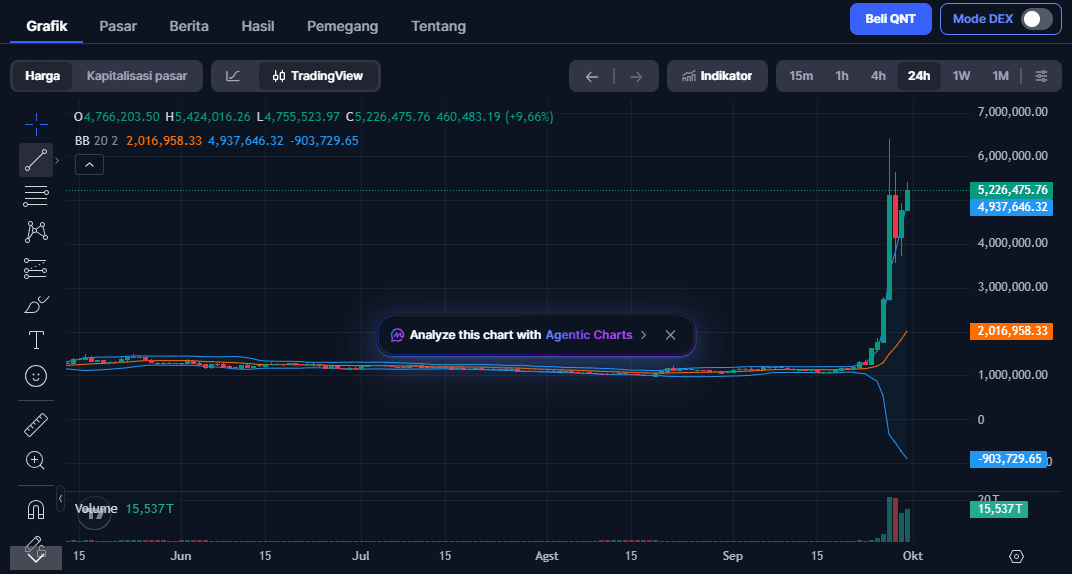
On the daily chart, QNT appears to be in a very strong bullish momentum phase after breaking out of a consolidation area around Rp1 million and rapidly moving above Rp5 million.
The latest candle shows that the price opened at around Rp4.77 million, briefly reached Rp5.42 million, and then stood at around Rp5.23 million, up 9.66%. The surge was also accompanied by a significant increase in volume, indicating that the breakout was supported by strong trading activity.
However, the price is now above the upper Bollinger Band at around Rp4.94 million, indicating that momentum remains positive while also showing that the price has become quite extended after the rapid rise.
In the short term, the Rp5.4 million area is the first resistance to watch. If QNT can consistently close daily candles above that level while volume remains strong, the price could retest the previous peak around Rp6 million to Rp6.3 million.
From around Rp5.23 million, a move toward Rp6.3 million would represent potential upside of about 20%. A clean breakout above that peak could open room for further gains because the price would enter an area with relatively little historical resistance on this chart.
Even so, that upside potential comes with a high risk of a correction. After a vertical rally, profit-taking typically increases and volatility can widen. The Rp4.9 million area could become short-term support, while the Rp4 million–Rp4.3 million zone is an area to watch if selling pressure strengthens.
Therefore, the bullish signal for QNT would be more convincing if the price can hold the Rp4.9 million area and break through Rp5.4 million with strong volume, rather than rising only because of a brief price spike.
5 Key Factors Behind the Rise in Quant QNT
1. Partnership with US Banking Infrastructure
The biggest factor is The Clearing House’s decision to use Quant technology for the On-Chain Money Initiative.
The Clearing House is not a new crypto network. Its payment infrastructure processes more than US$2 trillion in transactions every day through various payment rails in the United States.
For the market, Quant’s involvement strengthens the perception that the company’s technology can be used in financial systems with demanding scale and regulatory requirements.
However, investors need to distinguish between the success of Quant the company and direct demand for the QNT token. The two are related within the ecosystem, but they do not necessarily move in the same proportion.
2. Growing RWA Tokenization Trend
The QNT rally occurred alongside growing market attention to RWA tokenization, or real-world asset crypto.
RWA refers to real-world assets such as bonds, money market instruments, property, credit, or other financial assets represented using blockchain technology.
The value of real-world assets held on-chain has reached approximately US$40.9 billion in the latest data cited at the end of September 2026. The figure has also increased by around 4.2% over 30 days.
This growth has brought renewed attention to projects related to tokenization infrastructure.
3. Quant Offers Blockchain Interoperability
One of the main challenges for institutional blockchain adoption is fragmentation.
A bank may use a private ledger. Another capital market may use a different network, while certain assets or liquidity may be available on a public blockchain such as Ethereum.
All of these systems must be able to communicate without requiring institutions to replace their entire existing infrastructure.
This is where Quant Overledger fits in.
Overledger provides an API layer that allows companies to connect multiple blockchains and traditional systems through a single interoperability layer. The system is designed so companies do not have to build separate integrations for every network.
4. Derivatives Activity Amplifies Price Movements
A fundamental rise can turn into an extreme rally when leverage enters the market.
During the early phase of the rally, QNT futures volume was reported to be far higher than spot volume. Open interest also rose sharply.
This can create a short squeeze. When the price rises and short positions begin to be liquidated, forced buying can accelerate the price increase.
The same effect applies when the price reverses downward. Highly leveraged long positions can be liquidated, accelerating the correction.
5. Institutional Crypto Narrative Gains Strength Again
The rise in Quant crypto is not happening in a vacuum.
Banks, investment firms, and market infrastructure providers are increasingly exploring tokenized deposits, tokenized funds, digital bonds, and other blockchain-based assets.
In the UK, several major banks have also conducted interbank transactions using tokenized deposits.
These developments strengthen the narrative that tokenization is moving from an experimental phase toward more tangible financial implementation.
What Is Quant Network and the QNT Token?
Quant Network is a project focused on interoperability between blockchains, distributed ledger technology, and traditional enterprise systems.
Its main product is Overledger.
Rather than creating a single blockchain that every company must use, Quant’s approach is to help multiple existing networks communicate with one another.
What Is Quant Overledger Used For?
Simply put, imagine an institution that needs to connect to Ethereum, a private network, a bank payment system, and other blockchains.
Without an interoperability layer, an institution may require many integrations. Overledger seeks to simplify this process through a single API layer.
The technology can be used for several purposes, including:
- connecting blockchain networks;
- issuing digital assets;
- building multi-chain applications;
- connecting enterprise systems with DLT;
- supporting digital asset transactions and settlement.
This is what differentiates Quant from crypto projects that focus on only one blockchain.
So What Is the QNT Token Used For?
QNT is the utility token within the Quant ecosystem.
Historically, QNT has been used in certain access and licensing mechanisms on Overledger. Quant documentation also indicates that QNT has functions related to license payments and staking mechanisms for certain services.
However, one important point needs to be understood. Institutional use of Quant technology does not automatically mean that all economic value from institutional transactions will flow directly to QNT. Therefore, investors need to assess utility-token developments separately from the company partnership headline.
3 Reasons Quant Is Linked to RWA Tokenization
1. Tokenized Assets Require Interoperability
Tokenisasi RWA will not take place on just one blockchain.
Banks, investment managers, companies, and infrastructure providers may choose different networks based on security, privacy, regulatory, or cost requirements.
The more networks emerge, the greater the need to connect them all. This makes interoperability an important part of tokenization infrastructure.
2. Quant Is Already Active in Financial Infrastructure
Quant is not associated with crypto RWA solely because of market sentiment. Its technology has been used in several projects involving tokenized deposits, digital money, blockchain interoperability, and institutional settlement.
In March 2026, Quant also announced a partnership with Murex to bring tokenized deposit and digital bond settlement capabilities to capital market infrastructure.
This helps explain why the market often includes Quant in the crypto RWA narrative.
3. Tokenization Requires a Bridge to Legacy Systems
Financial institutions will not replace their core systems overnight. They need technology that can connect existing systems with new blockchain networks. This model fits the Overledger approach, which functions as an interoperability layer.
Therefore, Quant’s opportunity in RWA tokenization depends not only on the amount of assets being tokenized, but also on how strong the market’s need is for connectivity between networks.
Why Do Institutions Need Blockchain Interoperability?
Interoperability becomes important as financial systems use an increasing number of networks. Without interoperability, money or assets can become trapped within a particular ecosystem. Institutions would also have to build point-to-point connections repeatedly.
For banks, this can increase integration and reconciliation costs, operational risk, and compliance complexity. Interoperability solutions aim to make these connections simpler. For example, a payment instruction could involve tokenized deposits on one network and tokenized securities on another.
If the two systems can communicate, the settlement process could become more automated. This is why blockchain interoperability is receiving attention as institutions begin taking tokenization seriously.
Quant Advantages to Consider
Quant has several factors that differentiate it from many crypto projects. First is its focus on institutions and enterprises. Second is its positioning as interoperability infrastructure rather than simply another blockchain.
Third is Quant’s involvement in tokenization and payment projects that touch traditional financial systems. Fourth is the scarcity of QNT compared with many other tokens. Market data indicates that the maximum supply is around 14 million tokens.
Scarcity can amplify price movements when demand rises quickly, but the same effect can also increase volatility when investors take profits.
QNT Risks After a Major Rally
A rally of hundreds of percent does not only create opportunities. Risks also increase.
1. Profit Taking
Investors who bought QNT before the rally have large unrealized profits. When the price rises too quickly, some investors may sell to lock in gains. QNT itself has experienced sharp corrections after previous surges.
2. High Leverage
Futures activity can amplify movements in both directions. A short squeeze can accelerate gains, while long liquidations can accelerate declines. Beginner traders should not view a rapid rise as proof that the price will continue moving higher.
3. Excessively High Expectations
Markets sometimes value a project based on its future potential before its economic impact is actually visible. The On-Chain Money Initiative itself is targeted to be available to institutions in the first half of 2027. This means there is still a gap between the partnership announcement, network implementation, actual usage, and its impact on the QNT ecosystem.
4. The Relationship Between Revenue and Token Price Is Not Always Direct
This is a risk that is often overlooked. A blockchain company can secure institutional partnerships without automatically creating token demand on the same scale. Investors need to examine how QNT utility, staking, network fees, and ecosystem activity develop as technology adoption increases.
5 Things to Understand Before Looking at Quant Price Predictions
Quant price predictions should not rely on charts alone.
There are five factors that are more useful to monitor.
- The Clearing House Implementation
Watch the development of the On-Chain Money Initiative ahead of its targeted launch in 2027. - RWA Tokenization Growth
The greater the use of tokenized assets, the greater the potential need for interoperability. - QNT Token Utility
Investors should assess whether the use of Quant Network is increasing real demand for QNT. - Spot Versus Derivatives Volume
A spot-supported rally typically has different characteristics from a rally dominated by leverage. - Overall Crypto Market Conditions
Bitcoin, global liquidity, interest rates, and risk sentiment can still affect QNT.
No single factor can guarantee the future of Quant Network or the price of its token.
If you want to follow the latest updates on the crypto market, you can register with Bittime to receive market information, the latest news, and regular analysis. Always conduct your own research before making trading decisions.
Is QNT Still Attractive After the Rally?
The answer depends on why someone is considering QNT. For traders, volatility and momentum are key factors.
For longer-term investors, the more relevant question is whether Quant can turn its technological position into sustainable network usage. The current institutional catalyst is real. The Clearing House did select Quant as a technology provider for an important part of its infrastructure.
However, the token price has already undergone significant repricing in a short period. This means improving fundamentals must be weighed alongside valuation and volatility risks.
Conclusion
Quant QNT rose sharply due to a combination of fundamental catalysts and market activity. Quant’s partnership with The Clearing House was the main trigger, while RWA tokenization trends, interoperability, short squeezes, and institutional crypto sentiment increased attention toward QNT.
Quant Network’s prospects are worth monitoring because institutions need ways to connect various blockchains and traditional financial systems. However, technology adoption does not guarantee that the QNT token will continue to rise, so developments in token utility, project implementation, market volume, and correction risks still need attention.
If you are following QNT after this major rally, use the latest price and market data before making a decision. You can also follow crypto updates on Bittime to compare Quant’s development with other crypto RWA projects.

Bittime is a licensed Digital Financial Asset Trader (PAKD) platform authorized and supervised by the Financial Services Authority (OJK) — where you can buy Bitcoin in Indonesia and hundreds of other crypto assets starting from Rp10,000. Registration is fast and secure, and you can get started today.
Track the conversion USDT to IDR and the real-time price movements of your favorite crypto assets. Everything is available in one crypto investment app that can be downloaded for free from the Play Store.
Ready to get started? Register now on Bittime and execute your investment strategy with a platform trusted by millions of users in Indonesia.
FAQ
Why is Quant (QNT) rising?
Quant QNT rose primarily after The Clearing House selected Quant to support the On-Chain Money Initiative in the United States. The momentum was then amplified by the tokenization narrative, derivatives activity, and growing market attention toward interoperability projects.
What is Quant Network?
Quant Network is a blockchain interoperability technology provider that develops Overledger. The technology helps connect blockchains, distributed ledgers, and enterprise systems through an interoperability layer.
Is Quant related to RWA tokenization?
Yes, Quant technology is relevant to RWA tokenization because assets issued across different networks require interoperability and settlement. Quant is also involved in tokenized deposit and digital asset infrastructure, although QNT is not a token representing any specific RWA.
Does QNT still have growth potential?
QNT still has catalysts to monitor, such as institutional project implementation, Overledger developments, token utility, and tokenization growth. However, after a major rally, correction and profit-taking risks also increase, so there is no guarantee that the price will continue rising.
What are the risks of investing in Quant crypto?
The main risks include high volatility, post-rally corrections, market leverage, shifts in crypto sentiment, and uncertainty over how much adoption of Quant technology will generate direct demand for QNT. Therefore, investment decisions should not be based solely on short-term price increases.
Disclaimer: The views expressed belong exclusively to the author and do not reflect the views of this platform. This platform and its affiliates disclaim any responsibility for the accuracy or suitability of the information provided. It is for informational purposes only and not intended as financial or investment advice.
.png)