World Oil Prices Today: Why the Market Has Been in Turmoil in 2026
2026-05-02
Since late February 2026, world oil prices have surged nearly 60% in just two months. WTI Crude — the US benchmark — which had been trading around $67 per barrel before the conflict, now sits above $100. Brent Crude briefly touched $126 per barrel on April 30, 2026, its highest intraday level since Russia's full-scale invasion of Ukraine in 2022.
No single cause is behind the spike. The US-Iran conflict, the closure of the Strait of Hormuz, the United Arab Emirates' abrupt exit from OPEC, and stalled peace negotiations have combined to create a supply shock that the International Energy Agency has described as unprecedented.
Understanding what drives global oil prices today is essential for anyone trying to read where the energy market is heading — and what it means for inflation, trade, and everyday costs around the world.
Key Takeaways
- World oil prices today remain far above their long-run average — Brent is holding above $110 per barrel and WTI near $100 per barrel as of early May 2026, driven by a massive supply disruption from the US-Iran conflict and the closure of the Strait of Hormuz.
- The Strait of Hormuz is the single most critical pressure point — roughly 20% of the world's oil and LNG supply passes through it daily. Goldman Sachs estimates exports through the strait have fallen to just 4% of normal levels.
- The UAE's exit from OPEC has weakened the world's most influential oil cartel, though its immediate price impact has been overshadowed by the far larger geopolitical shock still unfolding in the Persian Gulf.
World Oil Prices Today: Where Do They Stand?
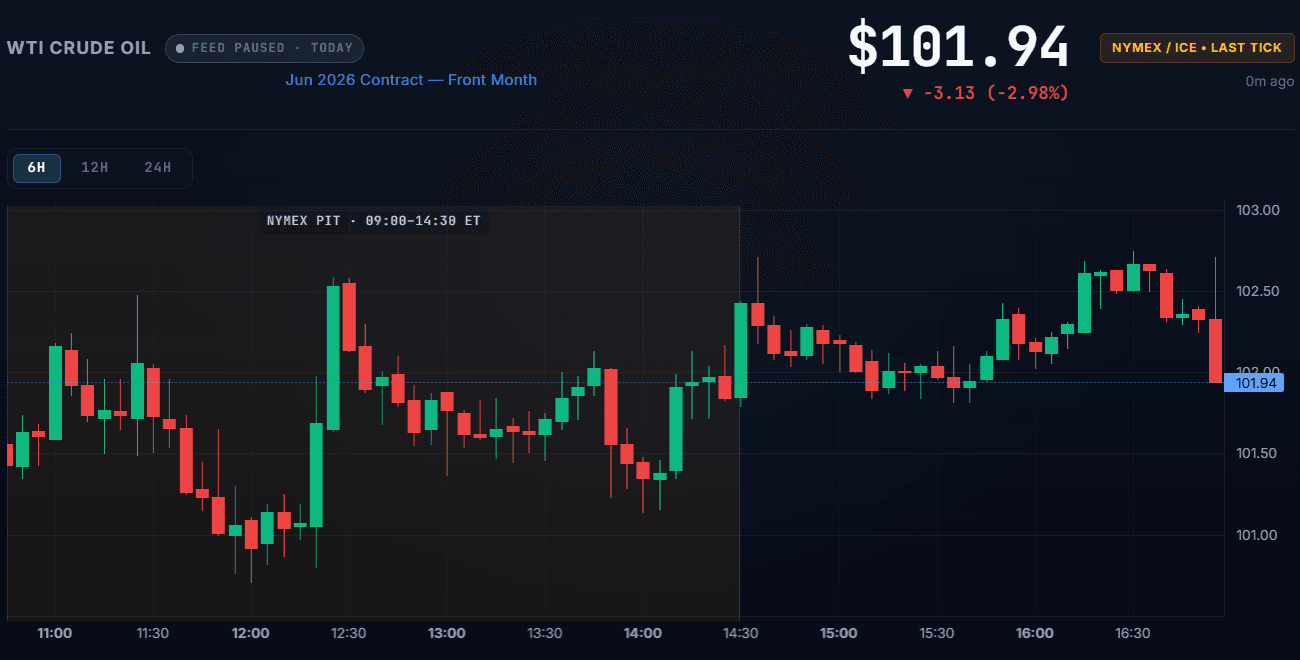
As of early May 2026, WTI Crude opened at around $105 per barrel and briefly touched $111 before pulling back toward $100 following reports that Iran had sent a fresh peace proposal to Washington. Brent Crude is trading in the $110 to $114 range after earlier hitting its wartime high of $126.
The IEA has characterized the situation as an unprecedented supply shock, and its effects are showing up well beyond the trading floor. Gasoline prices in the United States reached their highest level in nearly four years.
The US Consumer Price Index climbed to 3.3% on an annual basis in April, driven significantly by the energy component.
Oxford Economics projects Brent will average around $113 per barrel through the current quarter before potentially falling back below $80 by the end of 2026 — provided the conflict reaches some form of resolution.
The Strait of Hormuz: The World's Most Critical Oil Chokepoint
The Strait of Hormuz is a narrow waterway roughly 33 kilometers wide connecting the Persian Gulf to the Gulf of Oman. Around 20% of the world's daily oil and liquefied natural gas supply — approximately 20 million barrels of crude, fuels, and petrochemicals — passes through it every day, destined primarily for markets in Asia and Europe.
When the US and Israel launched strikes against Iran on February 28, 2026, Tehran responded by closing access to the strait. The US then tightened pressure further with a naval blockade of Iranian ports.
Goldman Sachs estimates that exports through the chokepoint have since fallen to just 4% of their normal volume.
Even if hostilities ended immediately, analysts say a full return to normal market conditions would take four to six months — accounting for the time needed to clear sea mines, ease tanker congestion, and gradually restart production and refining capacity.
Andy Lipow, president of Lipow Oil Associates, put it plainly: if the conflict ended tomorrow, crude prices would likely drop by around $10 per barrel, but full stabilization would still take months.
OPEC and the UAE Exit: What It Means for Oil Markets
On April 29, 2026, the United Arab Emirates announced it would leave OPEC effective May 1 — ending more than six decades of membership.
The move had been anticipated for some time, as the UAE had repeatedly clashed with Saudi Arabia over production quotas that it felt were constraining its investment and output capacity.
In theory, leaving OPEC gives the UAE the freedom to raise its production from around 3.4 million barrels per day toward a potential 5 million barrels per day.
Dutch bank ING described the departure as "a big blow" to OPEC, noting it would erode the cartel's influence over the global market and would be welcomed by oil-importing nations.
In practice, however, while the Strait of Hormuz remains closed, any additional UAE production cannot reach global buyers. Analysts widely agree that the "war premium" — the price spike driven by conflict uncertainty — currently overrides all other market fundamentals.
Across OPEC as a whole, production reportedly fell 27% to 20.79 million barrels per day in March 2026, largely as a result of the Middle East supply disruption.
Structural Factors That Move Oil Prices Over Time
Beyond the acute crisis, several structural forces always shape the medium to long-term trajectory of global oil prices:
Global Demand. Economic growth in major consuming nations — China, India, and the United States chief among them — directly drives energy consumption. When economies expand, oil demand rises and prices follow.
Recessions or slowdowns push in the opposite direction. Goldman Sachs noted that global oil consumption in April 2026 was running roughly 3.6 million barrels per day below February levels, a reflection of demand destruction caused by the price spike itself.
EIA Inventory Reports. Each week, the US Energy Information Administration publishes data on changes in domestic crude oil stockpiles. A drawdown in inventories typically signals strong consumption or tightening exports and pushes prices higher.
A build in stocks signals weaker demand or rising production and tends to pull prices lower. Traders watch these weekly figures closely as a real-time gauge of market balance.
The US Dollar. Oil is priced and traded in US dollars globally. When the dollar strengthens, oil becomes more expensive in local currency terms for buyers outside the US, which can dampen international demand and weigh on prices.
A weaker dollar has the reverse effect — it makes oil cheaper in relative terms for foreign importers, supporting demand and lifting prices.
Speculation in Futures Markets. Institutional traders and hedge funds actively trade oil futures contracts on exchanges such as NYMEX and ICE.
Large shifts in speculative positioning can amplify price trends in the short term — sometimes significantly — even before any real-world change in physical supply or consumption has occurred.
Bill Perkins, chief investment officer at Skylar Capital Management, described current market dynamics as being driven by "a mix of physical disruptions, geopolitics and investor psychology," with traders closely tracking tanker movements and political signals in real time.
Conclusion
World oil prices today sit at the intersection of an acute geopolitical crisis and deeper structural forces that will outlast any single conflict. The closed Strait of Hormuz, a weakened OPEC after the UAE's departure, and unresolved US-Iran negotiations are the three most decisive short-term variables.
In the medium term, a diplomatic resolution and the reopening of shipping lanes would be the primary catalysts for a price correction. What the current episode underscores is a reality that holds in any market environment: oil prices never move for a single reason.
Geopolitics, production policy, macroeconomic conditions, and market sentiment always work in combination — and understanding each layer is what separates informed analysis from noise.
FAQ
What is the oil price today?
As of early May 2026, WTI Crude is trading in the range of $100 to $108 per barrel, while Brent Crude is around $110 to $114 per barrel. Prices have been highly volatile, moving sharply with each development in US-Iran negotiations and the status of the Strait of Hormuz. For live prices, monitor platforms such as OilPrice.com or Trading Economics.
Why have oil prices risen so sharply in 2026?
The primary trigger was the US-Israeli military strikes on Iran that began on February 28, 2026. Iran responded by closing the Strait of Hormuz — cutting off roughly 20% of global oil and LNG flows. The US subsequently imposed a naval blockade of Iranian ports. The combination of these two disruptions created what the IEA has called an unprecedented supply shock, sending Brent up nearly 60% from pre-conflict levels.
How does the UAE's OPEC exit affect oil prices?
Over the medium term, the UAE's departure from OPEC frees it to significantly increase production beyond its former quota. However, as long as the Strait of Hormuz remains closed, additional UAE output cannot reach global markets. Analysts expect the real production impact to materialize gradually once the conflict is resolved and shipping lanes reopen.
What factors influence global oil prices beyond geopolitics?
In addition to geopolitical events, oil prices are shaped by OPEC production decisions, weekly EIA inventory data, the strength of the US dollar, global economic growth trends, and speculative activity in futures markets. Under normal conditions — without an acute crisis — the balance between global supply and demand is the primary driver of price direction over the medium term.
Will oil prices come back down?
Oxford Economics projects Brent could fall back below $80 per barrel by the end of 2026, assuming the US-Iran conflict reaches a resolution and the Strait of Hormuz is reopened. Even so, analysts estimate that full market normalization would take four to six months after any ceasefire, due to the logistical complexity of clearing shipping lanes, restarting production, and rebuilding depleted inventories.
How to Buy Crypto on Bittime?

Want to trade sell buy Bitcoins and crypto investment easily? Bittime is here to help! As an Indonesian crypto exchange officially registered with Bappebti, Bittime ensures every transaction is safe and fast.
Start with registration and identity verification, then make a minimum deposit of IDR 10,000. After that, you can immediately buy your favorite digital assets!
Check the exchange rate BTC to IDR, ETH to IDR, SOL to IDR and other crypto assets to find out today's crypto market trends in real-time on Bittime.
Also, visit the Bittime Blog for interesting updates and educational information about the crypto world. Find reliable articles about Web3, blockchain technology, and digital asset investment tips designed to enrich your crypto knowledge.
Disclaimer: The views expressed belong exclusively to the author and do not reflect the views of this platform. This platform and its affiliates disclaim any responsibility for the accuracy or suitability of the information provided. It is for informational purposes only and not intended as financial or investment advice.

.png)