JTO Price Is Expected to Rise Thanks to Revenue Sharing and a Share Buyback
2026-06-17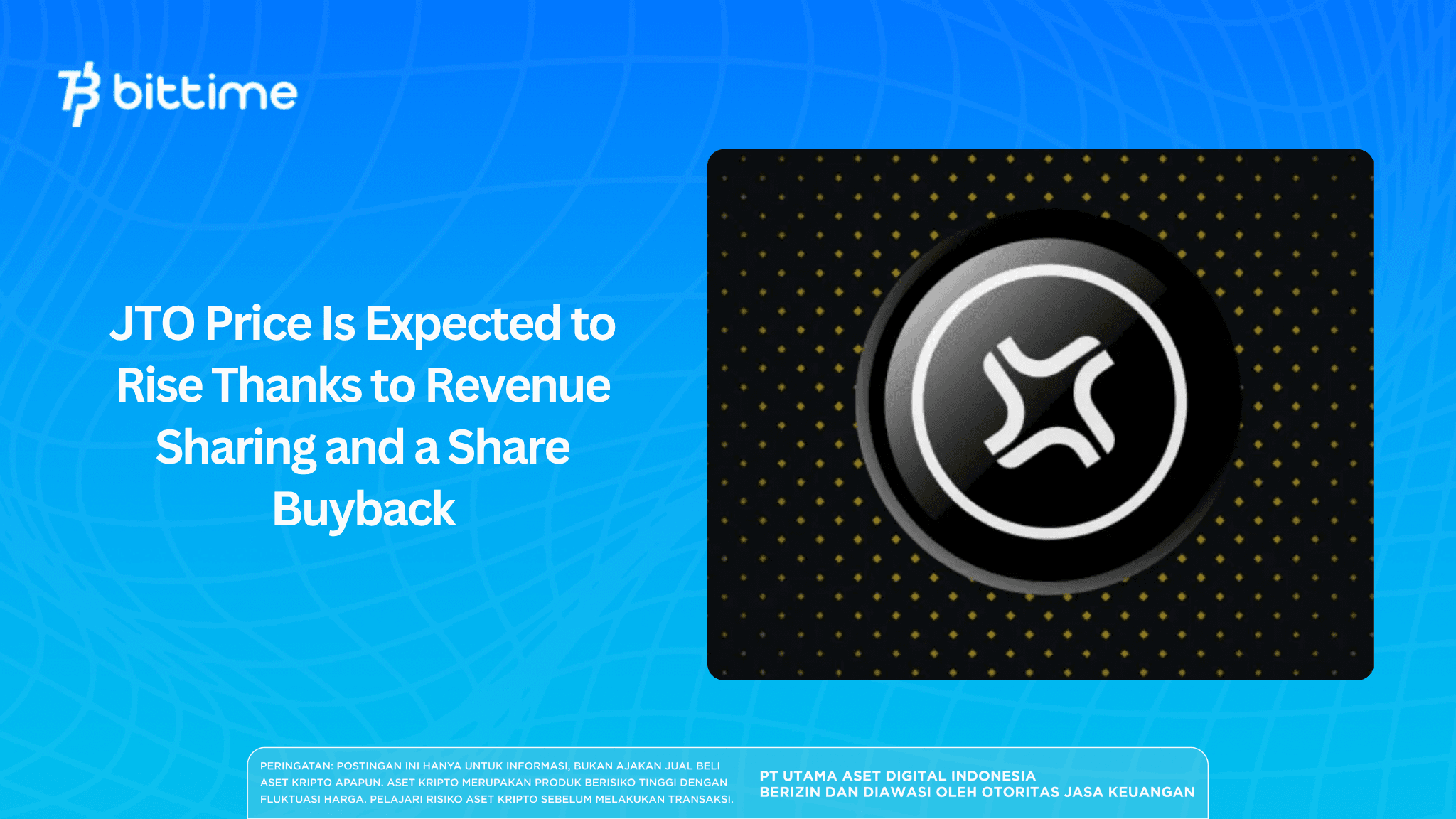
Solana governance token, Jito (JTO), is once again drawing market attention after posting an intraday gain of up to 18% in early June 2026.
This rally was driven not only by technical factors, but also by the emergence of a new narrative called the Jito Economy, a crypto-economic vision that places JTO at the center of value accumulation from various products within the Jito ecosystem.
Amid many governance tokens that struggle to maintain relevance, Jito’s approach of combining buybacks, revenue-based distribution, and cross-product integration is starting to attract investor attention.
So, is this narrative strong enough to push JTO higher in 2026?
Key Takeaways
- JTO surged after the market responded positively to the Jito Economy narrative, which emphasizes value accumulation from various revenue sources.
- The buyback mechanism is considered healthier than token-inflation-based incentives, which often suppress price over the long term.
- The US$1 area is an important psychological level, while the medium-term target is around US$1.50 if the momentum continues.
Register at Bittime now and start crypto trading with a fast, safe, and easy process in the app.
What Is Jito (JTO)?
Before discussing the price prediction, it is important to understand what the Jito JTO token is.
Jito is one of the largest protocols in the Solana ecosystem, focusing on liquid staking and MEV (Maximal Extractable Value).
Its main product is JitoSOL, a liquid staking asset that allows users to earn staking rewards while still maintaining asset liquidity.
JTO functions as a governance token that allows holders to participate in decision-making related to the development of the Jito ecosystem.
However, as the project develops, JTO’s role is shifting from a mere governance token to an asset that can potentially capture economic value from various services within the Jito network.
Read also: Solana (SOL) Staking Guide 2026 from A to Z for Passive Income
The Jito Economy Narrative That Is Changing Market Sentiment
The main catalyst behind the latest rise came from a statement by the Jito governance team saying the project could become one of the first truly sustainable crypto economies.
In this concept, JTO is not only a voting token, but also the center for aligning economic incentives across the ecosystem.
Some revenue sources said to support this model include:
- JTX
- JitoSOL
- BAM
- Other ecosystem products and services
This is what later formed the Jito Economy Narrative, the idea that the growth of all Jito products will ultimately increase demand for JTO.
This narrative is considered more attractive than traditional governance tokens, which often have no direct connection to protocol revenue.
Track the price movements of other popular coins such as Solana (SOL) only on the Bittime market!
Jito Revenue Sharing Impact: Why Are Investors Starting to Get Interested?
One reason the market is responding positively is the emergence of expectations around a mechanism similar to revenue sharing.
Although JTO does not directly distribute revenue to holders like a stock dividend, the idea is that part of the value generated by the ecosystem is used to buy back tokens from the market.
In practice, this creates an effect similar to revenue sharing because revenue growth can potentially increase demand for the token.
For investors, this approach is considered more sustainable than distributing new tokens, which can add selling pressure.
The larger the economic activity in the Jito ecosystem, the greater the potential impact on JTO’s value.
Read also: How to Get a Solana Faucet: A Complete Guide for Beginners
JTO Buyback Mechanism Becomes an Important Factor
The most discussed topic right now is the JTO buyback mechanism.
Buyback is a strategy in which a project buys back tokens circulating in the market using revenue or cash it holds.
In the crypto world, this mechanism has several advantages:
First, it reduces inflationary pressure that usually comes from new token emissions.
Second, it creates real demand for the token in the open market.
Third, it provides a clearer link between business growth and token value.
According to the narrative that has developed, JTO buyback does not rely on a single product, but rather comes from several revenue sources at once. This diversification makes Jito’s economic model look stronger than projects that depend on only one business line.
Find out how to buy Solana (SOL) on Bittime!
JTO Fundamental Analysis Amid Solana’s Rise
From a fundamental perspective, JTO has several advantages that make it different from many other governance tokens.
First, Jito is one of the important infrastructures in the ever-growing Solana ecosystem.
Second, JitoSOL has become one of the largest liquid staking products on the network.
Third, the continued growth of Solana staking activity has the potential to expand Jito’s user base.
Fourth, the integration of staking products, MEV, and new services creates more diverse revenue opportunities.
In the context of JTO fundamental analysis, these factors provide a stronger base than tokens that rely only on market speculation.
Even so, investors should still pay attention to competition from other staking protocols also growing on Solana.
Read also: ASTER Price Prediction 2025-2050: Is ASTER Coin a Good Investment?
JTO Price Prediction 2026: How Far Can It Go?
At present, market attention is focused on the psychological US$1 level.
According to the latest data, JTO has recovered significantly from its low around US$0.23 reached in February 2026. In addition, the token has managed to break back above the 200-day EMA, a technical signal often viewed positively by traders.
For the JTO price prediction 2026, there are several scenarios to consider.
Conservative Scenario
If Solana market momentum slows and the buyback narrative does not develop further, JTO could trade in the range of US$0.80 to US$1.00.
Moderate Scenario
If JitoSOL adoption continues to grow and the new economic mechanism succeeds in attracting institutional and retail investors, the price could move toward the US$1.20 to US$1.50 area.
Optimistic Scenario
If Jito successfully proves a buyback- and value-accrual-based economic model in practice, then the JTO price target for 2026 could reach US$2 or higher as long as the crypto market remains bullish.
However, it is important to remember that such an achievement depends heavily on the growth of economic activity within the Jito ecosystem, not just market sentiment alone.
Convert 1 IDR to JTO - Indonesian Rupiah Exchange Rate
Risks to Watch Out For
Although the outlook is attractive, there are several risks that should not be ignored.
First, not all of the economic mechanisms discussed are in full implementation yet.
Second, the success of buybacks depends on the protocol’s ability to generate revenue consistently.
Third, the governance token market is still very sensitive to sentiment changes.
In addition, if Solana experiences a slowdown in network activity, Jito’s growth may also be affected.
Start trading JTO/IDR with Bittime here!
Conclusion
The recent rise in JTO’s price shows that the market is beginning to value a more sustainable economic model. The Jito Economy narrative and the potential for revenue-based buybacks give investors new reasons to pay attention to this token.
In the short term, the US$1 level is an important area to defend. Meanwhile, the path toward US$1.50 to US$2 could open up if Jito’s ecosystem growth continues and value accrual mechanisms are successfully realized.
For investors seeking exposure to Solana infrastructure, JTO is no longer seen merely as a governance token, but as an asset that can potentially capture economic value from one of the largest staking ecosystems on the network.

Start crypto trading with major assets such as BTC/IDR and ETH/IDR directly in the Bittime app.
Bittime is a licensed and Financial Services Authority-supervised Digital Financial Asset Trader (PAKD) platform — a place where you can buy Bitcoin in Indonesia and hundreds of other crypto assets starting from Rp10,000. The registration process is fast, safe, and can be started today.
Track conversions USDT to IDR and real-time price movements of your favorite crypto assets. Everything is available in one crypto investment app that can be downloaded for free on the Play Store.
Ready to start? Sign up now on Bittime and execute your investment strategy with a platform trusted by millions of users in Indonesia.
FAQ
What is Jito JTO token?
JTO is the governance token of the Jito ecosystem on Solana, used for governance and potentially becoming the main asset in Jito’s economic model.
Why did JTO’s price rise in June 2026?
The increase was driven by the Jito Economy narrative, the buyback mechanism, and expectations that JTO could capture value from various ecosystem revenue sources.
What is the JTO buyback mechanism?
Buyback is the process of repurchasing JTO tokens from the market using ecosystem resources or revenue to reduce inflationary pressure and increase demand.
What is the impact of revenue sharing on JTO?
Although it is not a direct dividend distribution, using revenue for buybacks can create an economic effect similar to revenue sharing for token holders.
What is the JTO price prediction for 2026?
In a moderate scenario, JTO could reach the US$1.20 to US$1.50 range. In a strong bullish condition, the price could test the US$2 area.
Is JTO suitable for long-term investment?
JTO has relatively strong fundamentals because it is supported by real products such as JitoSOL and Solana staking activity. However, investors still need to consider market risk and competition in the liquid staking sector.
What is the most important factor affecting JTO price?
The main factors include Jito ecosystem growth, buyback implementation, increased protocol revenue, and overall Solana market conditions.
Disclaimer: The views expressed belong exclusively to the author and do not reflect the views of this platform. This platform and its affiliates disclaim any responsibility for the accuracy or suitability of the information provided. It is for informational purposes only and not intended as financial or investment advice.
.png)