Ethereum Price After US CPI: Does ETH Have Potential to Rise?
2026-09-10
The movement of Ethereum price has once again attracted investors' attention as the market awaits a new direction from US inflation data. After the release of US CPI data, market participants have begun assessing how changes in inflation could affect the Federal Reserve's monetary policy and the outlook for risk assets such as Ethereum.
In addition to US CPI, investors are also paying attention to US PPI as an indicator of price pressures from the producer side. The combination of inflation data, interest rate expectations, and global liquidity conditions is an important factor that could determine the direction of ETH price in the coming period.
Key Takeaways
- Ethereum price remains influenced by US CPI, US PPI, and Federal Reserve policy.
- Ethereum is entering a consolidation phase after experiencing a strong previous rally.
- ETH support and resistance levels are a major focus for traders.
Impact of US CPI and US PPI on Ethereum Price
US inflation data is one of the key factors monitored by the crypto market. Easing inflation could increase the possibility of a more accommodative monetary policy from the Federal Reserve.
If the Federal Reserve signals that inflationary pressures are becoming more controlled, the market may anticipate room for interest rate cuts. Such conditions could increase liquidity and encourage interest in risk assets such as Ethereum.
Conversely, if US CPI or US PPI shows inflation rising again, the market may expect tighter monetary policy to remain in place for longer. Such a situation could put pressure on ETH price.
Therefore, investors look not only at the inflation figures but also at how the market interprets the data in relation to the Federal Reserve's next policy direction.
Read also : Major Events This Week That Could Move Crypto Prices
US PPI and Federal Reserve Policy Expectations
In addition to US CPI, US PPI is also an important indicator because it reflects price changes from the producer side.
A weaker PPI may indicate that production cost pressures are beginning to ease. If this trend continues, the market may see a greater likelihood that consumer inflation will become more controlled.
However, the Federal Reserve's decisions do not depend on a single economic indicator. The US central bank also considers labor market conditions, economic growth, and financial market stability.
For Ethereum, changes in expectations surrounding Federal Reserve policy could be a major factor in determining whether ETH can continue its upward trend or face renewed pressure.
Read also : Crypto Market This Week: Is Bitcoin Ready to Rise or Face Pressure Ahead of US CPI?
Ethereum Ahead of the Federal Reserve Decision
Ethereum's price movement ahead of the Federal Reserve decision often experiences increased volatility as investors adjust their positions based on monetary policy expectations.
If the market sees a higher probability of lower interest rates, investors are usually more willing to take risks. Conversely, tight monetary policy can cause investors to reduce their exposure to risk assets.
In addition to macroeconomic factors, Ethereum also has internal factors such as:
- blockchain ecosystem development;
- Ethereum network activity;
- growth of Web3 applications;
- demand for ETH staking.
These factors give Ethereum characteristics that differ from traditional assets such as stocks.
Read also : HYPE Price Surges 10%, US$100 Target Starts Being Discussed — Key Hyperliquid Signal
Ethereum and the S&P 500: Why Do They Often Move Together?
During certain periods, Ethereum and the S&P 500 have shown a correlation because both are influenced by investor sentiment toward risk assets.
When the US stock market strengthens, investors generally have greater confidence in economic conditions, which can increase interest in crypto assets.
Conversely, when the stock market comes under pressure due to economic concerns or tight monetary policy, Ethereum can also experience selling pressure.
However, this relationship is not absolute. Ethereum is also influenced by specific factors such as network activity, blockchain technology development, and demand for its ecosystem.
Ethereum Price Analysis and Current ETH Momentum
From a technical perspective, ETH price is currently in a consolidation phase after experiencing a fairly strong increase.
Ethereum previously experienced a rally of around 37% over a 10-day period and briefly reached the US$2,564 area before moving sideways. This condition formed a consolidation pattern that technical analysts often call a bull flag, which is a pattern in which the price pauses after a sharp increase before determining its next direction.
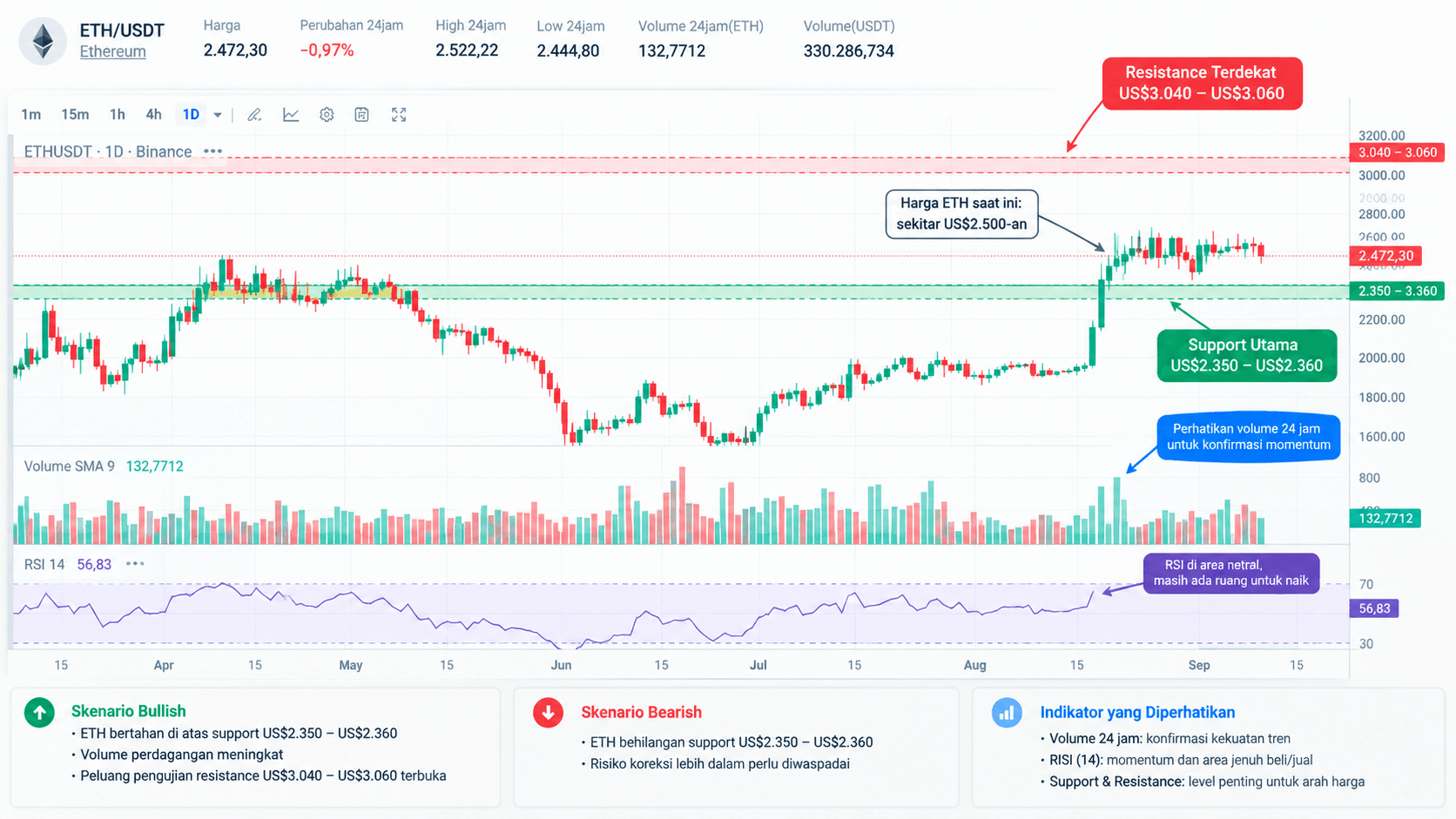
Several important levels are being closely watched by the market:
- ETH price: around the US$2,500 area after the previous upward move.
- Main ETH support: the US $ 2.350 – US $ 2.360 area is an important level that needs to hold to maintain the bullish structure.
- Nearest resistance: the US$3.040–US$3.060 area is a zone that needs to be broken if Ethereum is to continue its upward momentum.
In addition to price levels, traders are also watching 24-hour trading volume to determine whether the ETH increase is supported by strong market participation or is merely a temporary movement.
If ETH price manages to remain above support with increasing volume, the possibility of testing the next resistance level remains open. However, if ETH loses its main support, the risk of a deeper correction needs to be considered.
Read also : Robinhood Chain Overtakes Solana? DEX Volume Explodes, Can It Last?
Factors That Could Drive ETH Price Higher
Several factors that could act as positive catalysts for Ethereum include:
1. Expectations for Lower Interest Rates
Lower interest rates can increase market liquidity and make investors more interested in risk assets.
2. Improving Crypto Sentiment
If the overall crypto market turns positive again, Ethereum could attract new capital inflows.
3. Growth of the Ethereum Ecosystem
Network activity, the use of decentralized applications, and the development of Ethereum technology remain important long-term fundamental factors.
Risks ETH Investors Need to Consider
Although Ethereum's outlook appears positive, several risks still need to be considered.
First, a renewed increase in US inflation could cause the Federal Reserve to maintain tight policy for longer.
Second, crypto volatility remains high, meaning price movements can change rapidly in response to market sentiment.
Third, Ethereum continues to face competition from other blockchains that offer different transaction costs and speeds.
Therefore, ETH price analysis should not be based solely on a single factor such as US CPI, but should also consider overall fundamental and technical conditions.
Read also : South Korea Prepares a Tokenized Securities Market for 2027, What Does It Mean for Digital Assets?
Investor Strategies for Ethereum Price Movements
Ethereum investors should avoid making decisions based solely on short-term price movements.
Several things that can be considered include:
Understanding Price Levels
Support and resistance areas help investors determine risk limits and opportunities.
Following Economic Data
US CPI, US PPI, and Federal Reserve decisions can be major market drivers.
Combining Fundamental and Technical Analysis
Technical analysis helps assess momentum, while fundamental analysis helps understand the reasons behind price movements.
Ethereum's price movement is increasingly influenced by global economic developments such as inflation data and Federal Reserve policy. Follow the latest crypto news, market analysis, and digital asset developments through Bittime to better understand market changes.
Conclusion
Ethereum price movement after the US CPI release remains highly dependent on the direction of US inflation and Federal Reserve policy.
US CPI and US PPI data will be important factors in determining whether the market sees an opportunity for increased liquidity or instead faces renewed pressure.
From a technical perspective, Ethereum is showing a consolidation phase after a strong increase. The ETH support area at US$2.350–US$2.360 is an important level for maintaining momentum, while the US$3.040–US$3.060 zone is the next resistance target if market sentiment remains positive.
Investors should consider a combination of macroeconomic factors, the relationship between Ethereum and the S&P 500, and developments within the Ethereum ecosystem before making investment decisions.

Bittime is a licensed and supervised Digital Financial Asset Trader (PAKD) platform regulated by the Financial Services Authority — where you can buy Bitcoin in Indonesia and hundreds of other crypto assets starting from IDR 10,000. The registration process is fast and secure, and you can get started today.
Monitor USDT to IDR conversions and the real-time price movements of your favorite crypto assets. Everything is available in one crypto investment app that can be downloaded for free from the Play Store.
Ready to get started? Sign up now on Bittime and execute your investment strategy with a platform trusted by millions of users in Indonesia.
FAQ
Does US CPI affect Ethereum price?
Yes. US CPI can affect Ethereum through changes in expectations surrounding Federal Reserve interest rate policy. Lower inflation can increase the possibility of more accommodative monetary policy.
What is the relationship between US PPI and Ethereum?
US PPI provides an overview of producer price pressures. Lower PPI data can increase market optimism toward risk assets such as Ethereum.
Can ETH price rise after US CPI?
Ethereum could rise if the market sees inflation as controlled, liquidity improves, and risk sentiment increases. However, volatility still needs to be considered.
What is the important ETH support level right now?
The US$2.350–US$2.360 area is one of the important support levels monitored by traders to maintain Ethereum's bullish structure.
Does Ethereum follow the S&P 500?
Ethereum can move in the same direction as the S&P 500 because both are influenced by global risk sentiment, but Ethereum also has its own fundamental factors.
Disclaimer: The views expressed belong exclusively to the author and do not reflect the views of this platform. This platform and its affiliates disclaim any responsibility for the accuracy or suitability of the information provided. It is for informational purposes only and not intended as financial or investment advice.

.png)