New BI Governor Destry Damayanti: Profile and Strategy for Leading Bank Indonesia
2026-09-02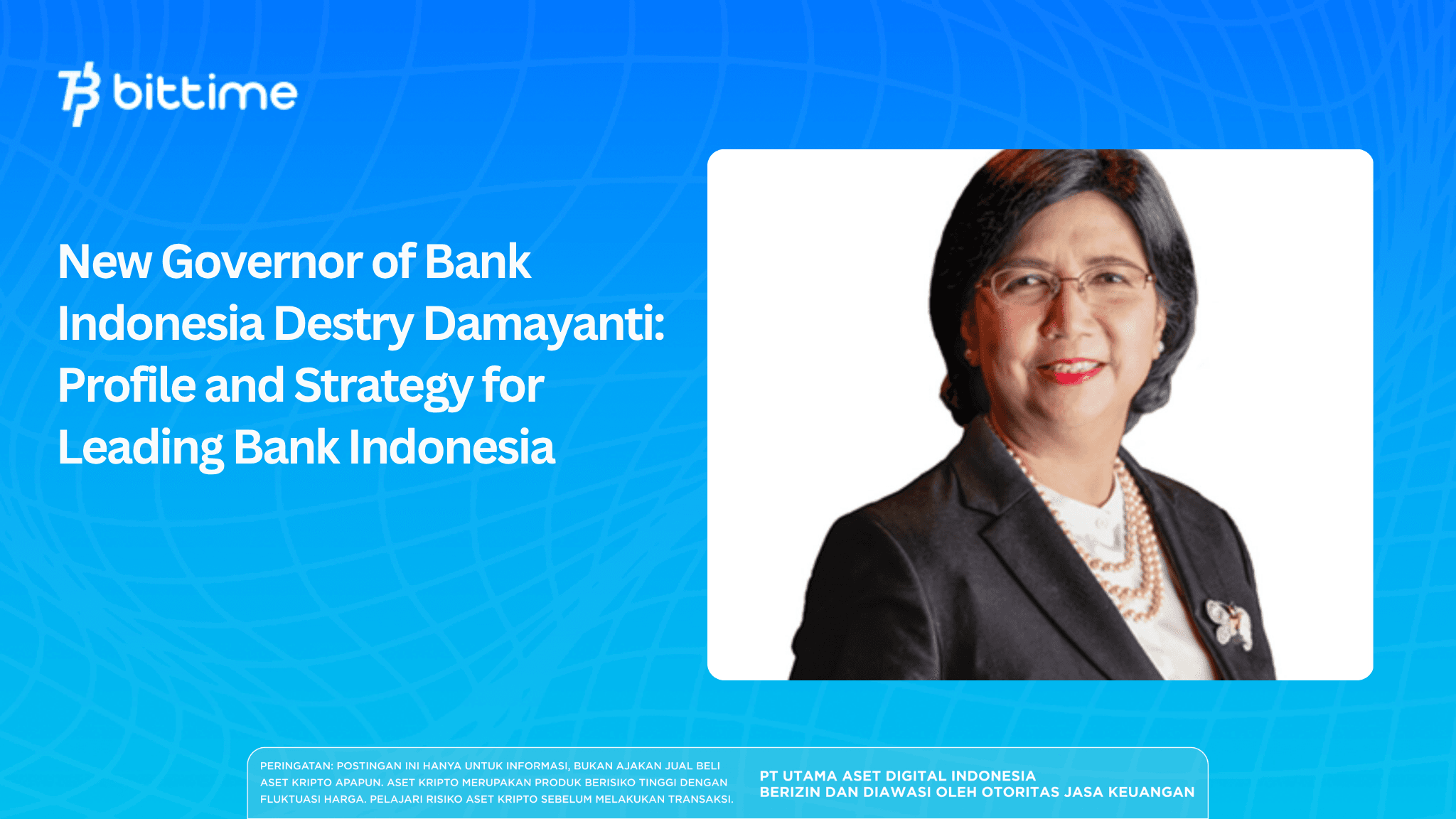
Destry Damayanti is entering a new chapter in her career after the House of Representatives (DPR) approved her nomination as Governor of Bank Indonesia (BI).
The approval was made during the DPR Plenary Meeting on September 1, 2026, after Destry underwent a fit-and-proper test with Commission XI.
This leadership change is drawing attention because Bank Indonesia is facing a complex economic environment.
Global uncertainty, exchange rate pressures, inflation, capital flows, and changes in global central bank policies will be the main challenges for the new BI governor.
So, who is Destry Damayanti, the new Governor of Bank Indonesia, and what strategy will she bring?
Key Takeaways
- Destry Damayanti is an economist with extensive experience in banking, financial markets, the Indonesia Deposit Insurance Corporation (LPS), and Bank Indonesia.
- Her initial strategy places rupiah stability and inflation among the priorities amid global uncertainty.
- Destry also emphasizes synergy with the government while maintaining the division of authority between BI and other state institutions.
Who Is Destry Damayanti, the New BI Governor?
Destry Damayanti is an economist born in Jakarta in 1963 who has more than two decades of experience in economics and finance.
She earned a Bachelor of Economics degree from the University of Indonesia and later obtained a Master of Science in Regional Science from Cornell University in the United States.
Her career has been diverse. Destry previously served as Senior Economic Adviser to the British Ambassador to Indonesia, as a researcher and lecturer at the University of Indonesia, and as an economist in the banking and capital markets sectors.
She later served as Chief Economist of Mandiri Sekuritas and Chief Economist of Bank Mandiri. Destry also led the Economic Task Force at the Ministry of State-Owned Enterprises before joining the Indonesia Deposit Insurance Corporation (LPS) as a member of the Board of Commissioners for the 2015–2019 period.
This experience is an important asset because the role of BI governor is not only related to interest rates. The central bank must also assess financial market conditions, the banking system, rupiah stability, inflation, and global economic dynamics.
Read Also: 5 Strategic Policies of Finance Minister Purbaya Yudhi for Indonesia's Economic Growth
Destry's Experience at Bank Indonesia
Before becoming governor of Bank Indonesia, Destry was already a familiar figure within the central bank.
She was first inaugurated as Senior Deputy Governor of BI in August 2019. In 2024, Destry was again entrusted with the position for the following five-year term.
Her experience as Senior Deputy Governor gave Destry direct insight into the policymaking process at Bank Indonesia. Therefore, the leadership transition does not necessarily mean a drastic change in direction.
In her statement after receiving approval from the DPR, Destry emphasized that stability would remain a priority while global uncertainty remains high. This focus includes exchange rate stability and inflation control.
Turn today's opportunities into the first step toward investing. Sign up on Bittime and start building your portfolio.
Destry's Strategy for Leading Bank Indonesia
One of the most important signals from the new Bank Indonesia governor is her intention to maintain a focus on stability.
According to Destry, stable economic conditions will create a more conducive environment for growth. Therefore, the rupiah exchange rate and inflation will be two key indicators to monitor.
This approach is relevant to Bank Indonesia's mandate. Institutionally, BI's objective is to maintain rupiah stability, reflected in inflation and exchange rate stability, while also supporting payment system and financial system stability.
Therefore, Destry's strategy will likely be more about continuity with adjustment rather than an extreme shift in policy direction. The challenge is determining how much monetary policy needs to be adjusted as global conditions change.
Read Also: Rupiah at Risk of Weakening? Expectations for a Fed Rate Hike Rise
Synergy with the Government Is an Important Part
Destry also brings the concept of “Red and White Synergy” to strengthen coordination between BI and the government.
This synergy is particularly important for inflation issues arising from the supply side. Bank Indonesia has monetary instruments, but it cannot directly address all sources of inflation.
Examples include rising food prices such as chili, onions, and other commodities. When price pressures stem from production, distribution, or supply disruptions, resolving them requires coordination with central and regional governments.
This approach shows that Destry views price stability as more than just an interest rate issue. Monetary policy needs to work alongside real-sector policies and cross-institutional coordination.
However, Destry also emphasized that such synergy must continue to respect the mandates and authorities of each institution.
Convert 1 BTC to IDR - Bitcoin to Rupiah Exchange Rate
Destry's First Steps at Bank Indonesia
Another interesting point is Destry's plan to reorganize the division of responsibilities within the Board of Governors.
She said she would first sit down with all members of the Board of Governors to determine the division of responsibilities. These areas may include monetary policy, macroprudential policy, financial market deepening, and other fields.
According to Destry, this division is not static and can be adjusted according to needs. This step is important to ensure that responsibilities are clearly structured and that BI's duties can be carried out effectively as soon as possible.
For the market, this step may also serve as an early indicator of how Destry's leadership will manage internal coordination within the central bank.
Read Also: Indonesian Bonds Become a Target for Foreign Investors, Will the Rupiah Strengthen Too?
Challenges for the New BI Governor Ahead
Destry's biggest challenge is not simply maintaining domestic inflation. The external environment will also be a major determining factor.
Changes in global central bank interest rates can affect capital flows and the rupiah. When global asset yields rise, Indonesia needs to maintain the attractiveness of domestic assets without sacrificing growth momentum.
On the other hand, price pressures from commodities and food can emerge without being caused by excessive domestic demand. Such conditions require a combination of monetary policy and coordination with the government.
Therefore, Destry's success as the new BI governor will largely depend on her ability to balance stability and growth.
Read Also: Indonesia's Middle Class Is Moving Down the Economic Ladder: Are Living Costs the Main Burden?
Conclusion
Destry Damayanti has a comprehensive background to lead Bank Indonesia, ranging from experience in banking, capital markets, and LPS to direct experience as Senior Deputy Governor of BI.
This experience gives her an understanding of both market dynamics and central bank policy mechanisms.
Destry's initial strategy appears to emphasize rupiah stability and inflation amid global uncertainty. At the same time, she wants to strengthen coordination with the government to address supply-side inflation issues.
With global challenges remaining high, Destry's leadership will be an important factor in determining the direction of monetary policy and Indonesia's economic stability over the coming years.

Start trading crypto with major assets such as BTC/IDR and ETH/IDR directly on the Bittime app.
Bittime is a licensed Digital Financial Asset Trader (PAKD) platform authorized and supervised by the Financial Services Authority (OJK) — where you can buy Bitcoin in Indonesia and hundreds of other crypto assets starting from IDR 10,000. Registration is fast, secure, and can be started today.
Monitor the USDT to IDR conversion and your favorite crypto asset prices in real time. Everything is available in one crypto investment app that can be downloaded for free from the Play Store.
Ready to get started? Sign up for Bittime now and execute your investment strategy with a platform trusted by millions of users in Indonesia.
FAQ
Who is Destry Damayanti, Governor of Bank Indonesia?
Destry Damayanti is an economist who previously served as Senior Deputy Governor of Bank Indonesia. She has experience in banking, capital markets, LPS, government, and economic policy.
When did Destry Damayanti become Governor of BI?
The DPR approved Destry Damayanti as a candidate for BI Governor during its Plenary Meeting on September 1, 2026. On September 2, 2026, she was scheduled to take her oath of office at the Supreme Court based on the information provided.
What is Destry Damayanti's strategy as BI Governor?
Destry's main focus is maintaining rupiah exchange rate stability and controlling inflation amid global economic uncertainty. She also emphasizes coordination with the government to address supply-side inflationary pressures.
What was Destry's experience before becoming BI Governor?
Destry previously served as an economist at Mandiri Sekuritas and Bank Mandiri, a member of the LPS Board of Commissioners, and Senior Deputy Governor of Bank Indonesia. She also has experience in government and academia.
What are the main challenges for the new BI Governor?
The challenges include maintaining rupiah stability, controlling inflation, dealing with changes in global interest rates, maintaining financial system stability, and supporting Indonesia's economic growth.
Disclaimer: The views expressed belong exclusively to the author and do not reflect the views of this platform. This platform and its affiliates disclaim any responsibility for the accuracy or suitability of the information provided. It is for informational purposes only and not intended as financial or investment advice.

.png)