What is Forecasting? Functions, Methods, and Examples in Business
2026-08-12
That small bakery had the same problem every year: a week before Eid, its pastry shelves were sold out first, but the following year it ended up with hundreds of leftover jars that went stale in the warehouse.
This thin line between profit and loss is usually determined by one ability that small business owners rarely realize: forecasting.
Simply put, the definition of forecasting is the process of preparing business estimates based on historical data, so that production and inventory decisions become more measured, not just relying on gut feeling.
This business forecasting concept is actually used in almost all business scales, from MSMEs preparing cookie stock to capital market analysts predicting the movement of listed company stocks. Even crypto asset traders rely on similar principles when reading price trends before taking a position.
This article thoroughly discusses what forecasting is, its types, commonly used methods, and examples of its application in the field.
Key Takeaways
- Forecasting is a technique for estimating future business conditions using historical data, market trends, and statistical analysis.
- There are two main methods: qualitative (based on opinion/surveys) and quantitative (based on data and numbers).
- Forecasting is useful for inventory planning, budget allocation, risk management, and as a requirement for funding applications to investors.
What is Forecasting in the Business World?
Forecasting means the activity of estimating future business conditions by analyzing data from previous periods.
It is not a random guess; forecasting serves as a guide for business owners to make important policy decisions, from how many goods need to be produced to when is the best time to add stock.
According to the Institute of Business Forecasting (IBF), almost all business decisions are fundamentally based on forecasts, because every plan always anticipates something that will happen in the future. The more accurate the forecast, the more mature the plans that can be made.
The practice is not always about long-term plans. Many businesses use forecasting for seasonal moments, such as spikes in demand during Eid al-Fitr, Christmas, or New Year.
That way, business owners can anticipate market crises like inflation or recession before their impact is felt on the company's cash flow.
If you are interested in monitoring digital asset market trends as part of a personal forecasting strategy, you can start exploring market data by registering an account on Bittime, which is licensed by OJK and provides real-time price data for various crypto assets.
Types and Methods of Forecasting Most Commonly Used
Forecasting has several categories depending on the point of view.
Based on time horizon:
- Short-term: 0–3 months
- Medium-term: 3 months to 2 years
- Long-term: above 2 years
Based on function:
- General business — macroeconomic, social, and political projections
- Demand forecasting — market demand estimates
- Financial forecasting — cost and capital projections
- Sales forecasting — estimates of the quantity of goods that can be sold
In terms of methods, forecasting is divided into two major approaches.
Read Also: What Is Margin? Definition, Types, Functions, Formulas, and Examples
Qualitative methods rely on opinions and experience, not exact numbers. Three commonly used techniques are market surveys of potential customers, executive opinions from a combination of cross-divisional managers, and the aggregation of sales force reports in each region.
The drawback is that the results tend to be subjective because they are influenced by the background and intuition of the analyst.
Quantitative methods are more objective because they are based on mathematical calculations.
Two popular approaches are causal models (predicting demand through supporting variables such as income or demographics) and time series — analyzing historical data sequentially, either through smoothing techniques (averaging previous forecast errors) or decomposition (breaking down data into trend, seasonal, cyclical, and random components).
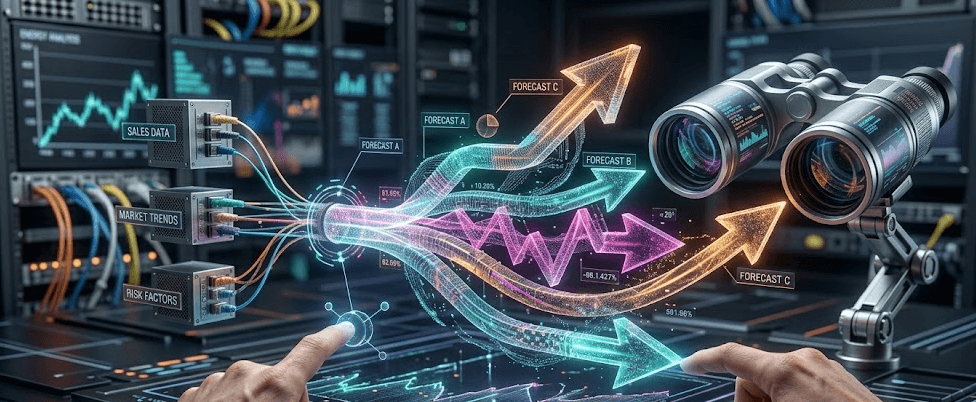
Illustration: Generated by AI
How It Works, Influencing Factors, and Examples of Forecasting in the Field
The way forecasting works is actually quite systematic. The process begins with identifying the condition of the company and similar industries, predicting the future direction of the business based on that data, comparing old forecast results with actual reality, and then re-evaluating the method used so that subsequent forecasts are more accurate.
Several factors determine how sharp the forecasting results are: the level of competition in the market, product characteristics (seasonal or durable), and most crucially, the quality of the historical data available. The more complete and longer the data range, the more accurate the prediction usually is.
The easiest example of forecasting is in the bakery scenario mentioned earlier. Last year's Eid sales data is used to estimate how many cookies need to be produced this year. But forecasting is also used in much more complex realms: predicting the price of crypto assets which have high volatility.
Read also: What Are Digital Assets? A Complete Definition + Examples for Beginners
For cases like these, simple quantitative models are often inadequate. Research published in the Journal of Risk and Financial Management noted that the crypto market has nonlinear characteristics and trend shifts that are difficult to capture with classical statistical models like ARIMA, so many analysts are turning to machine learning approaches such as LSTM to read Bitcoin and Ethereum price patterns more precisely.
This shows that forecasting methods continue to evolve following the complexity of the data being analyzed, from grocery stores to digital asset exchanges.
Read Also: What Is Speculative? Meaning, Examples, Risks, and the Law of Buying and Selling It
Conclusion
Forecasting is the foundation of business decision-making that turns past data into future policy direction.
Whether through qualitative methods that rely on market opinion, or quantitative ones based on numbers and statistical models, the goal is the same: to reduce uncertainty and make business plans more mature.
From home bakeries to crypto asset traders, anyone who understands how forecasting works has an advantage in reading market direction before others realize it.

Check the prices of Bitcoin (BTC), Ethereum (ETH), XRP, Solana (SOL), GRAM, and BNB as well as leading memecoin DOGE. You can trade directly on Bittime!
Bittime is a Digital Financial Asset Trader (PAKD) platform licensed and supervised by the Financial Services Authority — where you can buy Bitcoin in Indonesia and hundreds of other crypto assets starting from Rp10,000. The registration process is fast, secure, and can be started today.
Monitor the USDT to IDR conversion and price movements of your favorite crypto assets in real-time. All available in one crypto investment app that can be downloaded for free on the Play Store.
Ready to start? Register now on Bittime and execute your investment strategy on a platform trusted by millions of users in Indonesia.
FAQ
What is forecasting?
Forecasting is the process of estimating future business conditions using historical data and trend analysis. Its purpose is to help business owners make more measured decisions.
What is the function of forecasting for business?
Its function is as a guide for company policy, ranging from production planning to financial risk management. Forecasting is also often a requirement when applying for funding from investors or financial institutions.
What are the commonly used forecasting methods?
There are qualitative methods (market surveys, executive opinions) and quantitative ones (causal models, time series). The choice depends on data availability and the purpose of the analysis.
What is an example of forecasting in everyday business?
The most common example is estimating product demand during Eid or Christmas based on previous year's sales data. In more complex realms, forecasting is also used to predict stock or crypto asset price movements.
What is the difference between qualitative and quantitative forecasting?
Qualitative forecasting is subjective because it is based on opinion and intuition, while quantitative forecasting relies on numerical data and mathematical calculations. Both can be used together depending on business needs.
Disclaimer: The views expressed belong exclusively to the author and do not reflect the views of this platform. This platform and its affiliates disclaim any responsibility for the accuracy or suitability of the information provided. It is for informational purposes only and not intended as financial or investment advice.

.png)