Ethereum vs Hyperliquid 2026: Which is Superior?
2026-06-02
Are you comparing Ethereum and Hyperliquid for investment or trading in 2026? These two blockchains are often discussed because Hyperliquid emerged as a strong competitor to Ethereum in the DeFi world.
Ethereum has long been the foundation of smart contracts, while Hyperliquid is a layer 1 platform focused on perpetual trading speed. Which is superior depends on your needs.
This year's Ethereum vs. Hyperliquid comparison is interesting because Hyperliquid boasts fast performance and strong token economics, but Ethereum still holds the edge in ecosystem size and widespread adoption.
Let's discuss this comprehensively and impartially based on the latest data as of June 2026.
Key Takeaways
- Ethereum has a market cap of around US$250 billion and a much larger DeFi TVL, while Hyperliquid has a market cap of around US$16 billion and a TVL of around US$5.7 billion.
- Hyperliquid uses a very fast HyperBFT consensus and a HYPE token buyback mechanism of up to 97-99 percent of fees, making the HYPE token more deflationary.
- In 2026, Hyperliquid dominated over 70 percent of on-chain perpetual futures open interest, but Ethereum remained the primary choice for mainstream DeFi applications and developers.
Register at Bittime now and start trading crypto with a fast, safe, and easy process in the app.
What is Ethereum and Hyperliquid?
Ethereum is blockchain layer 1 the most popular platform for smart contracts. Since 2015, it has been home to thousands of DeFi applications, NFTs, and tokens. Ethereum has adopted proof of stake since The Merge and continues to improve scalability through layer 2.
Now in 2026, Ethereum still has the largest ecosystem. Many major projects like Aave, Uniswap, and Lido run on it. However, users sometimes complain about relatively high gas fees when the network is busy.
Hyperliquid is a new layer 1 blockchain with a different focus. It was originally known as a decentralized perpetual futures exchange. Hyperliquid uses HyperBFT technology, a specialized consensus mechanism that can handle up to 200,000 orders per second with a block time of just 0.07 seconds.
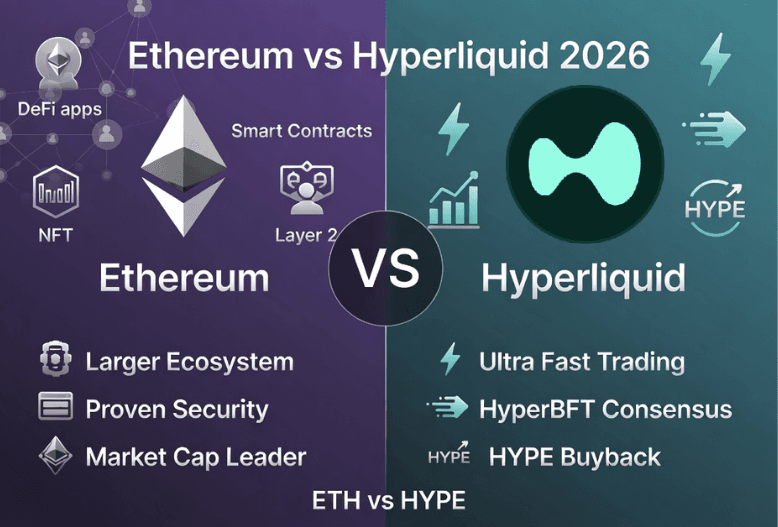
Hyperliquid also has HyperEVM, making it compatible with Ethereum. Developers can easily bring their smart contract applications to market. Because of this, many people consider Hyperliquid a faster Ethereum competitor for trading.
The main differences are clear. Ethereum is a general-purpose blockchain that supports almost any type of application. Hyperliquid specializes in derivatives trading and is beginning to expand into lending and prediction markets. Both have important roles to play in 2026, but each with its own strengths.
Read also: Will HYPE Coin Price Rise? Check Out the Predictions for May 2026
Technology and Performance Comparison 2026
When it comes to speed, Hyperliquid is far superior. HyperBFT offers single-block finality and low latency, making it suitable for high-frequency trading. Orders, trades, and liquidations all occur on-chain with lightning speed.
Ethereum, while improved after upgrades, still relies on layer 2 for high scalability. Its base speed is slower than Hyperliquid, but it offers years of proven security and decentralization.
Here is a simple comparison of the two technologies:
- Consensus mechanism: Ethereum uses proof of stake, Hyperliquid uses HyperBFT which is optimized for trading.
- Transaction speed: Hyperliquid reaches hundreds of thousands of orders per second, Ethereum is lower on layer 1.
- Gas fees: Hyperliquid is usually cheaper and more stable for perpetual trading.
- Compatibility: Both support EVM, but Hyperliquid is lighter for trading applications.
In 2026, Hyperliquid recorded a massive perpetual trading volume, controlling over 70 percent of the on-chain perpetual market. Meanwhile, Ethereum remains the primary choice for lending and stablecoins due to its deep liquidity.
Performance hype token the comparison between Ethereum and Ethereum is also interesting. HYPE experienced a strong surge in early 2026 thanks to buybacks and high revenue from trading fees. Ethereum is more stable but has seen slower growth due to its large size. Both have their own strengths, depending on what you're looking for: speed or a mature ecosystem.
Read also: Why Is HYPE Coin Rising? An Analysis of Buybacks, Short Squeezes, and the $2.6 Billion RWA
Tokenomics, Market Cap, and TVL in 2026
The ETH and HYPE tokens have different roles. ETH is Ethereum's gas token and is used for staking and governance. Its supply is large and it has become deflationary following EIP-1559.
HYPE is Hyperliquid's native token. It is used for gas, staking, and governance. Most interestingly, 97 to 99 percent of transaction fees are used to buy back and burn HYPE on the open market. This mechanism makes the token increasingly scarce as trading volume increases.
A market cap comparison in June 2026 shows that Ethereum is still significantly larger. ETH has a market cap of around US$250 billion. Hyperliquid, with HYPE, reached around US$16 billion. Despite this, HYPE grew rapidly and reached a peak price of around US$73-75.
TVL also differs significantly. Ethereum still has the largest DeFi TVL in the market, despite experiencing outflows in some periods. Hyperliquid TVL is around US$5.7 billion and continues to rise thanks to the dominance of perpetual futures.
Hyperliquid TVL and buyback hype are the main attractions for investors who enjoy revenue sharing directly with token holders. Ethereum offers long-term stability and broader institutional adoption. Which option is superior depends on your strategy.
Read also: Top Ethereum Meme Coins 2026: How to Buy on Bittime
Conclusion
Ethereum vs. Hyperliquid 2026 showcases two contrasting approaches to the blockchain world. Ethereum remains the ecosystem's king, boasting a large market cap and TVL, along with proven security.
Hyperliquid presents itself as a faster, more efficient layer 1 platform with robust tokenomics through HYPE buybacks.
There's no definitive answer as to which is superior. If you enjoy fast trading and high returns, Hyperliquid could be an attractive option. If you need a complete ecosystem and long-term stability, Ethereum remains the top choice.
In 2026, both will continue to grow and complement each other in the DeFi space. Keep an eye on Ethereum's developments versus hype to make informed investment decisions.

Both Ethereum and Hyperliquid are available on the Bittime marketplace with the ETH/IDR and HYPE/IDR trading pairs for those looking to start investing.
Bittime is a licensed and regulated Digital Financial Asset Trader (PAKD) supervised by Indonesia’s Financial Services Authority (OJK) — where you can buy Bitcoin in Indonesia and hundreds of other crypto assets starting from just Rp10,000. The registration process is fast, secure, and you can get started today.
Track USDT to IDR conversions and monitor your favorite crypto assets in real time. Everything is available in one crypto investment app that you can download for free on the Play Store
Ready to start? Register now on Bittime and execute your investment strategy with a platform trusted by millions of users in Indonesia.
FAQ
What are the main differences between Ethereum and Hyperliquid?
Ethereum is a general-purpose layer 1 with a large ecosystem, while Hyperliquid is a layer 1 dedicated to high-speed perpetual trading using HyperBFT.
What will be the market cap of HYPE and ETH in 2026?
As of June 2026, Ethereum's market cap is around US$250 billion, while Hyperliquid HYPE's is around US$16 billion.
What is HyperBFT in Hyperliquid?
HyperBFT is a Hyperliquid consensus mechanism that provides speeds of up to 200 thousand orders per second and fast finality.
Does Hyperliquid use token buybacks?
Yes, 97-99 percent of transaction fees are used for HYPE buybacks and burns, making the token more deflationary.
Which is better for perpetual trading in 2026?
Hyperliquid is superior for perpetual futures due to its speed and market dominance, but Ethereum remains strong for DeFi overall.
Disclaimer: The views expressed belong exclusively to the author and do not reflect the views of this platform. This platform and its affiliates disclaim any responsibility for the accuracy or suitability of the information provided. It is for informational purposes only and not intended as financial or investment advice.

.png)