Microeconomics and Macroeconomics: Definition, Differences, and Examples
2026-08-11
When the price of chilies in the market rises, a store raises the price of its products, or consumers choose cheaper brands, we are seeing economic problems on a small scale.
However, when the discussion turns to national inflation, economic growth, unemployment, and interest rate policy, the perspective becomes much broader.
Two ways of looking at economic activity are known aslikemicro and macro economics.The two are not mutually exclusive.
Consumer and corporate decisions can influence aggregate economic conditions, while changes in the national economy can also alter the behavior of households and businesses.
Key Takeaways
Microeconomics studying the decisions of individuals, households, companies, prices, and the mechanisms of a market.
Macroeconomics discusses the economy in aggregate through indicators such as GDP, inflation, unemployment, and economic policy.
Differences between micro and macro economics mainly located in the unit of analysis, variables what is observed, the purpose of the analysis, and the policies related to it.
Understanding Microeconomics
Definition of microeconomics is a branch of economics that studies how individual economic actors make decisions under conditions of limited resources.
These actors can be consumers, households, companies, workers, or producers in an industry.
Focus on micro economics including how consumers determine which goods to buy, how companies determine production quantities, and how the interaction of supply and demand shapes prices in the market.
Therefore, micro analysis is often used to understand economic behavior at a specific level.
Read Also: Examples of Demand Deposits: From Giro, Checks to Digital Wallets
Scope of Microeconomics
The scope of micro economics includes supply and demand, consumer behavior, production, production costs, price formation, and market structure. These structures can include perfect competition, monopoly, oligopoly, or monopolistic competition.
In microeconomic theory, the concept of incentives, utility, elasticity, marginal costs, andProfit also plays an important role. Its analysis helps explain why consumers or companies make certain decisions when prices, revenues, or costs change.
Characteristics and Objectives of Microeconomics
One of the characteristics of microeconomics is a relatively specific object of analysis.
The discussion can be directed at a single product, company, consumer, or industry without having to directly look at the economic conditions of a country as a whole.
Meanwhile, microeconomic goals are to understand how resources are allocated, how prices are formed, and how consumer and producer decisions affect market equilibrium.
Read Also: Law of Demand: Definition, Curve, Factors & Explanation by Economists
Understanding Macroeconomics
Understanding macroeconomics is a branch of economics that studies economic activity as a whole or in aggregate.
If microeconomics looks at a single household or firm, macroeconomics looking at the bigger picture, such as a country's economy.
The discussion involves indicators such as Gross Domestic Product (GDP), inflation, unemployment, national consumption, investment, the money supply, and international trade. Macroeconomic indicators are also used to gauge the direction of economic development.
Scope of Macroeconomics
The scope of macroeconomics includes economic growth, inflation, unemployment, national income, fiscal policy, monetary policy, international trade, and economic stability.
In macroeconomic theory, the primary attention is no longer given to a single consumer or company.
The analysis is directed at the relationship between aggregate variables that can influence economic conditions in general.
Characteristics and Objectives of Macroeconomics
Characteristics of macroeconomics is the use of aggregate data and a broad perspective. Economic conditions are assessed using various national and regional indicators to determine whether economic activity is growing, slowing, or facing specific pressures.
Macroeconomic objectives include understanding economic growth, maintaining price stability, analyzing employment, and assessing the impact of government and central bank policies.
Fiscal and monetary policies are two important instruments frequently discussed in macroeconomic analysis.
Read Also: 15 Unexpected Benefits of the Creative Economy in 2026
Differences between Micro and Macro Economics
Source: AI
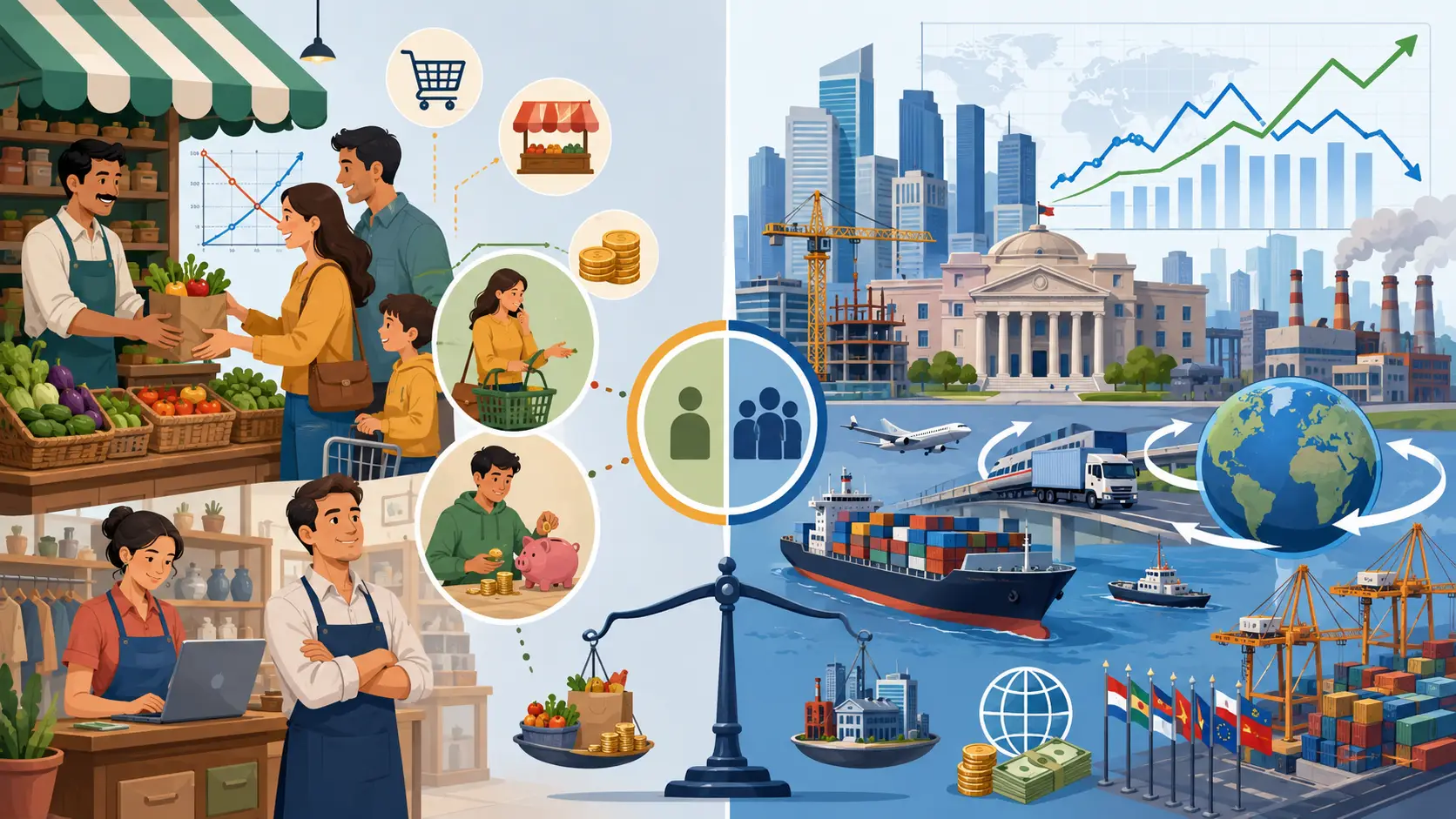
The simplest way to understand differences between micro and macro economics is by looking at the scale of analysis.
This difference does not mean that the two are completely separate.
Changes at the micro level can accumulate into macro changes, while macro policies can directly influence consumer and corporate decisions.
Examples of Microeconomics in Everyday Life
Examples of microeconomics can be found when a coffee shop determines prices based on the cost of raw materials and customer demand.
Another example is consumers switching to cheaper products after the price of their favorite product increases.
A company's decision to increase production due to increased demand also falls under micro-discussions.
Likewise, price competition between two stores selling similar products.
If you want to start getting to know the digital asset ecosystem in a more practical way, you can register at Bittime and study the risks and market dynamics before making a decision.
Examples of Macroeconomics in Indonesia
Examples of macroeconomics can be seen through the development of Indonesia's GDP and inflation.
BPS noted that the Indonesian economy grew in the first quarter of 2026 5.61% year-on-year, with GDP value at current prices reaching around IDR 6,187.2 trillion.
Inflation is also a macro indicator.
Bank Indonesia recorded CPI inflation in June 2026 at 3,34% year-on-year, while Indonesia's economic growth in 2026 is estimated to be in the range of 4.9–5.7%.
These figures differ from the case of a single product price increase. Macroeconomics looks at general price changes and aggregate economic activity.
Read Also: 7 Best Investments of 2026 Worth Considering Now
Why Are Microeconomics and Macroeconomics Related?
Imagine raw material costs rising across many companies at once. At the micro level, individual companies could reduce production or raise prices.
If this phenomenon occurs widely, its impact could potentially be seen in aggregate price levels and economic activity.
Conversely, changes in interest rate policy at the macro level can influence micro decisions such as taking out credit, buying a house, expanding a business, or saving funds.
Therefore, understanding both perspectives provides a more complete picture of the economy. Understanding micro and macro conditions is also useful when studying financial markets and digital assets.

Let’s start trading crypto with the largest assets, such as BTC/IDR and ETH/IDR, right in the Bittime app.
Bittime is a licensed and regulated Digital Financial Asset Trader (PAKD) supervised by Indonesia’s Financial Services Authority (OJK) — where you can buy Bitcoin in Indonesia and hundreds of other crypto assets starting from just Rp10,000. The registration process is fast, secure, and you can get started today.
Track USDT to IDR conversions and monitor your favorite crypto assets in real time. Everything is available in one crypto investment app that you can download for free on the Play Store
Ready to start? Register now on Bittime and execute your investment strategy with a platform trusted by millions of users in Indonesia.
FAQ
What are the main differences between micro and macro economics?
Microeconomics focuses on the decisions of consumers, households, firms, and specific markets. Macroeconomics looks at the aggregate state of the economy through indicators such as GDP, inflation, and unemployment.
What is an example of microeconomics?
Examples include companies determining selling prices, consumers choosing products based on budget, changes in demand for a product, and companies determining production quantities.
What is an example of macroeconomics?
Examples include Indonesia's economic growth, national inflation, unemployment rate, interest rate policy, changes in the money supply, and government fiscal policy.
Is inflation a micro or macro economics issue?
Inflation in general is included in the discussionmacroeconomicsbecause it describes changes in the price level of goods and services broadly in the economy, not just increases in the price of one particular product.
Can micro and macro economics be separated?
In theory, the two have different focuses, but in practice, they are closely related. The decisions of millions of consumers and companies can shape national economic conditions, while macroeconomic policies can influence economic decisions at the individual and business level.
Disclaimer: The views expressed belong exclusively to the author and do not reflect the views of this platform. This platform and its affiliates disclaim any responsibility for the accuracy or suitability of the information provided. It is for informational purposes only and not intended as financial or investment advice.

.png)