What Does Cut Loss Mean? When Should You Sell or Hold?
2026-08-12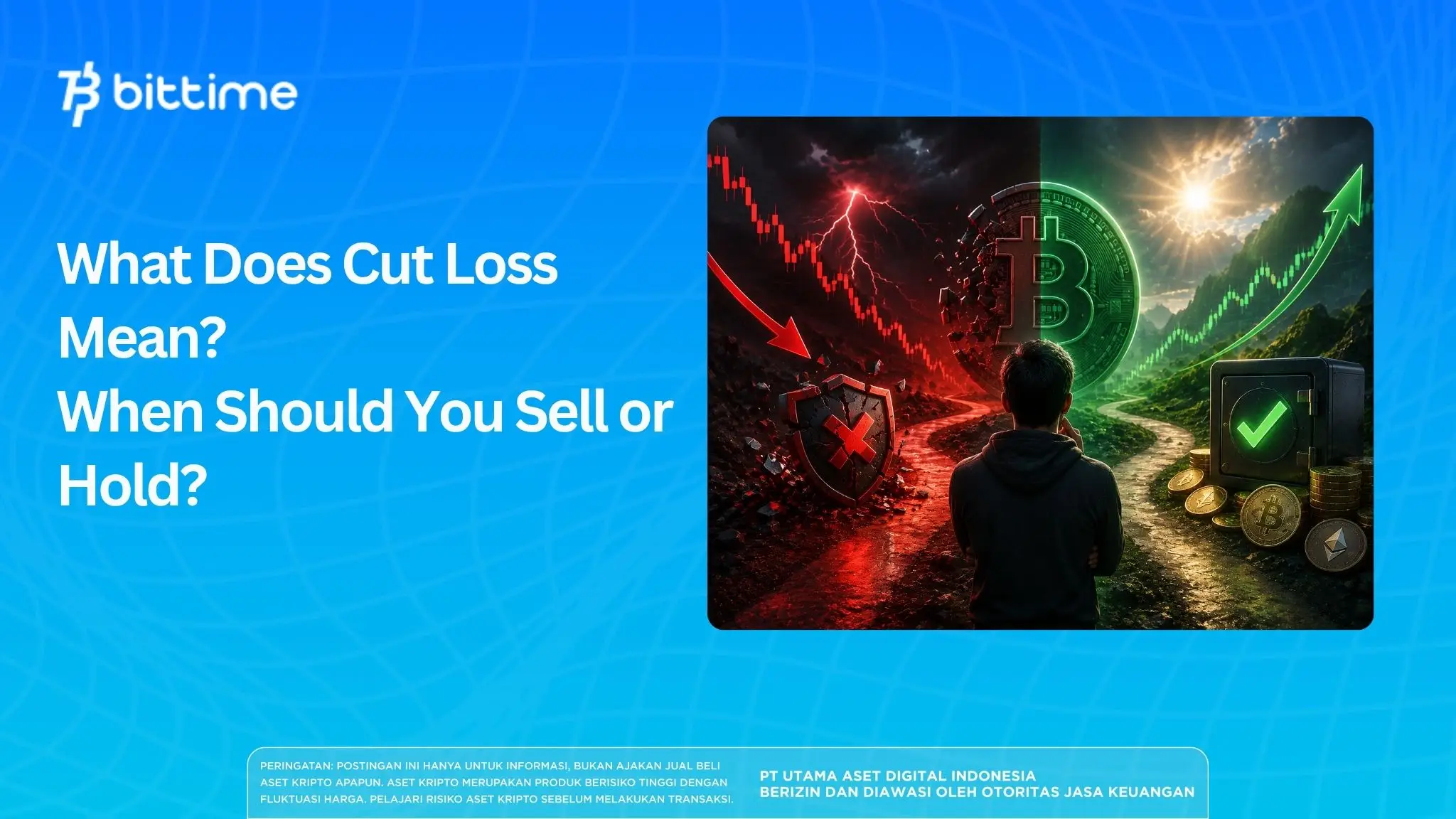
Asset price downturn often places investors in a dilemma of two equally difficult choices: sell now to limit losses or hold on to assets while waiting for a recovery.
In conditions like this, understanding what is cut loss much more important than just following a certain percentage.
Cut loss is the decision to close a position when losses have reached the limit previously established or when the initial reason for purchasing the asset is no longer valid. This strategy can be used on both stocks and crypto as part of risk management.
Meanwhile, hodl means maintaining ownership even when prices are fluctuating or falling because investors still believe in the long-term prospects of the asset.
That is, the question cut loss or hod lshould not be answered solely based on the red color in the portfolio.
Key Takeaways
Cut loss aims to limit losses before the decline gets deeper, not to guess the market's lowest point.
Holding makes more sense if the investment thesis and asset fundamentals are still strong and the investor has a long-term horizon.
The decision to sell or hold should have rules before buying, not be made in a panic.
What Does Cut Loss Mean in Trading?

Source: AI
Simply, understanding cut loss is the act of selling assets at a loss to prevent potential greater losses.
For example, a trader buys an asset at a price of IDR 10,000 and sets a risk limit of 10%.
If the trading scenario fails and the price falls to around Rp9,000, the position can be closed as planned.
What needs to be understood is that cutting losses does not always mean that someone has chosen the wrong asset.
A trader may have a sound analysis, but market conditions change so that the initial scenario no longer applies.
In practice,cut loss in trading also closely related to stop-loss orders.
A stop order will be activated when the price reaches a predetermined level and then changes to a market order.
However, the final execution price is not always exactly the same as the stop price, especially when the market is moving quickly.
Therefore, determining a fixed risk limit is more important than simply setting a random stop loss number.
Read Also: Stop Market vs. Stop Limit for Futures Risk Management: Don't Choose the Wrong One
When to Cut Loss?
The question when to cut loss is there is no one percentage that applies to all investors.
Stop loss should be adjusted according to strategy, asset volatility, position size, and risk tolerance.
One of the most sensible conditions for selling is when the initial reason for buying has changed.
For example, investors buy tokens due to high network growth, but then network activity continues to decline and the project experiences serious fundamental problems.
Holding on to an asset simply because you hope the price will return to the purchase price can turn an investment decision into an emotional one.
Cut loss is also worth considering when the price breaks through the technical level that was the basis of the initial strategy.
Stop orders are often used by investors as a tool to manage market risk and limit losses when prices move against a position.
Want to start trading crypto with a more calculated strategy? Sign up with Bittime and use a cut-loss plan tailored to your risk profile.
Stock Cut Loss and Crypto Cut Loss: What's the Difference?
Principle cut loss stock And cut loss crypto is basically the same: limiting losses when investment scenarios do not go according to plan.
The difference lies mainly in the character of the market.
Crypto can move 24 hours a day and some assets have much higher volatility and liquidity.
Therefore, a cut loss limit that is too narrow can be more easily affected by short-term fluctuations.
In stocks, investors also need to consider factors such as financial reports, corporate actions, industry conditions, and changes in the company's prospects. In crypto, analysis can extend to tokenomics, network activity, token unlocks, protocol security, regulation, and developer development.
So, when is the best time to cut loss should be determined by measurable reasons, not just because the price dropped a few percent.
Read Also: What is Speculative? Meaning, Examples, Risks, and Trading Laws
When Does Holding Make More Sense?
Hodl does not mean refusing to sell under any circumstances.
This strategy makes more sense when investors do have a long-term horizon and the price decline has not changed their investment thesis.
Reku emphasized that holding is generally chosen when investors still believe in the asset's fundamentals even though the market is experiencing short-term volatility.
On the other hand, if the decline occurs due to serious fundamental problems, cut loss can be an alternative to protect capital.
For example, if Bitcoin falls along with the rest of the market due to short-term macroeconomic sentiment, long-term investors who still believe in their initial thesis might choose to hold.
However, this decision is different from holding onto a token that has lost liquidity, been abandoned by developers, or experienced serious exploitation simply because it hopes the price will rise again.
Read Also: Short-Term Gambles vs Long-Term HODL
Cut Loss vs Hodl: Which is Better?
In comparing cut loss vs hodl, no strategy is always superior.Both have different functions.
Cut loss is more relevant to protect capital when the scenario fails.
Hodl is more relevant to weather short-term volatility when the long-term thesis is still intact.
Problems arise when both are used for the wrong reasons. Investors may panic and cut their losses just before the price recovers.
On the other hand, someone may call themselves a “hodler” when in fact they are just afraid to admit that the assets they purchased no longer have the same fundamentals.
Healthy decisions start from a simple question:If I don't own this asset now, would I still want to buy it given the current fundamental conditions?
Read Also: Buy Limit vs. Buy Stop: This Difference Often Traps Traders, Don't Make the Wrong Entry!
How to Determine Cut Loss Limit?
The ideal cut loss limit is determined before the position is opened.
Traders can use support levels, volatility, or specific risk percentages as references, but these percentages must be linked to position size.
For example, a 10% loss on a position that only covers 5% of the portfolio will have a different impact than a 10% loss on a position that takes up 70% of the portfolio.
Investors also need to understand that stop orders are not always executed exactly at the specified price.
Investor.gov reminds us that short-term price movements can activate stop orders, while during fast-moving market conditions the execution price may differ from the stop price.
Therefore, cut loss should be part of the wholeposition sizing Andrisk management.
Read Also: What Is Forecasting? Its Functions, Methods, and Examples in Business
Common Mistakes When Cutting Loss or Holding
The most common mistake is making decisions based on the purchase price. Investors feel they shouldn't sell until the asset returns to breakeven, even though the market doesn't know or consider the price the investor paid.
Another mistake is changing strategy after a losing position.
A position that was originally planned as a one-week trade is suddenly called a long-term investment because the price has fallen.
Emotional decisions, not having a plan from the start, and ignoring fundamental and technical analysis are mistakes that often occur when choose cut loss or hodl.
Read Also:How to Trade Crypto for Beginners from Zero to Understanding
So, Should You Cut Loss or Keep Holding?
Cut loss is more appropriate when the investment thesis is broken, the risk limit has been reached, or the capital has a better use opportunity elsewhere.
Holding makes more sense when the fundamentals are consistent with the initial thesis, the investment horizon is long, and the investor is able to tolerate volatility without disrupting their financial condition.
The key isn't to perfectly predict price fundamentals. It's more important to ensure that one bad position doesn't cause significant damage to the entire portfolio.
Thus, the answer to when to cut lossdoes not come from fear of seeingprice drops.
The answer comes from an investment plan that was made before the risk actually appeared.

Let’s start trading crypto with the largest assets, such as BTC/IDR and ETH/IDR, right in the Bittime app.
Bittime is a licensed and regulated Digital Financial Asset Trader (PAKD) supervised by Indonesia’s Financial Services Authority (OJK) — where you can buy Bitcoin in Indonesia and hundreds of other crypto assets starting from just Rp10,000. The registration process is fast, secure, and you can get started today.
Track USDT to IDR conversions and monitor your favorite crypto assets in real time. Everything is available in one crypto investment app that you can download for free on the Play Store
Ready to start? Register now on Bittime and execute your investment strategy with a platform trusted by millions of users in Indonesia.
FAQ
What is meant by cut loss?
Cut loss is a decision to sell assets at a loss to limit the possibility of greater losses when prices or fundamental conditions no longer match the initial scenario.
What is the ideal cut loss percentage?
There's no one-size-fits-all figure for all investors. Cut-loss limits are influenced by asset volatility, strategy, position size, investment horizon, and risk tolerance.
What is the difference between cut loss and stop loss?
A cut-loss is a decision or strategy to limit losses. A stop-loss typically refers to an order placed to execute a transaction when the price reaches a certain level.
When is it best not to cut losses?
Investors may consider not cutting losses if the decline is only due to short-term volatility, while the fundamentals and long-term investment thesis remain strong. However, the decision should still take into account risk tolerance.
Is hodl always better than cut loss?
No. Holding can be profitable when assets recover, but it can also magnify losses if fundamentals continue to deteriorate. Cut-loss and holding should be used appropriately, not as a hard and fast rule.
Disclaimer: The views expressed belong exclusively to the author and do not reflect the views of this platform. This platform and its affiliates disclaim any responsibility for the accuracy or suitability of the information provided. It is for informational purposes only and not intended as financial or investment advice.

.png)