DeXe Coin Dumps 83%: Why Did DEXE Price Drop So Sharply?
2026-07-22
DeXe Coin experienced an extreme dump after its price plunged from the US$36–US$46 range to around US$6 in a short period of time.
The over 80% drop is believed to have been triggered by early holder sales, token flows to exchanges, changes in derivative positions, and chain liquidations after the previous rally accelerated.
Key Takeaways
- The price of DEXE fell by about 83% in 24 hours and was trading around US$5.9–US$6.1 on July 22, 2026.
- The main triggers identified were token distribution by early holders, a surge in inflows to exchanges, negative funding rates, and liquidation of leveraged positions.
- There's no strong indication that the dump stemmed from a protocol hack; however, the price is still at risk of falling if the selling pressure persists.
What is DeXe Coin?
DeXe is a protocol that provides the infrastructure for creating, managing, and running decentralized autonomous organizations (DAOs). The protocol allows communities to create proposals, vote, delegate tokens, distribute rewards, and manage treasuries through smart contracts.
Source dexe.network
DEXE is a utility and governance token within the ecosystem. Token holders can use it to participate in governance, propose decisions, vote, and support treasury management.
The main functions of DEXE include:
- Voting rights in governance.
- Submission and implementation of proposals.
- Delegation of voting power.
- Rewards for active contributors.
- DAO treasury management.
- Research funding, grants, and ecosystem development.
DEXE is available as an ERC-20 token on Ethereum and BEP-20 on the BNB Smart Chain. Because the token name and symbol can be forged, users should verify the official contract address before making transactions.
Read Also: What's that DeXe (DEXE)? Token for a Decentralized Social Trading Platform
What is the Price of DeXe Coin Today?
On July 22, 2026, DEXE was listed on the exchange.numbers in the rangeUS$5,9–US$6,1The price dropped by about 83% in 24 hours, with a very wide daily trading range between about US$5.74 and US$46.65.
Twenty-four-hour trading volume surged to around US$257 million. The nearly 300% surge compared to the previous day suggests the decline wasn't just due to small transactions, but was accompanied by significant buying and selling activity.
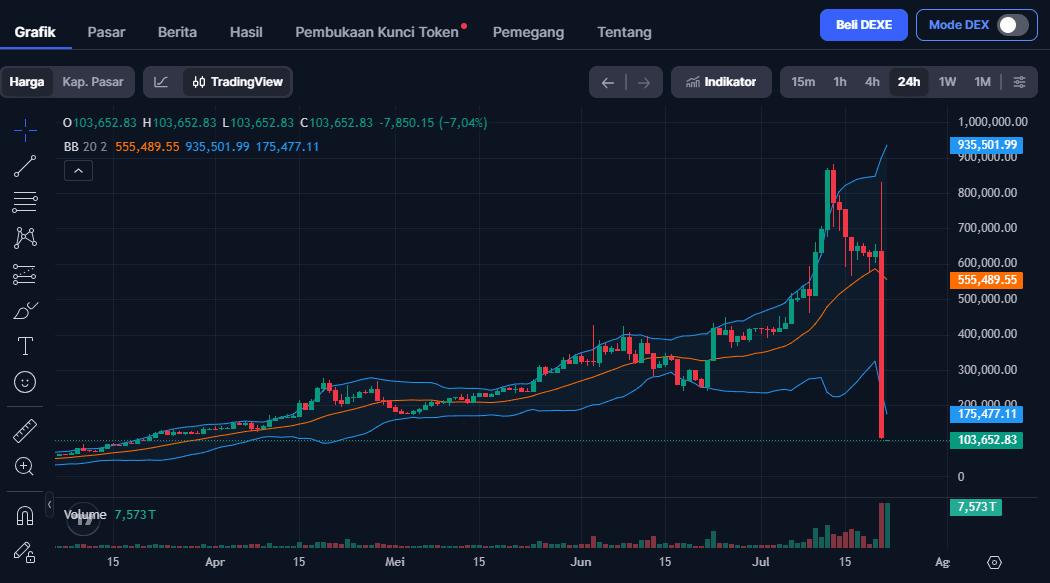
Sumber coinmarketcap | DeXe
DEXE previously recorded an all-time high of around US$48.91 on July 13, 2026. This means that in just nine days, the price lost about 87% of its peak.
Market capitalization and circulating supply data are available Differences between platforms. Some aggregators list around 47 million tokens in circulation, while others use higher figures.
These methodological differences mean investors should check supply through explorers and token contracts, rather than relying solely on a single platform.
To keep up with DEXE price developments and digital asset market news, users can register at Bittime and read the latest crypto updates. Check whether the asset is officially available and understand the risks before making a transaction.
Why Did the DeXe Coin Price Drop?
1. Initial Holders Move Tokens to the Exchange
On-chain analysis shows that a number of wallets that accumulated DEXE when its price was around US$3 began moving tokens to exchanges on July 20–21, 2026.
The total value of the tracked tokens was over US$1.6 million when transferred to several trading platforms. Transferring to an exchange doesn't always mean an immediate sale of the tokens, but it typically raises concerns as the assets become more readily available to the market.
When several large holders make deposits in close proximity, other traders may interpret this activity as a sign of distribution. Panic then prompts smaller holders to sell first.
The identity of the wallet owner has not been independently confirmed. Therefore, the term "insider dump" should not be used as a definitive conclusion without proof of direct connection to the team or internal project stakeholders.
2. DEXE's Previous Rally Was Too Parabolic
Prior to the dump, DEXE experienced a rapid rise. The price moved from around US$20 to nearly US$49 in a short period of time following a new listing, a technical breakout, and a short squeeze.
A short squeeze occurs when traders holding short positions are forced to buy tokens to cover their losses. This forced buying accelerates price increases but doesn't necessarily reflect long-term organic demand.
When the forced buying is over, the market loses one of its main sources of demand. Holders who have already made substantial profits then have an incentive to sell.
Prices that rise too rapidly often fail to establish strong support. When selling begins, few buyers are willing to withstand the decline at each price level.
3. Funding Rate Changes Very Negatively
DEXE perpetual funding rate reportedly changed from positive to around-2.5% per hour Negative funding means short traders must pay high costs to maintain their positions or indicates that the derivatives market has become extremely bearish.
These extreme swings create an imbalance. Traders may continue to hold short positions due to weakening price momentum, while long position holders face margin pressure.
When the price breaks through the liquidation level, long positions are automatically closed. This automatic selling pushes the price lower and triggers further liquidation.
4. Chain Liquidations Enlarge the Dump
Leverage allows traders to open positions worth more than their initial capital. However, leverage also accelerates losses when prices move against them.
After DEXE lost key support, long positions began to be liquidated. Each liquidation resulted in additional selling, which could put pressure on the order book.
The process can take place as follows:
- Big holders start selling.
- Price breaks support.
- Active trader stop-loss.
- Leveraged positions are starting to get liquidated.
- Automatic sales push prices down.
- Other traders also panicked.
- Liquidity is running low.
- Prices are falling faster and faster.
This is why tokens can drop tens of percent even though there are no project announcements that directly wipe out most of their fundamental value.
5. Liquidity is Unable to Absorb Sales
A large market capitalization does not necessarily mean a deep order book.
If most tokens are held by holders and only a few are actively traded, a large sale can deplete the buying queue. The price then moves rapidly towards a much lower bid.
Prior to the dump, market analysts had warned that DEXE's float structure was relatively thin. This condition favors parabolic gains when demand increases, but also increases the risk of a chain decline when whales sell.
Read Also: Analysis of DeXe Price Surge: What Triggered the DEXE Rally?
Did DeXe Coin Dump Due to Hack?
Based on available information, the DEXE decline is more consistent with large holder distribution, derivatives pressure, and a liquidity crisis than a smart contract hack.
The DeXe Protocol continues to offer its product, documentation, governance, token contract, and audits as normal. No official announcements have been made indicating the protocol lost funds due to the exploit during the dump period.
However, the absence of exploit reports doesn't necessarily mean the token is safe to purchase. Market risks can result in losses as significant as security incidents.
Investors need to differentiate:
- Protocol risks: bugs, hacks, smart contract failures, or treasury losses.
- Market risk: whale selling, leverage, low liquidity, and panic.
- Tokenomics risks: changes in supply, treasury distribution, and holder concentration.
- Fundamental risks: low DAO usage, revenue, or growth.
The current DEXE dump is more indicative of market risk and token distribution.
DEXE Technical Analysis After Dump
Support Coin DeXe
The price touched the areaUS$5,74–US$5,85, so that the zone becomes the initial intraday support.
If that area fails to hold, the next psychological level is around:
- US$5,00.
- US$4,50.
- US$3.00, which is the accumulation area of some of the initial holders.
Support after an extreme crash isn't always strong. The market needs time to determine a new equilibrium price.
Resistance Coin DeXe
The nearest resistance can be monitored at:
- US$7,00.
- US$8,85.
- US$10,00.
- US$15,00.
The US$8.85 area was previously considered a key swing low when DEXE was still trading above US$10. The US$15 level is the boundary that needs to be reclaimed for bearish pressure to begin to ease.
As long as prices are below US$10–US$15, the rally could serve as a technical bounce, not a confirmed trend reversal.
Is DEXE Oversold?
After dropping more than 80%, momentum indicators likely indicate extremely oversold conditions on short timeframes. However, oversold conditions don't necessarily mean an immediate price rise.
Tokens can remain oversold if:
- Large holders are still making deposits to the exchange.
- Funding rate is not yet normal.
- Selling volume remains high.
- The order book is not yet stable.
- Market confidence has not yet returned.
Traders need to wait for a price bottom to form, a decrease in selling volume, and a reduction in token flow to exchanges before concluding that the squeeze is over.
Read Also: What Is DeXe Network? A DAO Governance Platform for Web3 and On-Chain Treasury
Can DEXE Price Rebound?
DEXEs can rebound as extreme declines often attract short-term traders and encourage short sellers to take profits.
Rebound Scenario
The chances of recovery increase if:
- Prices held above US$5.74.
- Sales volume started to decline.
- Funding rate is back near zero.
- Tokens stopped entering the exchange.
- Prices reclaimed US$7 and US$8.85.
- No new sales from whales appeared.
In this scenario, DEXE could test the US$10 area. However, a recovery towards US$30–US$40 would require significantly greater demand and a restoration of market confidence.
Consolidation Scenario
Prices could move in the US$5–US$8 range as buyers start to come in, but distribution pressure has not fully subsided.
Consolidation can last for days or weeks. Decreasing volume while the price remains stable is usually healthier than a rapid price spike with speculative volume.
Further Downturn Scenario
DEXE still has the potential to fall if:
- Support of US$5.74 was broken.
- The initial holder sends the tokens back to the exchange.
- Selling volume remains high.
- Bitcoin and altcoin prices weakened.
- The exchange reduces trading access.
- Investor panic continues.
A decline to the US$5 area or lower remains possible under these conditions.
DEXE Price Predictions Should Be Used With Caution
Before the crash, several prediction models were still predicting the DEXE price would be in the range of US$23.67–US$29.54 in August 2026. The actual price drop towards US$6 demonstrates how quickly algorithmic predictions become irrelevant after changes in market structure.
Price predictions usually use:
- Price history.
- Moving average.
- Volatility.
- Cycle pattern.
- Market growth.
- Assuming normal conditions.
Such models have difficulty predicting whale sales, chain liquidations, funding rate changes, and market panic.
Therefore, price predictions should be used as scenarios, not targets that are guaranteed to be achieved.
Read also: Arthur Hayes Sells 6,000 ETH for a Loss of US$606,000, Buys Back Another 1,900 ETH at US$1,920
Is DeXe Coin Still Worth Buying?
An 80% drop doesn't automatically make DEXE cheap. A price is only considered attractive if the risks and fundamentals are commensurate with the valuation.
Before buying, check:
- Token flow to the exchange.
- Largest holder distribution.
- DAO proposal activity.
- DeXe Protocol Usage.
- The growth of the DAO being built.
- Protocol revenue or fees.
- Treasury movements.
- Spot and derivatives volumes.
- Funding rate.
- Open interest.
- Stability support.
- Changes in supply.
Buying while the price is still falling is called catching a falling knife. This strategy is risky because there's no certainty that a bottom has been reached.
A more conservative approach is to wait for price to consolidate, selling volume to subside, and initial resistance to be recaptured.
Strategy for Dealing with DeXe Coin Dump
Investors who already own DEXE should avoid making emotional decisions. Evaluate positions based on capital size, purchase price, investment objectives, and ability to tolerate losses.
Some steps to consider:
- Don't add to your position just because the price is falling.
- Avoid leverage during extreme volatility.
- Check liquidity before selling.
- Use limit orders.
- Set a stop loss.
- Monitor whale movements.
- Don't use basic needs funds.
- Avoid decisions based on a single price prediction.
- Differentiate between short-term trading and fundamental investing.
- Keep records of reasons for buying and selling.
Dollar-cost averaging isn't always suitable for tokens experiencing market structure changes. Incremental purchases can still result in losses if the price continues to decline.
Read also: Strategy: Why You Shouldn't Buy Bitcoin for the First Time?
Conclusion
DeXe Coin is the utility and governance token of the DAO infrastructure protocol. DEXE is used for voting, proposals, delegation, rewards, and treasury management.
The price of DEXE dropped more than 80% to around US$6 after previously reaching nearly US$49. The decline was likely triggered by the distribution of early holders, token flows to exchanges, extreme fluctuations in the derivatives market, liquidation of long positions, and insufficient liquidity to absorb the selling.
There's no solid evidence that the dump stemmed from a protocol hack. However, the price trend remains bearish, and selling pressure could continue if token inflows to exchanges continue.
Investors should monitor the US$5.74 support level, US$7–US$8.85 resistance level, funding rate, open interest, and large wallet movements. A sharp drop could lead to a rebound, but it's not enough to suggest the price has bottomed.

Let’s start trading crypto with the largest assets, such as BTC/IDR and ETH/IDR, right in the Bittime app.
Bittime is a licensed and regulated Digital Financial Asset Trader (PAKD) supervised by Indonesia’s Financial Services Authority (OJK) — where you can buy Bitcoin in Indonesia and hundreds of other crypto assets starting from just Rp10,000. The registration process is fast, secure, and you can get started today.
Track USDT to IDR conversions and monitor your favorite crypto assets in real time. Everything is available in one crypto investment app that you can download for free on the Play Store
Ready to start? Register now on Bittime and execute your investment strategy with a platform trusted by millions of users in Indonesia.
FAQ
What is DeXe Coin?
DeXe is a utility and governance token for the DAO management protocol. It is used for voting, proposals, delegation, rewards, and treasury management.
Why did the price of the DeXe coin drop?
The decline is believed to have been triggered by early holder sales, token flows to exchanges, negative funding, liquidation of leveraged positions, and thin market liquidity.
Is DEXE hacked?
There has been no official announcement of a hack directly related to the dump. Available data points more to market pressure and token distribution.
Can DEXE rise again?
A rebound could occur if selling pressure eases and the price reclaims the US$7–US$8.85 level. However, a trend reversal is not confirmed as long as the price remains well below US$10–US$15.
Is now a good time to buy DEXE?
There's no guarantee that prices have bottomed. Investors should examine market flows, large holders, volume, support, and derivative conditions before making a decision.
Disclaimer: The views expressed belong exclusively to the author and do not reflect the views of this platform. This platform and its affiliates disclaim any responsibility for the accuracy or suitability of the information provided. It is for informational purposes only and not intended as financial or investment advice.

.png)