CFTC Sued Over Stock Perpetual Futures, What's the Issue?
2026-11-04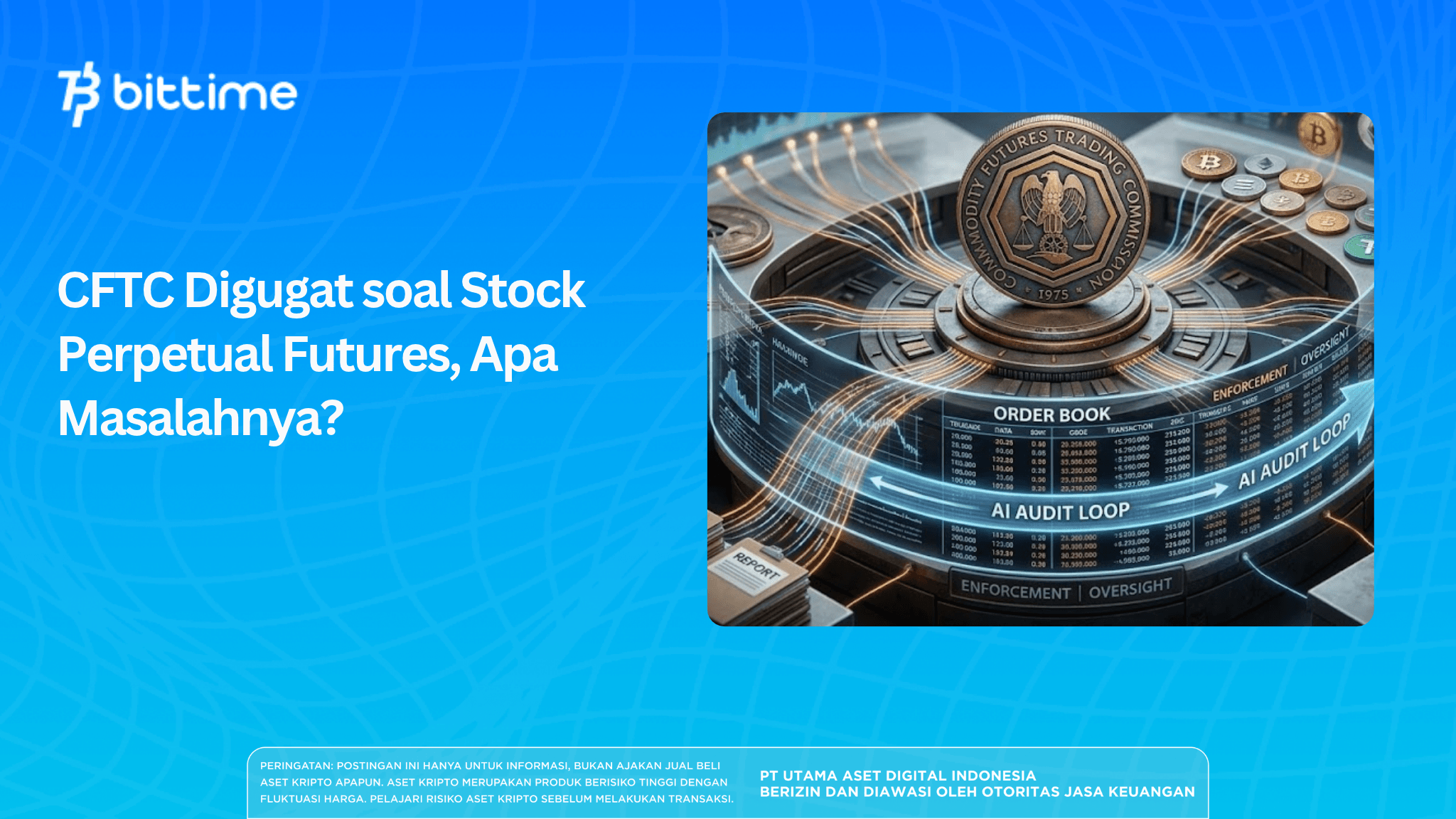
Approval and lawsuit came on the same day. On Tuesday, 3 November 2026, the United States derivatives regulator opened the door for stock perpetual futures on domestic exchanges, and a Wall Street-backed group immediately took the decision to court.
This CFTC lawsuit concerns an old question now emerging in crypto-style products: who has the authority to oversee stock-based derivative contracts.
Key Takeaways
- The CFTC approved single-stock perpetual futures on US exchanges for the first time on 3 November 2026.
- The Capital Markets Alliance, backed by Citadel Securities and Cboe, sued on the grounds that the contracts are actually swaps falling under the SEC's purview.
- Similar contracts for crypto had previously been challenged by CME Group.
What the CFTC Approved
According to CoinDesk, the CFTC gave the green light for perpetual futures contracts based on individual stocks on registered US exchanges. These contracts are also known as equity perpetual futures.
CFTC Chair Michael Selig stated that the contracts are considered approved under existing security futures rules, and oversight is shared between the CFTC and the SEC.
Perpetual futures, or perps, are contracts with no expiration date. Traders can bet on an asset's price without owning it, and this product often uses leverage that magnifies both profits and losses.
The format is popular in crypto markets, especially on overseas exchanges and decentralized platforms such as Hyperliquid. CoinDesk noted that perps volume reached more than USD 630 billion in the past month, based on DeFiLlama data.
Selig said the move gives US traders a regulated alternative, so they are not pushed toward overseas venues that are often unsupervised. He did not specify which exchanges will offer the product, or which stocks will be available at launch.
This decision continues a previous step. About five months ago, the CFTC approved the first bitcoin perps on a regulated US exchange, and Wall Street also began to take interest. The parent of the New York Stock Exchange, Intercontinental Exchange (ICE), recently invested in tradeXYZ, the builder of the perps market on Hyperliquid.
Keep up with crypto derivatives regulation developments through Bittime, a crypto asset trading platform licensed and supervised by OJK.
Read Also:
- Crypto Futures Regulation in Indonesia, the US, Europe, and Asia: A Complete Guide
- Trading Crypto Futures in Indonesia? These Are the OJK 2026 Rules You Must Understand
- Volatile Crypto Market: How Traders Use Long and Short Positions
Contents of the Lawsuit Against the CFTC
The plaintiff is the Capital Markets Alliance (CMA), a new organization representing traditional financial firms. According to CoinDesk, its members include Cboe, Citadel Securities, and the Healthy Markets Association.
The lawsuit was filed in the US District Court for the Southern District of New York, and the CMA is asking for the policy to be vacated.
There are two main arguments. First, the CMA argues that this product is a security-based swap, placing it under SEC jurisdiction rather than the CFTC.
Second, the CMA accuses the CFTC of violating the Administrative Procedure Act by failing to explain its policy, including why it contradicts the agency's previous position.
Support came from the American Securities Association. Its president, Chris Iacovella, said the CFTC "sidestepped the SEC's jurisdiction and Congress' ban" in selling security-based swaps to retail investors, according to a quote in a CoinDesk report. The same quote also circulated in a Coin Bureau post on X.
CFTC Response and Previous Lawsuits
The CFTC responded sharply. An agency spokesperson said it was surprising that an anonymous group was using legal channels to disrupt markets regulated by the CFTC. According to the spokesperson, markets should be governed by law, not by a litigation campaign to hinder innovation, as written by CoinDesk.
This is not the first legal clash over perps. CoinDesk reported that the CFTC's earlier move on crypto perps was also challenged by CME Group.
The argument is similar: contracts without an end date are not real futures but swaps with different rules. This pattern shows that the debate over perps classification is not settled in the United States.
Impact on the Market and Traders
The lawsuit has not decided anything yet. Stock perpetual contracts remain approved until a court changes that, and there is no clarity on exchanges or a launch date. Market participants are likely waiting for two things: whether the court accepts the jurisdiction argument, and how the CFTC responds to the accusation of insufficient policy explanation.
For crypto traders, this case matters because the fate of crypto-style perps on Wall Street depends on the outcome. Stock perps with high leverage also carry the same risks as crypto perps, so clear rules will determine how widely this product can be accessed by investors.
Conclusion
This dispute is not about technology but about the boundary of authority between the CFTC and the SEC over stock derivative contracts. Approval and lawsuit happened on the same day, so the fate of stock perpetual futures now depends on a federal court in New York.
Check the prices of Bitcoin (BTC), Ethereum (ETH), XRP, Solana (SOL), GRAM, and BNB as well as leading memecoin DOGE. You can trade directly on Bittime!

Bittime is a licensed Digital Financial Asset Trader (PAKD) platform supervised by the Financial Services Authority — a place where you can buy Bitcoin in Indonesia and hundreds of other crypto assets starting from IDR 10,000. The registration process is fast, secure, and can be started today.
Track the USDT to IDR conversion and your favorite crypto asset price movements in real time. Everything is available in one crypto investment app that can be downloaded for free on the Play Store.
Ready to start? Register now on Bittime and execute your investment strategy with a platform trusted by millions of users in Indonesia.
FAQ
1. Who sued the CFTC?
The Capital Markets Alliance, an organization representing traditional financial firms and backed by Cboe and Citadel Securities.
2. What is requested in the lawsuit?
The court is asked to vacate the CFTC policy that opened the door for single-stock perpetual contracts.
3. What are stock perpetual futures?
Derivative contracts with no expiration date that track the price of individual stocks. Traders can open them with leverage as long as margin is sufficient.
4. Can stock perps already be traded in the US?
There is no certainty yet. The exchanges and stocks available at launch have not been announced.
Disclaimer: The views expressed belong exclusively to the author and do not reflect the views of this platform. This platform and its affiliates disclaim any responsibility for the accuracy or suitability of the information provided. It is for informational purposes only and not intended as financial or investment advice.

.png)