How to Use Muse AI for Crypto Trading and the Risks
2026-11-04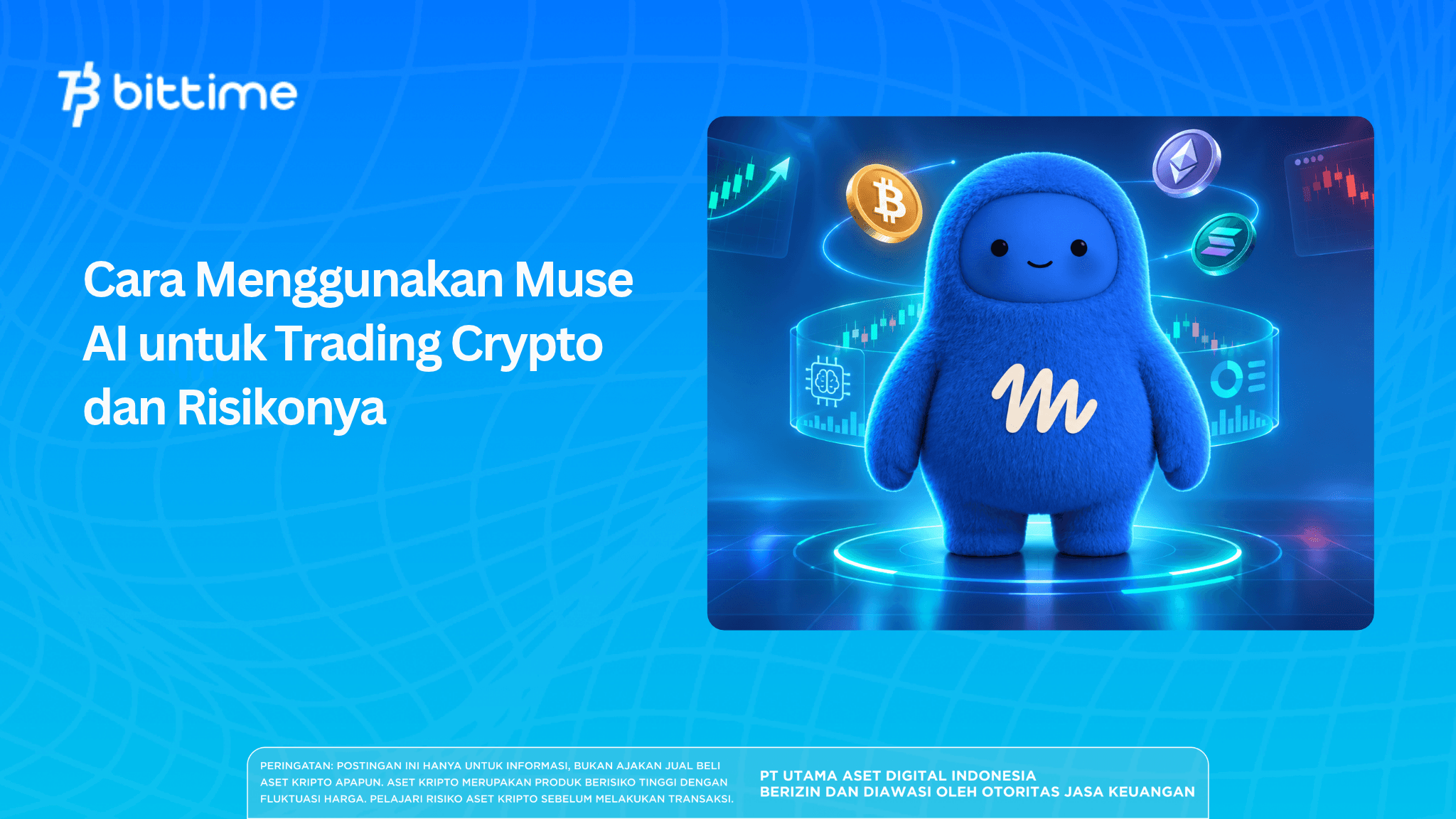
How to use Muse AI for crypto trading is attracting growing interest as AI agent technology develops. Rather than simply answering questions, Meta's Muse AI is designed to help users complete various digital tasks, including finding information and compiling research that can be useful when studying the cryptocurrency market.
So, can Muse AI buy Bitcoin automatically or identify potential opportunities in newly launched tokens? Some users have begun sharing experiments that combine AI agents with Binance Agentic Wallet, including efforts to track airdrops and NFTs. Before trying it yourself, there are a few important things to understand about Muse's capabilities, how to use it, and the risks of granting access to a crypto wallet.
Key Takeaways
- Muse AI can assist with crypto research, summarize market information, and prepare analyses based on available data.
- Integrating AI agents with Binance Agentic Wallet creates opportunities for Web3 automation, but direct compatibility with Muse has not been officially confirmed.
- Using AI for trading still requires oversight, as inaccurate analyses and overly broad wallet permissions can lead to financial losses.
What Is Meta's Muse AI?
Muse AI is a personal AI agent launched by Meta in September 2026. The technology is designed to help users complete digital tasks, from finding information online to carrying out work through connected applications.
Unlike a conventional chatbot, Muse does more than provide answers. When given an instruction, the system can plan a workflow, use available tools, and proceed with tasks according to the permissions granted by the user.
Muse also has a dedicated computing environment called Muse Secure VM. This environment allows the AI to use a browser and perform tasks without relying entirely on the user's device.
For crypto traders, these capabilities are appealing because much of the time spent trading actually goes toward finding and checking information. Project announcements, regulatory developments, and market conditions often need to be reviewed before opening a position.
This is where Muse could help: not as a tool that guarantees profits, but as a way to organize research more efficiently.
Read also: Getting to Know Muse AI, Meta's App That Surpassed ChatGPT in the US App Store
How Does Muse AI Work for Crypto Trading?
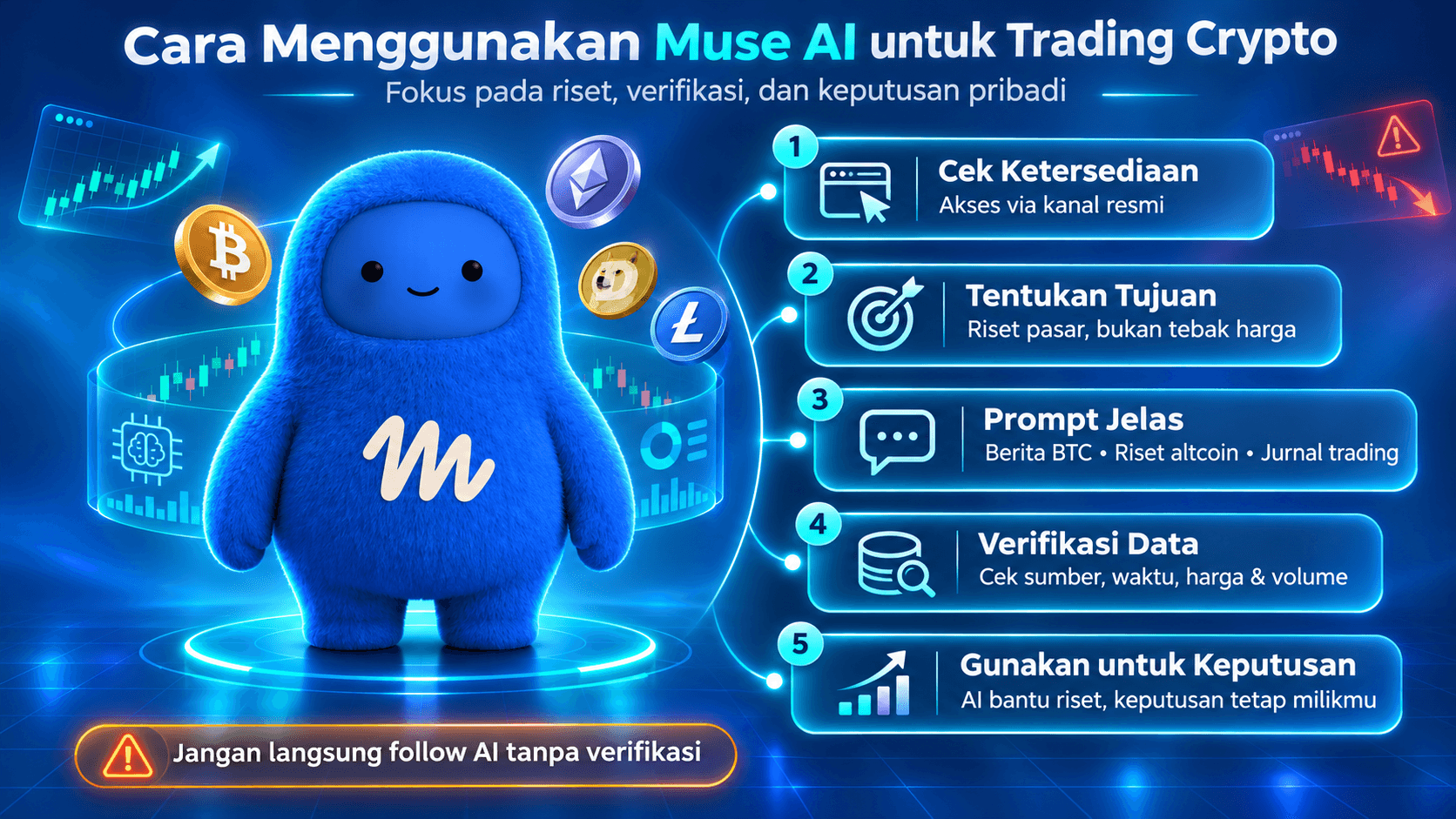
When Muse receives an instruction, it attempts to identify the steps needed to complete the task. For example, if a user asks for a summary of recent Bitcoin developments, the AI can use a browser to find relevant information and compile it into a report.
The resulting report can then support further analysis. However, its quality still depends on the sources Muse can access and how accurately the AI interprets the information.
In the crypto space, Muse could potentially assist with several tasks:
- Market research: Collecting cryptocurrency news and developments from specified sources.
- Fundamental analysis: Comparing projects based on tokenomics, utility, ecosystem development, and publicly available information.
- Information monitoring: Helping track project announcements, policy changes, and industry developments.
- Trading journal: Organizing transaction records and helping evaluate decisions based on the data provided.
- Web3 research: Organizing information about airdrops, NFTs, and new blockchain projects.
These are examples of what general-purpose AI agents may be able to do; they are not all dedicated trading features that have been tested and verified on Muse.
This distinction matters, especially when tasks involve real-time price data or transactions using actual funds.
How to Use Muse AI for Crypto Trading
You do not need to connect a wallet or exchange account immediately to explore how AI can help with trading. A more sensible starting point is to use Muse for research tasks whose results are easy to verify.
Here is a step-by-step guide.
1. Check Muse AI Availability
Muse can be accessed through the official muse.ai website and apps available in certain countries.
As of November 4, 2026, confirmed official launches include the United States, Canada, Japan, and Singapore. There has been no official announcement of general availability in Indonesia.
If the service is available for your account and region, visit an official channel and follow the registration process. Avoid imitation websites or unofficial apps promising faster access.
Muse offers free access subject to certain limits. Users who need greater capacity can consider the subscription options available in their region.
2. Define Your Crypto Analysis Goals
Before giving instructions, decide what information you actually want to find.
For instance, you might want to understand why Bitcoin's price moved sharply. Instead of asking the AI to predict the next price, direct Muse to identify events that may have influenced the market during that period.
This approach makes the research easier to evaluate, because you can examine the relationship between the information found and actual market conditions.
3. Use Clear Prompts
The quality of your instructions strongly influences the AI's output. The more specific your request, the easier it will be to check whether the response meets your needs.
Here are a few examples of Muse AI prompts for crypto trading.
Prompt for Bitcoin research:
Find Bitcoin developments from the past 24 hours. Summarize the main news, changes in market sentiment, and factors that could affect BTC's price. Include sources and publication times, and distinguish facts from opinions or forecasts.
Prompt for altcoin project analysis:
Help me compare two crypto projects based on token utility, development activity, tokenomics, and fundamental risks. Use official documents and verifiable public information. Do not invent missing data.
Prompt for trading evaluation:
Create a trading journal using the transaction records I provide. Organize entries by date, asset, reason for entering a position, risk management plan, and trade outcome. Identify patterns of mistakes without changing the original data.
These three prompts serve different purposes. The first helps you understand market conditions, the second supports asset research, and the third helps you review your trading process.
4. Verify the Generated Data
Do not use an AI-generated analysis to make a decision without checking it first.
Confirm that summarized news actually comes from the cited sources. If a report includes prices, trading volumes, or technical indicators, make sure the data has a clear observation timestamp.
This matters because cryptocurrency markets move continuously. Information that was accurate a few hours ago may no longer be relevant when you are ready to trade.
5. Use Research Findings to Inform Decisions
Once you have verified the data, use the findings to supplement your own analysis.
For example, if Muse identifies an increase in a project's development activity, you still need to determine whether that progress has actually affected network usage or demand for the token.
AI can help you gather information faster, but assessing opportunities and risks remains your responsibility.
Read also: Meta Muse Charm Officially Unveiled: An AI Gadget That Could Replace Smartphones?
Can Muse AI Connect to Binance Agentic Wallet?
One noteworthy development at the intersection of AI and crypto is the introduction of Binance Agentic Wallet.
Unlike a conventional wallet, this service is designed so that compatible AI agents can perform Web3 activities under rules set by the user. Agentic Wallet balances are kept separate from the main wallet, while access and transaction limits can be managed through its settings.
Binance also offers Skills Hub, a collection of tools that lets certain AI agents access features such as token information, wallet activity, and blockchain services.
This technology could enable AI applications that go well beyond reading news.
However, an important distinction is needed: Binance Agentic Wallet may support AI agents, but that does not mean Muse has an official integration available to every user.
Compatibility depends on supported tools, configuration, permissions, and the services being used.
How Could Binance Agentic Wallet Be Used?
With a compatible AI agent, users can install an official Binance Skills Hub integration, connect Agentic Wallet through the available authentication process, and grant permissions as needed.
Read-only information features and transaction features should be treated separately from the outset.
Asking an AI to display a wallet balance carries a different level of risk from authorizing it to swap tokens or interact with a smart contract.
Therefore, if you want to explore an AI-wallet integration, start with information checks that do not require signing transactions.
Never enter a seed phrase or private key into a prompt, even if the instructions claim to come from an official service.
Read also: What Is Muse Coin? A Base Token Inspired by Meta's AI Agent
Can AI Agents Find Airdrops, NFTs, and New Tokens?
Within the Web3 community, experiments are emerging that use AI agents to discover opportunities that would normally require manual monitoring.
For example, a system might check announcements for new tokens, airdrop programs, and NFT minting schedules. The AI then organizes the findings according to criteria specified by the user.
Some users have even described systems that run checks every 30 minutes.
The concept is interesting, but monitoring information is different from executing transactions. Each requires a different level of access.
1. Monitor Token Launches
An AI agent can be tasked with finding announcements about new crypto projects through official websites or designated communication channels.
The information collected may include the project's name, blockchain network, launch date, and links to documentation.
To reduce the risk of scams, compare the findings with announcements on the project's official channels. A newly launched token does not necessarily have worthwhile utility, liquidity, or fundamentals.
2. Find Airdrop Information
An airdrop is a distribution of tokens to users who meet certain requirements.
AI can help list active programs, record deadlines, and explain eligibility requirements based on available information.
However, not every airdrop is genuinely free or safe. Some require transaction fees, while fraudulent programs may use claim pages to steal wallet access.
3. Assess NFT Minting Opportunities
NFT minting is the process of creating or issuing a non-fungible token on a blockchain.
Some projects offer free mints, meaning NFTs with no initial purchase price. Even so, users may still have to pay gas fees to process transactions.
AI can help check basic information such as contract addresses, networks, and minting terms. These checks do not guarantee that a project is safe or that its NFTs will have resale value.
4. Create an Opportunity Tracker
One practical use is asking AI to organize crypto opportunities into a list that is easy to update.
The list can include project names, announcement sources, participation requirements, estimated costs, verification status, and identified risks.
This allows you to compare opportunities without immediately connecting a wallet.
The list can also help prevent you from repeating activities for the same project.
Read also: Eigen Labs Brings AI Agents to Open Research Through Yukon
Can Muse AI Trade Crypto Automatically?
The answer is not a simple yes or no.
Muse can carry out digital tasks, but executing trades requires access to a trading platform or blockchain service that supports those actions.
Within Muse's connector system, reading financial information is subject to different rules from transferring funds or placing orders. Official support for trade-execution connectors should not be assumed.
Meanwhile, Binance provides technology that enables compatible AI agents to execute transactions within specified permission limits.
In other words, automated trading capabilities exist in the broader AI agent ecosystem, but they should not automatically be regarded as built-in Muse features.
What About AI That Can Earn $10–$50 a Day?
Some community posts describe AI agents designed to find token opportunities, claim assets, and then monitor the assets obtained.
There are also examples of strategies that aim to sell tokens when their prices rise to five times the entry price.
Unfortunately, a strategy target is not evidence of actual profits. Even a token that rises sharply may lack sufficient liquidity to sell, especially when trading activity is low.
The same applies to claims of potential earnings of $10–$50 per day. Without verifiable transaction histories, costs, and results, those figures cannot be treated as realistic profit expectations.
For now, a more sensible approach is to use AI to discover and check information first, rather than allowing it to execute transactions without supervision.
5 Risks of Using Muse AI for Crypto Trading
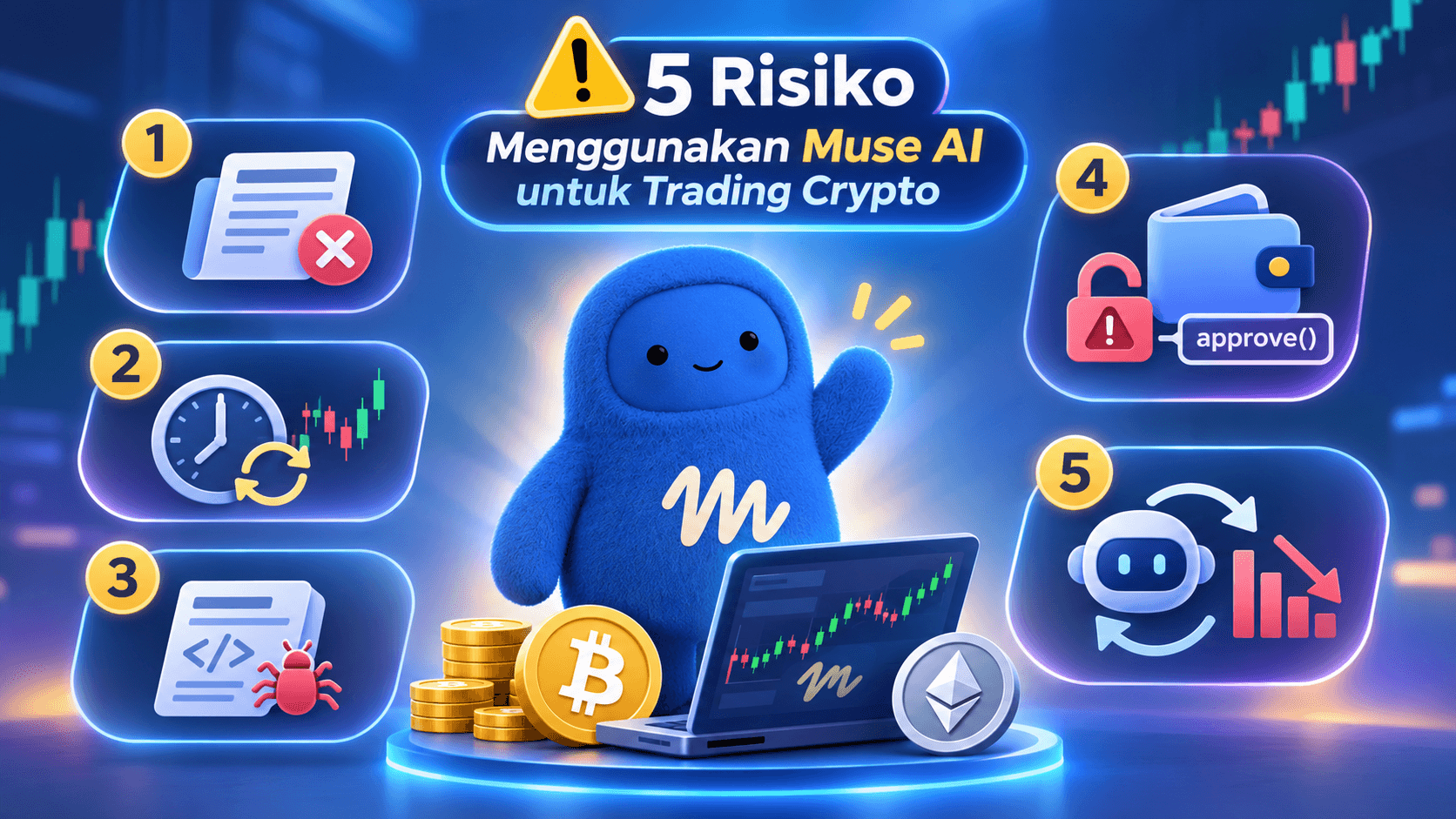
AI's ability to perform tasks independently can be convenient. However, when a system is connected to digital assets, even small mistakes can have financial consequences.
Here are five risks to consider.
1. AI-Generated Information Can Be Incorrect
AI sometimes produces answers that appear comprehensive even when some of the information is inaccurate.
In trading, mistakes involving figures, news timestamps, or project conditions can affect decisions. That is why every important piece of information should be double-checked.
2. Market Data Is Not Always Real-Time
Browser access does not automatically provide low-latency price data.
If an AI uses outdated information, its analysis may lag behind actual market conditions. This risk is greater with short-term strategies that are sensitive to price changes.
3. Smart Contracts May Contain Hidden Risks
Not all tokens and NFTs are backed by secure contracts.
Some projects impose selling restrictions, high transaction fees, or other mechanisms that disadvantage holders. AI-based checks may help identify warning signs, but they do not replace a thorough security audit.
4. AI Agents May Receive Excessive Permissions
Risks increase when users grant permission to sign transactions or manage assets without clear limits.
Functions such as approve() and setApprovalForAll() deserve particular attention because they can grant specific contracts permission to use assets.
Do not approve a transaction just because an AI says it is safe.
5. Automation Can Still Lose Money
An AI agent running around the clock will not necessarily find profitable opportunities.
Price movements, slippage, gas fees, low liquidity, and failed strategies can still cause losses.
A fast-running system can even amplify the impact of mistakes if its transaction permissions are too broad.
Read also: What Is Sakana Fugu by Sakana AI? An AI Model That Can Coordinate Multiple LLMs
How to Use AI Trading Agents More Safely
Beginners do not need to jump straight into automated transactions.
Start by using AI for tasks that do not involve personal assets, such as analyzing news, reviewing project documents, or creating a trading journal.
If you later want to explore Web3 integrations, the following steps can help limit risk:
- Use official websites and documentation before installing integrations.
- Never give an AI your seed phrase or private key.
- Prioritize read-only permissions when you only need information.
- Use a separate wallet with limited funds for any necessary testing.
- Check contract addresses, transaction amounts, and token permissions before approving on-chain activity.
- Avoid downloading apps or APK files from sources you cannot verify.
- Review and revoke permissions for apps and smart contracts you no longer use.
You should also be cautious about prompts shared openly on social media.
Long sets of instructions that look like tutorials may contain additional commands unrelated to the original purpose.
Read the full instructions before using them, especially if the AI has access to a wallet or services capable of executing transactions.
Is Muse AI Suitable for Beginner Crypto Traders?
For users new to AI agents, Muse is more relevant as a research assistant than as a trade-execution tool.
With the right instructions, AI can help gather information, compare cryptocurrencies, and organize trading records. These tasks produce results that are relatively easy to verify without granting access to funds.
More experienced users may be interested in exploring integrations with Web3 services. However, doing so requires an understanding of wallet security, smart contracts, and permission management.
If your only goal is to monitor the prices of Bitcoin, Ethereum, or other cryptocurrencies, there is no need to build a complicated automated trading system.
You can also sign up for Bittime to follow crypto prices and market updates as research material before making decisions.
Conclusion
Using Muse AI for crypto trading can begin with straightforward activities, such as researching market information, comparing projects, and keeping a trading journal. AI agent technology can reduce repetitive research work, but its findings still need to be verified before use.
Integrations with services such as Binance Agentic Wallet create possibilities for more complex Web3 activities. Even so, direct compatibility with Muse has not been officially confirmed, and automated transactions still involve risks.
For traders, AI's greatest benefit is not the promise of instant profits, but the opportunity to conduct more structured research. Use the technology as a supporting tool while keeping control of your decisions and crypto assets.

Bittime is a licensed Digital Financial Asset Trader (PAKD) platform regulated and supervised by Indonesia's Financial Services Authority (OJK) — where you can buy Bitcoin in Indonesia and hundreds of other crypto assets starting from IDR 10,000. Registration is quick and secure, and you can get started today.
Track the USDT to IDR conversion rate and real-time price movements of your favorite cryptocurrencies. Everything is available in one crypto investment app that you can download for free from the Play Store.
Ready to get started? Sign up for Bittime now and put your investment strategy into action on a platform trusted by millions of users in Indonesia.
FAQ
What Is Muse AI and How Does It Work?
Muse AI is a personal AI agent from Meta designed to help carry out digital tasks through a browser and connected applications. Users provide instructions, and Muse plans and performs the necessary steps according to its capabilities and the permissions available.
Can Muse AI Be Used for Automated Crypto Trading?
Muse can assist with crypto research, but there is no confirmation that it provides an official automated trading feature generally available to users. Executing transactions requires additional integrations and appropriate permissions, so it should not be confused with the AI's ability to analyze information.
Can Muse AI Be Connected to Binance Agentic Wallet?
Binance Agentic Wallet supports certain AI agents through compatible integration systems. However, a direct Muse connection has not been verified as an official feature available to all users. Check the documentation and compatibility before attempting to connect a wallet.
Is Muse AI Free and Available in Indonesia?
Muse offers free access with usage limits, as well as subscription options. As of November 4, 2026, Meta has not announced an official Muse launch for the general public in Indonesia. Availability may change as the service expands to more regions.
Is It Safe to Use Muse AI for Crypto Trading?
Using Muse to research public information carries less risk than granting it permission to transact through a wallet. If you use an AI agent with financial access, limit its permissions, review every transaction, and never share your seed phrase or private key.
Disclaimer: The views expressed belong exclusively to the author and do not reflect the views of this platform. This platform and its affiliates disclaim any responsibility for the accuracy or suitability of the information provided. It is for informational purposes only and not intended as financial or investment advice.
.png)