Bitcoin (BTC) Rises 3.5% to $82,007 but Has Not Broken Out Yet: Chance to Rise or Fall?
2026-05-15
Bitcoin (BTC) rose about 3.5% to the $82,007 area, but its move has not formed a strong breakout. The price remains within a trading range near $80,000 to $82,500.
The main question for traders as BTC price rises today is not only about profit potential. Many readers also want to know whether this level is safe enough to enter, or whether it is still prone to correction because resistance has not been clearly broken.
Key Takeaways
- Bitcoin (BTC) is still moving within a $80,000 to $82,500 trading range, so the breakout has not been confirmed.
- The nearest support and resistance areas are $80,000 as the main support and $82,000 to $82,500 as the resistance zone.
- Traders need to monitor market analysis, derivatives volume, and price reaction before making short-term Bitcoin predictions.

Register on Bittime now and start trading crypto through a fast, secure, and easy process in the app.
Bitcoin (BTC) Rises to $82,007, but Remains in a Trading Range
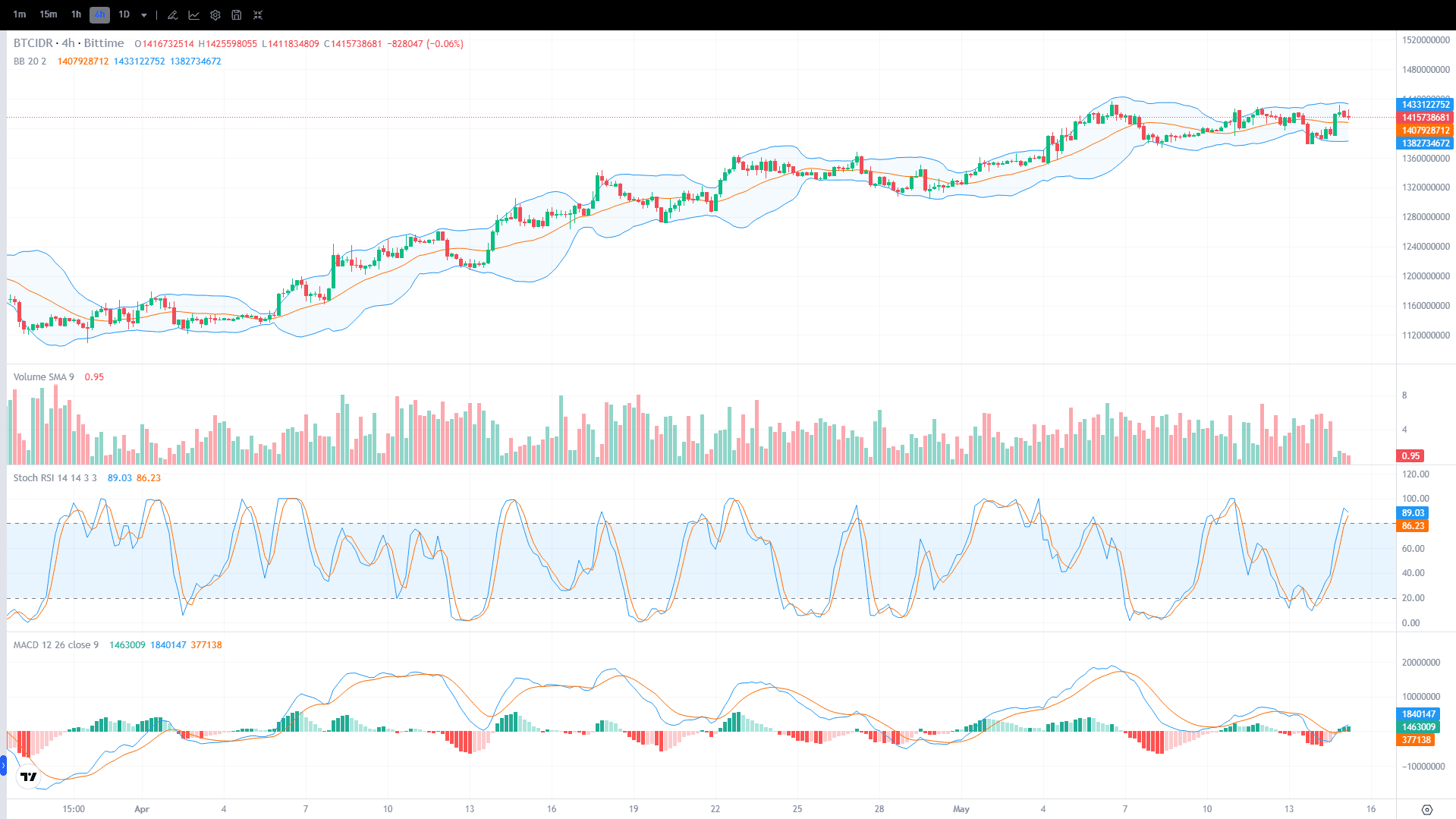
Bitcoin rose to around $82,007 after posting a fairly strong daily gain. However, that rise is not enough to say that a new trend has started.
The price is still moving within a narrow trading range. This means buyers and sellers are still holding each other back, especially near the $82,000 to $82,500 area.
BTC Price Today: Breakout Not Yet Confirmed
BTC price today needs to be read from two sides. First, the move to $82,007 shows that buying interest is still present. On the other hand, the price has not been able to close strongly above resistance.
A healthier breakout usually appears when the price breaks resistance, holds above that level, and receives support from volume. Without that confirmation, the upward move can turn into a false breakout, which is a brief rise that fails to continue.
Also read: Today's Coinglass Crypto Market Data: Futures vs Spot and Their Impact
Bitcoin (BTC) Support and Resistance Levels to Watch
Support and resistance serve as basic guides for reading short-term risk. Support is an area that often holds back price declines. Resistance is an area that often holds back price increases.
For movement when the reference price is near $82,007, the most watched levels are $80,000 as support and $82,000 to $82,500 as resistance.
Bullish Scenario: BTC Holds Above $82,500
The bullish scenario becomes stronger if Bitcoin (BTC) can break $82,500 and hold above that area. A solid candle close above resistance can signal that buyers are starting to take control.
However, traders still need to watch volume and market reaction after the breakout. If the price rises but volume is weak, the chance of correction remains open.
Bearish Scenario: BTC Fails to Hold $80,000 Support
A bearish scenario can appear if BTC fails to hold above $80,000. A drop below that support could trigger further selling, especially from short-term traders.
The $80,000 area also has psychological value. Many market participants use round numbers as references for entry, exit, or stop-loss placement.
Bitcoin (BTC) Market Analysis: Derivatives and Spot Volume

Bitcoin market analysis needs to look at both spot and derivatives markets. The spot market shows direct asset purchases, while derivatives reflect contracts such as futures that are often used for speculation or hedging.
When derivatives volume increases, Bitcoin volatility can rise. Small moves can trigger liquidations of leveraged positions, especially when many traders build positions around the same price area.
What Does Derivatives Volume Mean for Traders?
High derivatives volume does not always mean the price will rise. Large volume only shows that market activity is busier.
If volume rises together with price and support remains strong, the signal may be more positive. If volume rises but the price fails to break resistance, the market may be forming a trap for traders who enter too quickly.
Short-Term Bitcoin Prediction: Chance to Rise or Fall?
The short-term Bitcoin prediction while the price is near $82,007 remains neutral with a cautious bias. Upside potential remains as long as BTC can hold above $80,000 and try to break $82,500 again.
Downside risk has not disappeared either. Failure to break out at the resistance area can prompt traders to take profits, then push the price back toward support.
Factors That Could Push Bitcoin Higher
Bitcoin (BTC) could continue rising if buyers can turn the $82,000 to $82,500 area into new support. This condition usually shows that the old level that held the price back has become a new base.
Global market sentiment also plays an important role. U.S. economic data, institutional fund flows, U.S. dollar movement, and crypto-asset regulatory news can affect BTC direction.
Factors That Could Make Bitcoin Fall
BTC could weaken if the price fails to hold above $80,000. Pressure may also appear if the derivatives market becomes too crowded with leveraged long positions.
In addition, macro news that does not support risk assets can accelerate a correction. For that reason, traders should not rely on only one technical indicator.
Also read: What Bitcoin Mining Is and How It Works: A Beginner's Guide
Bitcoin (BTC) for Beginners: Check Risks and Platforms Before Trading
Bitcoin is not a company and does not have a central team that promises a price. Its model is an open blockchain-based network, with a validation process that runs through nodes and mining.
Therefore, claims related to security, fees, trading features, and platform status must be checked directly with the service provider being used. There is no reason to assume that all platforms have the same standards.
Checklist Before Buying When BTC Price Moves Quickly Today
Beginners should not enter only because they see Bitcoin rising. Use a simple plan before buying crypto assets.
Check support and resistance areas, capital size, transaction fees, account security features, trading-pair liquidity, and Bitcoin volatility risk. Do not use essential living funds for trading.
How to Read Signals from the BTC Chart?
On the 4-hour chart, price movement near the upper limit of an indicator such as Bollinger Bands can show that buying pressure is strong. However, that condition can also mean the price is becoming vulnerable to a short-term pullback.
Indicators such as MACD and Stochastic RSI can help read momentum. Even so, indicators are not certainty tools. Always combine them with price levels, volume, and the market calendar.

Conclusion
Bitcoin (BTC) did rise to around $82,007, but it has not moved out of the $80,000 to $82,500 trading range. As long as resistance has not been clearly broken, the market remains in a waiting phase.
For traders, upside potential remains open if BTC can hold above $82,500 with strong volume.
For investors, a gradual approach and risk management remain healthier than chasing price when volatility increases. Monitor the live price, recheck market data, then make decisions with a clear plan.
FAQ
What does it mean that Bitcoin (BTC) rose to $82,007 but has not broken out?
It means BTC moved up to the $82,007 area, but has not managed to break through and hold firmly above the $82,000 to $82,500 resistance.
What are Bitcoin's nearest support and resistance levels?
The main support is around $80,000, while the nearest resistance is in the $82,000 to $82,500 area.
Does BTC price today still have upside potential?
Upside potential remains if BTC can hold above resistance and volume supports the move.
Why is derivatives volume important for Bitcoin market analysis?
Derivatives volume is important because it can show speculative activity and the risk of leveraged-position liquidations when price moves quickly.
Is it safe for beginners to buy Bitcoin when the price is rising?
Beginners need to be careful when the price rises quickly. Check support and resistance, volatility risk, platform fees, and use funds that are ready to bear risk.
Disclaimer: The views expressed belong exclusively to the author and do not reflect the views of this platform. This platform and its affiliates disclaim any responsibility for the accuracy or suitability of the information provided. It is for informational purposes only and not intended as financial or investment advice.

.png)