Arb Coin Drops 4% Due to $18 Million Ostium Exploit: Will the Correction Continue?
2026-07-17
Arb Coin fell by around 4% after the Ostium exploit resulted in an initial loss estimated at US$18 million.
The incident on the Arbitrum-based perpetual DEX platform sparked renewed concerns about oracle security and the risks of DeFi applications.
Key Takeaways
- ARB's price dropped by around 4% while the overall crypto market remained relatively flat, so the pressure appears to be more specific to the sentiment of the Arbitrum ecosystem.
- The exploit attacks the Ostium oracle system, not the Arbitrum underlying network or Ethereum consensus mechanism.
- The next price direction of ARB will depend on the outcome of the investigation, the recovery of funds, Ostium's response, and the condition of the altcoin market.
Why did Arb Coin drop 4%?
ARB Price experienced a decline of around 4.17% in the 24-hour period after news of the Ostium exploit began to spread. Meanwhile, the overall crypto market cap remained flat.
This performance difference suggests that selling pressure on ARB may be related to more specific sentiment toward the Arbitrum ecosystem.
Despite this correction, ARB had previously recorded gains within a week. Part of the decline could also stem from profit-taking following the previous rally, not solely from the Ostium incident.

Sumber AI Generated Image
This kind of reaction is common in the crypto market. When a major protocol experiences an exploit, investors don't always wait for the results of a full investigation. Some market participants choose to reduce exposure first to avoid further risk.
However, it's important not to immediately conclude that the Arbitrum network has been hacked. Ostium does run on top of Arbitrum, but the source of the problem appears to be the oracle system the application uses.
Read also: Is Bitcoin Prediction Market Safe? Stanford Study Finds Risk of Manipulation
What Happened in the $18 Million Ostium Exploit?
Ostium is a decentralized exchange that provides perpetual trading for various cryptocurrencies. real-world assets or RWA. Users can gain exposure to price movements in stocks, commodities, indices, foreign exchange, and cryptocurrencies through perpetual contracts without directly holding the underlying assets.
Initial estimates put the loss at around US$18 million in USDC. Subsequent reports from on-chain transaction monitoring indicate a higher figure, closer to US$24 million.
The discrepancy likely arose because the fund tracing process was still ongoing and the final amount had not been fully confirmed when the news was first published. The exchange halted trading activity after detecting an anomaly.
The shutdown was done to limit further losses and give the team time to investigate the attack path.
Read also: Robinhood Chain Is Growing in Popularity, Is It Time to Buy HOODX?
Is Arbitrum L2 Really Exploited?
The term "Arbitrum L2 exploit" can be misleading. While the incident occurred in an application built on the Arbitrum network, it doesn't necessarily mean the rollup system, main bridge, sequencer, or underlying Arbitrum protocol was compromised.
Arbitrum is a Layer 2 platform that processes transactions with lower fees and higher throughput, then finalizes the data and securely manages it through Ethereum.
Applications within the network can utilize different smart contracts and additional infrastructure. As with Ostium, vulnerabilities were discovered in the oracle and signer management layers.
Oracles function to bring price data from outside the blockchain into smart contracts. If the private key of the party signing the data falls into the hands of an attacker, the contract could accept false information as valid.
Perbedcan be summarized as follows:
- The Arbitrum Network continues to process transactions according to the protocol rules.
- Ostium smart contract receives manipulated oracle data.
- The main issues relate to key security and price validation.
- The losses came from Ostium's liquidity vault, not the entire assets on Arbitrum.
While the incident didn't damage the underlying network, it still impacted the ecosystem's reputation. Investors often judge the quality of a blockchain based on the security of the applications running on it, especially those with significant funding and institutional investor support.
Read also: Profit-Taking Strategy During a Bearish Market with Crypto Futures
Why Could the Ostium Exploit Affect ARB Price?
ARB is the governance token of the Arbitrum ecosystem. Token holders can participate in proposals and decisions related to network development through the Arbitrum DAO.
The ARB price has no direct mechanical relationship to Ostium's OLP vault balance. Ostium's losses also don't change the ARB supply or directly remove funds from the Arbitrum treasury.
The impact works more through three channels.
1. Decreased trust in the DeFi ecosystem
A major exploit could lead users to question the security of other applications on the same network. These concerns could lead to liquidity withdrawals or delays in new investments.
2. Lower growth expectations
Ostium is part of the RWA and perpetual trading narrative on Arbitrum. Disruptions to these protocols could dampen market expectations for volume growth and network adoption in the short term.
3. Sentiment-based selling pressure
Traders often sell ecosystem tokens when negative news emerges, even if the tokens themselves aren't directly involved. This strategy aims to mitigate risk before full information is available.
A drop of around 4% doesn't prove that the exploit was the sole cause. However, ARB weakened when the market was generally relatively stable, so the connection to Ostium sentiment makes sense. ARB Today After Correction
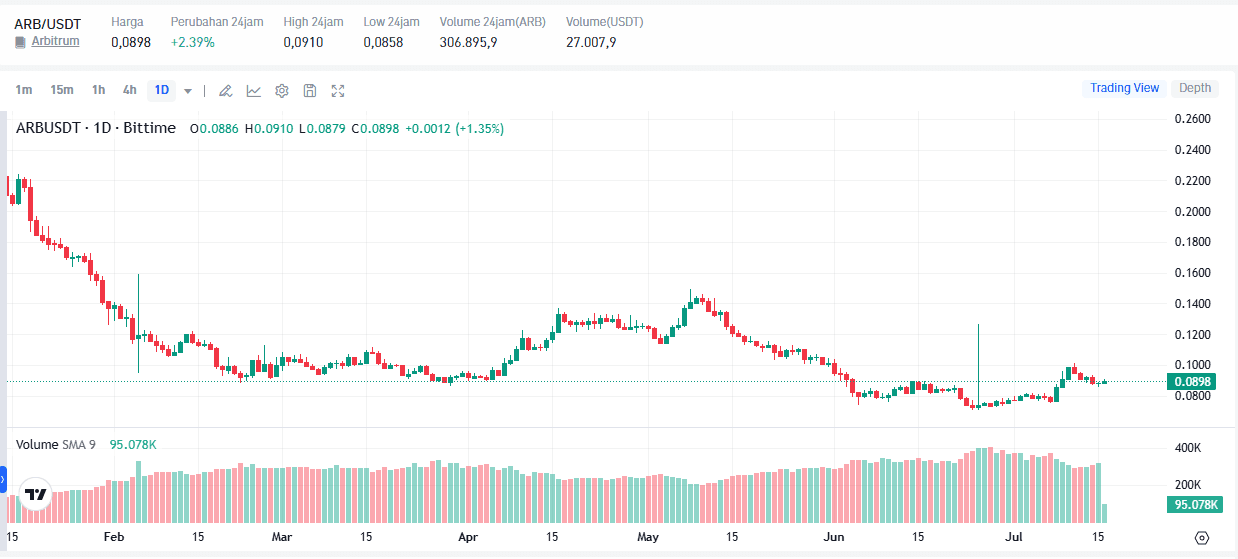
On July 17, 2026, ARB's price was around US$0.089. The price fluctuated daily between US$0.086 and US$0.091, with a market capitalization of approximately US$563 million and a circulating supply of approximately 6.36 billion tokens, trading more than 96% below its record high of US$2.39.
Investors need to see whether the price is able to stay above the daily low or whether it will return to its yearly low.
Read also: Is Noxa.fi Safe? Features, Costs, and Risks
Arb Coin Price Prediction: Will the Correction Continue?
ARB price predictions following the Ostium exploit need to be constructed in a scenario-based manner. Security news can change rapidly, and altcoin volatility makes a single price target insufficient to adequately reflect the full range of possibilities.
Skenario Bearish: US$0,070–US$0,082
A bearish scenario could occur if the investigation finds larger losses, the compensation plan is unclear, or the exploited funds are difficult to recover.
A decline below US$0.086 could open the risk of a retest of the US$0.080 area. If market pressure intensifies, ARB has the potential to approach record lows around US$0.070.
Factors that can strengthen this scenario include:
- The emergence of further exploits in the Arbitrum ecosystem.
- Liquidity withdrawal from DeFi applications.
- Bitcoin and Ethereum decline.
- ARB selling volume is increasing.
- Ostium's response was deemed inadequate.
- Concerns about token unlock or supply pressure.
Neutral Scenario: US$0.085–US$0.105
ARB could move sideways if the incident is successfully contained and no impact is found on other applications. In this scenario, the market is likely awaiting a post-mortem report, compensation plan, and security enhancements.
The US$0.10 area is a key psychological level. Prices need to break through and hold above this level to indicate that short-term sentiment is improving.
Sideways movement is also possible if investors assess the Ostium exploit as an individual application problem, not a weakness of the Arbitrum network.
Skenario Bullish: US$0,110–US$0,135
A bullish scenario requires a stronger restoration of trust. This could occur if some funds are secured, users receive assurances regarding compensation, and Ostium publishes verifiable security fixes.
ARB also needs support from the crypto market as a whole. Ethereum's strengthening, increased Layer 2 activity, and the growth of Arbitrum-based applications could distract the market from the Ostium incident.
A rise towards US$0.13 still requires consistent buying volume. Without fundamental support, the price surge risks becoming a temporary rally.
Read also: Robinhood Chain is buzzing with memecoins, DEX volume reaches $3 billion
Indicators that ARB Investors Need to Monitor
Investors should look beyond daily price changes. The following indicators can provide a more comprehensive picture of the impact of the Ostium incident.
Ostium post-mortem report
The report should explain how the signer key could be compromised, why reports with unusual timestamps were still accepted, and what security controls will be implemented.
Status of exploited funds
The possibility of fund recovery can affect sentiment. The movement of funds into mixers or asset laundering channels typically reduces the chances of returns.
Arbitrum TVL Changes
A sharp drop in total value locked could indicate that users are starting to withdraw liquidity. Conversely, a stable TVL indicates that concerns remain limited regarding Ostium.
Network activity
Transaction volume, active addresses, network revenue, DEX volume, and bridge activity should be monitored. Stable network fundamentals can help limit reputational impact.
Ethereum and Bitcoin Prices
ARB has a high correlation with the altcoin market. Positive news from Ostium may not be enough to spur a recovery if Bitcoin or Ethereum experience a major correction.
ARB trading volume
A price recovery with high volume provides stronger confirmation than a rise with thin trading. Volume also helps assess whether the sell-off is starting to subside.
Read also: NOXA Launchpad on Robinhood Chain Beats Pump.fun in 24 Hours
What Should Arb Coin Holders Do?
The decision depends on your investment horizon and risk tolerance. Short-term traders should pay attention to volatility and nearby price levels, while long-term investors should assess whether the incident changes Arbitrum's fundamental thesis.
Some steps to consider include:
- Waiting for the investigation report before adding large positions.
- Avoid high leverage when volatility increases.
- Separating Ostium risks from Arbitrum network risks.
- Monitor on-chain activity and liquidity changes.
- Determine the stop loss limit before opening a position.
- Don't buy just because the price has dropped.
- Check unlock schedule and circulating supply changes.
A low nominal price doesn't necessarily mean a low valuation. Investors still need to consider market capitalization, token supply, ARB utility, and the ecosystem's ability to retain users.
To monitor ARB movements and the latest crypto security news, you can register at Bittime and follow market updates before making decisions. Ensure each transaction aligns with your strategy and risk tolerance.
Does Arb Coin Still Have Prospects?
The Ostium incident didn't immediately erase the value of Arbitrum's technology. The network continues to provide infrastructure for applications, tokenization, and specialized blockchains with lower transaction fees than Ethereum Layer 1.
ARB remains dependent on the ecosystem's ability to generate growth that benefits the token. Adopting Arbitrum technology won't necessarily automatically increase ARB's price unless a clear value accrual mechanism is followed.
Investors also need to assess competition with other Layer 2s. Developers and users may switch networks if they find greater liquidity, more attractive incentives, or a better user experience.
In the short term, the Ostium exploit creates reputational pressure. In the long term, the impact will depend on the quality of the response, the transparency of the investigation, and changes to oracle security standards in the ecosystem.
Conclusion
Arb Coin fell around 4% after an Ostium exploit raised concerns about the security of DeFi on the Arbitrum network. The attacker allegedly used a compromised oracle signing key to inject fake price data and withdraw funds from Ostium's liquidity vault.
The incident doesn't indicate that Arbitrum's underlying protocol has been hacked. Nevertheless, the loss of approximately US$18 million still creates reputational pressure that could impact sentiment, liquidity, and ecosystem growth expectations.
ARB's correction could extend to the US$0.070–US$0.082 area if the investigation worsens or the crypto market weakens. Conversely, stabilization above US$0.085 and a recovery above US$0.10 could signal the market is beginning to separate Ostium's risks from Arbitrum's fundamentals.
Monitor official reports, funding status, trading volume, and network activity before making a decision. Avoid judging ARBs solely based on a single-day price drop.
Bittime is a licensed and regulated Digital Financial Asset Trader (PAKD) supervised by Indonesia’s Financial Services Authority (OJK) — where you can buy Bitcoin in Indonesia and hundreds of other crypto assets starting from just Rp10,000. The registration process is fast, secure, and you can get started today.
Track USDT to IDR conversions and monitor your favorite crypto assets in real time. Everything is available in one crypto investment app that you can download for free on the Play Store
Ready to start? Register now on Bittime and execute your investment strategy with a platform trusted by millions of users in Indonesia.
FAQ
Why did Arb Coin drop 4%?
ARB weakened after the Ostium exploit raised concerns about the security of DeFi applications on Arbitrum. The decline could also have been influenced by profit-taking following the previous rally.
How much did the Ostium exploit cost?
Initial estimates put the loss at around US$18 million in USDC. Subsequent investigations indicated the figure could be closer to US$24 million, but the final figure still needs confirmation.
Was the Arbitrum network hacked?
There's no indication that Arbitrum's underlying protocol has been compromised. The exploit affected Ostium's oracle and liquidity vault systems, one of the applications running on Arbitrum.
Can ARB prices still go down?
It's still possible, especially if the price breaks through the US$0.085 area or new negative developments emerge. The US$0.070–US$0.082 area is the next risk scenario, not a guaranteed target.
Is now a good time to buy ARB?
This decision depends on each individual's strategy and risk tolerance. Investors should wait for clarity on the investigation, monitor volume, and avoid buying simply because the price appears low.
Disclaimer: The views expressed belong exclusively to the author and do not reflect the views of this platform. This platform and its affiliates disclaim any responsibility for the accuracy or suitability of the information provided. It is for informational purposes only and not intended as financial or investment advice.

.png)