What Is Zebec Network (ZBCN)? Full Explanation & Tokenomics
2026-03-26
Imagine a payroll system where salaries don't arrive once a month in a lump sum — instead, they flow directly into an employee's wallet every second, continuously, like a stream that never stops. That's the core idea behind Zebec Network.
Zebec Network is a blockchain-based payments and payroll infrastructure project best known for streaming payments — a way to send money continuously over time instead of in one-time batch transfers.
Founded in 2021 by Sam Thapaliya and backed by $35 million from Coinbase, Circle, and Solana Ventures, Zebec has grown well beyond its origins as a payroll protocol into something considerably more ambitious.
Key Takeaways
- Streaming payments as the foundation. Zebec enables real-time payroll where employees are paid per second, alongside crypto-to-fiat payment cards, DePIN tools, and treasury management systems for Web3 companies.
- ZBCN is an evolution of ZBC, not a new token. ZBCN represents the next generation of the original ZBC token, migrated at a 1:10 ratio to streamline the gas fee structure — with no additional supply minted.
- Institutional partnerships that carry real weight. In December 2025, Zebec joined the Nacha Payments Innovation Alliance, which governs the $85 trillion U.S. ACH network, placing it alongside JP Morgan, Wells Fargo, Circle, and ADP.
Register on Bittime now and start trading crypto with a fast, secure, and easy process on the app.
How Does Zebec Network Actually Work?
Zebec Network is built as a decentralized infrastructure network designed to create a future where real-world value moves freely and seamlessly, giving individuals, businesses, investors, and teams immediate access to funds and tokens.
The mechanics run on smart contracts that automate financial flows — removing manual processing, eliminating batch transfers, and compressing settlement times down to real-time.
With its roots and native token on Solana, Zebec has expanded across multiple blockchains including Base, BNB Chain, NEAR, and Ethereum, evolving into a comprehensive multi-chain ecosystem that now encompasses data management and physical infrastructure through DePIN, including proprietary Point of Sale systems.
This is no longer a payroll app with a token attached — Zebec is positioning itself as a full financial infrastructure layer bridging crypto rails with the traditional financial system.
ZBCN Tokenomics: What the Numbers Actually Say
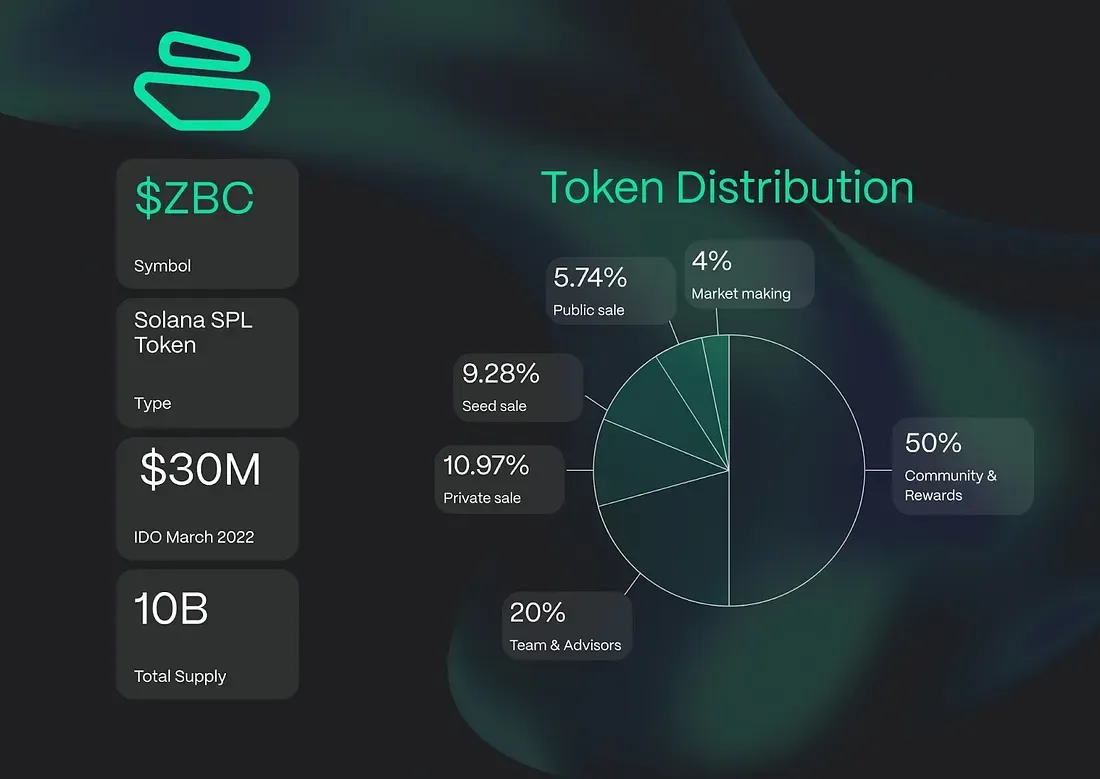
Based on the official tokenomics infographic and Zebec documentation, the original ZBC token supply of 10 billion — now migrated 1:10 to 100 billion ZBCN — is distributed across six categories.
Community & Rewards holds the largest share at 50%, signaling the project's commitment to ecosystem growth. This is followed by Team & Advisors at 20%, Private Sale at 10.97%, Seed Sale at 9.28%, Public Sale at 5.74%, and Market Making at 4%.
ZBCN is used for gas and bridging fees within the Zebec ecosystem, with a fee structure of 1 ZBCN per transaction supporting the token's deflationary aspect — when used as a bridging fee, it is automatically distributed to validators with a portion automatically burned.
Beyond fees, staking ZBCN can earn up to 15% APY, with token holders also gaining access to premium features including reduced fees and early access to new products.
Utility & Governance: More Than a Passive Token
ZBCN is the governance and utility token of the Zebec Network. Holders have voting rights in the governance system and vote on critical decisions affecting the network and ecosystem, with influence proportional to the amount of ZBCN held or controlled.
Zebec operates a hybrid governance model that blends on-chain voting with off-chain deliberation. Community members initiate proposals through Zebec's forum and social channels, which move through consultation before being formalized as Zebec Improvement Proposals (ZIPs) and voted on-chain.
Beyond governance, ZBCN holders gain access to VIP no-fee premium Zebec products — including safe, treasury, and streaming features — as well as priority access to the Zebec Instant Card with increased spending limits. That makes ZBCN an active utility token with tangible benefits rather than a purely speculative governance instrument.
Conclusion
Zebec Network is one of the more credible blockchain payment infrastructure projects currently operating — combining streaming payroll, treasury management, crypto cards, and DePIN expansion into an ecosystem that continues to mature.
With Nacha membership, ISO 20022 compliance, and live products across 138 countries, ZBCN trades more like an early-stage project despite having institutional partnerships and a functioning multi-product ecosystem.
For anyone looking to follow this project closely, understanding the full tokenomics — including unlock schedules, burn mechanics, and the governance model — is the most important groundwork before taking any position.
FAQ
1. What is Zebec Network (ZBCN)? Zebec Network is a decentralized blockchain infrastructure for real-time payments, streaming payroll, and DePIN. Its native token ZBCN serves as the governance and utility token across an ecosystem that currently operates across 138 countries on multiple blockchains.
2. What is the difference between ZBC and ZBCN? ZBC was Zebec Protocol's original token. In 2024, ZBC migrated to ZBCN at a 1:10 ratio — every ZBC holder received 10 ZBCN. No new supply was created; only the denomination changed to support more granular fee calculations for microtransactions and continuous payment flows.
3. What does the ZBCN token actually do? ZBCN is used to pay gas fees (1 ZBCN per transaction), bridging fees, governance voting through the Zebec DAO, staking with up to 15% APY, and as collateral within the Zebec ecosystem. A portion of each transaction fee is automatically burned, adding a deflationary dynamic over time.
4. Where can ZBCN be traded? ZBCN is listed on major centralized exchanges including KuCoin, Bybit, OKX, Crypto.com, HTX, Gate, BitMart, and Bitget, as well as decentralized exchanges like Raydium and Orca within the Solana ecosystem.
5. Is Zebec Network worth following in 2026? Fundamentally, Zebec has live products, growing institutional partnerships, and a multi-chain ecosystem with real usage. That said, all crypto assets carry volatility and execution risk. Understanding tokenomics, unlock schedules, and roadmap progress in full is the right starting point before making any investment decision.
How to Buy Crypto on Bittime?

Want to trade sell buy Bitcoins and crypto investment easily? Bittime is here to help! As an Indonesian crypto exchange officially registered with Bappebti, Bittime ensures every transaction is safe and fast.
Start with registration and identity verification, then make a minimum deposit of IDR 10,000. After that, you can immediately buy your favorite digital assets!
Check the exchange rate BTC to IDR, ETH to IDR, SOL to IDR and other crypto assets to find out today's crypto market trends in real-time on Bittime.
Also, visit the Bittime Blog for interesting updates and educational information about the crypto world. Find reliable articles about Web3, blockchain technology, and digital asset investment tips designed to enrich your crypto knowledge.
Disclaimer: The views expressed belong exclusively to the author and do not reflect the views of this platform. This platform and its affiliates disclaim any responsibility for the accuracy or suitability of the information provided. It is for informational purposes only and not intended as financial or investment advice.

.png)