What Is WHUF? Its Functions, Tokenomics, and How It Works
2026-10-08
WHUF or Whuffie is a token that forms an essential part of the Ethos ecosystem, a protocol focused on on-chain reputation. Unlike tokens used solely as speculative assets, WHUF is designed to support mechanisms like vouching, which involves staking tokens to demonstrate a level of trust in a specific profile.
The important question is not just what WHUF is, but also how this token is used to build a reputation system based on economic incentives. With the TGE having taken place in September 2026 and the transferability period entering its next phase on October 8, 2026, attention to the functions and tokenomics of WHUF becomes increasingly relevant.
Key Takeaways
- WHUF is the native token used in the Ethos on-chain reputation mechanism.
- The main functions of WHUF include vouching and the economic mechanisms supporting the Ethos ecosystem.
- WHUF has a total supply of 10 million tokens with no additional emission mechanism, according to official project information.
What Is WHUF or Whuffie?
WHUF is the Whuffie token used within the Ethos ecosystem to support the on-chain reputation system. Ethos builds a mechanism that allows a person's reputation to be represented through social and economic activities on the blockchain.
This concept differs from traditional reputation systems that usually rely on centralized data. Ethos uses activities such as reviews and vouches to form an overview of a profile's credibility.
In this mechanism, WHUF has an economic function. The token can be used as a staked asset when a user gives a vouch to another profile.
Thus, reputation does not just become a number or a label. There are assets placed behind the act of giving that trust.
Why Does Ethos Need WHUF?
According to the project's explanation, Ethos previously operated using ETH. The introduction of WHUF is intended to make the asset used in the reputation mechanism native to the network.
This model creates a relationship between reputation and economic incentives.
If someone engages in vouching, they are not just making a statement that a profile is trustworthy. They are also placing WHUF as a form of economic support.
Read also : What Is PLAGUE Coin? Get to Know the Yersinia pestis Token on Solana
What Is the Relationship Between WHUF and Ethos Network?
WHUF does not stand alone. This token is part of the economic design of Ethos, a protocol striving to build a reputation layer for on-chain activities.
Ethos uses the concept of a credibility profile to help users assess the reputation of an individual or entity. The system uses signals like reviews and vouches to build a network of trust.
One of the main mechanisms in this system is vouching.
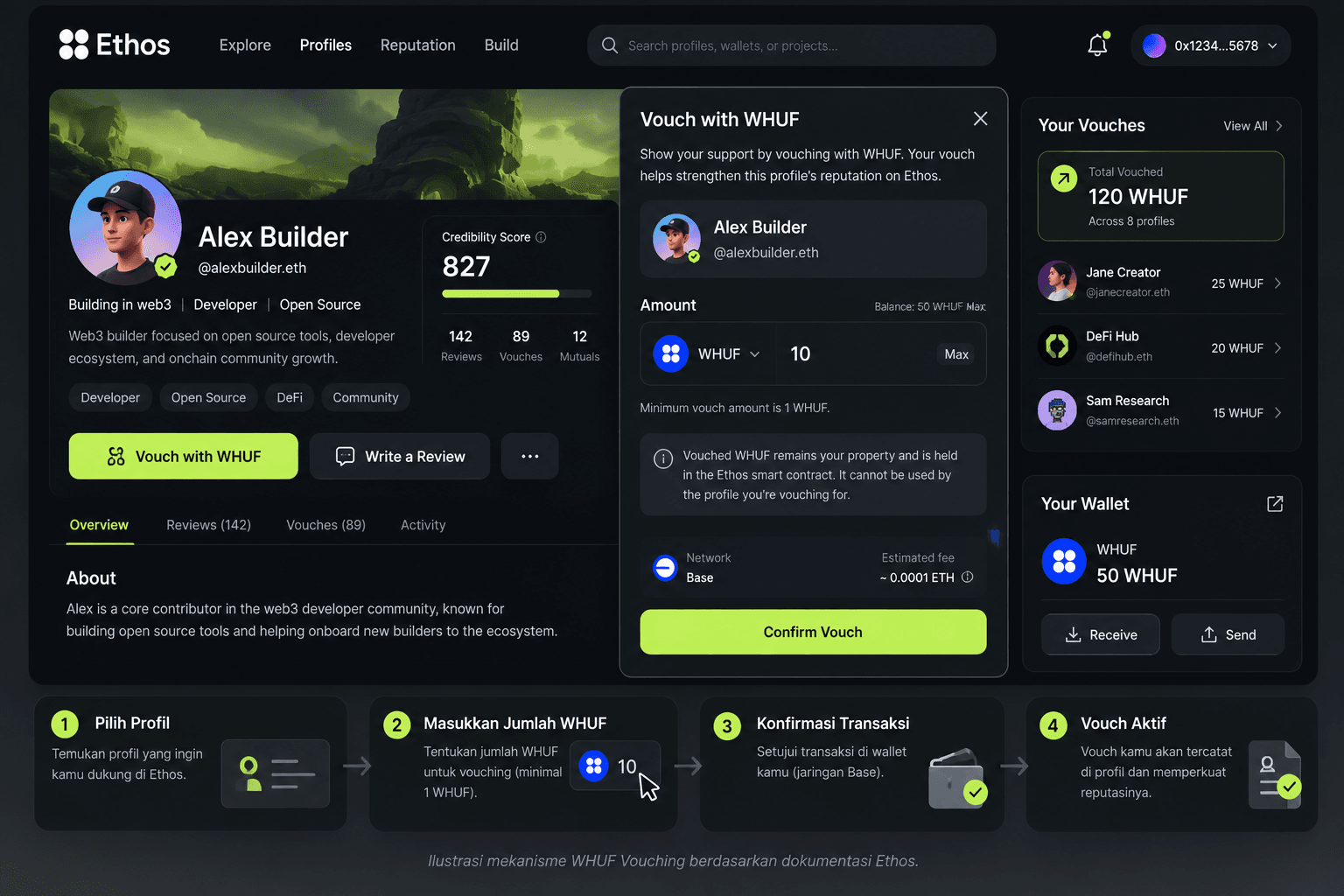
When a user makes a vouch, WHUF is placed as an asset supporting that trust. Tokens that have been vouched remain the property of the party making the vouch and cannot be used by the profile receiving the support.
This gives WHUF a different role from tokens that are only used for payments or governance.
Read also : Is USDP Legit or a Scam? Check the Facts About the United States Dividend Program
What Are the Functions of the WHUF Token?
There are several key functions to understand when discussing the WHUF token.
1. Vouching
Vouching is one of the core mechanisms of Ethos.
Users can stake WHUF on specific profiles to show a level of trust. The amount of WHUF used reflects the magnitude of economic support provided.
This system ensures that the decision to give trust has economic consequences.
2. Forming On-Chain Reputation
WHUF helps build a relationship between reputation and digital assets.
The more reputation activities that occur within the ecosystem, the more data can be used to understand trust relationships between profiles.
The goal is to make reputation easier to verify and use in blockchain-based applications.
3. Supporting the Protocol Economy
WHUF is also designed as an asset used in the Ethos economic mechanism.
Project documentation explains that this asset relates to staking, user contributions, and protocol usage.
Therefore, the utility value of WHUF does not solely depend on token trading activities.
4. Replacing the ETH-Based Vouch Mechanism
Ethos has introduced a conversion mechanism from ETH vouches to WHUF vouches.
In this process, ETH previously used as vouches is returned to the wallet, and users can then create new vouches using WHUF.
This change shows that WHUF is beginning to take a central role in the Ethos reputation mechanism.
Read also : USDF and Trump: Is There Really a Connection to the Trump Dividend?
How Does WHUF Work?
Simply put, the WHUF mechanism can be understood through the following flow:
- A user holds WHUF.
- The user selects a profile they want to support.
- WHUF is used to make a vouch.
- The vouch value becomes part of that profile's reputation.
- WHUF remains under the control of the party making the vouch.
- This activity becomes part of the Ethos reputation network.
This model provides users with an incentive to consider carefully who they are supporting.
If someone has a poor reputation, the decision to give a vouch can become riskier economically. Conversely, users can provide greater support to profiles they believe possess credibility.
WHUF Tokenomics
Tokenomics is a crucial part when researching WHUF crypto.
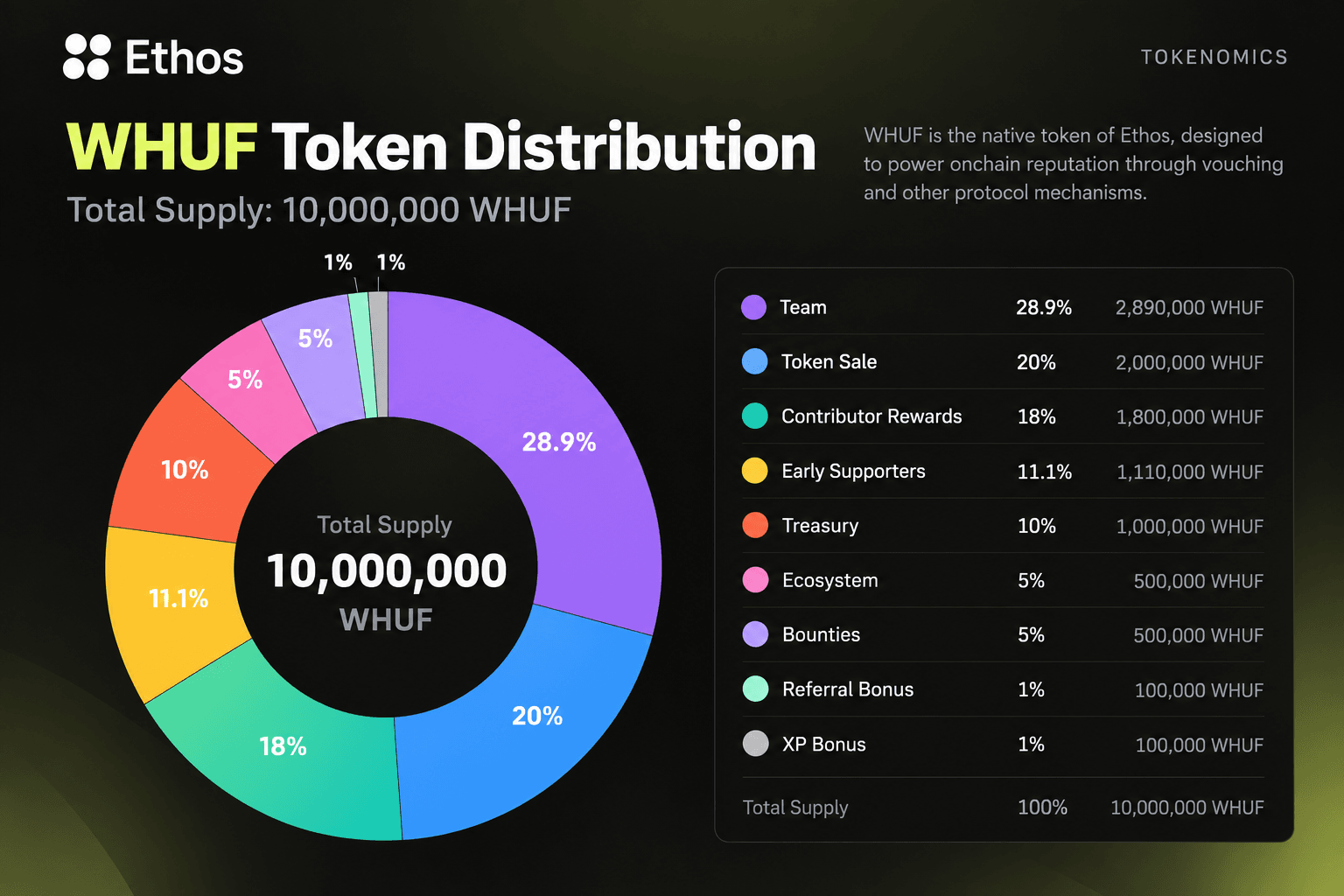
According to official project information, WHUF has a total supply of 10 million tokens and does not use an additional emission mechanism. Its distribution is divided into several categories, including token sale, team, contributor rewards, early supporters, treasury, ecosystem, bounties, referral bonus, and XP bonus.
This distribution is important because the number of tokens held by each group can affect future supply dynamics.
The largest composition in the distribution is the allocation for the team at 28.9%, followed by the token sale at 20% and contributor rewards at 18%. Early supporters receive 11.1%, while the treasury obtains 10%.
The remainder is allocated to the ecosystem at 5%, bounties at 5%, referral bonus at 1%, and XP bonus at 1%.
Total Supply of WHUF
The total supply of WHUF is set at:
10,000,000 WHUF
The project states that the token has a fixed supply and no emissions. However, a fixed supply does not automatically mean the token price will increase.
The price remains influenced by demand, liquidity, token distribution, ecosystem activity, market sentiment, and the number of tokens actually in circulation.
WHUF Token Distribution
Some of the main categories of WHUF distribution include:
- Token Sale: 20%
- Team: 28.9%
- Contributor Rewards: 18%
- Early Supporters: 11.1%
- Treasury: 10%
- Ecosystem: 5%
- Bounties: 5%
- Referral Bonus: 1%
- XP Bonus: 1%
This composition should be noted because the allocations to the team, contributors, and early investors can be important factors when analyzing potential supply pressure.
What Is WHUF TGE?
A TGE or Token Generation Event is the stage when tokens begin to be distributed according to the project's launch mechanism.
In the case of WHUF, the token sale took place from September 1–4, 2026. The auction results set a clearing price of US$4.20 per WHUF, and the tokens were then distributed on September 8, 2026, locked until October 8, 2026.
The US$4.20 figure is important to understand as the token sale clearing price, not automatically the market price of WHUF once the token becomes transferable.
This distinction is important because the market price is formed through supply and demand mechanisms in the secondary market.
According to Ethos documentation, the transferability period enters its phase on October 8, 2026.
Read also : What Is SARP? Get to Know the Strategic American Protocol and SARP Token
What About the WHUF Price?
The WHUF clearing price during the token sale was set at US$4.20. That figure should not be written as today's WHUF price without the latest market data.
Available market tracking data also does not yet provide a sufficient basis to present real-time price figures as facts. Therefore, price, volume, market cap, FDV, and liquidity should be updated again right before publication.
WHUF Contract Address
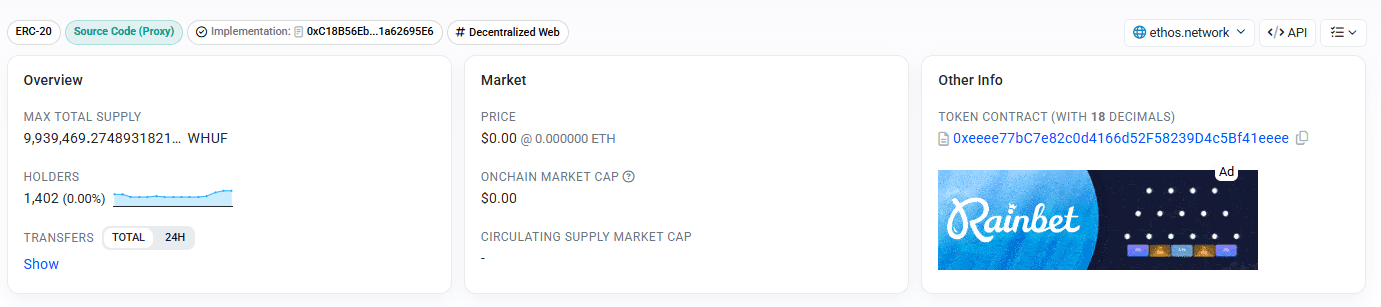
WHUF is on the Base network with the contract address:
0xeeee77bC7e82c0d4166d52F58239D4c5Bf41eeee
The address is also recorded in the Base asset data available for WHUF.
The contract address is crucial because tokens with the same name and ticker can appear as counterfeit tokens.
Therefore, users should not only search for the WHUF ticker but also cross-check the network and contract address before making a transaction.
5 Factors to Consider Before Looking at WHUF
1. Token Utility
First, see if WHUF is genuinely used in Ethos activities.
Vouching already uses WHUF as a staked asset, so the token's utility has a direct relationship with the protocol's core mechanisms.
2. Token Distribution
Pay attention to allocation concentration.
The team and contributors hold a considerably large portion compared to some other categories. This condition makes the token distribution and usage schedule a relevant factor in supply analysis.
3. Liquidity
New tokens can experience high volatility when liquidity is still limited.
Relatively small transaction changes can result in larger price movements compared to assets with deeper markets.
4. Ethos Adoption
The utility of WHUF is closely tied to the usage of Ethos.
The more reputation activities, vouching, and applications that use the Ethos mechanism, the more relevant the token's functions in the ecosystem become.
However, protocol adoption should not be assumed to automatically result in an increase in the token price.
5. Smart Contract and Market Risks
WHUF remains a crypto asset.
In addition to volatility risk, users need to be aware of smart contract risks, transaction errors, liquidity, ownership concentration, as well as the risk of changes to protocol mechanisms.
Read also : Is IOF Coin Legit or a Scam? Check Institutional Oil Fund Data
What Needs to be Monitored After WHUF TGE?
After entering the transferability phase, several indicators become more important.
Vouching Activity
Monitor whether the use of WHUF actually increases in the reputation mechanism.
If the token's utility grows, demand for WHUF could fundamentally gain support from protocol activity. However, this relationship still needs to be proven through usage data.
Holder Distribution
Holder distribution is also important.
If a large portion of the supply is concentrated in a small number of wallets, positional changes in those wallets can have a larger impact on the market.
Liquidity and Volume
Volume and liquidity help indicate how active the WHUF market is.
High volume doesn't always mean the asset has strong fundamentals. Conversely, low liquidity can cause volatility to increase.
Ethos Ecosystem Development
Readers also need to follow the development of Ethos products.
On-chain reputation is a category that is still developing. The success of WHUF is ultimately closely related to Ethos's ability to generate real-world use cases for its system.
Is WHUF Worth Paying Attention To?
WHUF is interesting to watch because its utility is directly connected to the Ethos on-chain reputation mechanism.
The token is not just designed as a speculative tool. WHUF is used in mechanisms like vouching that link reputation with an economic stake.
Nevertheless, utility does not equal a guarantee of investment value.
Readers still need to monitor the development of Ethos usage, token distribution, liquidity, wallet activity, and market developments after the token becomes transferable.
If you want to follow the latest updates regarding WHUF and crypto market developments, you can register on Bittime to get market information, the latest news, and periodic analysis.
Conclusion
What is WHUF? WHUF or Whuffie is a token designed to support the on-chain reputation mechanism within the Ethos ecosystem.
Its primary function is related to vouching, which is staking WHUF to demonstrate a level of trust in a specific profile. Tokens used to vouch remain the property of the party providing the support.
From a tokenomics perspective, WHUF has a fixed supply of 10 million tokens without emissions according to official project information. Its distribution includes token sale, team, contributor rewards, early supporters, treasury, ecosystem, bounties, referral bonus, and XP bonus.
The WHUF TGE took place in September 2026, with a token sale clearing price of US$4.20 per token. The transferability phase then enters on October 8, 2026, making post-phase market data critical for seeing how WHUF develops.
Ultimately, analyzing WHUF crypto is not enough just by looking at the price. The use of the token within Ethos, supply distribution, liquidity, holder activity, and ecosystem growth are factors that need to be considered together.

Bittime is a licensed Digital Financial Asset Trader (PAKD) platform supervised by the Financial Services Authority (OJK) — where you can buy Bitcoin in Indonesia and hundreds of other crypto assets starting from IDR 10,000. The registration process is fast, safe, and can be started right away today.
Monitor USDT to IDR conversions and real-time price movements of your favorite crypto assets. Everything is available in one crypto investment app that can be downloaded for free on the Play Store.
Ready to start? Register now on Bittime and execute your investment strategy with a platform trusted by millions of users in Indonesia.
FAQ
What is WHUF?
WHUF or Whuffie is a token used within the Ethos ecosystem to support the on-chain reputation mechanism. One of its main functions is as an asset used to vouch for specific profiles.
What is WHUF used for?
WHUF is used in mechanisms like vouching and becomes part of the Ethos protocol economy. In vouching, users stake WHUF to show a level of trust in other profiles.
What is the relationship between WHUF and the Ethos Network?
WHUF is the token supporting the Ethos economic mechanism. Ethos uses WHUF to connect on-chain reputation with an economic stake, primarily through the vouching mechanism.
What is the total supply of WHUF?
The total supply of WHUF is set at 10 million tokens, and the project states that the token has a fixed supply without emissions. Its distribution is divided into several categories such as team, token sale, contributor rewards, treasury, and ecosystem.
When is the WHUF TGE and when is it tradable?
The WHUF token was distributed at the TGE on September 8, 2026, and locked until October 8, 2026. The transferability status needs to be continuously checked upon publication as execution timing and market conditions can change.
Disclaimer: The views expressed belong exclusively to the author and do not reflect the views of this platform. This platform and its affiliates disclaim any responsibility for the accuracy or suitability of the information provided. It is for informational purposes only and not intended as financial or investment advice.

.png)