Safe Ways to Trade USDP Coin: Here Are the Risks to Watch Out For
2026-10-08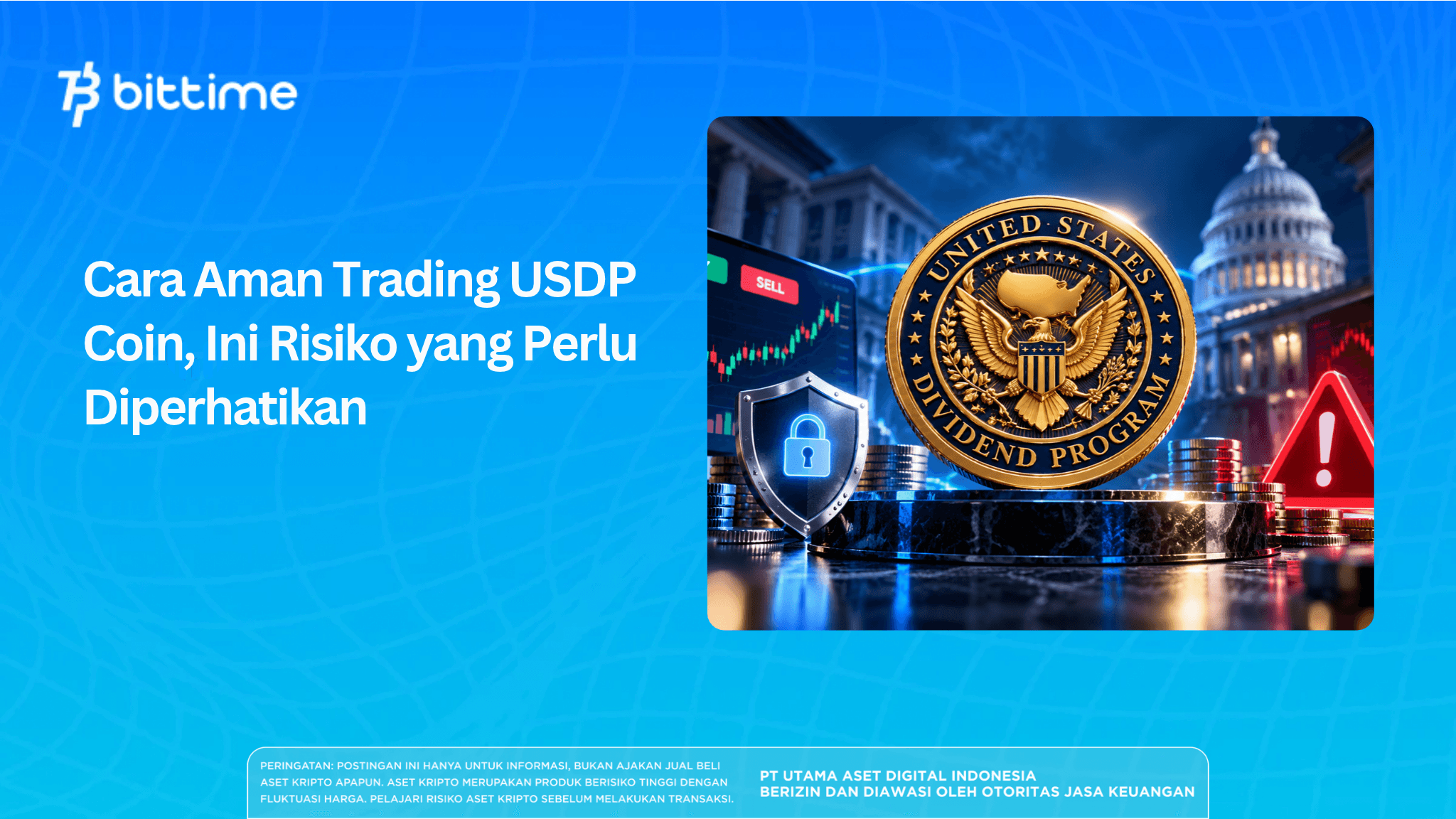
USDP Coin is attracting attention because it carries the narrative of the United States Dividend Program and offers the concept of on-chain-based dividend distribution. However, before looking for ways to trade USDP, there is a more important thing to check, which is whether the token you are looking at is actually the token intended by the project.
Trading USDP also carries risks that cannot be ignored. Price movements, liquidity, volume, contract addresses, and holder distribution need to be checked before transacting because the token's name and ticker alone are not enough to ensure the identity or security of the asset.
Key Takeaways
- USDP Coin brings the concept of a token-based dividend program with a target distribution date of October 25, 2026.
- The discrepancy in contract addresses is one of the most important things that needs to be verified before trading USDP.
- Price, volume, liquidity, and security scans are not enough to prove that a project is completely safe or legitimate.
What Is USDP Coin?
USDP Coin is a token that uses the name United States Dividend Program. The project website presents USDP as a tokenized dividend program with the concept of token-based ownership and on-chain distribution.
The site lists October 25, 2026, as the distribution target. However, this date is still a target and is said to be subject to change pending official confirmation.
This concept makes USDP different from tokens that solely rely on meme narratives or simple utilities. Nevertheless, the dividend concept does not automatically mean that token holders will receive payments.
The economic mechanism must be clearly explainable. Users need to know the source of funds, distribution mechanism, recipient requirements, and the documents supporting the program.
Is USDP a United States government program?
The name United States Dividend Program may give the impression that USDP has a relationship with the United States government.
However, the project website itself states that the page does not represent government affiliation, guaranteed returns, exchange listings, or regulatory approval.
Therefore, the project's name should not be used as proof of an official relationship with the government.
Read also: What Is PLAGUE Coin? Get to Know the Yersinia pestis Token on Solana
How to Trade USDP Coin?
The process of trading USDP Coin should begin with verification, rather than making a direct purchase.
Here is a step-by-step checklist you can use:
- Verify the token's network.
- Match the contract address.
- Check the trading pair.
- Check the liquidity.
- Check the transaction volume.
- Check the holder distribution.
- Estimate the slippage and price impact.
- Review the project documentation.
- Ensure you understand the risks before executing a transaction.
This sequence is important because tokens with the same ticker can have different addresses.
On the Solana network, the technical identity of a token is determined by its token or mint address. Therefore, simply searching for “USDP” is not enough.
Read also: Is USDP Legit or a Scam? Fact-Check the United States Dividend Program
The USDP Coin Contract Address Needs to Be Checked
This is one of the most critical parts of trading USDP.
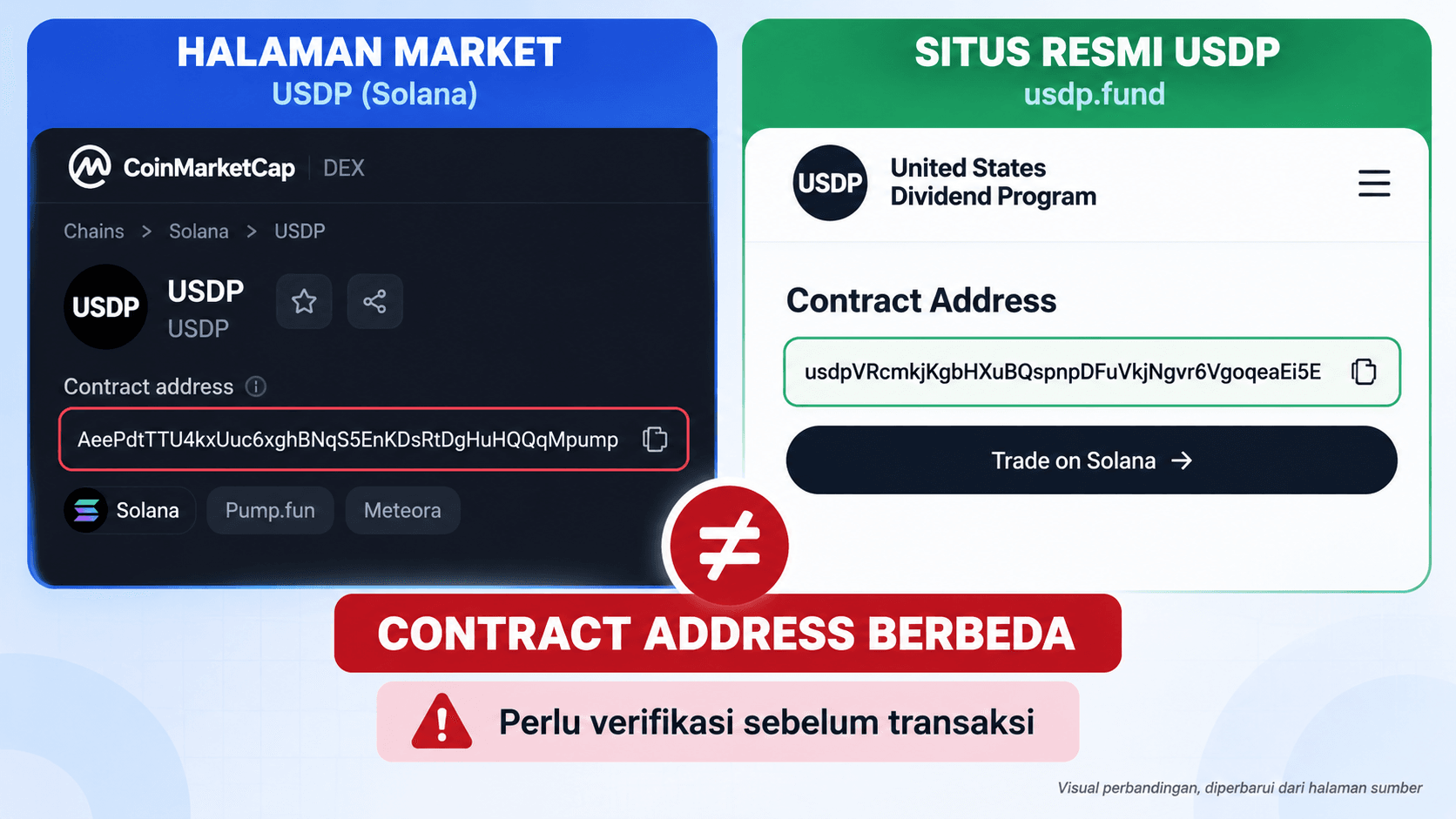
The market page used in the analysis displays a USDP token on the Solana network with the contract address:
AeePdtTTU4kxUuc6xghBNqS5EnKDsRtDgHuHQQqMpump
Meanwhile, the USDP website displays an address abbreviated as usdp...aEi5E. The trading link provided on the site directs to a Solana token with the address usdpVRcmkjKgbHXuBQspnpDFuVkjNgvr6VgoqeaEi5E.
These two addresses are different.
This does not automatically prove that either token is a scam. However, the relationship between the two tokens should also not be assumed to be the same just because they use the USDP name and ticker.
Why Is the Contract Address Important?
Token names can be cloned.
Tickers can also be used by different tokens.
The contract address serves as a more specific technical identity for the asset. Therefore, before buying USDP Coin, ensure the selected token's address matches the source you genuinely intend to use.
USDP Coin Market Data
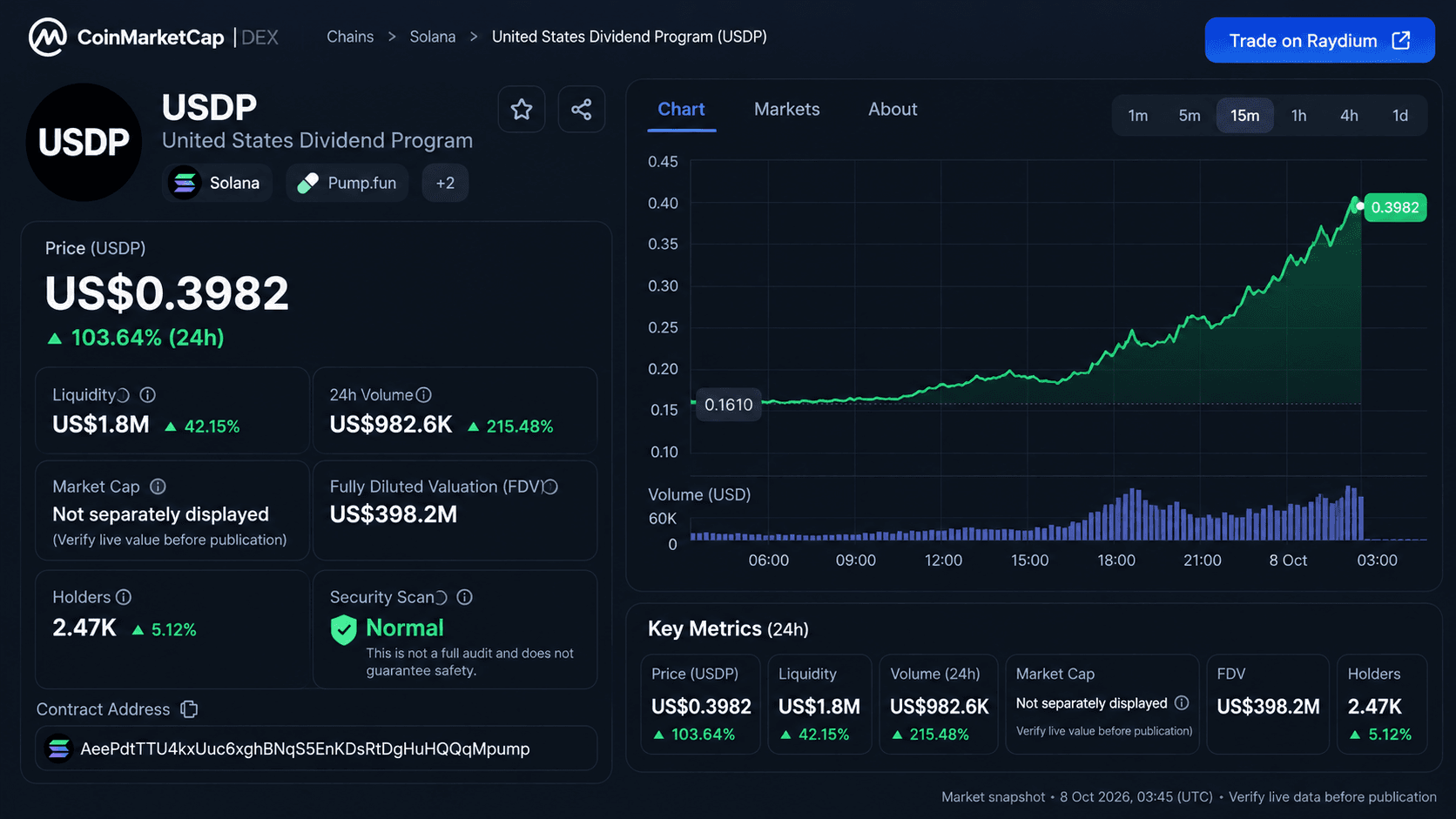
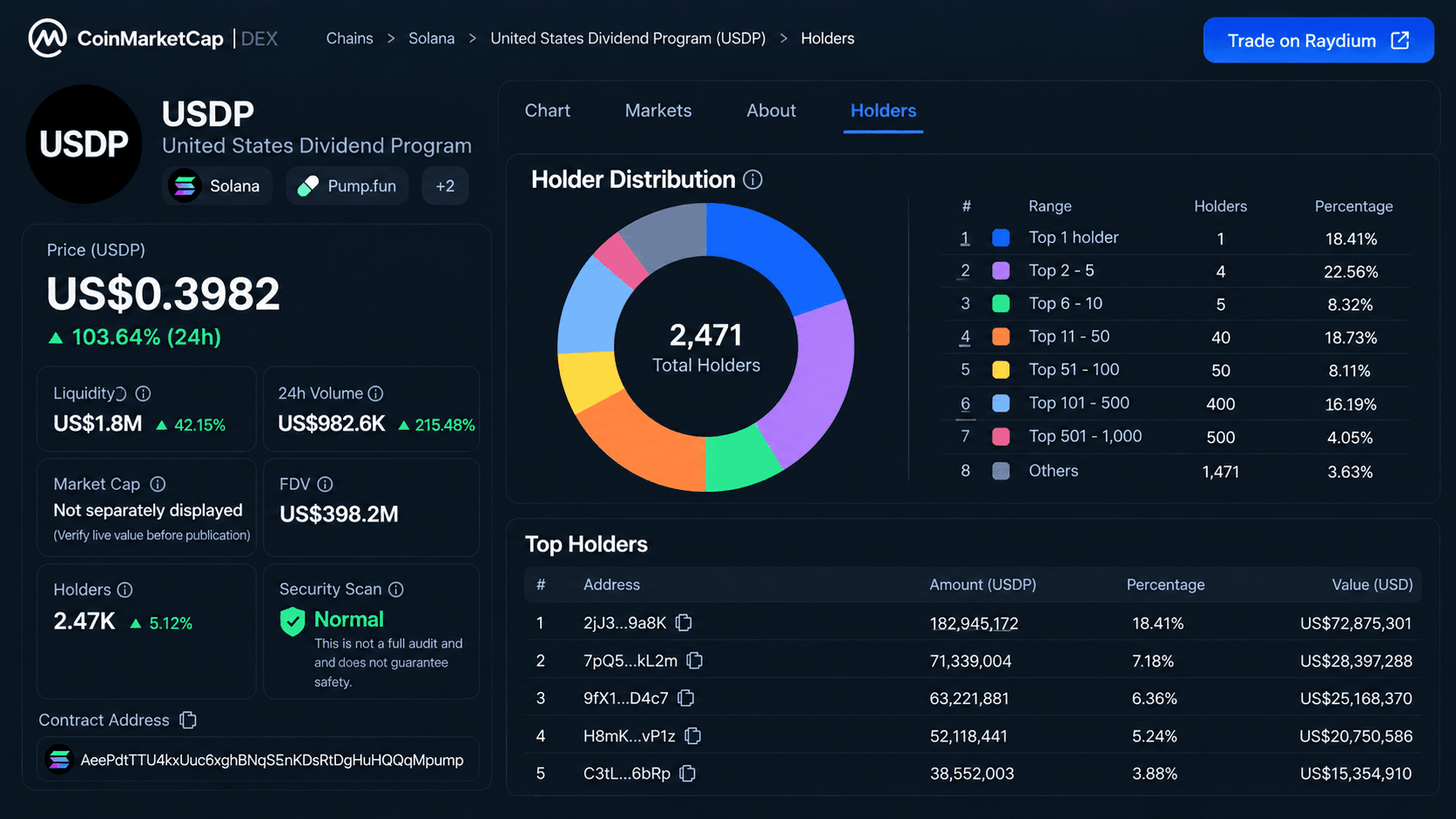
The market snapshot used in the analysis shows USDP priced at around US$0.3982 with a change of about +103.64%. The data also shows an FDV of approximately US$398.2 million, liquidity around US$1.8 million, and a 24-hour trading volume of about US$982.6 thousand.
In the same snapshot, the security scan panel displays a Normal status. However, this status should not be considered a comprehensive project audit or a guarantee that the token is risk-free.
Price and volume can also change very quickly. Therefore, these figures should be treated as a market snapshot, not permanent data.
What Does USDP Liquidity Mean?
Liquidity indicates how much funding is available in the market to support buying and selling activities.
The more limited the liquidity compared to the transaction size, the greater the potential for price impact. This condition can cause the execution price to differ from the price seen prior to the transaction.
In the analyzed snapshot, USDP's liquidity was around US$1.8 million. This figure indicates an observable market, but it does not answer how that liquidity is structured or how stable it is.
Why Is Volume Important?
Volume indicates trading activity over a specific period.
A volume of about US$982.6 thousand in 24 hours shows fairly visible transaction activity in that snapshot. However, high volume does not automatically mean the project is legitimate or has strong fundamentals.
Volume should be read alongside liquidity and price movement.
Read also: USDF and Trump: Is There Really a Connection to the Trump Dividend?
7 Risks to Consider When Trading USDP
1. Risk of the Wrong Contract Address
This is the most obvious risk in the case of USDP.
If you buy a token based solely on its ticker without verifying the address, there is a possibility of purchasing a different asset that uses a similar name.
The discrepancy found in the contract addresses makes this check even more crucial.
2. Liquidity Risk
Low liquidity can increase the difficulty of buying or selling tokens in certain quantities.
Transactions that are relatively large compared to the liquidity can also result in a larger price impact.
3. Slippage Risk
Slippage occurs when the executed price of a transaction differs from the expected price.
The more volatile the market and the more limited the liquidity, the more important it is to pay attention to slippage before making a transaction.
4. Volatility Risk
USDP exhibited very rapid price movements in the analyzed market snapshot.
A change of about 103.64% indicates that the price can move to extremes in a short amount of time.
A sharp rise does not mean the price will continue to climb. Conversely, a correction can also happen rapidly.
5. Holder Concentration Risk
The number of holders does not automatically depict a healthy token distribution.
If the supply is concentrated in a few large wallets, transactions from those wallets can exert significant pressure on the price.
Therefore, traders should not look solely at the holder count. Also, check the percentage of supply controlled by the top holders.
6. Documentation Risk
The USDP website currently states that program documents are not yet available for independent review. The site also mentions that the allocation model and supporting documents have not been provided for independent examination.
This condition does not automatically prove it's a scam. However, limited documentation makes the due diligence process more difficult.
7. Dividend Claim Risk
The dividend narrative is one of the main aspects of USDP.
However, a distribution target is not the same as proof that distribution has occurred. The project site lists October 25, 2026, as a target and states that the distribution is still subject to official confirmation.
Therefore, do not use potential dividends as the sole basis for making a trading decision.
Read also: What Is SARP? Get to Know the Strategic American Protocol and SARP Token
Safe Ways to Trade USDP Coin for Beginners
If you are a beginner, use a simple approach before executing transactions.
Step 1: Identify the token
Make sure the name, ticker, network, and contract address match.
Do not just search for “USDP” in a wallet or decentralized exchange.
Step 2: Match the Contract Address
Compare the token's address with the address referenced by the source you are using.
If there are differences, stop first and look for an explanation regarding the relationship between the two addresses.
Step 3: Check the Market
Check:
- Price
- Liquidity
- Volume
- FDV
- Market cap if available
- Trading activity
- Holder distribution
Do not make a decision based solely on one indicator.
Step 4: Check Transaction Size
Do not ignore the price impact.
Transactions that are too large compared to the liquidity can yield execution results that differ from expectations.
Step 5: Set Risk Limits
Do not use funds you are not prepared to lose.
Crypto can move very quickly, especially when liquidity and market depth are not yet as large as major crypto assets.
Step 6: Re-evaluate Before Execution
Ensure your wallet, network, token, and transaction amount are correct.
Address errors in blockchain transactions can be difficult or impossible to reverse.
Read also: What Is Super Intelligence Force (SIF)? Functions, Tokens, and Risks
Is USDP Coin Safe?
The question “is USDP Coin safe?” cannot be answered simply by looking at a security scan or the existence of a website.
Market data does provide information about price and trading activity. However, these aspects are different from verifying the business model, project documentation, token ownership, and dividend mechanism.
The USDP website also states that eligibility requirements, jurisdictional limits, distribution terms, and risk disclosures are not yet available.
Therefore, the more appropriate approach is to view USDP as an asset with risks and uncertainties that need further examination, rather than assuming it is automatically safe or a scam.
Is USDP Coin Legit or a Scam?
It is not yet appropriate to give a final label based solely on the available data.
There is a USDP token whose market activity can be observed. However, there is a difference in the contract address between the token on the analyzed market page and the address referenced by the USDP website.
Additionally, the project site states that several important documents are not yet available for independent review.
In conclusion, there is not enough evidence to declare USDP a scam, but there is also insufficient basis to assume that all the project's claims have been fully verified.
What Should Be Done Before Trading USDP?
Use the following checklist:
- The contract address matches.
- The token network is correct.
- The trading pair has been checked.
- Liquidity has been checked.
- Volume has been checked.
- Holder distribution has been checked.
- Slippage has been accounted for.
- Price impact has been considered.
- Project documentation has been reviewed.
- Dividend claims have been differentiated from verified facts.
- The funds used are within your risk tolerance.
This checklist helps reduce basic errors, but it cannot eliminate crypto trading risks.
If you want to follow crypto asset developments and get the latest market information, you can register on Bittime to monitor the market and learn about various digital asset products before transacting.
What Needs to Be Monitored Next?
One of the dates attracting attention is October 25, 2026, which is listed as the USDP distribution target. However, this date is still referred to as a target and is subject to official confirmation.
Leading up to that date, the more important thing to monitor is not just the price of USDP.
Pay attention to whether the project provides:
- Program documents.
- An allocation model.
- Eligibility requirements.
- Distribution terms.
- Risk disclosures.
- An explanation of the dividend mechanism.
- Clarification regarding the contract address.
If this information becomes more complete and verifiable, the project's level of transparency can be better evaluated.
Conclusion
USDP Coin carries the United States Dividend Program narrative and the concept of on-chain-based dividend distribution. However, a safer way to trade USDP must start with token verification, rather than directly buying based on the name or ticker.
The most important thing is the contract address. The USDP token on the analyzed market page uses the address AeePdtTTU4kxUuc6xghBNqS5EnKDsRtDgHuHQQqMpump, while the USDP website refers to a different address ending with aEi5E. This discrepancy needs to be clarified before both tokens can be considered the same asset.
Market data such as price, liquidity, volume, and security scans can help read trading conditions, but they are not enough to prove the legitimacy of a project. If you want to trade USDP, conduct a separate check of the contract address, liquidity, volume, holder distribution, slippage, documentation, and dividend mechanism.

Bittime is a licensed Digital Financial Asset Trader (PAKD) platform supervised by the Financial Services Authority (OJK) — where you can buy Bitcoin in Indonesia and hundreds of other crypto assets starting from IDR 10,000. The registration process is fast, safe, and can be started right away today.
Monitor USDT to IDR conversions and real-time price movements of your favorite crypto assets. Everything is available in one crypto investment app that can be downloaded for free on the Play Store.
Ready to start? Register now on Bittime and execute your investment strategy with a platform trusted by millions of users in Indonesia.
FAQ
Is USDP Coin safe?
There is not yet enough basis to call USDP Coin fully safe or risk-free. In addition to market volatility, there is a discrepancy in the contract address and some program information that, according to the project site, is not yet available for independent review.
How to trade USDP Coin?
Start by verifying the token's network and contract address, then check liquidity, volume, holder distribution, slippage, and price impact. Do not rely solely on the USDP name or ticker when choosing a token.
Is USDP Coin legit or a scam?
It is not yet appropriate to draw a final conclusion that USDP is a scam or a fully verified project. The difference in contract addresses and the limited documentation make due diligence absolutely necessary.
What are the risks of trading USDP Coin?
The risks include volatility, liquidity, slippage, price impact, holder concentration, wrong contract addresses, and uncertainty regarding the dividend mechanism. These risks can amplify when the market moves rapidly.
Is USDP a United States government program?
There is no basis to consider USDP a government program just based on its name. The USDP website itself states that the page does not represent government affiliation or regulatory approval.
Disclaimer: The views expressed belong exclusively to the author and do not reflect the views of this platform. This platform and its affiliates disclaim any responsibility for the accuracy or suitability of the information provided. It is for informational purposes only and not intended as financial or investment advice.

.png)