What Is VEIL? The Private DePIN Network on Robinhood Chain
2026-07-14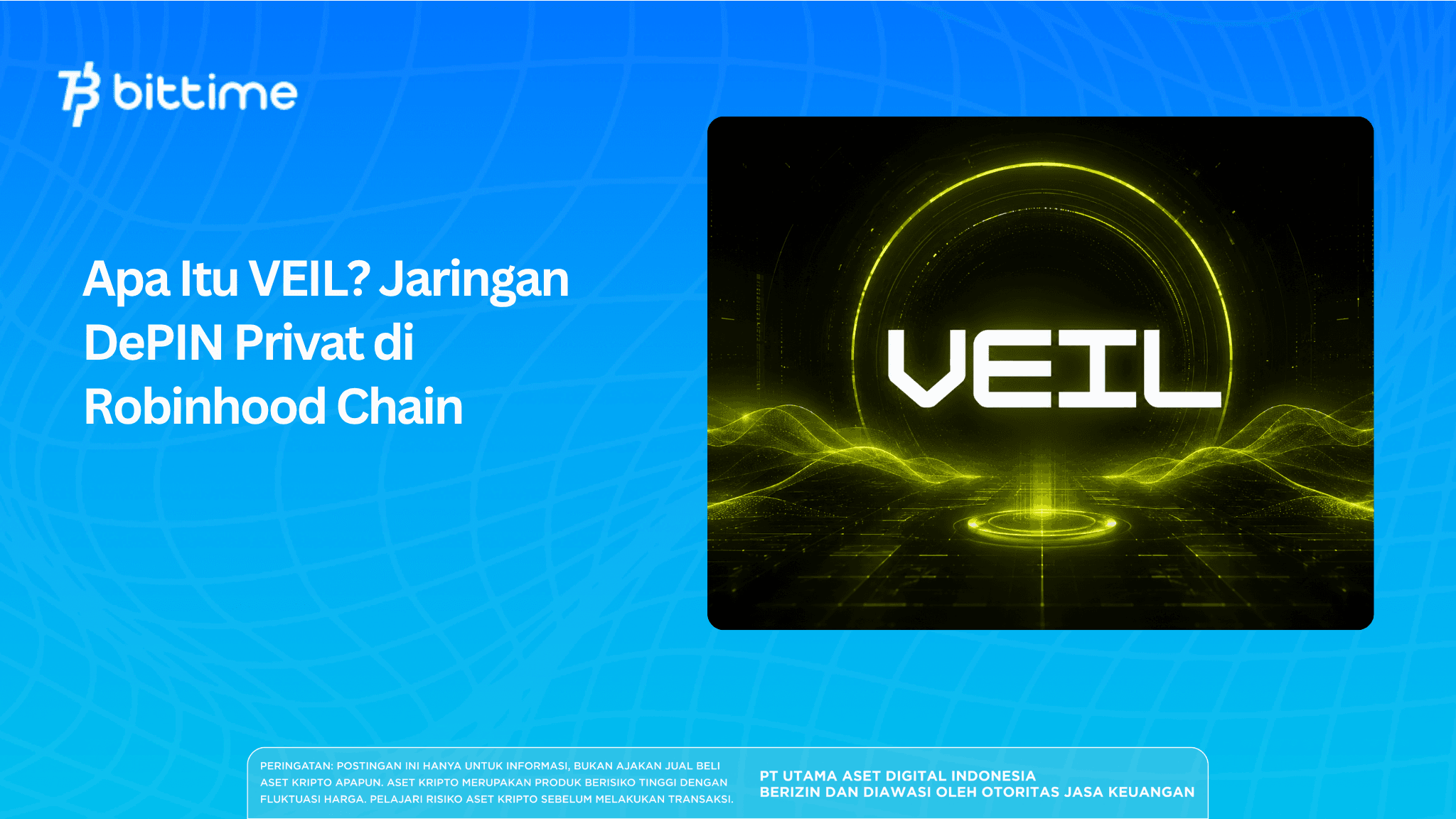
VEIL is a DePIN-based private data network designed to help users earn rewards from their device data without sharing raw data with buyers.
The project operates within the Robinhood Chain ecosystem and combines device-side encryption, user consent, aggregated data processing, and differential privacy.
Key Takeaways
- VEIL wants to connect data from wearables, vehicles, sensors, and IoT devices with data buyers without exposing individual records.
- Users are expected to earn rewards when their encrypted data is used in a query or aggregate analysis.
- VEIL is still in its early stages, has not yet had a third-party security audit, and its documentation contains some details that need to be confirmed before use.
What is VEIL?
VEIL is a confidential DePIN data network, which is a decentralized physical infrastructure network specifically designed to manage sensitive data.
In the traditional DePIN model, users provide physical resources such as internet connections, storage, sensors, computing power, or location data. In return, users earn tokens or revenue from network activity.

Source: dexscreener.com | VEIL
VEIL applies the concept to much more sensitive data, for example:
- Heart rate from wearable.
- User activity and movement.
- Vehicle data.
- Location and mobility data.
- Environmental sensor readings.
- Internet of Things or IoT device data.
According to its official website, VEIL is not designed to sell individual records directly. Buyers such as companies, AI labs, researchers, or insurance companies receive only aggregated results that have been processed with privacy protections.
Thus, VEIL's core value proposition is not simply about “selling personal data,” but about creating a marketplace where insights from data sets can be traded without providing direct access to each user's raw data.
How Does VEIL DePIN Work?
In simple terms, the VEIL workflow consists of five stages.
1. User connects the device
Contributors can connect wearables, vehicles, apps, or sensors through VEIL Connect or developer software or SDKs.
Users then determine the data categories and the purposes for which they agree to use them. This mechanism is important because data shouldn't be used for any purpose simply because a user has connected their device.
2. Data is encrypted from the device
The VEIL homepage uses the term “secure enclave.” However, the technical documentation explains that the current implementation uses software attestation, while a hardware Trusted Execution Environment (TEE) is planned for a future version.
The difference is significant. Software attestation verifies that specific software is running, but it does not necessarily provide the same level of hardware isolation as a TEE.
3. Buyer sends query
Data buyers don't ask for a user's history. They ask aggregate questions, such as:
- What is the average heart rate for a certain age group?
- What is the mobility pattern of a group during peak hours?
- What proportion of devices recorded a particular condition?
- How is user activity distributed in a research cohort?
The system then checks whether the query complies with contributor approvals, the minimum number of participants, and the available privacy limits.
4. System for processing aggregate results
VEIL applies a minimum limit-anonymity of 25 According to the documentation, queries involving fewer than 25 contributors will be rejected. The system also uses a Laplace mechanism to add noise to the differential privacy process.
The buyer only receives the aggregate results, number of contributors, privacy parameters, proof of consent, and attestation describing the computational process executed.
5. Payments are shared
The VEIL model uses a pay-per-query mechanism. Buyers pay each time an analysis request is executed, and revenue is then distributed among network participants.
VEIL's Terms of Use lists the planned divisions as follows:
- 60% for data contributors.
- 20% for compute nodes.
- 10% for stakers.
- 10% for treasury and burn components.
Contributor payments are said to be settled periodically to prevent a single payment from being easily linked to a specific query. However, the same document emphasizes that this mechanism is not a promise of income or a guarantee of profit.
Read Also: Robinhood Token: List of 10 Trending Memecoins on DexScreener
What is Differential Privacy in VEIL?
Differential privacy is a mathematical approach to limiting how much information about an individual can be learned from data analysis.
Intuitively, the results of an analysis should not change significantly when a single person's data is added or removed. This makes it more difficult for observers to determine whether a person participated or to guess specific information about that individual.
Differential privacy usually uses the epsilon parameter ore. The epsilon value indicates the magnitude of the privacy loss:
- Smaller epsilons generally provide stronger privacy protection.
- Larger epsilons allow for more accurate results, but weaker privacy protection.
- Many queries performed on the same data set can exhaust the privacy budget.
The VEIL documentation mentions the use of the Laplace mechanism, a minimum k requirement of 25, and a cumulative epsilon limit of 5.0 over a 30-day period.
However, these parameters represent the project's technical design and should not be considered a guarantee that the entire implementation has been independently verified.
Read also: What Is WISHBONE? Getting to Know the Memecoin from the Robinhood Chain Ecosystem
VEIL's relationship with Robinhood Chain
Robinhood Chain is an Ethereum-based Layer 2 network built using Arbitrum technology. The network is designed for on-chain financial activities, real-world assets (RWAs), DeFi services, and applications that can be used by AI agents.
Robinhood officially announced the public mainnet launch of Robinhood Chain on July 1, 2026. The network is compatible with the Ethereum Virtual Machine and uses ETH as its gas token.
VEIL uses Robinhood Chain for several functions, such as:
- User consent registration.
- Query commitment logging.
- Payment distribution.
- Proof of processing results.
- Staking and planned governance.
- Recording network parameter changes.
However, not all sensitive data is stored on the blockchain. Encrypted data is processed through a separate infrastructure, while the blockchain is used as a settlement layer, recording agreements, payments, and computational proof.
Fancy buying some VEIL? Sign up to Bittime now, buy the underlying asset, then swap it with ease.
Can I Get USDC from Data via VEIL?
According to VEIL's documentation and Terms of Use, contributors are expected to receive payments based on USDC when their data is used in qualifying queries.
Payment isn't awarded simply because a device is connected; earnings depend on buyer demand, data category, participation level, and query activity.
However, there are some notable inconsistencies. Some VEIL pages mention USDC, while others list USDG. Robinhood Chain's official documentation lists USDG as one of the network's primary token contracts.
Therefore, prospective users should not immediately assume that all payments will be received in USDC mainnet. Check first:
- Stablecoins that are actually used.
- Are payments still in testnet tokens?
- Minimum withdrawal.
- Distribution schedule.
- Network costs.
- Countries that are allowed to participate.
- Device integration status.
- Is there a real data request from the buyer?
Read Also: Why Does Robinhood Chain Need USDG? Not USDC?
Latest VEIL Price Analysis
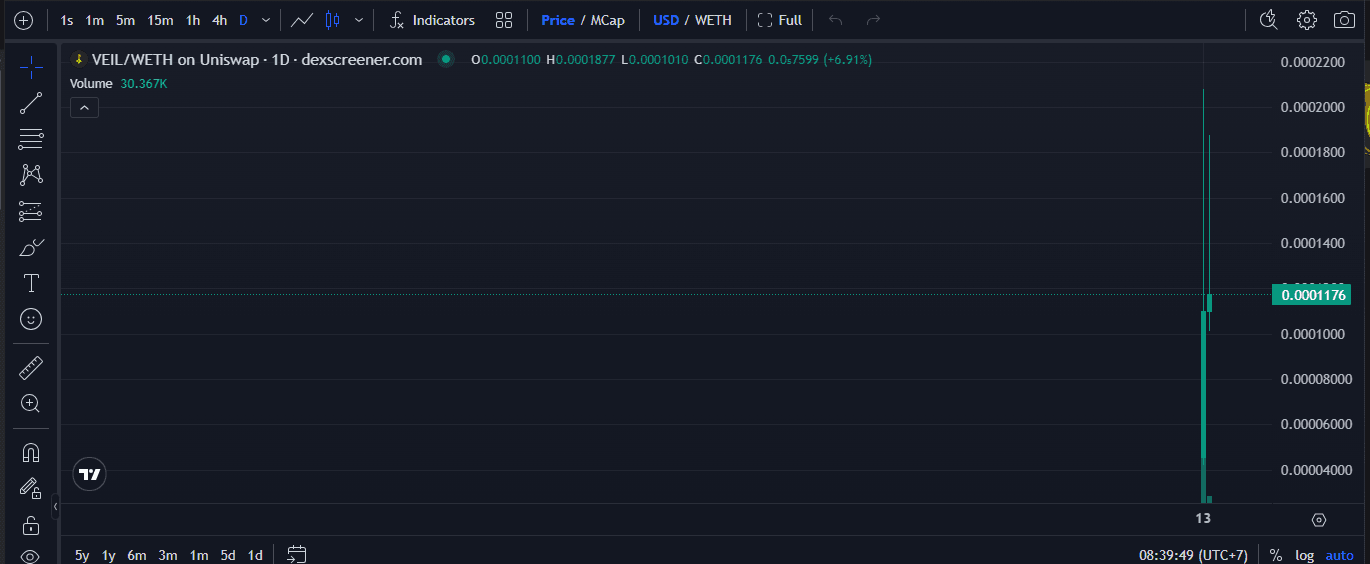
According to a DEX Screener snapshot on July 14, 2026, the VEIL token was trading at around US$0.0001129 in the VEIL/WETH pair on Uniswap V2 on Robinhood Chain.
Its market capitalization and fully diluted valuation (FDV) were recorded at around US$112,000, while liquidity was around US$30,000.
Source dexscreener.com | VEIL
The data shows that VEIL remains a very small-cap, or micro-cap, asset. This situation offers significant potential for price appreciation, but also carries a much higher risk of volatility, slippage, and price declines compared to large-cap crypto assets.
VEIL Price Movement
At the time the data was checked, the VEIL price change was recorded as follows:
- Up about 2.86% in five minutes.
- Down about 16.89% in one hour.
- Down about 8.85% in six hours.
- Up about 148% on the 24-hour column.
At first glance, a 148% increase might seem very bullish. However, the VEIL/WETH pair was only created approximately 6 hours and 48 minutes before the snapshot was taken.
This means that the 24-hour data essentially reflects almost the entire trading period since the token began trading, not the price trend that had been unfolding over the course of a full day.
The nearly 17% drop within an hour of the initial surge suggests some market participants are starting to take profits. This pattern is common with new tokens, where the price rises sharply during the launch period, then experiences a correction due to selling by early traders.
Read also: What Is Cashcat Token? A New Memecoin on Robinhood Chain
VEIL Token Functions
The VEIL token is designed as a network utility token. According to project information, its possible uses include:
Staking
Validators, auditors, or certain participants may be required to stake VEIL to gain the right to participate in network activities. Stakes can also serve as collateral that can be forfeited if the perpetrator violates the rules.
Governance
Network holders or participants can be involved in decision-making regarding data categories, epsilon limits, treasury allocation, and security parameters.
Contributor incentives
VEIL can be used as an additional reward besides stablecoins to encourage users to connect devices or participate in cohorts.
Revenue sharing
Stakers are expected to receive a share of query revenue. However, the technical documentation states that the staking contract has not yet been implemented in the initial version and is still planned for the token generation event phase.
The VEIL contract address listed on the official website is:
0x38ad35b5d753ba8c2eb7ba0d41e806a5282d7777
The address matches the VEIL token displayed in the VEIL/WETH pairing on the DEX Screener. However, a matching contract address does not automatically prove the security, legality, technological quality, or investment viability of a token.
Read also: Baby Cupsey Token: Price, How to Buy & Prospects 2026
VEIL Risks to Consider
1. Not audited by a third party
VEIL documentation explicitly states that no third-party security audits have been conducted. This means that the smart contracts, payment system, differential privacy pathways, and data processing infrastructure have not received published independent verification.
2. TEE hardware is not yet available
The VEIL homepage uses the term secure enclave. However, the technical documentation explains that the current implementation uses software attestation, while a hardware Trusted Execution Environment (TEE) is planned for a future version.
The difference is significant. Software attestation proves that a particular software is running, but it doesn't necessarily provide TEE-level hardware isolation.
3. Token liquidity risk
The VEIL/WETH pair has appeared on Uniswap via Robinhood Chain. However, price data, liquidity, volume, and valuation can change rapidly, especially for newly traded tokens.
Low liquidity can cause:
- High slippage.
- Prices can easily move sharply.
- Difficulty selling tokens.
- Risk of market manipulation.
- Huge losses due to volatility.
4. There is no certainty regarding the data request
A data monetization network requires buyers willing to pay consistently. Without companies, researchers, or AI labs actively purchasing queries, contributors' earning potential is limited.
5. Data risks and consent
Encryption doesn't eliminate all privacy risks. Transaction metadata, participation patterns, consent configurations, implementation errors, and the combination of aggregated results can still create risks of information leakage.
6. Documentation is still changing
Differences in the names of USDC and USDG, testnet and mainnet status, and staking implementation indicate that project details are still evolving. Users should review the latest documentation before connecting a wallet or device.
Start trading ETH/IDR with Bittime here!
Is VEIL Worth Your Attention?
VEIL brings up a relevant concept: individual data has economic value, but data owners often have neither control nor compensation.
The combination of DePIN, differential privacy, payment per query, and revocable consent offers an alternative model to the data broker business. If implemented with robust auditing, real buyers, integrated devices, and transparent payment mechanisms, this model has the potential to appeal to the healthcare, mobility, AI, research, and IoT sectors.
However, VEIL is currently more of a high-risk experimental project than a mature private data infrastructure. Security claims need to be substantiated through audits, TEE hardware implementations, real-world query activity, and verifiable contributor revenue data.
Conclusion
What is VEIL? VEIL is a privacy-based DePIN network that aims to enable users to earn rewards from device data without providing the raw data to buyers.
The system combines device encryption, user consent, k-anonymity, differential privacy, aggregated yield, and payment settlement via Robinhood Chain. The concept is compelling, especially as the demand for data for AI and research continues to grow.
However, VEIL still carries significant risks. The project hasn't been audited by a third party, the TEE hardware is still being developed, real-world data demand hasn't been proven, and the token is potentially volatile and has limited liquidity.

Monitor official documentation and the latest news via Bittime before deciding to use the network or purchase VEIL tokens.
Bittime is a licensed and regulated Digital Financial Asset Trader (PAKD) supervised by Indonesia’s Financial Services Authority (OJK) — where you can buy Bitcoin in Indonesia and hundreds of other crypto assets starting from just Rp10,000. The registration process is fast, secure, and you can get started today.
Track USDT to IDR conversions and monitor your favorite crypto assets in real time. Everything is available in one crypto investment app that you can download for free on the Play Store
Ready to start? Register now on Bittime and execute your investment strategy with a platform trusted by millions of users in Indonesia.
FAQ
What is VEIL?
VEIL is a private DePIN network for connecting data from wearables, vehicles, and sensors with data buyers. Buyers receive only aggregated results, not individual records.
Is VEIL built on Robinhood Chain?
Yes. VEIL uses Robinhood Chain to record approvals, queries, payments, and proof of computation. Some data processing still occurs off-blockchain.
How to get USDC from VEIL?
Users must connect their devices, provide consent, and contribute data used in paid queries. However, the stablecoin used needs to be confirmed, as the project page inconsistently mentions USDC and USDG.
Is personal data really safe on VEIL?
VEIL uses encryption and differential privacy, but it's not yet risk-free. The project hasn't been audited by a third party, and the TEE hardware is still in development.
Is VEIL token safe to buy?
No crypto token is completely secure. VEIL is an early-stage token with high volatility, liquidity, smart contract, and project execution risks.
Disclaimer: The views expressed belong exclusively to the author and do not reflect the views of this platform. This platform and its affiliates disclaim any responsibility for the accuracy or suitability of the information provided. It is for informational purposes only and not intended as financial or investment advice.

.png)