What Is Sat Rush? A Bitcoin Mining Game on Solana and the RUSH Token
2026-11-26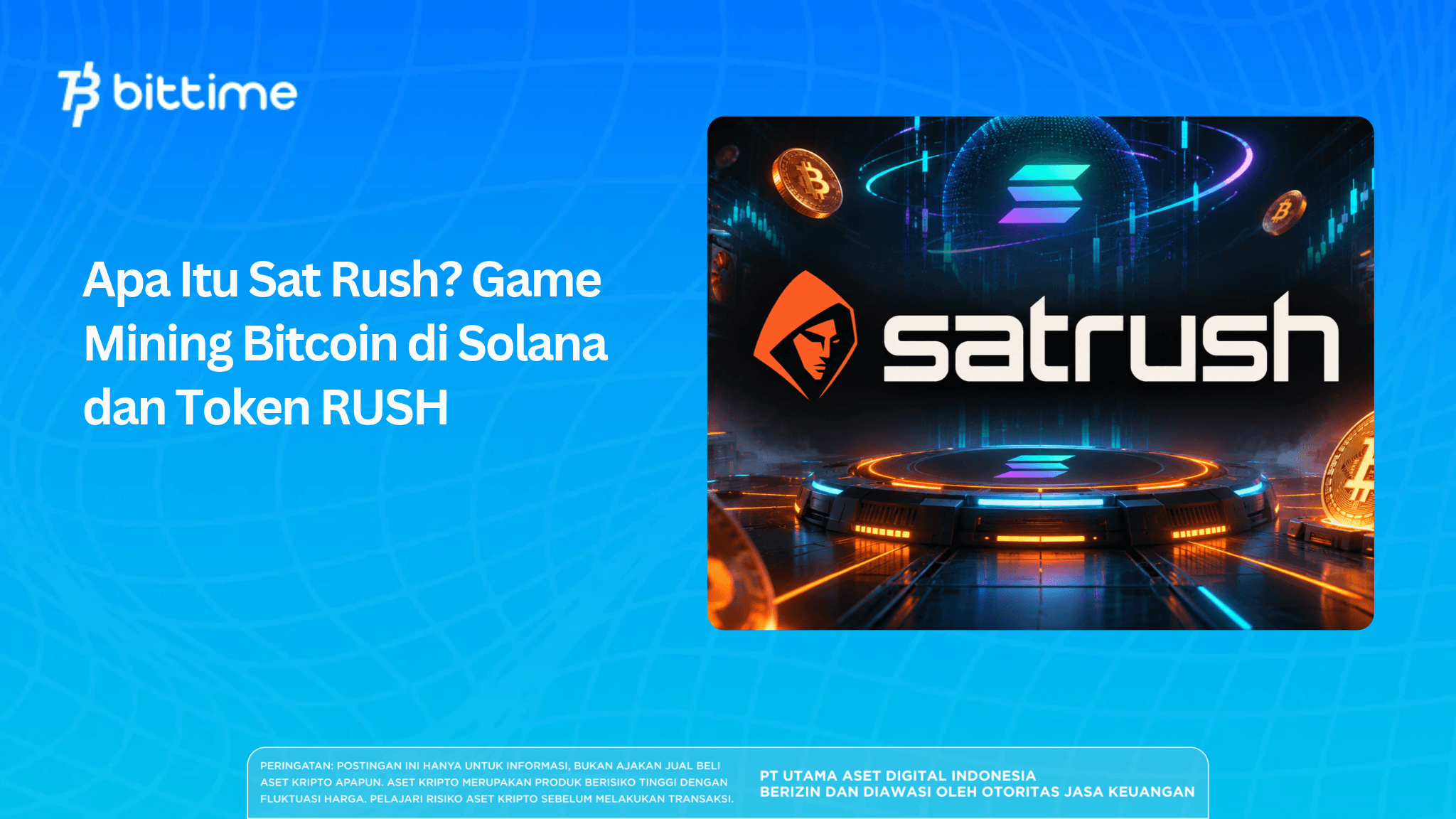
What is Sat Rush? Unlike Bitcoin mining involving ASIC machines and high electricity consumption, Sat Rush turns the concept of mining into a Solana blockchain-based game that offers rewards in the form of satoshis, RUSH tokens, and hashrate.
The project has attracted renewed attention after entering Season 2, with approximately 1,900 participants reportedly joining. However, there is a fundamental distinction to understand: Sat Rush does not mine new Bitcoin. Instead, it runs a chance-based game using USDC, with a risk of financial loss.
Key Takeaways
- Sat Rush is a Bitcoin mining-themed game on Solana that does not use the Proof of Work mechanism.
- Bitcoin rewards can be claimed in the form of Coinbase Wrapped Bitcoin (cbBTC), while RUSH serves as the ecosystem's primary token.
- Users should consider participation fees, token volatility, and the risk of losses arising from the game's mechanics.
What Is Sat Rush?
Sat Rush is a blockchain gaming project that combines the concept of Bitcoin mining with chance-based gameplay and a token economy.
All game activities, from recording transactions to distributing rewards, operate on the Solana network. This infrastructure allows Sat Rush to run game rounds relatively quickly.
This approach is known as gamified mining: turning the concept of mining into a digital game without using conventional mining hardware.
As GameFi projects continue to develop in the Solana ecosystem, you can also track the Solana (SOL) price on Bittime to understand the market dynamics of the network's native asset.
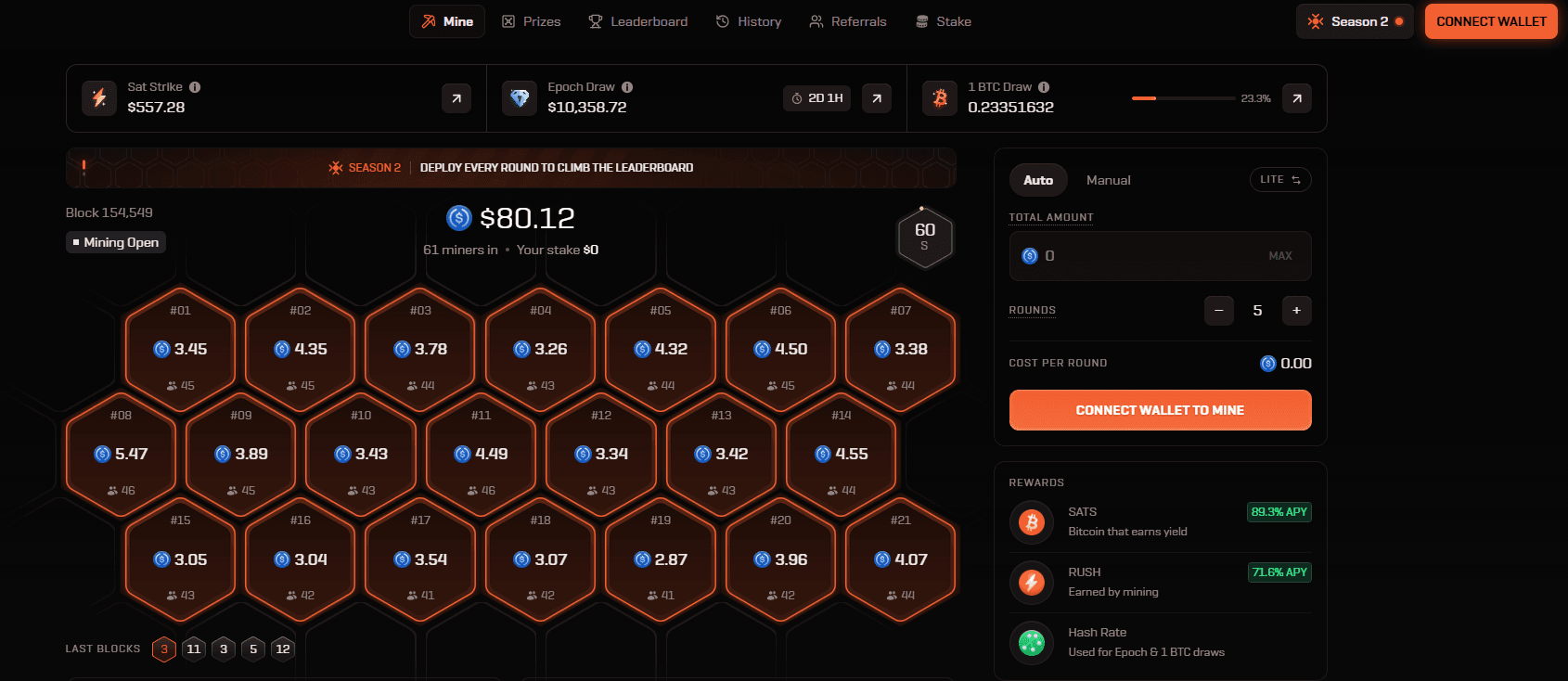
How Does Sat Rush Work on Solana?
Sat Rush uses a game board consisting of 21 blocks. Each round lasts approximately 60 seconds before the system randomly selects one winning block.
Sat Rush's 21-Block Mechanism
USDC is the asset used in the game. The outcome of each round determines how participants' funds are refunded, allocated to winners, or used to pay protocol fees.
Participants who choose losing blocks still receive a portion of their funds back after certain fees are deducted. The distribution of RUSH tokens and hashrate also follows the applicable game rules.
Where Do Sat Rush's Bitcoin Rewards Come From?
Bitcoin rewards come from the game's economic mechanism, not from the issuance of new BTC. Some participation funds are converted into Bitcoin and allocated to the Sats Vault.
When claimed, these rewards are received as Coinbase Wrapped Bitcoin (cbBTC), a token designed to represent BTC at a 1:1 ratio on other blockchain networks.
Reward balances are recorded in satoshis, with one satoshi equal to 0.00000001 BTC. This unit is distinct from the SATS token, which is traded as a separate crypto asset.
To find the value of Bitcoin in Indonesian rupiah, you can use Bittime's BTC-to-IDR converter as a reference for calculating asset values.
The Roles of Hashrate and Autominer
The term hashrate in Sat Rush does not refer to the computing power of mining machines. Instead, hashrate represents in-game points associated with the prize-draw mechanism.
An autominer feature also allows participation to continue automatically between rounds. Although convenient, this automation can cause fees and losses to accumulate without the user noticing.
Read also: How to Earn Free Crypto by Watching Videos
How to Mine Bitcoin on Solana Through Sat Rush
If you're looking for a Sat Rush tutorial, there are several essential components to understand first.
These five components support the game's mechanics and reward distribution, not Bitcoin mining through computational power.
Before granting a blockchain application access to your wallet, review smart contract permissions, transaction fees, and the risks associated with using your funds.
3 Prize Mechanisms in Sat Rush
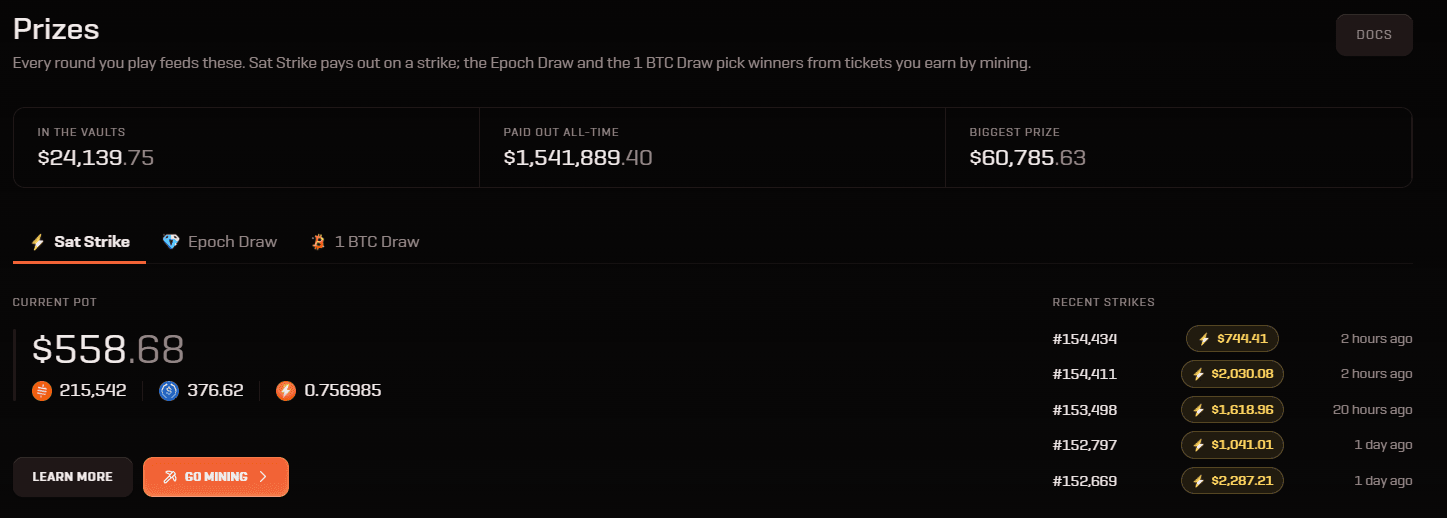
In addition to regular rewards, Sat Rush features three prize mechanisms with different characteristics.
1. Sat Strike
Sat Strike is an additional prize that can appear randomly during a round. Its distribution follows the rules governing participants' allocations on the winning block.
2. Epoch Draw
Epoch Draw is a recurring draw held approximately once every seven days. Hashrate acts as a lottery ticket, with prizes awarded to 21 winners according to the protocol's mechanism.
3. 1 BTC Draw
Sat Rush also features a prize pool that grows until it reaches one Bitcoin. Once the target is met, one winner is selected through a random draw.
This prize is chance-based and is not a guaranteed reward for every participant.
Read also: What Is Project ATX (ATX)? An AI- and Data-Themed Solana Meme Coin
What Is the RUSH Token? Functions and Tokenomics
RUSH is Sat Rush's native token, issued on the Solana network. Unlike Bitcoin, which uses a halving mechanism, RUSH has a token issuance system called Quartering.
Here is a breakdown of RUSH tokenomics:
How Does RUSH Token Quartering Work?
Quartering is designed to gradually reduce the rate of token issuance once RUSH distribution reaches certain thresholds.
This differs from Bitcoin halving because changes in emissions are determined by the number of tokens already issued, rather than Bitcoin block intervals.
Lower emissions may limit supply growth, but the price of RUSH remains subject to demand and market conditions.
RUSH Buybacks, Burning, and Staking
Sat Rush allocates 1.08% of participation volume to support its token economy, divided as follows:
- 71%: RUSH buybacks, followed by token burning to remove the tokens from circulation.
- 29%: Purchases of cbBTC to reward RUSH holders who stake their tokens.
This arrangement means staking rewards depend on the protocol's economic activity. When participation volume declines, the funds available to finance rewards may also shrink.
Read also: What Is TOTAL3 in Crypto? How to Read Altcoin Market Cap
How Much Does It Cost to Use Sat Rush, and How Much Capital Is Needed?
The minimum participation amount for Sat Rush is US$1. However, the actual cost does not end there, as protocol deductions and claim fees also apply.
For losing blocks, approximately 89% of funds are returned in USDC, while 5% is allocated to winners and 6% is charged as a protocol fee.
This fee structure matters because a growing reward balance does not necessarily mean a user is earning a net profit.
Differences Between Sat Rush and Conventional Bitcoin Mining
Although both use the term mining, Sat Rush and Bitcoin mining have different purposes and mechanisms.
Sat Rush is not a cloud mining service either, because it does not provide computing power to secure the Bitcoin network.
If your goal is to own BTC directly without participating in a game, you can read Bittime's guide on how to buy Bitcoin (BTC) while still taking price volatility risks into account.
Sat Rush Season 2 Developments
In Season 2, Sat Rush has reportedly attracted approximately 1,900 participants. The latest season also introduces points-based competitions and a leaderboard.
Meanwhile, the total rewards reportedly distributed throughout Season 1 exceeded US$1.5 million.
That figure reflects the scale of reward distribution, not participants' net profits. The project's sustainability still depends on user activity, protocol revenue, and the system's ability to fund rewards.
Read also: UNMD Coin: How NexusMind Utility, Nostr, and Tokenomics Work
Is Sat Rush Safe and Profitable?
Not needing mining hardware certainly distinguishes Sat Rush from conventional Bitcoin mining. However, that convenience does not mean its financial risks are lower.
Some of the risks associated with Sat Rush include:
- Loss of funds due to chance-based game outcomes.
- Accumulating participation and reward-claim fees.
- RUSH token price volatility.
- Smart contract vulnerabilities and wallet security risks.
- cbBTC's dependence on Bitcoin reserves and custodians.
- Declining rewards when protocol activity weakens.
Although game outcomes are designed to be verifiable on-chain, transaction transparency does not automatically guarantee the safety of funds.
Sat Rush also has the characteristics of a game of chance because it involves money and random outcomes. Participants should understand both the financial implications and applicable local laws before considering taking part.
Conclusion
Understanding what Sat Rush is means recognizing the distinction between genuine Bitcoin mining and a game that uses Bitcoin as part of its reward system.
The integration of Solana, cbBTC, the RUSH token, and the Quartering mechanism gives this project an economic model distinct from conventional mining. However, its significant fees and chance-based outcomes mean Sat Rush should not be regarded as a guaranteed source of Bitcoin income.
Interested in following developments in Bitcoin, Solana, and other blockchain projects? Sign up on Bittime to explore more digital assets and understand the opportunities and risks of the crypto market.
Bittime is a Digital Financial Asset Trading Platform (PAKD) licensed and supervised by Indonesia's Financial Services Authority (OJK) — where you can buy Bitcoin in Indonesia and hundreds of other cryptocurrencies starting from Rp10,000. Registration is fast and secure, and you can get started today.
Monitor the USDT to IDR conversion rate and the real-time price movements of your favorite crypto assets. Everything is available in one crypto investment app that you can download for free from the Play Store.
Ready to get started? Sign up for Bittime now and put your investment strategy into action on a platform trusted by millions of users in Indonesia.
FAQ
What Is Sat Rush?
Sat Rush is a Bitcoin mining-themed game that runs on the Solana network. The game uses USDC and offers rewards in the form of satoshis, RUSH tokens, and hashrate.
Does Sat Rush Actually Mine Bitcoin on Solana?
No. Sat Rush distributes Bitcoin rewards through a game mechanism rather than generating new BTC using Proof of Work.
What Is the Minimum Amount Needed to Use Sat Rush?
The minimum participation amount for Sat Rush is US$1 in USDC. Participants must also account for protocol fees, network transaction fees, and reward-claim fees.
What Is the RUSH Token?
RUSH is the Sat Rush ecosystem token, with a maximum supply of 2.1 million tokens. It features Quartering, buybacks, burning, and staking with cbBTC rewards.
Is Sat Rush Safe and Profitable?
Sat Rush profits cannot be guaranteed because game outcomes depend on chance. Users also face the risk of losing funds, transaction fees, token volatility, and smart contract vulnerabilities.
Disclaimer: The views expressed belong exclusively to the author and do not reflect the views of this platform. This platform and its affiliates disclaim any responsibility for the accuracy or suitability of the information provided. It is for informational purposes only and not intended as financial or investment advice.
.png)