What Is Qubitor (QBT)? A Post-Quantum Blockchain with Smart Accounts Without EOA
2026-06-12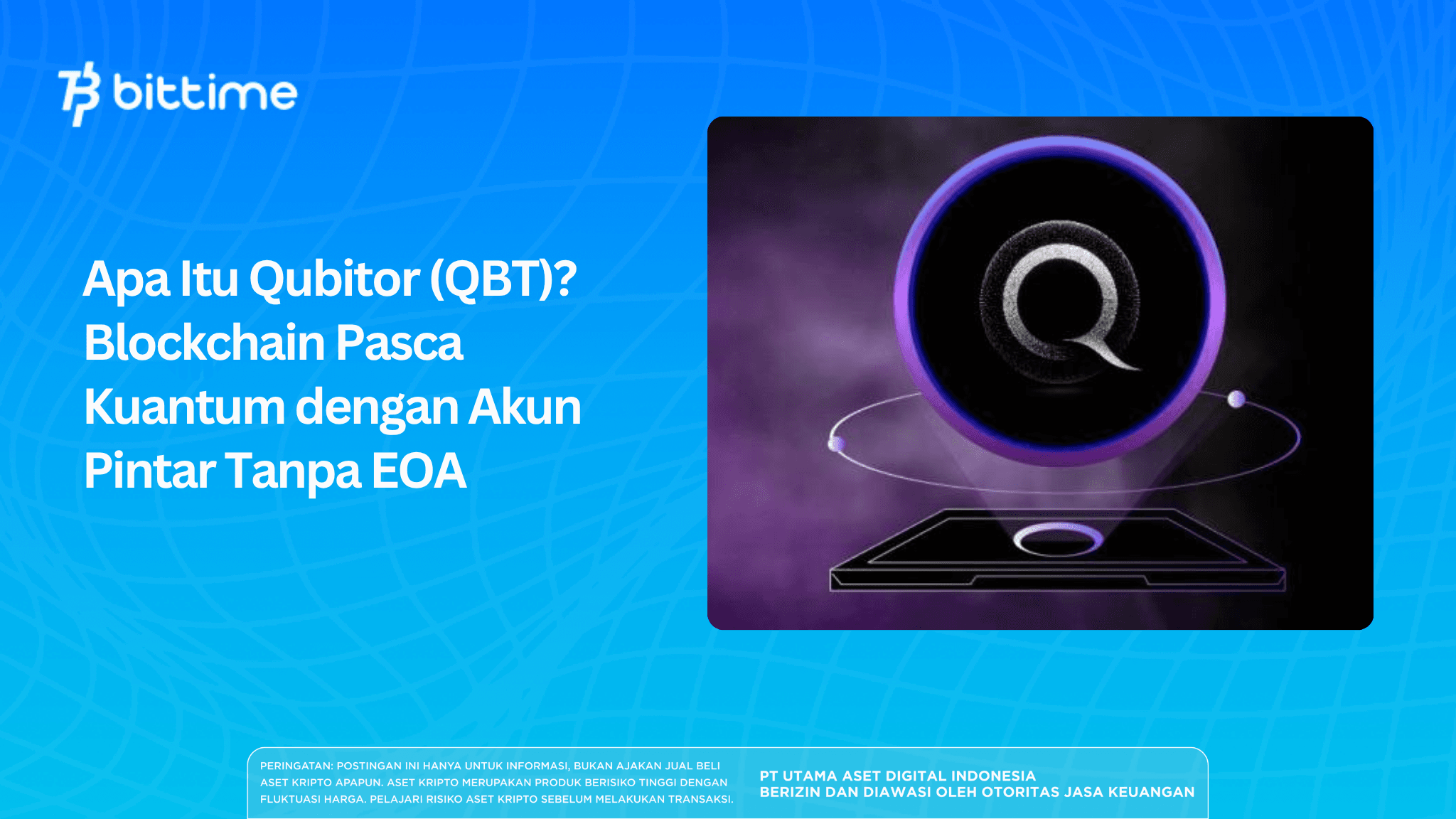
Qubitor is a blockchain project specifically designed to address future quantum computing threats. Many people ask what Qubitor is because this project offers a different approach from conventional blockchains, with a focus on post-quantum security.
By utilizing the ML-DSA-65 algorithm and completely eliminating EOA (Externally Owned Accounts), Qubitor builds an infrastructure that is more resistant to quantum attacks. The QBT token is a key component of this ecosystem.
Key Takeaways
- Qubitor is a post-quantum security layer that replaces ECDSA with ML-DSA-65 and eliminates EOA completely.
- All accounts on Qubitor are smart accounts that can only be controlled through ML-DSA-65 verification.
- The QBT token was launched on Base with a total supply of 1 million and is currently in its very early stages.
Register at Bittime now and start trading crypto with a fast, safe, and easy process in the app.
What Is Qubitor and Why Is It Important?
Qubitor Network is a project building a post-quantum security layer for blockchains. Its goal is to protect blockchain assets and operations from the threat of quantum computers, which could one day break current cryptographic algorithms like ECDSA.
A sufficiently powerful quantum computer could solve the elliptic curves used in most current blockchains. This means private keys could be extracted from public keys, opening the door to large-scale asset theft.
Qubitor addresses this problem with two main approaches:
- Replace ECDSA signature withML-DSA-65(based on NIST FIPS 204 standard).
- Eliminate EOA altogether and replace it with a smart account which only works through ML-DSA verification.
This approach makes the entire ecosystem — from user accounts, validators, bridges, to governance — quantum-resistant from the start.
Read more: What Is the American Virtual Oil Fund (AVOF)? The U.S. Oil Memecoin on Solana
Qubitor Key Features: ML-DSA-65 and No EOA
One of Qubitor’s biggest innovations is the absence of EOA. In conventional blockchains like Ethereum, EOAs are controlled by ECDSA private keys. Qubitor has completely eliminated this model.
All accounts on Qubitor are smart accounts with the following characteristics:
- No ECDSA owner
- No admin key
- There is no legacy onlyOwner path
- All key executions and rotations must go through ML-DSA-65 signatures.
Verification of ML-DSA-65 is performed via a native EVM precompile at a dedicated address. This makes the verification process fast and efficient without the need for complex additional smart contracts.
In addition, Qubitor also implements very strict replay protection. Each signed message binds the action domain, chain ID, account address, nonce, and call hash. This prevents replay attacks across accounts, nonces, and chains.
Read more: What Is the United States Water Reserve (USWR)? A Clean Water Memecoin on Solana
QBT Token and Tokenomics
QBT is the official token of the Qubitor ecosystem. It was launched on the Base network with the following details:
- Number: Qubitor
- Symbol: QBT
- Total Supply: 1,000,000 QBT
- Contract Address: 0x24D621B1f5f1CF295313C88dC331012140e52D54
- Holders: around 169–194 addresses
Currently, QBT’s market cap is around $288K with liquidity of approximately $92K. This token is still very new (the pair on DEX Screener was only a few hours old when the data was collected) and is traded on Uniswap and Base.
Due to its small total supply (only 1 million), QBT falls into the category of tokens with low supply. However, since the project is still in its early development stages, the token’s distribution and utility within the main ecosystem have not yet been fully detailed.
Read more: What Is the Sazan Island Development Fund (SAZAN)? The Albanian Island Memecoin on Solana
Qubitor's Roadmap to Mainnet
Qubitor has a structured roadmap with a mainnet target of 2027:
- Phase 01 (Q1 2026): Devnet is live with PQ-native features like ML-DSA verifier, no-EOA gas, genesis-installed accounts, and PQ faucet.
- Phase 02 (Q3 2026): Testnet with public bootnodes, RPC, and signed launch materials.
- Phase 03 (2027): Mainnet after full audit. All privileged authorities (treasury, upgrades, bridge guardians, governance) must use PQ policy.
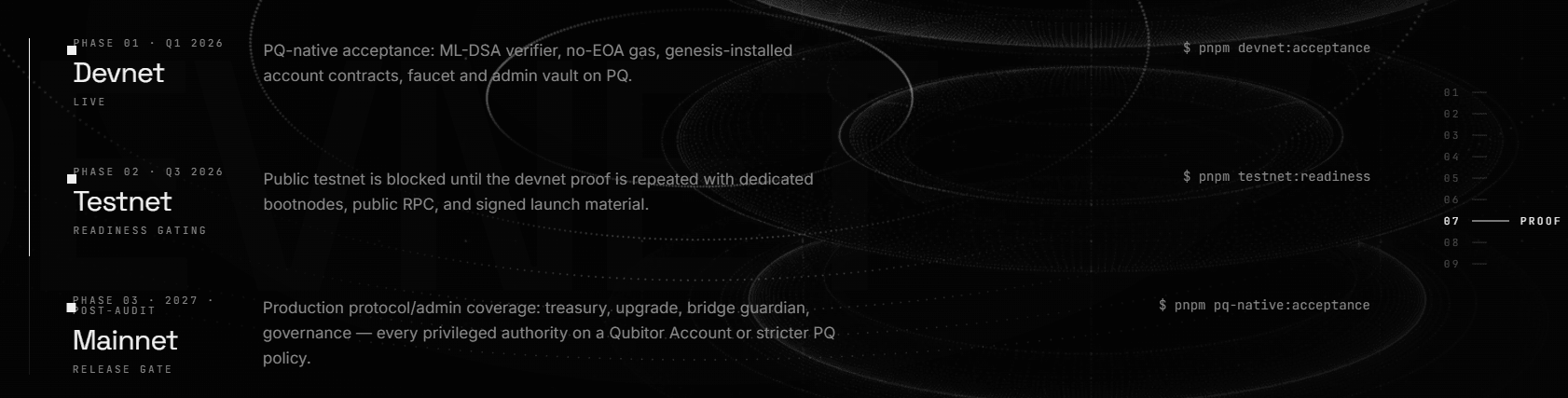
Qubitor's mainnet will not launch until all critical components have been audited and protected by post-quantum policies. This demonstrates a cautious approach to security.
Read more: What Is the Vanguard Oil Asset Fund (VOAF)? The Oil Memecoin on Solana
Bridge and Validator Security on Qubitor
One important aspect of Qubitor is the implementation of post-quantum security across all layers of the network, including:
- Bridge guardians and withdrawal authorities must use Qubitor Accounts (not ECDSA).
- Validators, sequencers, and other operators are also required to use PQ smart accounts.
- No ECDSA signatures are allowed on any privileged path.
This approach ensures that even the most sensitive infrastructure components are protected from quantum threats from the outset.
Read more: What Is zer0? An AI Agent That Monitors the Polymarket Prediction Market
QBT Investment Risks and Considerations
While the concept is interesting, QBT is still a very new project. Some things to note:
- Market cap and liquidity are still low, so prices are very volatile.
- The new mainnet is targeted for 2027, meaning the token's utility in the main ecosystem is not yet active.
- There is no full audit for the ML-DSA precompile yet.
- As with most new tokens, there is a risk that the project will not develop as planned.
Investors interested in the post-quantum security narrative need to understand that QBT is currently more speculative and based on a long-term technology narrative.
Conclusion
Qubitor is an ambitious blockchain project focused on post-quantum security. By eliminating EOA and adopting ML-DSA-65 as its primary signature standard, Qubitor is building a foundation that differs from most current blockchains.
The QBT token serves as the gateway to this ecosystem, though its full utility will only be realized after the mainnet launches in 2027. For those interested in the narrative of future technology and protection against quantum threats, Qubitor offers a unique story.
However, like other new crypto projects, the risks remain high. Do your own research (DYOR), monitor roadmap developments, and only invest funds you can afford to lose.
Let’s start trading crypto with the largest assets, such as BTC/IDR and ETH/IDR, right in the Bittime app.
Bittime is a licensed and regulated Digital Financial Asset Trader (PAKD) supervised by Indonesia’s Financial Services Authority (OJK) — where you can buy Bitcoin in Indonesia and hundreds of other crypto assets starting from just Rp10,000. The registration process is fast, secure, and you can get started today.
Track USDT to IDR conversions and monitor your favorite crypto assets in real time. Everything is available in one crypto investment app that you can download for free on the Play Store
Ready to start? Register now on Bittime and execute your investment strategy with a platform trusted by millions of users in Indonesia.
FAQ
What is Qubitor?
Qubitor is a blockchain project that builds a post-quantum security layer by replacing ECDSA with ML-DSA-65 and eliminating EOA entirely.
What is QBT token?
QBT is the Qubitor ecosystem token launched on Base. Its total supply is 1 million tokens and it is currently traded on Uniswap with a low market cap.
What are the main advantages of Qubitor over other blockchains?
Its main advantages are a quantum-native approach from the start, no EOA, and all critical operations (including bridge and governance) protected by ML-DSA-65.
When will Qubitor mainnet launch?
The mainnet is targeted for 2027 after a full audit process is complete. The project is currently in the devnet and testnet preparation phase.
Is QBT safe to invest in?
Like most new tokens, QBT carries high risks due to low liquidity, the project's infancy, and the token's utility not yet fully realized. Always do your due diligence before investing.
Disclaimer: The views expressed belong exclusively to the author and do not reflect the views of this platform. This platform and its affiliates disclaim any responsibility for the accuracy or suitability of the information provided. It is for informational purposes only and not intended as financial or investment advice.

.png)