What is QNTB? Quantinuum Stock Token and How It Works
2026-11-10
What is QNTB? QNTB is a tokenized stock that provides exposure to shares of Quantinuum, a U.S. technology company specializing in quantum computing. The token offers a way to track movements in the company's share value through blockchain technology without buying its shares directly on a traditional stock exchange.
QNTB is drawing interest because it brings together two growing sectors: quantum computing and the tokenization of real-world assets (RWAs). However, QNTB differs from conventional cryptocurrencies. Its ownership structure, price formation, and associated risks are important to understand before deciding to buy it.
Key Takeaways
- QNTB is a blockchain-based tokenized stock that provides exposure to Quantinuum shares.
- Quantinuum is a quantum computing technology developer listed on Nasdaq under the ticker QNT.
- QNTB's price is influenced by its underlying shares, trading liquidity, and conditions in the tokenization market.
What Is QNTB (Quantinuum Tokenized bStocks)?
QNTB stands for Quantinuum Tokenized bStocks, a tokenization product designed to provide economic exposure to Quantinuum shares. The token belongs to the category of tokenized stocks, digital instruments that connect capital market assets with blockchain technology.
In simple terms, investors can track changes in a stock's value through a token traded on supported platforms. However, buying QNTB does not automatically make someone a registered Quantinuum shareholder.
QNTB is also not a cryptocurrency issued by Quantinuum to power its quantum computing technology. The product belongs to the bStocksecosystem, with the token holders' rights and product structure determined by the issuer.
Read also: What Is SMHB? VanEck Semiconductor ETF Token and Its Risks
How Does the bStocks Ecosystem Work?
bStocks is a tokenized securities ecosystem that allows assets such as stocks and ETFs to be represented through blockchain-based instruments. bStocks products are issued by BTech Holdings Limited under arrangements linked to specific financial assets.
Under this model, backing assets are held through custody arrangements in accordance with the product terms. Investors receive tokens that provide economic exposure to the underlying assets rather than direct share ownership.
QNTB uses the BNB Smart Chain. This infrastructure allows the token to be transferred across a compatible blockchain, while trading and redemption access remain subject to the issuer's rules and the platform being used.
Understanding Quantinuum and Quantum Computing Technology
To understand QNTB's appeal, it helps to know the company behind its underlying shares.
Quantinuum was formed in 2021 through the merger of Honeywell Quantum Solutions and Cambridge Quantum. The company develops quantum computing technology, including hardware, software, and applications for business and research.
In June 2026, Quantinuum officially entered the U.S. stock market through a Nasdaq listing under the ticker QNT. This listing gave stock market investors an opportunity to invest directly in a company operating in the quantum computing sector.
What Makes Quantum Computing Different?
Everyday computers process information using bits that have a value of either 0 or 1. Quantum computers, meanwhile, use qubits that exploit properties of quantum mechanics, including superposition and quantum entanglement.
These differences allow quantum computers to take new approaches to solving certain types of problems. However, this does not mean the technology is automatically faster for every computing task.
Quantinuum develops systems based on trapped-iontechnology, which uses ions as qubits. One of its products is Helios, a quantum computing system designed to support research and the development of more complex applications.
Some fields that could benefit from this technology include:
- Pharmaceuticals: Supporting research into molecular structures and drug development.
- Materials science: Supporting simulations of material properties at the quantum level.
- Optimization: Exploring solutions to problems involving numerous variables.
- Energy: Supporting research into chemical processes and materials for energy technologies.
Some of these applications are still in development. It is therefore important to distinguish quantum computing's potential uses from capabilities that have already been commercially demonstrated.
How Is Quantinuum's Business Performing?
Quantinuum reported substantial revenue growth during 2026, although the company continued to record losses.
In the third quarter of 2026, revenue reached US$9.1 million, up 233% from the same period a year earlier. On the other hand, the company posted a net loss of US$118 million.
These figures illustrate two sides of Quantinuum's business. Demand and commercial activity are beginning to grow, but the company still requires significant investment in research, technology development, and operations.
For investors tracking QNTB, this financial position matters because it can influence how the market assesses the outlook for Quantinuum shares.
Read also: What Is STXB? Seagate Stock Token, Price, and Risks
How Does the QNTB Token Work?
QNTB uses a stock tokenizationmechanism, in which a digital instrument is issued to provide exposure to a traditional financial asset.
Imagine someone who wants to follow changes in Quantinuum's share price through a blockchain-based platform. Rather than buying shares directly through a broker, an eligible investor can use QNTB as an alternative instrument.
In general, the mechanism involves four components:
- Underlying stock: Quantinuum is the company whose share value underlies QNTB's exposure.
- Issuer: BTech Holdings Limited is responsible for the product structure and its issuance terms.
- Blockchain: The token is issued and can be transferred on BNB Smart Chain.
- Trading market: Investors buy or sell QNTB on platforms that support the token.
Although QNTB is designed to track the economic value of its underlying shares, its market price can diverge at certain times. Differences in trading hours, fees, liquidity, and redemption arrangements can affect execution prices.
Do QNTB Holders Have Rights to Quantinuum Shares?
This is one of the most important points to understand before buying QNTB.
QNTB holders do not automatically receive voting rights, direct dividend rights, or other rights normally associated with owning company shares. Their rights are determined by the terms of the bStocks product.
Redeeming tokens for underlying assets may also be possible under certain conditions, including identity verification, geographic restrictions, and applicable fees.
In other words, QNTB provides economic exposure to shares, but it is not entirely equivalent to holding Quantinuum shares in a brokerage account.
Read also: What Is TSMB? How It Works, Dividends, and Risks of the TSMC Stock Token
What Is the Difference Between QNTB and QNT Crypto?
The name Quantinuum sometimes causes confusion because the symbol QNT is also used by another asset in the cryptocurrency market.
In fact, QNTB, QNT shares, and the QNT token from Quant Network are three different instruments.
This distinction matters when looking up QNTB prices, reading charts, or selecting an asset on a trading platform.
Do not rely solely on ticker symbols. Check the asset's full name, blockchain network, and instrument type to avoid buying the wrong product.
Read also: What Is MUB? Understanding the Micron Stock Token and How It Works
QNTB Price Today and the Factors That Influence It
QNTB's price can change in response to stock market conditions and token trading activity.
For reference, market data reviewed on November 10, 2026, placed QNTB at around US$39.92, or approximately Rp720,000. This was the price at the time of observation, not a fixed price for every transaction.
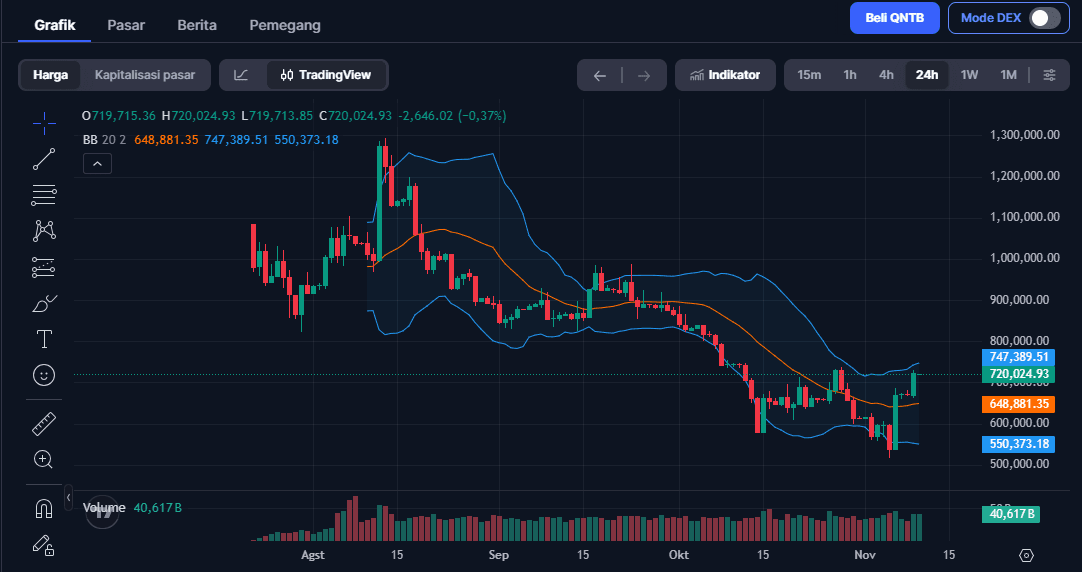
Here is a summary of QNTB's metrics at that time:
Keep in mind that QNTB's market capitalization reflects the value of tokens in circulation, not Quantinuum's total corporate valuation. The two are calculated on different bases.
5 Factors That Influence QNTB's Price
1. Quantinuum Stock Performance
Because Quantinuum shares are the underlying asset, changes in their price are a key driver of QNTB. Financial reports, business developments, and investors' assessments of the company can influence its movements.
2. Developments in the Quantum Computing Industry
Technological breakthroughs, industry partnerships, and research advances may affect investor interest in quantum computing companies. However, their impact on share prices still depends on how the market values their economic benefits.
3. Token Liquidity
The more limited a market's liquidity, the greater the potential difference between buying and selling prices. This can make it harder to execute large transactions at the expected price.
4. Financial Market Sentiment
Changes in interest rates, economic conditions, and investor appetite for technology stocks can affect demand for QNTB. Weakening market sentiment can also put pressure on its price even when there has been no major change in the company's business.
5. Trading Activity and Redemption Mechanisms
Transaction volume, token availability, and arrangements for redemption against underlying assets all affect price formation. A surge in volume therefore does not necessarily indicate stronger long-term investment demand.
Read also: What Is Marvell Technology Tokenized bStocks (MRVLB)?
Advantages and Risks of Investing in QNTB
QNTB offers an alternative way to gain exposure to technology stocks through blockchain. However, that convenience must be weighed against its associated risks.
What Are QNTB's Advantages?
One of QNTB's attractions is trading flexibility. On platforms that support it, token transactions may take place outside the trading hours of traditional stock exchanges.
In addition, blockchain technology allows tokens to be transferred over a compatible network. Investors can also track an underlying asset through a digital instrument without using conventional stock-purchase procedures for every transaction.
Nevertheless, access to the product remains subject to platform rules, geographic restrictions, and user eligibility requirements.
Risks to Consider
There are several risks to understand before considering QNTB for an investment portfolio:
- Price volatility: The token's value may fall when its underlying shares weaken or market conditions change.
- Issuer risk: The exercise of token holders' rights depends on the product structure and the party issuing it.
- Liquidity risk: Not every market has sufficient trading volume or order book depth.
- Technology risk: Blockchain disruptions, transfer errors, or smart contract issues may affect token use.
- Regulatory risk: Rules governing tokenized securities can vary between countries and change as regulations evolve.
Assessing QNTB therefore requires more than examining Quantinuum's technological prospects. Investors must also evaluate the quality of the tokenized instrument, including the transparency of backing assets and the issuer's terms.
Read also: What Is SNDKB? Understanding SanDisk Tokenized bStocks
How to Buy QNTB for Beginners
Before buying QNTB, make sure it is available on a platform you are permitted to use under the rules of your place of residence.
The following steps can help reduce the risk of mistakes when trading:
- Search for QNTB on a trading platform. Confirm that the asset is named Quantinuum Tokenized bStocks.
- Check the blockchain network and token contract. Compare the details with official information to avoid confusing it with another asset.
- Understand the trading requirements. Review identity verification rules, user restrictions, and fees.
- Examine market conditions. Consider the price, spread, and volume before choosing when to trade.
- Set your purchase amount. Adjust your transaction size to your investment goals and risk tolerance.
For the QNTB/USDT trading pair, investors should also understand that the price is quoted in USDT. Changes in asset value and transaction fees can still affect the final outcome.
Can You Buy QNTB on Bittime?
Bittime already offers a tokenized stocks category for users in Indonesia. However, as of this article's review, there was no official confirmation that QNTB was available for trading on the platform.
If you are looking for ways to buy QNTB on Bittime, first check the latest asset listings in its official app or website. Avoid transfers or trades based on unverified listing information.
For comparison, the QNTB/USDT pair has been listed on several international markets, including Binance, LBank, and KCEX. Access remains subject to each platform's terms.
You can also sign up for Bittime to explore the available digital assets and stay informed about developments in the crypto market and stock tokenization.
Read also: U.S. Stock Tokenization: Rights and Risks Investors Should Understand
What Is the Future Outlook for QNTB?
QNTB's future is tied to both Quantinuum's development and market acceptance of tokenized stock products.
On the technology side, Quantinuum still has a long-term development roadmap. The company is targeting its Sol system for 2027 and Apollo for 2029 as part of its effort to build more advanced quantum computers.
However, technical achievements do not necessarily translate immediately into revenue growth or a higher share price. The company must still demonstrate that its products can be widely adopted and generate sustainable business value.
Meanwhile, the tokenized stock market continues to face challenges relating to regulation, liquidity, and investor protection. All three will influence how widely products such as QNTB can be used.
Against this backdrop, developments in quantum computing are worth following. Nevertheless, the company's prospects and the merits of purchasing QNTB remain two separate questions that must be assessed independently.
Conclusion
Understanding what QNTB is helps investors see that it is not a conventional cryptocurrency, but an instrument that provides economic exposure to Quantinuum shares through blockchain technology. Although linked to a stock, QNTB has different mechanisms and ownership rights from purchasing shares directly.
Advances in quantum computing technology may create new business opportunities for Quantinuum, but investing in QNTB still involves price, liquidity, issuer, and regulatory risks. Before buying, make sure you understand the product's characteristics, review current market data, and choose an appropriate trading platform.
Bittime is a licensed Digital Financial Asset Trader (PAKD) supervised by Indonesia's Financial Services Authority (OJK) — where you can buy Bitcoin in Indonesia and hundreds of other crypto assets starting from Rp10,000. Registration is quick and secure, and you can get started today.
Track the USDT to IDR conversion rate and real-time price movements of your favorite crypto assets. Everything is available in one crypto investment app that you can download for free from the Play Store.
Ready to get started? Sign up for Bittime now and put your investment strategy into action on a platform trusted by millions of users in Indonesia.
FAQ
What is QNTB crypto?
QNTB is the Quantinuum Tokenized bStocks token, which provides exposure to Quantinuum shares through blockchain technology. Although it can be traded on digital asset platforms, QNTB is a tokenized stock, not a cryptocurrency native to the company.
Is QNTB the same as Quantinuum stock?
No. QNTB provides economic exposure to Quantinuum shares, but token holders do not automatically receive voting rights or other rights of direct shareholders. Ownership terms are governed by the bStocks product structure.
What is the difference between QNTB and QNT crypto?
QNTB is a tokenized stock linked to Quantinuum shares. QNT crypto, meanwhile, is a token in the Quant Network ecosystem, which is separate from Quantinuum shares listed on Nasdaq under the ticker QNT.
What influences the price of QNTB?
QNTB's price is influenced by the value of its underlying shares, Quantinuum's business developments, token liquidity, and market sentiment. Differences in trading activity and redemption mechanisms may also affect prices across platforms.
How can I buy QNTB on Bittime?
First, check whether QNTB is included in Bittime's official asset listings. If it is not listed, it cannot be purchased through Bittime until trading support is officially announced.
Disclaimer: The views expressed belong exclusively to the author and do not reflect the views of this platform. This platform and its affiliates disclaim any responsibility for the accuracy or suitability of the information provided. It is for informational purposes only and not intended as financial or investment advice.
.png)