What Is Layer 2? Here's How L2s Make Money on Ethereum
2026-10-05
What is Layer 2? Simply put, Layer 2, or L2, is a solution built on top of blockchain major blockchains such as Ethereum to process transactions faster and at a lower cost. Interestingly, L2 is not only a technology for increasing Ethereum's capacity, but also has a business model that enables the network to generate revenue.
The next question is even more interesting: if transactions on Layer 2 are much cheaper, how does an L2 network make money? The answer involves transaction fees, sequencers, data costs paid to Ethereum, and the difference between revenue and the network's operating costs.
Key Takeaways
- Layer 2 processes transactions outside Ethereum Layer 1 while still using Ethereum for settlement and security.
- L2 revenue primarily comes from fees paid by users to conduct transactions.
- Revenue does not automatically mean profit because L2 must also pay operating costs and costs associated with Ethereum.
What Is Ethereum Layer 2?
Ethereum Layer 2 is a network built to expand Ethereum's capabilities without moving all activity to another blockchain. L2 processes transactions separately, while Ethereum continues to serve as the base layer for settlement and security.
This concept emerged because Ethereum has limited capacity when transaction demand increases. When the network is congested, users may face higher gas fees, making small-value transactions less efficient.
With Layer 2, most transaction processing is moved away from Ethereum Layer 1. The final results are still linked back to Ethereum, allowing users to benefit from lower costs without fully leaving the Ethereum ecosystem.
Common Layer 2 technologies include Optimistic Rollups and ZK Rollups. Both use different approaches to ensure that transactions processed by L2 can be verified on Ethereum.
Read also: Could Ethereum Fall Behind Other L1s? Here Is the Tokenization Threat
How Does Layer 2 Work?
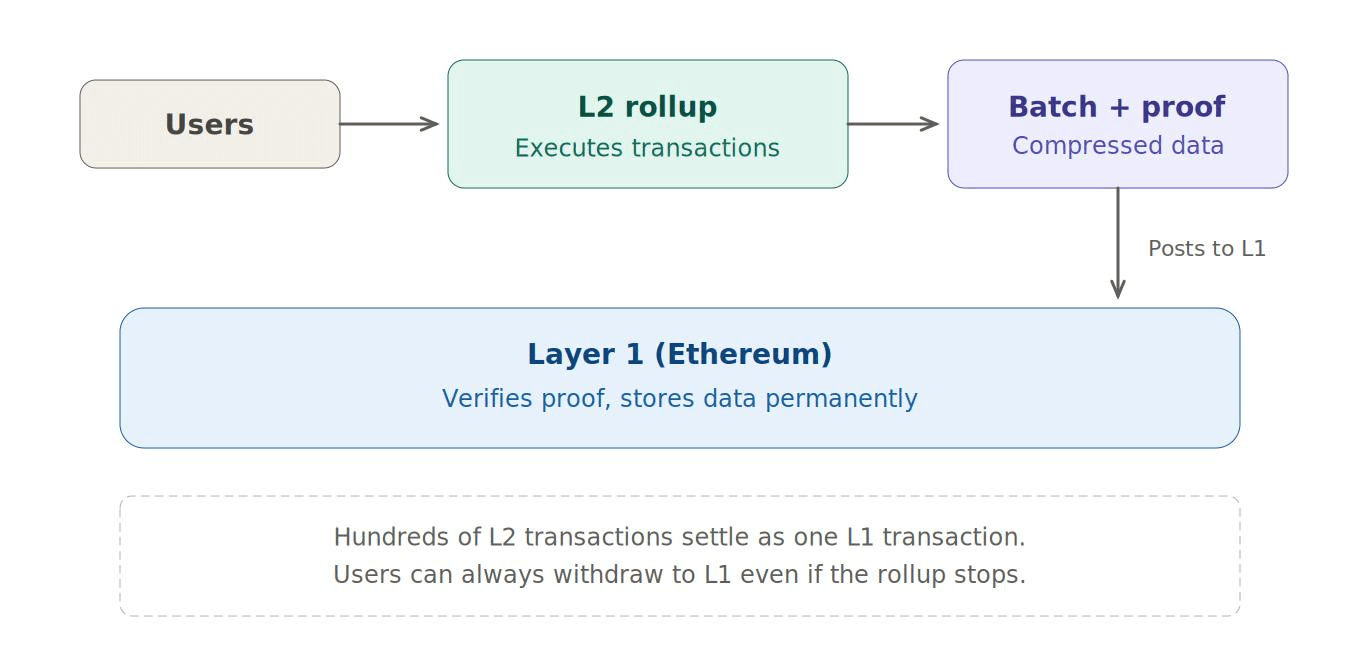
Layer 2's operation can be understood through three main processes.
1. Transactions Are Processed on L2
When users make transactions, such as swapping tokens or using a DeFi application, those transactions are first processed on the Layer 2 network.
This reduces the load on Ethereum Layer 1 because not every transaction has to be executed directly on the mainnet.
2. Transactions Are Batched
In a rollup system, many transactions can be grouped into a single batch. The costs associated with those transactions can then be shared among many users, reducing the cost per transaction.
This process is one reason why transactions on a Layer 2 network can be cheaper than transactions directly on Ethereum.
3. Data Is Sent Back to Ethereum
After transactions are processed, the required data or proofs are sent to Ethereum for settlement and verification according to each L2's design.
With this mechanism, Ethereum remains an important part of the system's security and finality, while most transaction execution takes place on L2.
Read also: Ethereum Price After the US CPI: Could ETH Rise?
Why Does Ethereum Need Layer 2?
The main problem Layer 2 aims to solve is scalability.
Ethereum must maintain security and decentralization while handling high transaction demand. When limited capacity meets high demand, the network can experience congestion and transaction fees can increase.
Layer 2 offers a different approach. Instead of having Ethereum process every transaction directly, some of the work is performed on an additional network that remains connected to Ethereum.
The result is higher throughput and lower costs for users.
How Does Layer 2 Make Money?
This is the part that is often overlooked when people discuss Layer 2.
The simple model can be illustrated as follows:
Users pay transaction fees → L2 receives the fees → L2 pays operating costs → the difference becomes net revenue or potential profit.
Users pay fees when making transactions on the L2 network. These fees may include L2 execution costs as well as costs associated with sending data to or settling on Ethereum.
Because a single batch can contain many transactions, the costs paid to Ethereum can be shared among many users. This is one of the economic foundations that allows L2 to offer lower fees while still maintaining a source of revenue.
Revenue from Transaction Fees
The easiest source of revenue to understand is transaction fees.
For example, a user pays a fee to perform a swap on an L2. Part of that fee is used to cover the costs required by the network to process the transaction.
If the total fees paid by users are greater than the network's costs, the difference can become revenue or a margin for the L2 operator.
However, the amount of revenue depends heavily on transaction volume and user activity.
Revenue from Sequencers
Many L2s use sequencers to receive, order, and process transactions before they are sent to Ethereum. This role is an important part of the architecture of several L2 networks.
Sequencers can also be an economic source for network operators. The greater the transaction activity, the greater the potential fees that can be collected.
In some designs, transaction ordering mechanisms can also create opportunities to capture MEV. However, the potential revenue varies between networks and depends on protocol design and market activity.
Costs Layer 2 Must Pay
This is where it is important to distinguish revenue from profit.
Layer 2 does not keep all transaction fees paid by users as profit. The network still requires infrastructure and must bear certain costs to process and send data to Ethereum.
Following the Ethereum upgrade that introduced support for blobs, rollups have a more efficient data mechanism than before. This can help reduce one component of L2 operating costs.
Therefore, L2 analysis should not only consider how much in fees is collected. More importantly, it should consider how much revenue the network generates compared with the costs it must bear.
Read also: ETH Nears US$2,500: Is US$3,000 the Next Target?
Is Layer 2 Profitable?
The answer cannot be generalized.
A Layer 2 can have high transaction volume without necessarily generating large profits. Conversely, a network with efficient operating costs may have better margins even if its transaction volume is not as high as its competitors.
There are several factors to consider:
- Transaction Volume
The higher the user activity, the greater the opportunity to earn transaction fees. - Transaction Fee Levels
Fees that are too high can reduce a network's appeal, while fees that are too low can limit revenue. - Settlement Costs Paid to Ethereum
L2 still incurs costs for using Ethereum's infrastructure. - Technological Efficiency
Data compression and technological improvements can reduce operating costs. - Ecosystem Activity
DeFi, gaming, stablecoins, trading, and other applications can increase demand for the network.
Therefore, L2 revenue is not the same as L2 profit. This distinction is important for anyone evaluating the business model of a Layer 2 network.
Read also: Ethereum Pectra Upgrade: Detailed Information and List of Enhanced Features
Ethereum Layer 1 vs. Layer 2
Ethereum Layer 1 is the main blockchain that provides consensus, network security, nodes, and transaction data. Layer 2 sits on top of it and is designed to handle some transaction activity more efficiently.
The simple difference is:
- Layer 1: Ethereum's main foundation.
- Layer 2: the scaling layer that expands Ethereum's capacity.
- L1: provides basic settlement and security.
- L2: handles large-scale transaction execution.
- L1: fees can increase when the network is congested.
- L2: is designed to offer cheaper transactions.
However, not every blockchain that is faster and cheaper is automatically a Layer 2. Sidechains and some other types of networks have security and data-availability models that differ from L2s that inherit Ethereum's security.
Optimistic Rollup vs. ZK Rollup
The two main approaches to Ethereum Layer 2 are Optimistic Rollups and ZK Rollups.
Optimistic Rollups essentially assume that transactions are valid unless evidence shows that an error occurred. The system uses fault proofs to handle disputes.
ZK Rollups, meanwhile, use validity proofs to demonstrate that transactions and computations comply with the rules before state changes are accepted on Layer 1.
Both have their own advantages and trade-offs. Therefore, users should not evaluate Layer 2 solely by transaction costs, but also by security, decentralization, proof technology, and trust assumptions.
Read also: Top Ethereum Meme Coins 2026: How to Buy on Bittime
What Does This Mean for Ethereum's Future?
The growth of Layer 2 means Ethereum is no longer understood simply as the place where all transactions are executed directly.
Ethereum increasingly serves as a base layer providing settlement, security, and data availability, while various L2s handle user activity at greater scale.
This model can create a more efficient ecosystem, but it also introduces new challenges. Competition among L2s is becoming increasingly important because each network must attract users, applications, liquidity, and transaction activity.
From a business perspective, the important question is not only “how cheap are L2 fees?” but also “can the network generate sustainable revenue after accounting for costs?”
Risks to Understand
Layer 2 still carries risks.
Ethereum.org notes that many L2 technologies are still relatively young compared with Ethereum Mainnet. Therefore, users need to understand the differences in design, trust assumptions, proof mechanisms, bridges, and levels of decentralization across networks.
Do not assume that all L2s have the same level of security simply because they use Ethereum as a settlement layer.
If you want to follow developments in Ethereum, Layer 2, and other crypto assets, you can sign up on Bittime to get the latest market information and analysis.
Conclusion
Understanding what Layer 2 is means understanding how Ethereum expands its capacity without processing all transactions directly on Layer 1. L2 moves some execution to an additional network, batches transactions, and then uses Ethereum for settlement and certain security functions.
From a business perspective, Layer 2 primarily makes money through transaction fees paid by users. However, revenue does not automatically become profit because the network still has to pay operating costs and costs associated with Ethereum.
Therefore, when evaluating a Layer 2, do not look only at transaction volume or fee levels. Also consider revenue, costs, network efficiency, security, and growth in user activity.

Bittime is a licensed Digital Financial Asset Trader (PAKD) platform authorized and supervised by the Financial Services Authority (OJK) — where you can buy Bitcoin in Indonesia and hundreds of other crypto assets starting from IDR 10,000. Registration is fast and secure, and you can get started today.
Track USDT to IDR conversions and the real-time price movements of your favorite crypto assets. Everything is available in one crypto investment app that can be downloaded for free from the Play Store.
Ready to get started? Sign up on Bittime now and execute your investment strategy with a platform trusted by millions of users in Indonesia.
FAQ
What is Layer 2?
Layer 2 is a scaling solution built on Layer 1 blockchains such as Ethereum. L2 processes transactions outside Layer 1 to increase capacity and reduce costs, while remaining connected to Ethereum's security and settlement according to its design.
How does Ethereum Layer 2 work?
Layer 2 processes transactions on its own network and then sends the required data or proofs to Ethereum. In a rollup, many transactions can be batched so that Layer 1-related costs can be shared among many users.
How does Layer 2 make money?
The main source of L2 revenue is transaction fees paid by users. After operating costs and costs associated with settlement or sending data to Ethereum are deducted, the difference can become net revenue or potential network profit.
Does Layer 2 pay Ethereum?
Yes, L2 can incur costs associated with using Ethereum for settlement and data publication. The amount depends on the network's design, transaction activity, and the data mechanism used.
Is Ethereum Layer 2 profitable?
Not every Layer 2 is automatically profitable. Profit depends on the network's ability to generate more revenue than its operating costs.
Disclaimer: The views expressed belong exclusively to the author and do not reflect the views of this platform. This platform and its affiliates disclaim any responsibility for the accuracy or suitability of the information provided. It is for informational purposes only and not intended as financial or investment advice.

.png)