What Is Kinesis Silver (KAG)? The Silver-Backed Crypto You Can Actually Spend
2026-05-06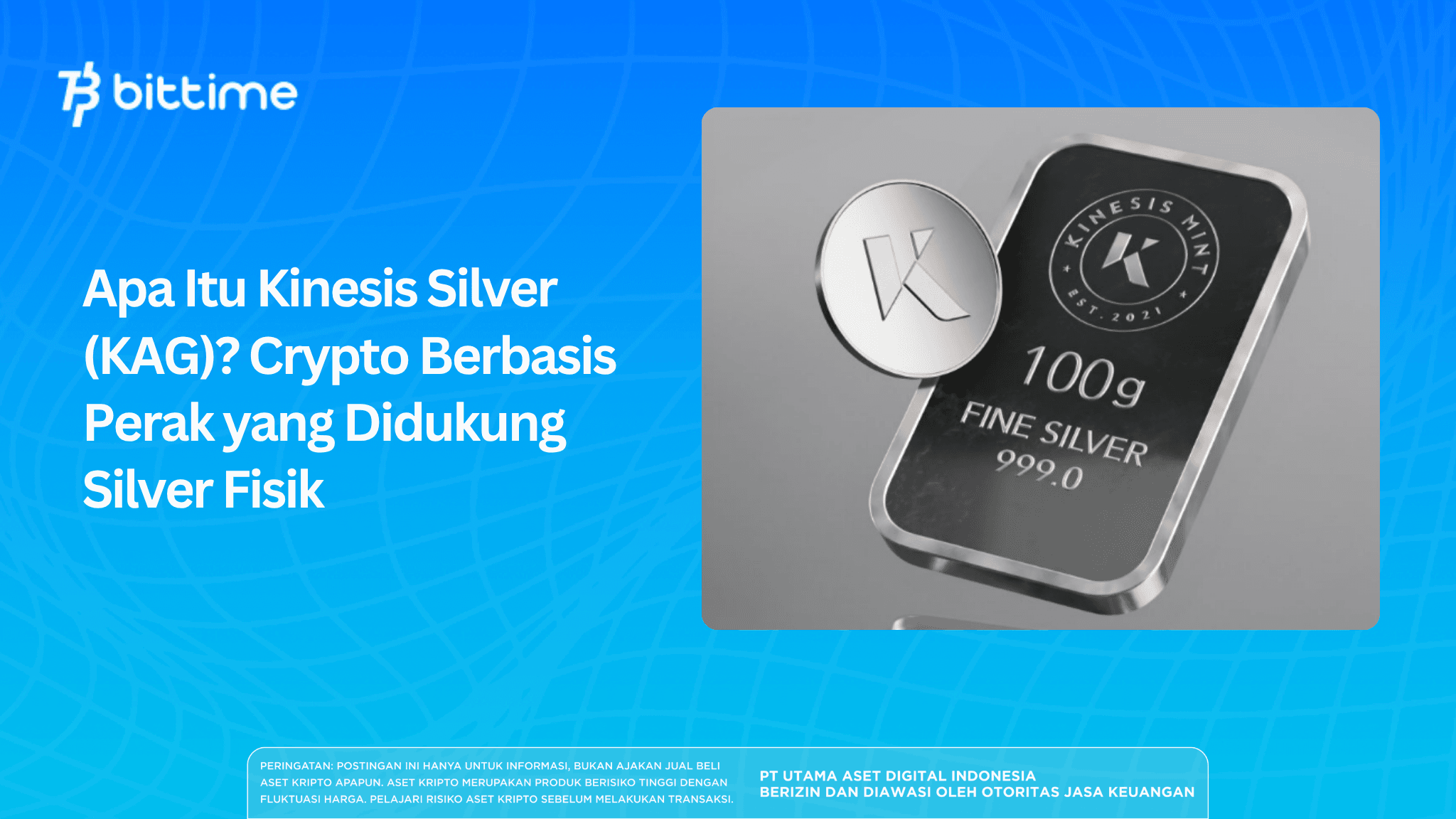
Silver has always been a legitimate store of value — but owning it has historically come with friction: storage fees, poor liquidity, and zero ability to use it for everyday transactions. Kinesis Silver (KAG) was designed to strip away each of those barriers.
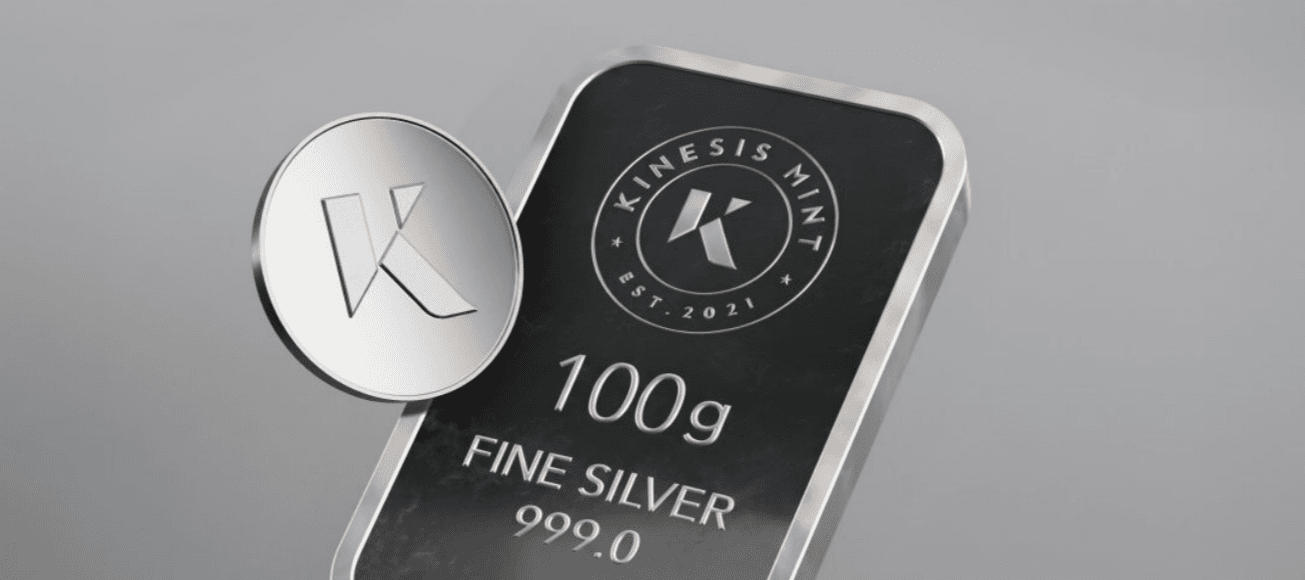
Each KAG token represents one troy ounce of physical silver bullion held in an independently audited, insured vault — not a paper claim, but documented legal title recorded on blockchain.
With the global silver market trending strongly in 2026 and real-world asset tokenization gaining serious institutional traction, KAG sits at an increasingly relevant intersection between precious metals and digital finance.
Key Takeaways
- 1 KAG = 1 troy ounce of physical silver stored in fully insured vaults globally — the legal title of the metal remains with the token holder at all times.
- KAG earns a passive monthly yield drawn from 15% of Kinesis' global transaction fee revenue, paid directly in KAG — a genuine economic first for precious metal holders.
- KAG is directly spendable via the Kinesis Virtual Card at any Mastercard-accepting merchant worldwide, with automatic conversion to local currency at the point of sale.
How KAG Works: The Mechanics of a Silver-Backed Crypto
The underlying concept is straightforward: when someone buys KAG on the Kinesis platform, the equivalent quantity of physical silver bullion is acquired and vaulted by Kinesis' strategic partner, Allocated Bullion Exchange (ABX) — an institutional precious metals exchange with over a decade of operational history.
The silver is stored on a fully allocated basis. That means the specific ounces backing your tokens are physically segregated and legally titled in your name. Kinesis states explicitly that bullion backing KAG will never appear on the company's balance sheet, which directly reduces counterparty risk compared to paper-silver instruments.
The blockchain underpinning KAG is a forked Stellar network — a deliberate technical choice made for three core reasons:
- Network speed suitable for high-frequency, everyday transactions
- Consensus model that avoids the energy and latency costs of proof-of-work
- Fee accumulation structure that integrates with Kinesis' yield distribution system
Alongside the native Stellar-based KAG, an ERC-20 version issued by KMS Labs now exists on Ethereum, enabling trading across Ethereum-compatible exchanges and eventual DeFi integrations.
KAG Token Utility: What You Can Actually Do With It
KAG's value proposition extends well beyond being a tokenized silver certificate. The ecosystem built around it defines what makes it functionally distinct.
Monthly passive yield. Every KAG holder on the Kinesis platform receives a yield paid monthly in KAG. This yield comes from Kinesis redistributing 15% of its global transaction fee revenue back to holders — with no lock-up requirements and no minimum holding period.
Direct spending capability. The Kinesis Virtual Card (currently in beta in the US) allows KAG holders to spend their silver balance at over 100 million Mastercard-accepting merchants worldwide. The conversion from KAG to local currency happens automatically at the point of purchase, with a 0.22% conversion fee.
Exchange trading. Beyond the Kinesis platform itself, KAG now has meaningful external exchange presence. In early 2026, ERC-20 KAG launched on MEXC — one of the world's largest spot exchanges, processing $1.5 trillion in volume in 2025 with over 40 million users.
Shortly after, KAG and KAU also went live on Mercado Bitcoin, the largest crypto exchange in Latin America by volume, opening direct BRL trading pairs for Brazilian and regional investors.
Physical redemption. The silver backing every KAG is redeemable as physical bullion. Minimum redemption is 200 KAG (200 oz of silver), with fees of 0.45% + $100 + delivery costs depending on location — among the more accessible redemption structures in the silver-backed token category.
Transparent fee structure:
- Buy/sell KAG: 0.22%
- Send KAG between Kinesis accounts: 0.45%
- Storage fee: 0% — vault costs covered by platform transaction revenue
- Minimum KAG deposit: 0.00001 KAG
- Card purchase via Banxa (IDR / Indonesia): 1.99% service fee
Why Kinesis Silver KAG Is Drawing Attention in 2026
Several converging factors are making KAG more relevant than it has been in some time:
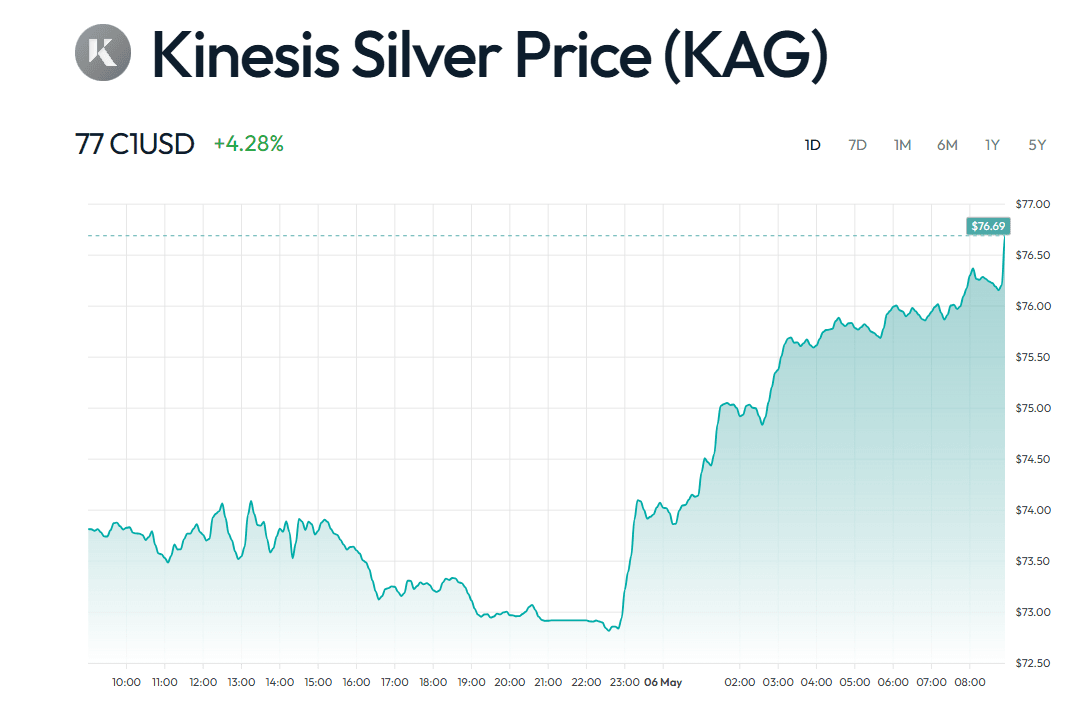
Physical silver is in a strong position. The silver price has been on what Kinesis itself describes as a historic run. KAG's all-time high of $130 was reached in November 2021, and a more recent peak of $93.60 hit in January 2026. As of early May 2026, KAG trades at approximately $73–$74 per token, with a market cap of roughly $276 million (ranked #156 on CoinGecko), circulating supply of ~3.8 million tokens, and daily trading volume ranging from $100K to $200K.
The RWA narrative is institutionally serious. Tokenized real-world assets are receiving significant institutional attention in 2026, with total RWA value on public blockchains reaching billions. KAG is one of the earliest and most operationally mature examples in the precious metals segment — not a new concept looking for product-market fit, but an established mechanism that has been processing real silver transactions since 2019.
Infrastructure that took years to build. Kinesis was founded in 2018 with ABX as its vaulting backbone. Physical silver is stored across a global vault network spanning London, New York, Brisbane, Sydney, Toronto, Hong Kong, Dubai, Istanbul, Vaduz, Panama City, Zurich, Batam, and Singapore — with independent physical audits conducted every six months.
Leadership with TradFi credibility. The Kinesis team is led by Thomas Coughlin (CEO), Michael Coughlin (CFO), and Eric Maine (President and Chief Strategy Officer) — backgrounds that blend traditional financial services with digital asset infrastructure.
KAG Price Chart and Current Market Data
KAG's price is intentionally designed to track physical silver spot prices — the token isn't meant to deviate from its underlying asset. Understanding the factors that drive silver helps contextualize KAG price movements:
Key silver price drivers:
- Inflation and USD strength (inverse relationship)
- Geopolitical uncertainty and safe-haven demand
- Industrial demand — silver is the most electrically conductive metal on earth, essential for solar panels, EVs, smartphones, and renewable energy technology
- Supply constraints from mining output
Live market snapshot (May 6, 2026):
- Price: ~$76–$77 per KAG
- Market Cap: ~$276 million (#156 on CoinGecko)
- Circulating Supply: ~3.8 million KAG
- 24h Volume: ~$100K–$200K
- All-time high: $130 (November 2021); recent peak $93.60 (January 2026)
- All-time low: $4.36
- Active exchanges: MEXC, Kinesis Money, BitMart, Mercado Bitcoin
The long-term industrial demand thesis for silver — particularly as clean energy infrastructure scales globally — provides a fundamentally different risk profile compared to speculative crypto assets.
Risks of Buying Kinesis Silver KAG
No honest assessment of KAG skips this section:
Price follows silver, not crypto cycles. KAG will not deliver the explosive percentage gains associated with altcoins. If that's the objective, this is the wrong instrument. Its value proposition is stability relative to crypto — not growth relative to silver's own historical range.
Counterparty concentration risk. While Kinesis separates bullion from its balance sheet, the system relies on ABX for vaulting and Kinesis Cayman as the operating entity. Any disruption to either — operational, financial, or regulatory — creates exposure for token holders.
Physical redemption threshold is high for retail. The 200 oz minimum for physical redemption (~$14,600 at current prices) means most retail holders will only be able to exit via exchange sales, not bullion delivery.
Evolving regulatory environment. Commodity-backed digital tokens occupy a complex regulatory space. Kinesis operates as a VASP registered in the Cayman Islands (CIMA reference number 1877923), and explicitly notes that its services are not intended for UK-based users. Regulatory changes in key jurisdictions could affect operations.
Yield variability. The monthly yield depends on Kinesis' total platform transaction volume. In periods of low activity, yield payments will be correspondingly small — it is not a guaranteed fixed-rate instrument.
Conclusion: Where KAG Fits (and Where It Doesn't)
Kinesis Silver (KAG) occupies a specific and genuinely useful position in the digital asset landscape — one that isn't well-served by most other products.
It offers physical silver ownership with zero storage costs, liquidity comparable to a traded token, passive monthly yield, direct spending capability, and the option of eventual physical redemption.
For an investor who already has conviction on silver as a portfolio component, KAG is meaningfully more functional than buying bullion bars or shares in a silver ETF.
The honest caveat: KAG is not for crypto traders seeking volatility and asymmetric upside. It's not for anyone whose investment thesis depends on price action that diverges from silver spot. And the counterparty trust required — in Kinesis as the operator and ABX as the vaulting partner — is a real consideration that each investor must evaluate against their own risk tolerance.
Within those parameters, the case for KAG as a "silver ownership layer for the digital age" is legitimate, coherent, and increasingly well-supported by exchange infrastructure and liquidity.
FAQ
What is Kinesis Silver (KAG)? KAG is a digital currency where each token is backed 1:1 by one troy ounce of investment-grade physical silver bullion, stored in fully insured, independently audited vaults. The legal title of the metal belongs to the token holder.
Is KAG a stablecoin? Kinesis calls KAG a "true stablecoin" because its value is anchored to a real asset rather than fiat currency — but its price does fluctuate in line with the global silver spot market.
Where can I buy KAG? KAG is available on the Kinesis platform, MEXC, BitMart, and Mercado Bitcoin. Note that only KAG held on the Kinesis platform qualifies for monthly yield payments.
How does the KAG yield work? KAG holders on the Kinesis platform receive 15% of the platform's global transaction fee revenue, distributed monthly in KAG. There are no lock-up requirements or minimum balances.
What does it cost to store KAG? Storage is completely free (0%). Kinesis covers vault costs using platform transaction fee revenue — a structural advantage over traditional physical bullion storage.
Can I redeem KAG for physical silver? Yes — every ounce of silver is redeemable. The minimum is 200 KAG (200 oz), with fees of 0.45% + $100 + delivery costs depending on location.
What is the difference between KAG on Stellar and ERC-20 KAG? The original KAG runs on Kinesis' custom Stellar-forked blockchain. ERC-20 KAG (issued by KMS Labs) runs on Ethereum, enabling trading on Ethereum-compatible exchanges. To earn yields, ERC-20 KAG holders need to transfer tokens to the Kinesis platform.
What is KAG's current price? As of May 6, 2026, KAG trades at approximately $76–$77 per token, tracking the global silver spot price. Check CoinGecko or CoinMarketCap for real-time data.
How to Buy Crypto on Bittime?
Want to trade sell buy Bitcoins and crypto investment easily? Bittime is here to help! As an Indonesian crypto exchange officially registered with Bappebti, Bittime ensures every transaction is safe and fast.
Start with registration and identity verification, then make a minimum deposit of IDR 10,000. After that, you can immediately buy your favorite digital assets!
Check the exchange rate BTC to IDR, ETH to IDR, SOL to IDR and other crypto assets to find out today's crypto market trends in real-time on Bittime.
Also, visit the Bittime Blog for interesting updates and educational information about the crypto world. Find reliable articles about Web3, blockchain technology, and digital asset investment tips designed to enrich your crypto knowledge.
Disclaimer: The views expressed belong exclusively to the author and do not reflect the views of this platform. This platform and its affiliates disclaim any responsibility for the accuracy or suitability of the information provided. It is for informational purposes only and not intended as financial or investment advice.
.png)