What Is INTWB Tokenized Stock? Price Potential and Leverage Risks
2026-11-19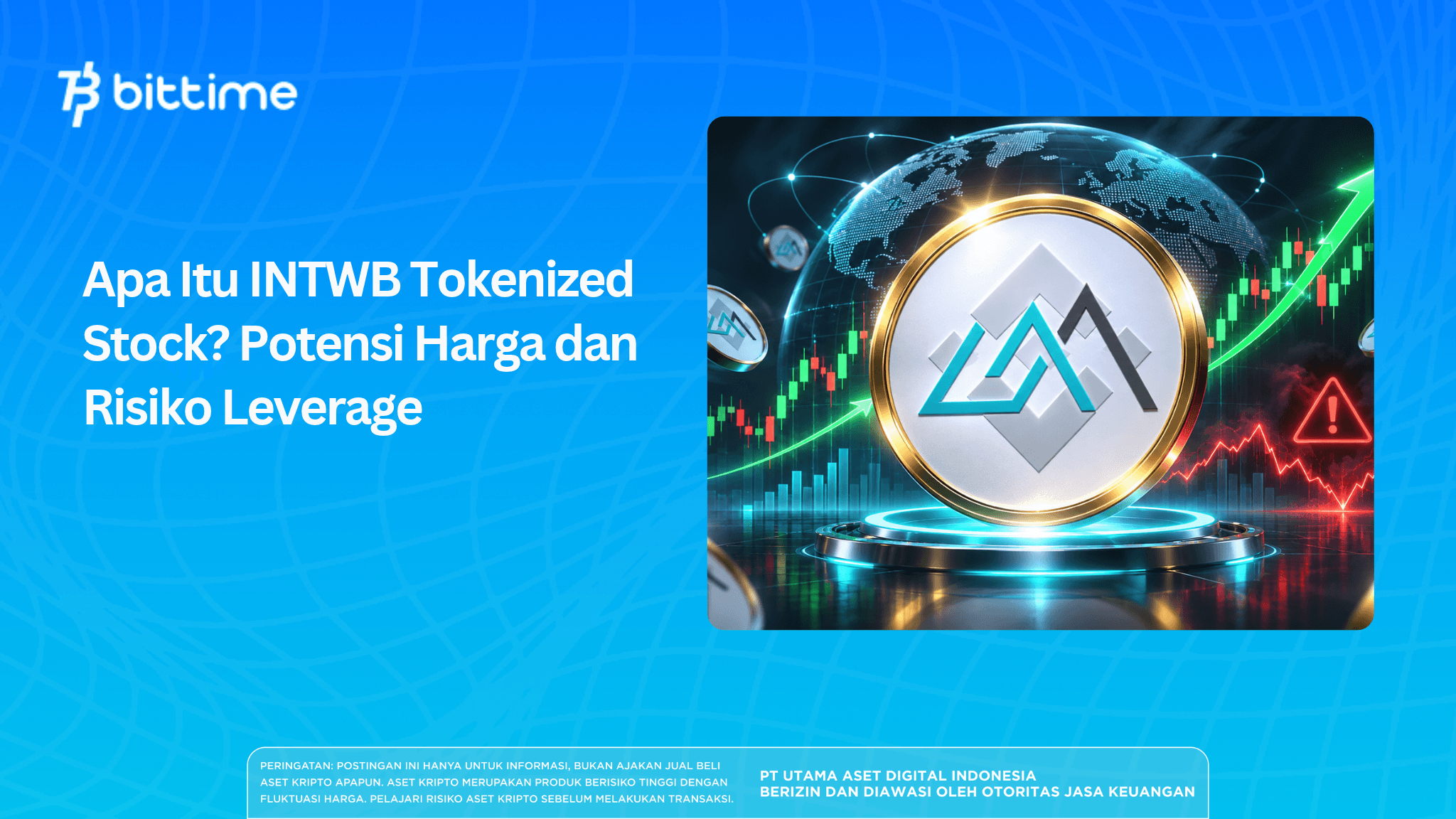
INTWB tokenized stock offers a different way to gain exposure to Intel shares. This digital asset tracks the GraniteShares 2x Long INTC Daily ETF, an ETF that aims to deliver twice the daily percentage change in Intel's share price.
Although INTWB offers the potential for greater gains when Intel shares rise, it also carries risks not found in ordinary tokenized stocks. In fact, Intel shares could gain value over a certain period while INTWB declines. How can that happen?
Key Takeaways
- INTWB is a tokenized version of the GraniteShares 2x Long INTC Daily ETF, which tracks Intel shares.
- The 2x leverage target applies to daily price movements, not long-term investment returns.
- INTWB's outlook depends on Intel's business performance, stock volatility, compounding effects, and token trading conditions.
What Is INTWB Tokenized Stock?
INTWB is a tokenized asset issued by BTech Holdings Limited through the bStocks ecosystem. It provides economic exposure to the GraniteShares 2x Long INTC Daily ETF (INTW), which trades on Nasdaq.
Instead of purchasing ETF units directly through a stockbroker, investors can gain exposure to the instrument through a blockchain-based token.
Here is a brief overview of INTWB:
Although often referred to as INTWB crypto or INTWB coin, this asset differs from cryptocurrencies such as Bitcoin. Its economic value is linked to the underlying financial instrument.
Read also: What Is QNTB? Understanding the Quantinuum Stock Token and How It Works
How Does INTWB Work?
There are three instruments you need to understand to see how INTWB works:
- INTC: Intel Corporation shares traded on Nasdaq.
- INTW: An ETF targeting twice the daily price movement of Intel shares.
- INTWB: A tokenized representation of the INTW ETF.
Simply put, movements in Intel's share price affect the value of INTW, while INTWB provides exposure to the performance of that ETF through tokenization.
Understanding the GraniteShares 2X Long INTC Daily ETF
The GraniteShares 2x Long INTC Daily ETF is designed to deliver 200% of the daily percentage price change in Intel shares before fees and expenses.
To achieve this objective, the fund manager uses derivatives and adjusts the fund's exposure on each trading day.
Unlike ETFs that hold shares in multiple companies, INTW focuses exclusively on Intel. This concentration makes its performance highly dependent on the company's business developments and market sentiment.
How Does INTWB's 2x Leverage Work?
Imagine you have US$100 to invest. If Intel's share price changes during a single trading day, the following example illustrates the result if the ETF perfectly achieves its leverage target.
Leverage works both ways. When Intel shares rise, potential gains are amplified, but a decline in the share price can also lead to deeper losses.
Actual INTWB trading results may differ from this simulation because of fees, spreads, tracking error, and differences between the token's price and the value of its underlying asset.
Read also: SNXXB vs. SNDKB: Understanding the Differences in Risks and Potential Returns
Differences Between INTWB, INTW, INTCB, and Intel Shares
If you are familiar with Intel Tokenized bStocks (INTCB), you may be wondering how it differs from INTWB.
Both are linked to Intel shares, but they use different product structures.
The most fundamental difference is the leverage mechanism. INTCB provides exposure to Intel shares without built-in leverage, while INTWB follows the characteristics of an ETF targeting 2x daily leverage.
For comparison with INTWB, you can also track the price of Intel Tokenized bStocks (INTCB) on Bittime to better understand exposure to Intel's share price without built-in leverage.
INTWB Price Today and Market Data
Based on market data snapshots available on November 19, 2026, INTWB was trading at approximately US$4.88–US$4.95.
Below is a comparison of data from two market aggregators.
These differences may reflect the timing of data collection, exchange coverage, and each platform's calculation methods.
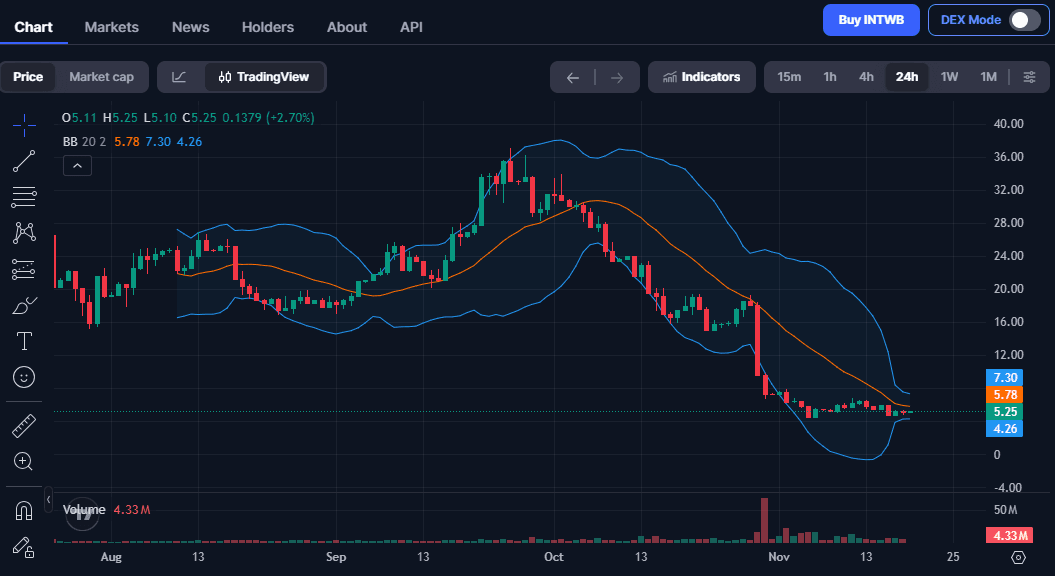
On October 31, 2026, INTWB was recorded at US$7.31. Compared with its price of US$4.95 on November 19, its value had fallen by around 32%.
Trading volume that is relatively high compared with market capitalization indicates substantial transaction activity. However, it does not prove investors are accumulating the token, since volume also includes selling activity.
Read also: What Is CRDOB? Understanding the Credo Technology Stock Token
5 Factors That Influence the Price of INTWB
To understand INTWB's price potential, following the crypto market alone is not enough. Several factors in the US stock market and semiconductor industry also deserve attention.
1. Intel's Financial Performance
In its third-quarter 2026 earnings report released on October 29, Intel posted revenue of approximately US$16.5 billion, up from US$13.65 billion in the same period a year earlier.
Despite revenue growth, GAAP earnings per share fell from US$0.90 to US$0.60.
This is a reminder that higher sales do not necessarily translate into better profitability. For INTWB investors, the market's response to Intel's financial results is important because changes in the share price can have a greater impact on a leveraged ETF.
2. Developments at Intel Foundry
Intel Foundry plays an important role in the company's efforts to strengthen its position in semiconductor manufacturing.
Winning new customers, improving production efficiency, and developing process technologies could improve Intel's business outlook.
Conversely, heavy investment without corresponding returns could put pressure on the company's finances.
3. Growth of the AI and Semiconductor Industries
Growing computing demand from artificial intelligence and data centers creates opportunities for semiconductor companies.
However, Intel must compete with NVIDIA and AMD to deliver competitive products. Growth in the AI industry will benefit Intel shareholders only if the company can turn those opportunities into higher revenue and profits.
4. US Interest Rate Policy
The Federal Reserve's interest rate decisions also influence investor appetite for technology stocks.
When financing costs rise and investors become more cautious about risk assets, technology company valuations can come under pressure.
For INTWB, these changes in sentiment are particularly important because its underlying asset has leveraged exposure to Intel shares.
5. Liquidity and Tokenization Mechanisms
INTWB's price is also influenced by trading conditions for the token itself, from market depth to bid-ask spreads.
On platforms that allow trading outside US stock market hours, INTWB may trade at a premium or discount to the value of its underlying asset.
This is important to consider, particularly when making large trades or when market liquidity is limited.
Read also: What Is SMHB? The VanEck Semiconductor ETF Token and Its Risks
INTWB Price Prediction for 2026–2027
What is the outlook for INTWB through 2027? The answer depends not only on how much Intel's share price might rise, but also on the path its price takes along the way.
Here are three scenarios to consider.
Bullish Scenario
A recovery in profitability, growth in the data center business, and positive developments at Intel Foundry could increase investor confidence in Intel shares.
If the share price rises consistently, INTWB could benefit from compounding effects in the leveraged ETF.
Moderate Scenario
If Intel's business developments bring no significant positive or negative surprises, its shares may trade sideways.
Such conditions are not necessarily favorable for INTWB. Alternating price gains and losses can erode the value of a leveraged ETF even if Intel shares remain relatively stable.
Bearish Scenario
Lower profit margins, delays in technology development, or increasing competitive pressure could weigh on sentiment toward Intel.
If its shares enter a prolonged downtrend, INTWB holders could face greater losses.
An accurate INTWB price forecast cannot be calculated simply by doubling an annual price target for Intel shares. Because leverage resets daily, investment results depend heavily on the price path over that period.
Read also: What Is STXB? Seagate Stock Token, Price, and Risks
Benefits and Risks of Investing in INTWB
INTWB provides access to a leveraged ETF product through the digital asset ecosystem. However, before considering its opportunities, you also need to understand the risks associated with the instrument.
Benefits of INTWB
- Provides exposure to an Intel-focused ETF through blockchain technology.
- Offers the potential for greater gains when Intel shares rise over a single trading day.
- Can be traded on digital asset platforms that support it.
- Offers an alternative instrument for traders who understand short-term leverage strategies.
Daily Reset and Volatility Decay Risks
Daily reset is the mechanism for adjusting an ETF's exposure to bring it back toward its target leverage on each trading day.
As a result, returns over several days do not always equal twice the cumulative change in Intel's share price.
For example, suppose you start with US$100 and Intel shares gain 10% on the first day, then fall 10% on the following day.
In this simulation, Intel shares lose only 1% of their value, while the leveraged ETF incurs a 4% loss.
The difference arises because each day's percentage gain or loss is calculated using the investment value as adjusted by the previous day's movement.
This phenomenon is related to volatility decay, the erosion of value that can occur when markets fluctuate. Conversely, when prices rise steadily, compounding can also amplify gains.
Tracking Error and Liquidity Risks
The INTW ETF may not achieve its daily leverage target perfectly. Management fees, the use of derivatives, and market conditions can cause actual results to differ from the target.
INTWB holders face an additional layer of risk because the token price may also deviate from the ETF's value, particularly when US stock markets are closed.
Issuer and Asset Custody Risks
Investing through bStocks involves a token issuer, custodians, and arrangements for holding the underlying assets.
The existence of assets backing INTWB does not mean investors' capital is protected against losses. Token holders also do not automatically gain voting rights or the status of Intel shareholders.
Terms relating to token redemption, ETF distributions, and investor rights remain subject to the product documentation and applicable regulations.
In addition to leveraged ETF-based products, you can also explore various tokenized stock assets available on Bittime to compare different forms of exposure to the US stock market.
Is INTWB Suitable for Long-Term Investing?
Believing in Intel's business prospects over the coming years is not necessarily a sufficient reason to hold INTWB for that entire period.
Leveraged ETFs are fundamentally designed to meet daily investment objectives. The longer a position is held, the greater the influence of compounding, volatility, and management fees on the final result.
For experienced traders, INTWB can be a tool for taking advantage of short-term momentum. Meanwhile, investors who want exposure to Intel's long-term business growth may consider non-leveraged alternatives for comparison.
It is also important to understand that buying INTWB without margin is different from opening a leveraged futures position. Although it does not automatically involve the same liquidation mechanism as futures, there is still a risk of losing most or all of the invested capital.
If you want to learn more about tokenized stocks and their relationship with traditional markets, you can sign up for Bittime to follow market developments and learn about the characteristics of various digital assets.
Conclusion
INTWB tokenized stock provides exposure to movements in Intel shares through the GraniteShares 2x Long INTC Daily ETF.
Its potential price appreciation is closely linked to Intel's ability to improve business performance, compete effectively, and capitalize on growth in the semiconductor industry.
However, promising company prospects do not automatically make INTWB suitable for every investor. Understanding daily leverage, choosing an appropriate investment horizon, and managing risk are far more important than simply chasing the possibility of double returns.
FAQ
What Is INTWB Tokenized Stock?
INTWB is a tokenized version of the GraniteShares 2x Long INTC Daily ETF offered through the bStocks ecosystem. It provides exposure to a leveraged Intel-focused ETF without granting direct ownership of Intel shares.
What Is the Difference Between INTWB and INTCB?
INTWB tracks an ETF that targets 2x daily leverage on Intel shares. INTCB, by contrast, provides exposure to Intel shares without built-in leverage.
Does INTWB Deliver Twice the Returns of Intel Shares?
Not necessarily. The 2x leverage target applies to daily changes in Intel's share price before fees, while long-term returns are affected by compounding and market volatility.
Is INTWB Suitable for Long-Term Investing?
INTWB has a more complex structure than a non-leveraged tokenized stock. Investors who plan to hold it over the long term need to understand daily reset, volatility decay, and management fee risks.
How Can You Buy INTWB, and What Are the Risks?
INTWB can be traded on platforms that offer the asset, subject to regional availability and applicable requirements. Before buying, make sure to check the token's identity, liquidity, leverage mechanism, and issuer terms.
Disclaimer: The views expressed belong exclusively to the author and do not reflect the views of this platform. This platform and its affiliates disclaim any responsibility for the accuracy or suitability of the information provided. It is for informational purposes only and not intended as financial or investment advice.

.png)